Planning a Saskatchewan Season Around Fire Risk
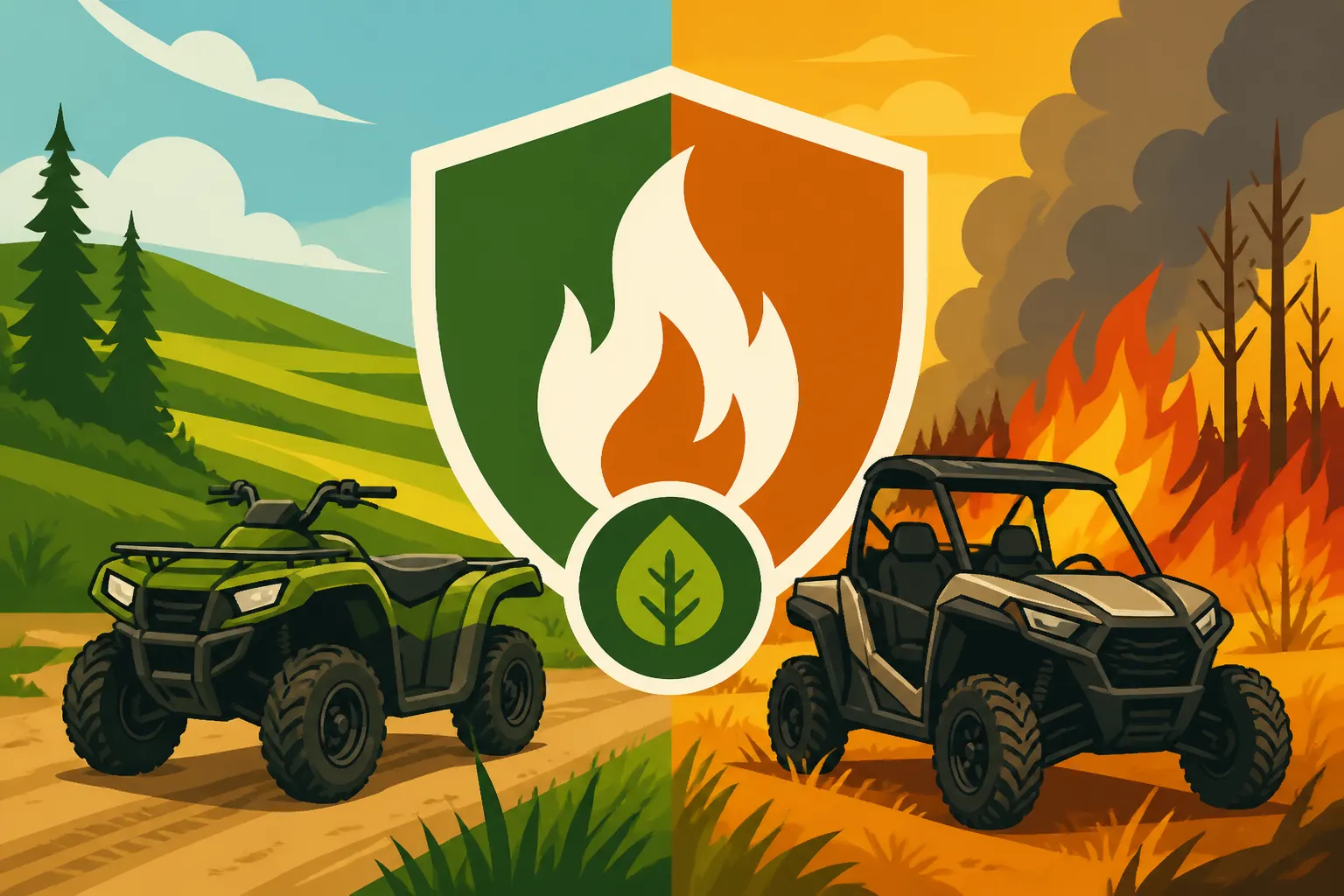
A Saskatchewan ATV season can change quickly when dry conditions, wind and wildfire activity raise the risk of riding. A route that was open when you planned the trip may later be restricted or closed. Build fire checks into your routine, know what your machine must carry, and have a backup plan before you haul.
Plan around the fire season, not just the riding season
Wildfire risk affects more than whether it feels safe to ride. Restrictions can limit access to Crown land, parks and other riding areas, sometimes with little notice. A trail map or a permit from an earlier visit does not guarantee that the route remains open today.
Saskatchewan’s wildfire season is generally treated as running from April 1 to October 31. That is a useful planning window, not a promise that risk starts or stops on those dates. Dry weather, vegetation conditions and local fire activity can make restrictions relevant outside the dates you expect. For rules and updates, start with Saskatchewan Wildfire Season Rules for Riders and Saskatchewan Fire Ban Lookups.
Use a short pre-trip check rather than relying on last week’s information:
- Check the riding area, not only the forecast. Look for closures or restrictions that apply to the specific land you plan to use. A regional fire notice may affect access differently from a municipal road rule or a park trail closure.
- Confirm the route is still open. Check the relevant official maps, notices or local office before loading the machines. If you cannot confirm access, choose another destination.
- Look at wind and dryness as well as temperature. Hot, dry and windy conditions can make a minor ignition harder to contain. A comfortable riding forecast does not necessarily mean conditions are suitable for off-road travel.
- Choose a backup area before leaving home. Make sure it is legally accessible and check its current restrictions too. Do not assume that an open road or trail nearby means adjacent land is open.
- Recheck on the day of the ride. Conditions and orders can change after you make your plan. If a closure takes effect while you are travelling, follow the notice and do not ride into the affected area.
| Planning question | What to verify | Why it matters |
|---|---|---|
| Is the route open? | Current notices for the exact riding area | A previous visit or map download may not reflect a new closure |
| Is the land accessible to ATVs? | Land designation, local rules and any required permission | Fire access and legal riding access are separate questions |
| Is a fire restriction in effect? | Current restrictions and their boundaries | A restriction may limit entry, travel or activities |
| Is the machine ready? | Debris, hot components and any required suppression equipment | A machine can create ignition risks even when operated carefully |
| What is the backup plan? | Another confirmed route or a decision to cancel | It prevents pressure to ride somewhere unsuitable |
A permit, plate or landowner’s permission does not override a wildfire closure. Those approvals answer different questions: a permit may address a park’s trail-use process, a municipal plate may apply within a local area, and permission may allow access to private land. Fire restrictions can still make travel prohibited or unsafe. For background, see Saskatchewan Crown Land Access Rules and Saskatchewan Park Regulations for Machines.
Understand restrictions and check what applies where
There is no single fire notice that answers every access question for every Saskatchewan riding area. A provincial restriction, a park closure, a municipal bylaw and a landowner’s direction can apply to different places and activities. You need to check the rule that governs the land you are actually using.
Crown land access deserves particular care. Some land may be subject to an order that limits or prohibits machine travel, and access rules can depend on whether land is occupied or leased. Do not treat a trail shown on a downloaded map as proof that riding is currently allowed. Check Saskatchewan Crown Land Occupant Permission and Saskatchewan Fire Season Riding Restrictions alongside the current notices for your destination.
Parks also have their own access and trail rules. A permit or use form may be required in some locations, while other places have different arrangements. A park permit is not a fire clearance. If the park or a section of its trails is closed, follow the closure even if you already have paperwork or have ridden there before. The park office is a practical place to confirm conditions when the online information is unclear. Saskatchewan Permit Questions Parks Hear covers the kinds of questions to ask.
Private land and grazing leases require a separate check. Get permission from the landholder or leaseholder before riding, and ask whether access is still acceptable under current fire conditions. Permission for one route or date should not be treated as permission to cross a different parcel or to continue after conditions change. A closed gate, a posted notice or a direct instruction to stay out should be respected.
For every destination, record the answers to a few specific questions before you leave:
- Which authority manages the land or trail?
- Is there an active fire restriction, closure or access order?
- Does the restriction cover the route, the whole area, or a particular activity?
- Are there conditions on travel, parking, stopping or equipment?
- Who can confirm the information if the notice is difficult to interpret?
If restrictions use a map, make sure you understand the boundary. A fire centre or district map may show an area differently from a park trail map. If you are near a boundary and cannot tell which side of it the trail falls on, call the relevant office or choose a route that is clearly outside the restricted area. Do not guess based on a nearby road, lake or familiar landmark.
Keep in mind that riding permission and fire preparedness are not interchangeable. An open route is not a guarantee that every activity is allowed, and carrying equipment does not give you permission to enter closed land. Treat each as a separate part of the decision.
Prepare the machine and riding group for fire risk
A machine can carry dry vegetation, debris and hot components close to combustible material. A quick inspection before departure can help identify obvious hazards, but it should not replace the specific requirements that apply to your riding area. Review Saskatchewan Wildfire Act Duties for Riders and Saskatchewan Spark Arrestor Requirements for the applicable duties and equipment guidance.
Before starting out, check the machine carefully:
- Remove grass, leaves, twigs and other debris from areas around the exhaust, engine and other hot parts.
- Look for material packed into guards, skid plates, racks or bodywork, especially after riding through brush or tall grass.
- Check for damaged wiring, leaking fuel or oil, and anything rubbing against a hot component.
- Confirm that required equipment is present, accessible and in working order.
- Carry any fire suppression gear required by the current order or land rules, and make sure riders know where it is.
An inspection at the trailhead is not the end of the job. Debris can accumulate during a ride, especially on rough or overgrown routes. Stop periodically to check the machine again, and inspect it after travelling through vegetation. A compact tool can help clear packed material, but use care around hot parts and follow the manufacturer’s instructions. If the machine is damaged or appears to be creating sparks or excessive heat, stop using it and deal with the problem before continuing.
Your group should also agree on how it will respond if someone spots smoke, a small fire or an official notice. Choose a person to keep track of route information and make sure everyone knows how to contact the group if it gets separated. Mobile reception can be unreliable in remote areas, so do not build a safety plan around the assumption that every rider can call for help from every point on the route.
Fire suppression gear is useful only if it is suitable, maintained and within reach. Check the requirements for the destination rather than assuming one item satisfies every rule. If you are buying equipment, compare the product’s rating and intended use, check the manufacturer’s instructions, and confirm it meets the relevant local requirements. Keep it secured so it does not become a hazard in a rollover, but not buried under cargo where nobody can reach it.
Riding choices matter too. Stay on permitted, established routes, avoid cutting across dry grass or brush, and do not stop or park where hot machine parts can contact combustible material. Avoid unnecessary idling over dry vegetation. These are sensible precautions, but they do not replace a closure or an official restriction. When the land manager says not to enter, the right response is to stay out.
The group’s pace should allow for checks and route changes. A schedule that leaves no time to inspect machines or turn around can push riders to take chances. Set a return time with enough margin to exit before conditions worsen, and be prepared to shorten the ride. If a restriction is announced while you are out, follow the instructions for leaving the area and do not detour onto another route unless its access is confirmed.
Make a go, change-route or cancel decision
A useful plan has three outcomes: go as planned, change the route, or cancel. Treating every trip as a commitment makes it harder to respond to changing conditions. Before unloading, be willing to choose the safer option even if it means losing a day of riding.
| Situation | Practical decision |
|---|---|
| The route is confirmed open, conditions are suitable, and the machine is ready | Ride the planned route while continuing to monitor conditions |
| The route is unclear, but another area is confirmed open | Change destinations and recheck that area’s rules |
| A closure or restriction covers the route | Do not enter; follow the notice and use a confirmed alternative |
| You cannot verify whether access is allowed | Delay, call the responsible office or choose another destination |
| The machine has debris, damage or missing required equipment | Clear, repair or equip it before riding |
| Smoke, a fire or rapidly worsening conditions appear nearby | Stop the ride, move away as directed, and contact emergency services if needed |
If you see a fire, do not ride toward it to investigate or attempt to manage a fire beyond your training and equipment. Move away from danger, alert others in your group, and report it through the appropriate emergency channel. Give a clear location if you can do so safely. Do not delay leaving in order to take photographs or retrieve gear.
A changed plan can mean a different trail, a shorter ride, or no ride at all. If you switch areas, repeat the access check rather than assuming the new destination is unaffected. Restrictions may be local, and the closest alternative may have its own land rules, closure notices or permission requirements.
When a season includes repeated dry periods, make your preparation routine easy to repeat. Keep a checklist with the trailer gear, save the contact details for the land manager or park office, and decide in advance how the group will communicate a route change. If you ride with children or less experienced operators, explain that closures and fire checks are part of the trip—not optional delays.
A careful plan cannot eliminate wildfire risk, but it can reduce avoidable hazards and help you avoid riding into a closed area. Check the current conditions, respect the land rules, keep the machine clear of combustible debris, and be ready to turn around. For a broader overview of seasonal fire-related responsibilities, see Saskatchewan Wildfire Season Rules for Riders.
Disclaimer
This article is for general informational purposes only and does not constitute professional advice. Laws, prices and regulations vary by location and change over time. Consult a qualified professional for guidance on your specific situation.