Saskatchewan Registration Compared to BC
It can be incredibly confusing when you're an ATV or UTV rider and you find yourself moving between provinces, especially one like Saskatchewan, which has a very unique approach to off-road vehicle registration, and then compare it to a place like British Columbia, which has its own distinct set of rules. Many riders hit a wall of frustration trying to figure out what paperwork they need, what plate they're supposed to have, or even if they need one at all. This guide will cut through that confusion, clearly outlining the fundamental differences in ATV/UTV registration between Saskatchewan and British Columbia, and detailing what you need to know to stay on the right side of the law, no matter which province you call home, or are just visiting.
The Saskatchewan Exception: No Provincial ATV Registration
One of the biggest head-scratchers for anyone moving to Saskatchewan or riding here from another province is the complete absence of a provincial ATV or UTV registration system. It’s not that we don't care about off-road vehicles; it’s just that the province has opted for a different regulatory framework. This often comes as a shock to riders from places like British Columbia, where registration is a familiar part of owning and operating an ATV. Here in Saskatchewan, you won’t be heading to a provincial office to get a plate or a registration sticker for your quad.
For decades, Saskatchewan has maintained this stance, choosing to focus enforcement efforts on operator conduct, safety gear, and insurance, rather than on a central registry for the machines themselves. This means there's no province-wide database of ATV owners, no specific registration number attached to your machine by the province, and definitely no standard provincial license plate to display. It simplifies some things, like not having to worry about annual renewals or registration fees, but it can complicate others, like proving ownership or dealing with theft.
So, when you hear about [Saskatchewan Does Not Register ATVs], it's not a myth or an oversight; it's a deliberate choice in how the province manages its off-road vehicle ecosystem. You simply won't find a provincial office that handles this, which is a stark contrast to many other jurisdictions. This also means that many of the conversations around "plates" for ATVs in Saskatchewan often refer to municipal bylaws, which are a whole different beast we'll touch on later, rather than any provincial requirement.
Proving Ownership Without a Registry
If there’s no provincial registration, how on earth do you prove you actually own your ATV in Saskatchewan? This is a question that throws a lot of people for a loop, especially those used to a formal title or registration document. The answer is surprisingly simple, yet critically important: your bill of sale. In Saskatchewan, a properly executed bill of sale acts as your primary proof of ownership. It’s the closest thing we have to a "title" for an ATV.
When you buy a quad from a dealer, they'll provide you with a comprehensive bill of sale that details the machine's VIN, the purchase price, the date, and the names of both the buyer and seller. If you're buying privately, creating your own detailed bill of sale is absolutely essential. This document is what you’ll present to your insurance company, show to a peace officer if ever asked, and pass on to a new owner when you sell the machine. Without a clear bill of sale, you could find yourself in a very difficult situation trying to establish legal ownership, especially if there's ever a dispute or a theft.
Many riders find templates from services like LawDepot incredibly helpful for creating these documents, ensuring all necessary fields are covered and both parties sign off properly. It's a small investment in time that can save a huge amount of headache down the line. Remember, even if your machine originates from a province with registration, once it's in Saskatchewan, its primary proof of ownership for provincial purposes defaults to that bill of sale.
Municipal Plates: A Saskatchewan Twist
While the province itself doesn't issue ATV plates, some individual cities, towns, and rural municipalities in Saskatchewan have taken it upon themselves to create their own local registration or permitting schemes. This is where things can get truly confusing for riders, as the rules vary wildly from one community to the next. You might be able to ride your ATV on municipal roads in one town if you have their specific permit, while the next town over strictly prohibits it.
These municipal plates or permits are designed to allow residents, and sometimes visitors, to operate their ATVs within specific municipal boundaries, often on designated streets or ditches, usually for a fee. The revenue collected typically goes towards local initiatives, sometimes even trail maintenance. It’s crucial to understand that a plate from, say, the District of Lakeland, will only be valid within that specific municipality and holds no weight in another town or on provincial Crown land. It certainly isn't a substitute for a provincial registration, because, as we've established, [Saskatchewan Has No ATV Plate or Decal] to begin with.
So, if you’re planning to ride within a specific community, you need to check their local bylaws. Don't assume that because you have a municipal plate from one place, you're good to go everywhere. This decentralized approach means riders need to be much more diligent in understanding local regulations than they might in a province with a uniform provincial registration system.
British Columbia's Off-Road Vehicle Act and Registration
Now, let's swing to the other side of the Rockies and look at British Columbia, a province that has a much more structured and centralized system for off-road vehicles (ORVs), which include ATVs and UTVs. Unlike Saskatchewan, BC has an Off-Road Vehicle Act that requires ORVs to be registered and display a license plate if they are operated off private property, specifically on Crown land or Forest Service Roads. This is a fundamental difference that can trip up riders accustomed to Saskatchewan's laxer approach.
The BC system aims to provide a clear identification for ORVs, improve safety, and assist with law enforcement in cases of accidents, infractions, or theft. When you purchase an ORV in British Columbia, whether new or used, you are generally required to register it with ICBC (Insurance Corporation of British Columbia), which is the provincial insurer and registrar for most vehicles. This process involves proving ownership, providing vehicle details, and paying a one-time registration fee.
This registration is a vital step for any ORV owner in BC, especially if you plan to explore the province's vast network of trails, forest roads, and other public lands. Without it, you could face fines and penalties if caught riding on Crown land or other public access areas. The registration provides you with an ORV registration certificate and a physical license plate that must be affixed to your machine. This plate makes your ORV easily identifiable, much like a car on the road, which is exactly what a Saskatchewan rider won't have provincially.
The BC Registration Process
Registering an ORV in British Columbia is a fairly straightforward process, primarily handled through ICBC. When you buy a new ORV from a dealer, they will often facilitate the registration as part of the purchase process. They'll submit the necessary paperwork, collect the fees, and help you get your ORV license plate. If you’re buying a used ORV privately, the responsibility falls to you, the buyer, to complete the transfer of ownership and registration.
You’ll need to visit an ICBC driver licensing office or an authorized broker with proof of ownership, such as the bill of sale from the previous owner, and identification. The ORV's vehicle identification number (VIN) will be recorded, and once the registration is complete, you'll receive your ORV registration document and the license plate. This plate must be displayed prominently on your ORV, usually at the rear. It’s a one-time registration fee, not an annual renewal like some other vehicle types, which is a welcome relief for many riders.
It's also worth noting that in BC, the ORV Act also sets out requirements for operator age, helmets, and insurance, similar to Saskatchewan’s [Saskatchewan All Terrain Vehicles Act], but the registration itself is the key differentiator for the machine. For anyone accustomed to [Looking for a Registry That Does Not Exist] in Saskatchewan, the BC system will feel much more familiar to traditional vehicle ownership.
BC's License Plate and Decal Requirements
A crucial part of BC's ORV framework is the physical license plate and validation decal. Once your ORV is registered with ICBC, you'll be issued a distinct ORV license plate. This plate is smaller than a standard vehicle plate but must be affixed to the ORV in a clearly visible location. This ensures that enforcement officers can easily identify registered machines while they are being operated on Crown land, Forest Service Roads, or other designated public areas.
Alongside the plate, you'll also receive a validation decal which usually gets applied to the plate itself, indicating that the registration is current. While the registration itself is a one-time process, if there are any changes to your ORV (e.g., if you significantly modify it and it changes class, though this is rare), or if your plate is lost or stolen, you would need to contact ICBC for replacement or update. The visible display of this plate and decal is non-negotiable for riding on public land in BC, and failing to do so can result in fines.
This system provides a robust method for tracking ORVs and their owners, which can be invaluable in case of an incident or for managing access to different types of terrain. It also means that if you're visiting BC from Saskatchewan, your unplated quad won't be legal on Crown land unless you go through the BC registration process, even if you’re just passing through.
Proving Ownership and Operating Privileges in Each Province
The disparate approaches to ATV registration in Saskatchewan and British Columbia mean that how you prove ownership and your legal right to operate your machine varies significantly. Understanding these differences is paramount, especially when buying, selling, insuring, or transporting your ATV across provincial lines.
Saskatchewan's Reliance on the Bill of Sale
In Saskatchewan, the bill of sale is your absolute cornerstone for proving ownership. Since there's no central registry, this document, signed by both buyer and seller, is your formal record. It should ideally include:
- Seller's Information: Full name, address, and contact details.
- Buyer's Information: Your full name, address, and contact details.
- Vehicle Information: Make, model, year, and critically, the Vehicle Identification Number (VIN).
- Purchase Price: The amount the vehicle was sold for.
- Date of Sale: When the transaction took place.
- Signatures: Both buyer and seller must sign and date the document.
- Witness (optional but recommended): A witness signature can add an extra layer of validity.
It's not just for buying and selling; this document is what your insurance company will primarily rely on to verify your ownership when you're obtaining coverage or making a claim. If your ATV is ever stolen, having a complete bill of sale with the VIN is critical for reporting it to the police and assisting with recovery efforts. Without a formal paper trail, recovering a stolen unplated ATV can be incredibly difficult, highlighting why [How to Prove You Own an ATV in Saskatchewan] is so important.
When it comes to operations, while the bill of sale proves ownership, your right to ride is governed by the [Saskatchewan's All Terrain Vehicles Act] and its associated regulations, which cover things like age, helmet use, and insurance requirements, rather than any registration.
British Columbia's Registration Certificate and Plate
In British Columbia, your proof of ownership is primarily established through your ORV registration certificate issued by ICBC. This document serves a similar purpose to a vehicle title in other jurisdictions, formally linking you, the owner, to the specific ORV by its VIN. The physical ORV license plate that you display on your machine acts as the immediate visual confirmation of this registration to law enforcement.
This system offers a clear and universally recognized method of verification across the province. If you're pulled over on Crown land or a Forest Service Road, an officer will expect to see that plate and may ask for your registration certificate. When you sell your ORV, the registration is transferred to the new owner, creating a continuous chain of documented ownership. This makes private sales and financing a registered machine much more structured than in Saskatchewan.
For insurance purposes, your BC registration confirms the vehicle's identity and your ownership, which is crucial for obtaining mandatory liability insurance and optional comprehensive or collision coverage. The integrated system means that proof of ownership, identification, and the legal right to operate on public lands are all tied together through the ICBC registration.
Implications for Riders Moving Between Provinces
The differences in ATV/UTV registration between Saskatchewan and British Columbia create specific considerations for riders moving between these two provinces or simply visiting. It’s not just about learning new rules; it’s about understanding how your machine’s legal status changes depending on where you are.
Moving an ATV from BC to Saskatchewan
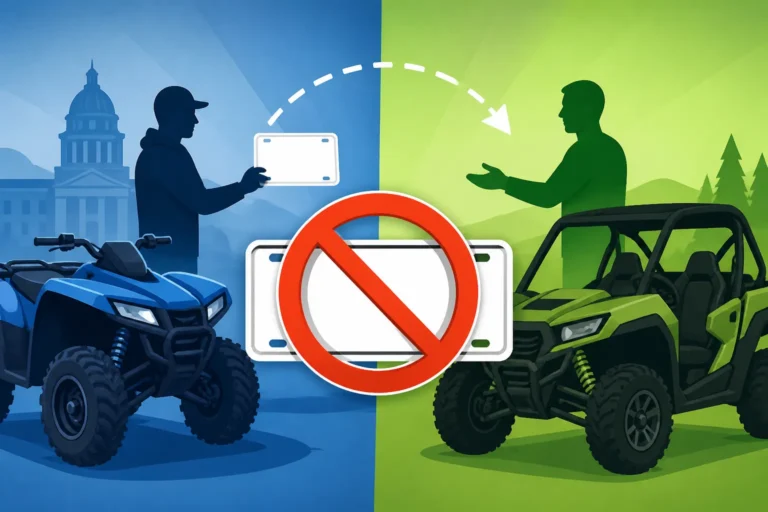
If you're moving from British Columbia to Saskatchewan with your ORV, you'll find that your BC registration and license plate become largely irrelevant for provincial purposes once you've crossed the border. Saskatchewan simply doesn't have a provincial system to register your ATV into. This means you don't need to 'transfer' your BC registration to Saskatchewan because there's nothing to transfer it to.
However, your BC registration certificate still acts as a strong piece of your ownership history. It provides official documentation of your past ownership, which can be beneficial when establishing a new insurance policy in Saskatchewan or if you ever decide to sell the machine. For day-to-day riding in Saskatchewan, your primary proof of ownership will revert to your bill of sale (which would have been part of your BC purchase paperwork). It's a good idea to keep a copy of your original BC registration certificate with your other important documents, especially for insurance purposes.
Remember, even without provincial registration, you still need to adhere to Saskatchewan's rules regarding [Saskatchewan ATV Age Requirements], [Saskatchewan ATV Helmet Law], and [Saskatchewan ATV Insurance Requirements]. And if you plan to ride within a specific municipality in Saskatchewan that requires its own permit, you'll still need to acquire that local permit.
Moving an ATV from Saskatchewan to BC
This is where things get a bit more complex. If you’re moving your ATV from Saskatchewan to British Columbia and intend to ride it on BC Crown land or Forest Service Roads, you absolutely must register it under BC's Off-Road Vehicle Act. Your Saskatchewan bill of sale, while proof of ownership in Saskatchewan, is not enough to legally operate an unplated machine on public land in BC.
The process will involve taking your Saskatchewan bill of sale, along with proof of identity, to an ICBC driver licensing office or authorized broker. You will then register the ORV in BC, pay the one-time registration fee, and be issued a BC ORV license plate and registration certificate. This effectively "converts" your unregistered Saskatchewan machine into a fully registered BC ORV for public land use. Without this step, your machine would be considered unregistered in BC and you could face fines. Think of it as formally introducing your machine to BC's system, even though it wasn't previously part of a provincial system.
Visiting Riders: What Rules Apply?
For riders visiting either province, the general rule of thumb is that you must abide by the local laws of the province you are riding in.
- BC Riders Visiting Saskatchewan: Your BC ORV plate and registration are perfectly valid proof of ownership and identification, but they don't exempt you from Saskatchewan's operational rules. You must still carry proof of insurance, wear a helmet, and follow age restrictions. While your BC plate looks official, it doesn't grant you any special privileges over a Saskatchewan rider regarding road access or ditch riding, which are governed by [Saskatchewan ATV Road Rules Explained].
- Saskatchewan Riders Visiting BC: This requires more foresight. If you plan to ride your Saskatchewan-purchased, unplated ATV on BC Crown land or Forest Service Roads, you would technically need to register it in BC first, or risk fines. This is a significant hurdle for casual visitors. Some riders might opt to rent an ORV in BC, or only ride on private land with permission, to avoid the registration process for a short visit. If you do bring your own machine, ensure you have your original bill of sale handy, as it will be your primary document for proving ownership.
Ultimately, whether you're moving or just visiting, always check the specific regulations of your destination. What's accepted in one province might be a clear violation in another.
Key Differences at a Glance
To help consolidate these distinct approaches, here’s a quick comparison of the major registration and ownership points between Saskatchewan and British Columbia for ATVs and UTVs.
| Feature | Saskatchewan ATV/UTV | British Columbia ORV |
|---|---|---|
| Provincial Registry | No. No central provincial database. | Yes. Registered with ICBC. |
| Provincial Plate | No. No province-wide license plate issued. | Yes. Specific ORV license plate issued. |
| Registration Fee | No provincial fee. | One-time registration fee. |
| Ownership Proof | Primarily a detailed bill of sale. | ORV Registration Certificate from ICBC. |
| Annual Renewal | No. | No. One-time registration. |
| Municipal Plates | Some municipalities issue local permits/plates for local use. | Not applicable; provincial system covers public land. |
| Public Land Riding | Governed by [Saskatchewan Crown Land Prohibition Regulations] and other acts; no plate required provincially. | Requires provincial registration and plate display. |
| Moving From | No transfer process from BC; BC plate becomes moot. | Must register Saskatchewan machine in BC for public land use. |
| Moving To | Requires BC registration for public land use. | BC registration valid; no provincial registration needed in SK. |
Disclaimer
This article is for general informational purposes only and does not constitute professional advice. Laws, prices and regulations vary by location and change over time. Consult a qualified professional for guidance on your specific situation.