Signs That Make a Ban Enforceable
Riding your ATV or UTV in Saskatchewan can feel like navigating a maze, especially when it comes to knowing where you're actually allowed to go. One minute you're enjoying the open prairie, the next you might be wondering if that worn-out sign nailed to a post means you're about to trespass or break a local bylaw. It's a common frustration, and honestly, the rules aren't always crystal clear from the saddle. This guide is here to shed some light on the kinds of signs and notices that make an ATV or UTV ban truly enforceable in Saskatchewan, helping you understand what to look for and how to stay on the right side of the law.
The Legal Framework for ATV Bans in Saskatchewan
Before we dive into the nitty-gritty of signs, it's important to understand who actually has the power to ban ATV and UTV use in Saskatchewan. It's not always the province, and local authorities play a much bigger role than many riders realize. Knowing the source of the ban helps you understand the weight behind the signs you might encounter.
Municipal Bylaws: The Power of Local Councils
Across Saskatchewan, cities, towns, villages, and rural municipalities have the authority to enact their own bylaws governing ATV and UTV use. This is where a lot of the confusion comes in because what's permissible in one RM might be strictly prohibited just a few kilometres down the road. These municipal bylaws can regulate everything from speed limits on grid roads to outright bans on certain streets, ditches, or public lands within their jurisdiction.
Imagine pulling into a small town on a weekend ride. One municipality might allow you to ride the ditch right up to the gas station, while the neighbouring village might have a bylaw explicitly prohibiting ATV use on any municipal street or even in the ditch alongside it. These local rules are passed by elected councils and, once properly established and communicated, they carry the full force of the law. Failing to observe them can lead to tickets and other penalties. It’s not just about common sense; it’s about checking [Saskatchewan Municipal Bylaws on Roads] and local regulations before you roll.
Crown Land Orders: Provincial Directives
Beyond local bylaws, the provincial government also has the power to restrict or prohibit ATV and UTV use on Crown lands. These restrictions often come in the form of Administrator Orders, issued by ministries like the Ministry of Environment. These orders are usually put in place for specific reasons, such as protecting sensitive ecological areas, managing wildlife, or, very commonly, during periods of high fire risk.
For example, during a particularly dry summer, the province might issue an order closing off certain forested areas or grasslands to all off-road vehicles to prevent wildfires. These aren't just suggestions; they are legally binding directives. While you might not see physical signs nailed to every tree in a vast Crown land area, the orders themselves are published and widely disseminated, and riders are expected to be aware of them. Checking the official provincial websites for [Saskatchewan Administrator Orders on Crown Land] or fire bans is a crucial part of planning any ride on public land.
Private Land: The Role of Landowner Permission
This one is perhaps the most straightforward, yet often overlooked. On private land, the landowner's word is law. If a farmer or rancher puts up a "No Trespassing" sign, or simply tells you not to ride on their property, that prohibition is absolutely enforceable. There's no special sign size or colour required; the fact that it's private property and the owner has denied permission is enough.
We've all seen those faded, hand-painted signs on a fence line that simply say "No Quads." While they might not be as official-looking as a municipal sign, they still mean you are forbidden to ride there. Riding on private land without explicit permission is trespassing, and property owners have the right to involve law enforcement. This applies whether it's a vast ranch or a small residential yard. Always remember the fundamental rule of respect: if it's not yours, get permission first. It saves a lot of headaches and keeps relationships friendly. For more on this, you might want to look at [Saskatchewan Trespass Law for Riders].
What Makes a Ban Sign Legally Enforceable?
So, you're out riding, and you see a sign. How do you know if it's a legitimate, enforceable ban, or just someone's wishful thinking? The details of the sign itself, and how the ban is communicated, are key.
Essential Elements of a Valid Municipal Sign
When a municipality wants to enforce a ban, their signs aren't just decorative. The provincial regulations, under The All Terrain Vehicles Act, actually specify requirements for signage that prohibits ATV use. This isn't just a suggestion; it's a legal standard. For a municipal sign to be truly enforceable in Saskatchewan, it generally needs to meet certain criteria:
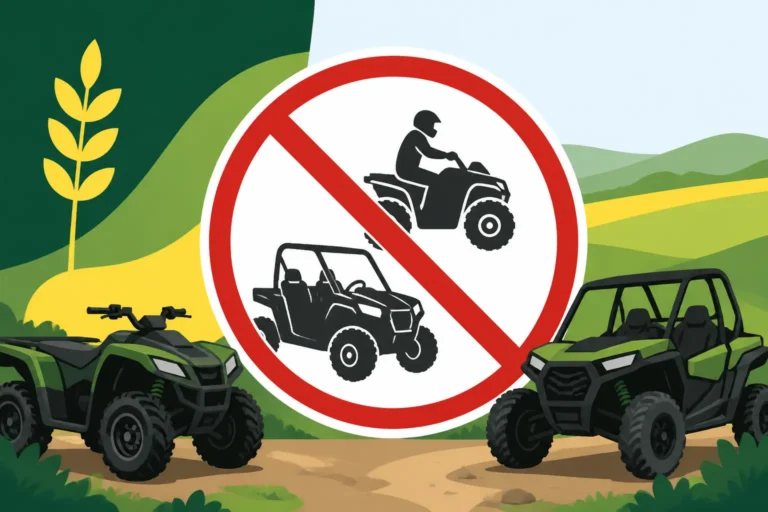
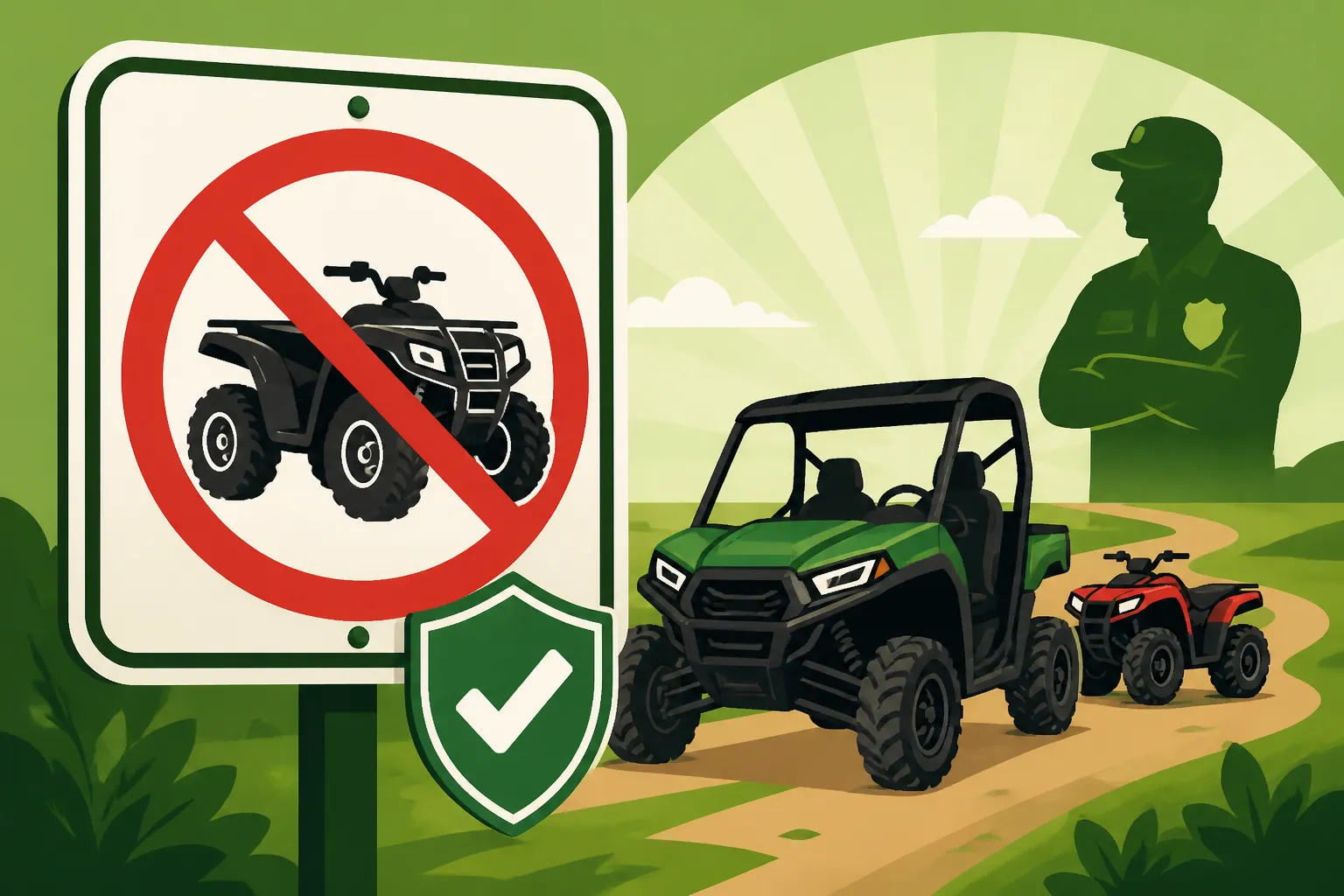
- Size: The regulations state that a prohibition sign must be a minimum of 60 centimetres square. That's roughly 2 feet by 2 feet. This ensures it's large enough to be easily visible to riders. A small, postcard-sized sign tucked away isn't going to cut it.
- Colour and Wording: The standard calls for a white sign with black lettering. This high contrast ensures legibility, even in varying light conditions. The wording needs to be clear and unambiguous, stating the prohibition directly (e.g., "ATVs Prohibited," "No Off-Road Vehicles Beyond This Point"). There should be no room for misinterpretation. The guidance in [White With Black Lettering] clarifies this.
- Placement: Signs must be placed in a conspicuous location, clearly visible to operators approaching the restricted area. They shouldn't be hidden behind overgrown bushes, around a sharp blind corner, or so far off the main path that a rider would reasonably miss it. The intent is to inform, not to trick.
- Authority: While not always explicit on the sign itself, a truly enforceable municipal sign is backed by a formally adopted bylaw. If a peace officer issues a ticket, they will be citing that specific bylaw. This means a hand-written sign by an individual, even if placed on public land, typically doesn't carry the same legal weight as one sanctioned by the municipality.
These specific requirements are there to protect riders and ensure fairness. If you get a ticket for riding in a prohibited area, and the sign didn't meet these basic standards, you might have grounds to dispute it. That being said, it's always better to err on the side of caution. Even an imperfect sign can indicate an underlying prohibition you should investigate. Perhaps you could mount a compact storage bag from a brand like SuperATV on your machine to carry a copy of local bylaws or a map with known restricted zones.
Communication of Crown Land Restrictions
For Crown land, the communication of restrictions often takes a slightly different form than physical signs at every entry point. While some frequently accessed areas might have physical signage, the primary method for communicating Administrator Orders or fire bans is through official government publications, websites, and media releases.
This means that as a responsible rider planning a trip onto Crown land, you have a duty to check the current status of the land. This involves looking up provincial fire ban maps, checking the Ministry of Environment's website for specific area closures, or even contacting the local conservation office. These orders are legally binding once issued, regardless of whether you personally saw a physical sign on the ground. For instance, [Saskatchewan Crown Land Access Rules] outlines the expectations for riders.
Think of it like this: when a provincial highway is closed due to flooding, you're expected to know about it from public announcements, not necessarily from a physical barrier at every single side road entrance. The same principle applies here. If a large tract of Crown land is closed for wildfire prevention, the order is effective even if you only saw a small notice online rather than a large sign at your specific entry point.
Understanding Unofficial Signs vs. Official Notices
This is where common sense and a bit of skepticism come into play. You might encounter all sorts of signs while out riding: "Private Road," "No Quads Here," "Keep Out." Some are official, some are not.
- Official Signs: These are typically robust, professionally made, and adhere to the size and colour guidelines (especially for municipal bans). They will usually be placed by a recognizable authority (municipality, provincial ministry).
- Unofficial Signs: These might be hand-painted, faded, or simply don't meet the regulatory standards. While they might indicate a landowner's preference (and should be respected on private land), they don't necessarily carry the same legal weight as an official municipal sign on public property. However, an unofficial sign could be an indicator of an underlying official ban that simply hasn't been properly signed yet. It's a red flag to investigate, rather than an automatic green light to proceed.
It's a tricky balance. You don't want to ride somewhere you're not supposed to, but you also don't want to be overly restricted by signs that have no legal basis. The best approach is to treat any "No ATV" sign as a signal to exercise caution and, if you're on public land, to consult local bylaws or provincial orders to confirm the restriction. Having reliable navigation and communication tools, perhaps mounted with a sturdy SuperATV clamp, can help you verify your location and any applicable rules in real-time if you have cell service.
Consequences of Ignoring Prohibited Riding Areas
So, what happens if you decide to ignore a clear, enforceable ban sign or restriction? The consequences can range from a hefty fine to losing your machine, and even facing significant liability in the event of an accident. It's not just a slap on the wrist.
Fines, Penalties, and Machine Seizure
Under [Saskatchewan's All Terrain Vehicles Act], fines for contravening a bylaw or an Administrator's order can be substantial. The Act sets a maximum fine of $1,000. While a first-time offence might not hit that maximum, it's certainly enough to put a serious dent in your wallet. And let's be real, no one wants to pay a $300 fine for riding somewhere they thought was fine. [Riding Unplated on Municipal Land Costs $300] is one example of a specific local penalty.
Beyond monetary penalties, peace officers in Saskatchewan have the authority to seize and impound your ATV or UTV if they believe you are operating it in contravention of the Act or its regulations, or a valid bylaw. This means your pride and joy could be towed away, and you'd be responsible for all towing and storage fees on top of any fines. Getting a seized machine back can be a complicated and expensive process, as detailed in [Saskatchewan Seizure and Impoundment Rules]. This is why knowing where you can and cannot ride is paramount.
| Type of Restriction | Typical Enforcement | Signage/Communication | Consequences of Violation |
|---|---|---|---|
| Municipal Bylaw | Local Peace Officers, RCMP | Specified signs (60cm sq, white with black lettering), formal bylaw publication | Fines (up to $1,000), machine seizure |
| Crown Land Order | Conservation Officers, RCMP | Official provincial publications, websites, media releases, some physical signs | Fines (up to $1,000), machine seizure, liability for damages (e.g., wildfire) |
| Private Land Ban | Landowner, RCMP | "No Trespassing" signs (any form), verbal communication | Trespass charges, fines, potential civil action |
Liability and Insurance Implications
Getting into an accident in an area where ATVs are prohibited introduces a whole new layer of problems. If you're riding in a banned area and cause damage to property or injure someone, your insurance company might deny coverage. Most insurance policies have clauses that state they won't cover incidents that occur during illegal activities or in contravention of laws and regulations.
This means you could be personally responsible for significant costs: repair bills for damaged property, medical expenses for injured parties, and even legal fees. The minimum insurance requirement in Saskatchewan is $200,000 in third-party liability coverage, but if your insurer denies your claim because you were riding illegally, that coverage won't help you. It could quickly become a life-altering financial burden. So, while [Saskatchewan Insurance Requirements for Riders] are in place to protect you, they only work if you're riding legally.
Think about it: if you're riding in a prohibited ditch and swerve, damaging a farmer's fence, or worse, hitting a person or another vehicle, your insurance policy might deem your actions to be outside the scope of coverage. This is a very real, very serious risk that far outweighs the thrill of ignoring a ban.
Rider Responsibility and Due Diligence
Ultimately, the onus is on the ATV or UTV operator to know and respect the rules. Ignorance of the law is generally not a valid defence. While it can be frustratingly complex with varying municipal bylaws and ever-changing Crown land orders, due diligence is a must for responsible riders.
This means:
- Checking before you ride: Before heading out, especially to a new area, take the time to check municipal websites for local bylaws and provincial government sites for Crown land orders or fire bans. [Saskatchewan Bylaw Lookups Before You Ride] can be a lifesaver.
- Looking for signs: Be vigilant while riding. Keep an eye out for any signs indicating restrictions, even if they don't perfectly meet the exact specifications for [Prohibition Signs Must Be 60 Centimetres Square]. Treat them as a warning to proceed with caution or find an alternative route.
- Asking locals: If you're in an unfamiliar area, don't hesitate to ask local residents, campground hosts, or even staff at a local gas station about common ATV restrictions. They often have the most up-to-date, on-the-ground knowledge.
- Carrying documentation: While not always legally required, carrying printouts of relevant bylaws or fire bans, or having them accessible on your phone, can be incredibly helpful if you encounter a peace officer. A waterproof storage box or bag from a company like SuperATV could be useful for this.
Riding ATVs and UTVs in Saskatchewan offers incredible opportunities to explore our beautiful province. By understanding what makes a ban sign enforceable, and by taking responsibility for knowing the rules, we can ensure these activities remain enjoyable and sustainable for everyone. Stay safe, informed, and respectful of the land and its rules.
Disclaimer
This article is for general informational purposes only and does not constitute professional advice. Laws, prices and regulations vary by location and change over time. Consult a qualified professional for guidance on your specific situation.