Saskatchewan Cabins Near a Riding Area
A cabin can make a Saskatchewan ATV weekend feel easy—until you learn the trailhead is farther away than expected, the access road is unsuitable for your trailer, or the route you planned crosses land where riding is not allowed. This guide explains how to choose a cabin near a riding area, check trail access, and plan the practical details before you haul your machine north.
Choose a riding area before you choose a cabin
Match the riding area to your kind of trip
Start with the riding area, not the accommodation listing. Saskatchewan’s riding options vary: some trips are built around designated park trails, while others depend on club-maintained routes or access that needs careful checking. The right choice depends on how far you want to ride, whether you’re bringing children or newer riders, and whether you want a quiet cabin stay or convenient access to services.
For example, a group looking for forest trails and a cabin-focused weekend might begin by researching areas around Candle Lake, Christopher Lake, or the Narrow Hills region. Someone travelling from southern Saskatchewan may prefer to look at Moose Mountain and the Kenosee Lake area. These are starting points for planning, not guarantees that a particular cabin connects directly to a legal ATV route. Check the riding area itself as well as the accommodation location.
A useful first step is to compare designated riding areas and local trail information. [Moose Mountain Provincial Park ATV Trails] and [Narrow Hills Provincial Park ATV Trails] can help you understand the kind of park riding to investigate. If you’re considering a stay around the lakes north of Prince Albert, also review [Saskatchewan Riding Near Candle Lake] and [Saskatchewan Riding Near Christopher Lake]. The goal is to identify a suitable riding base before you commit to lodging.
Treat “near the trail” as a question to verify
Accommodation descriptions often use “near” loosely. It might mean a short ride to a trailhead, a drive with your ATV on a trailer, or simply a cabin in the same broader region. Ask the owner or booking contact for the nearest legal unloading area, the approximate road route to it, and whether you can park a truck and trailer at the cabin.
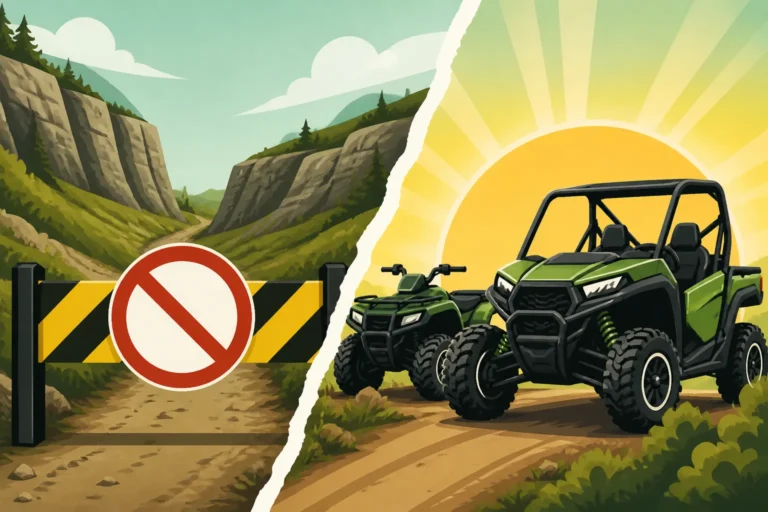
Do not assume that a trail visible on a map can be ridden from the property. It could cross private land, a restricted area, or a road where ATV use is not permitted. A cabin’s proximity to bush, a lake, or an old road does not automatically give guests permission to ride there. Review [Saskatchewan Parks With Designated Trails Only] and confirm the rules for the specific area you plan to visit.
Mapping tools can help you plan distances and compare routes. Some riders use onX Offroad to explore mapped routes and terrain, but a line on a map should be treated as a planning clue—not proof that a route is open or authorized. Check the relevant park, club, municipality, or land manager before riding. That extra call can prevent an awkward arrival followed by a long search for somewhere you’re actually allowed to unload.
Compare cabins by how well they support a riding trip
Look beyond the cabin itself
A pleasant-looking cabin is only part of the decision. For an ATV or side-by-side weekend, check whether the property has enough room for your truck, trailer, and machines. Ask about turning space, parking surfaces, gates, storage, and whether the driveway is manageable with a loaded trailer. A narrow lane or soft, muddy yard can make arrival and departure more stressful than the ride itself.
Also ask how the host expects machines to be stored. Some properties may have rules about parking ATVs near the cabin, washing mud off, using outdoor taps, or running engines early in the morning. Respect those rules and avoid assuming there is a secure shed or a suitable place to work on a machine. If you’re travelling with several riders, confirm how many vehicles and trailers the site can realistically accommodate.
Here’s a practical comparison checklist:
| Cabin feature | Why it matters for riders | What to confirm |
|---|---|---|
| Trailer parking | You may need space for a truck, trailer, and multiple machines | Number of vehicles allowed, parking surface, and room to turn around |
| Trailhead access | A nearby cabin may still require a drive to a legal unloading point | The route to the trailhead and whether machines can legally ride from the property |
| Machine storage | Weather and theft concerns do not disappear when the ride ends | Where machines may be parked and whether indoor storage is available |
| Water and cleanup | Muddy gear and machines can create extra work | Whether outdoor water or a wash area is permitted |
| Group capacity | A cabin may sleep a group but not fit its vehicles | Guest limits, vehicle limits, and parking arrangements |
| Road conditions | Gravel, soft shoulders, and seasonal conditions affect towing | Access-road surface, grades, and any restrictions for trailers |
If you’re comparing a cabin with a campground or other accommodation, include the drive to the unloading area in your calculation. [Saskatchewan Campgrounds Near a Trailhead] may help you assess a different kind of riding base, while [Saskatchewan Trailheads With Trailer Parking] is useful when trailer access is a deciding factor. A cabin can be a great fit, but it is not automatically the most convenient option for every group.
Choose a location that suits the whole group
A cabin near a riding area is often about more than mileage. Consider who is travelling and what they need when they are not on the machine. A family with young children may value a kitchen, separate sleeping spaces, and somewhere to relax if the weather turns. A group of adults may prioritize parking, easy unloading, and nearby fuel or groceries. Someone bringing a dog should confirm pet rules rather than relying on assumptions based on the property photos.
Think about how your group handles daily logistics. If riders plan to set out early, ask about quiet hours and driveway access. If some people are not riding all day, look for nearby activities or an easy route to a community for supplies. In the Candle Lake or Christopher Lake area, for instance, a cabin may be close to recreational amenities without being close to an authorized ATV trail. Keep those two kinds of proximity separate when comparing listings.
It also helps to agree on a realistic riding plan before booking. If one rider expects long loops and another wants short outings with a return to the cabin, that difference affects the best location. A place that is ideal for evening swims may not be the best base for repeated trailhead drives. Decide what matters most—ride time, comfort, access, or a mix—and use that list to narrow the choices.
Check trail access, permissions, and seasonal conditions
Confirm where riding is allowed
Saskatchewan does not have one simple rule that makes every visible trail or road open to ATVs. Access depends on the land, the route, local rules, and any seasonal restrictions. In a provincial park, machines may be limited to designated routes. On private land, you generally need permission from the landholder. Crown land and grazing leases can have their own access conditions, so do not treat them as unrestricted riding areas.
Before travelling, identify the exact route from the cabin to the riding area and the area where you intend to ride. Ask the accommodation host whether guests commonly trailer to a particular access point, but independently confirm that the route is permitted. A host may know the local roads without being able to confirm current trail rules. [Saskatchewan Crown Land Riding Explained] and [Saskatchewan Grazing Lease Access Rules] can help you understand why access needs to be checked rather than guessed.
If you use onX Offroad or another mapping app, check what the map can and cannot tell you. A mapped line may help with navigation, but it does not replace permission, signage, or current local guidance. Save the contact details for the park office, municipality, or local club relevant to your route. Where practical, keep a paper map or offline navigation option available, especially in areas where phone service can be unreliable.
Check conditions close to departure
A route that was usable on your last trip may be unsuitable this time. Rain can make some roads or trails difficult, while fire-related restrictions and closures can affect access. Before towing a long distance, look for recent local updates and contact the appropriate office or club if the trail status is unclear. [Saskatchewan Trail Conditions Before You Haul] is a useful reminder to make this part of trip planning rather than an afterthought.
Season matters for both the ride and the cabin. Spring thaw can mean soft access roads or muddy yards. Summer brings more demand for lakeside accommodation and can coincide with fire restrictions. Fall trips may involve hunting activity and changing weather. Ask the host about the access road’s usual condition during your travel dates, then verify current restrictions separately through the relevant land manager.
Build a backup plan in case the route you intended to ride is closed or inaccessible. That might mean choosing another designated area, shortening the day, or spending more time around the cabin. Confirm cancellation terms and arrival instructions before you book, and avoid planning a weekend that only works if a single trail is open. A little flexibility can save a lot of frustration when conditions shift.
Plan the details that make the weekend work
Ask the right questions before booking
A short message to the host can reveal whether a property is genuinely suited to an ATV trip. Be specific: mention the number of riders, machines, trucks, and trailers, then ask about parking and the closest legal trail access. If you are bringing a side-by-side, confirm that the driveway and parking area can handle its width and turning needs. Do not rely on a listing’s general “vehicle access” wording to answer those questions.
A useful pre-booking checklist includes:
- How many trucks and trailers can park on the property?
- Is the parking area firm and level enough for unloading?
- Is there room to turn around with a trailer?
- Where is the nearest legal unloading area or designated trail access?
- Can machines be parked overnight at the cabin?
- Are there rules about washing machines or muddy equipment?
- Are pets, extra vehicles, or late arrivals allowed?
- Is the access road maintained and suitable for a trailer during the planned season?
Save the answers in writing so everyone in the group has the same expectations. If the host says a trail is “right nearby,” ask what that means in practical terms: distance by road, distance by trail, or a short drive with machines on a trailer. A clear answer is much more useful than a vague promise of easy access.
Prepare the ride and the cabin stay as one plan
Once you book, organize the ride around where you will unload, not simply where you will sleep. Check whether a permit, acknowledgement form, or other park requirement applies to your chosen route. Requirements can vary between areas, so review the rules for the specific park rather than assuming one permit or process covers every destination. [Saskatchewan Park Trail Permits Are Free] and [Saskatchewan Permit Questions Riders Ask] are useful starting points for understanding that park access may involve steps even when a permit itself has no charge.
Pack for both trail time and cabin time. Bring the machine’s required safety equipment, appropriate riding gear, water, basic repair supplies, and a way to navigate if cell service drops. Then think about the less exciting items: a tarp for muddy boots, bags for wet clothing, food for arrival night, and a plan for refuelling. If the cabin is outside a town, do not assume you can pick up every forgotten item nearby.
Before leaving home, share the itinerary and accommodation details with someone who is not on the trip. Confirm arrival instructions, identify the nearest community for supplies, and make sure the group understands the route and access rules. If a trail is closed or the weather turns, be willing to change the plan. The best cabin weekend is not the one where every kilometre goes exactly as expected; it is the one where the group can adapt without taking unnecessary risks.
Keep expectations realistic
A cabin near a riding area can reduce travel time and make it easier to enjoy a relaxed weekend, but “near” does not always mean ride-from-the-door access. A short drive to a legal trailhead may be the sensible arrangement, especially when accommodation sits beside private property or within a community with its own rules. Confirming that detail early helps avoid both disappointment and accidental trespassing.
The most reliable planning approach is to choose the riding area, verify where you can legally ride, and then select accommodation that works for your group’s vehicles and comfort needs. Use maps to compare options, but confirm route access with the relevant local authority or land manager. When you combine that research with clear questions for the host, you can book a cabin with a much better idea of what the weekend will actually involve.
Disclaimer
This article is for general informational purposes only and does not constitute professional advice. Laws, prices and regulations vary by location and change over time. Consult a qualified professional for guidance on your specific situation.