Riding Around Cattle on a Grazing Lease
A quad can make a Saskatchewan grazing lease feel like open country, but cattle, fences, gates and leaseholder rules can turn a casual detour into a serious problem. The safest ride starts before you unload: confirm you have permission, learn where livestock are being grazed, and plan a route that avoids disturbing them. Here’s how to ride around cattle without putting animals, people or your machine at risk.
Confirm access before riding a grazing lease
Permission matters even when the land looks open
A grazing lease is not automatically an unrestricted ATV trail. The land may be Crown land used by a livestock operator, and access can depend on the lease conditions, land-management restrictions, posted notices and the permission of the person responsible for the cattle. Don’t assume that a visible trail, open gate or lack of a fence means you may ride through.
Start by checking the rules for the specific area and contacting the leaseholder before you go. Ask whether ATV or UTV access is allowed, which route to use, where livestock are currently grazing and whether any areas are off-limits. The details in [Saskatchewan Grazing Lease Access Rules] and [Saskatchewan Crown Land Access Rules] can help you understand why access needs to be checked rather than assumed.
A useful request is specific: “May we ride the established trail from the west access point to the grid road on Saturday? We’ll be on two machines. Are cattle in that pasture, and should we avoid any particular gate or water area?” That gives the leaseholder a chance to flag a temporary concern, such as a herd near the trail, a recently moved group of animals or a closed section.
If you can’t reach the leaseholder, don’t treat silence as approval. Choose a route where access is clearly permitted or postpone the ride until you can confirm. [Getting Consent From a Grazing Lease Holder] and [Reaching a Rancher Before You Cross Their Lease] offer useful next steps for making that conversation before you haul out.
Check signs, boundaries and changing conditions
Permission for one route or one visit does not necessarily cover the entire lease. A pasture may be divided into sections, and the cattle may be moved between them. Seasonal restrictions or temporary closures can also change where riding is appropriate. Read signs at the entrance and along the route, and follow any instructions from the leaseholder.
A map can help you understand where you are, but it won’t tell you whether cattle have been moved into a particular pasture that morning. Before unloading, check the planned route against the access instructions you received. If you find a new barrier, a closed gate, fresh livestock activity or a sign you did not see before, stop and reassess rather than riding around it.
Treat boundaries as meaningful. Don’t cut across a pasture to save time, cross a fence, or use a stock trail just because it looks like a convenient shortcut. For a broader permission checklist, see [Saskatchewan Private Land Permission] and [Reading Posted Land Signs Before You Unload].
| Situation | Safer choice |
|---|---|
| You have not confirmed lease access | Contact the leaseholder or choose a route with confirmed permission |
| Cattle are close to the planned trail | Stop, give them room and use another permitted route if available |
| A gate is closed or marked with instructions | Follow the instructions; don’t assume you should open or bypass it |
| You can’t tell whether a route is permitted | Turn back until you can confirm |
| Conditions have changed since permission was granted | Pause and contact the leaseholder before continuing |
Ride in a way that does not pressure cattle
Give the herd space and avoid splitting it
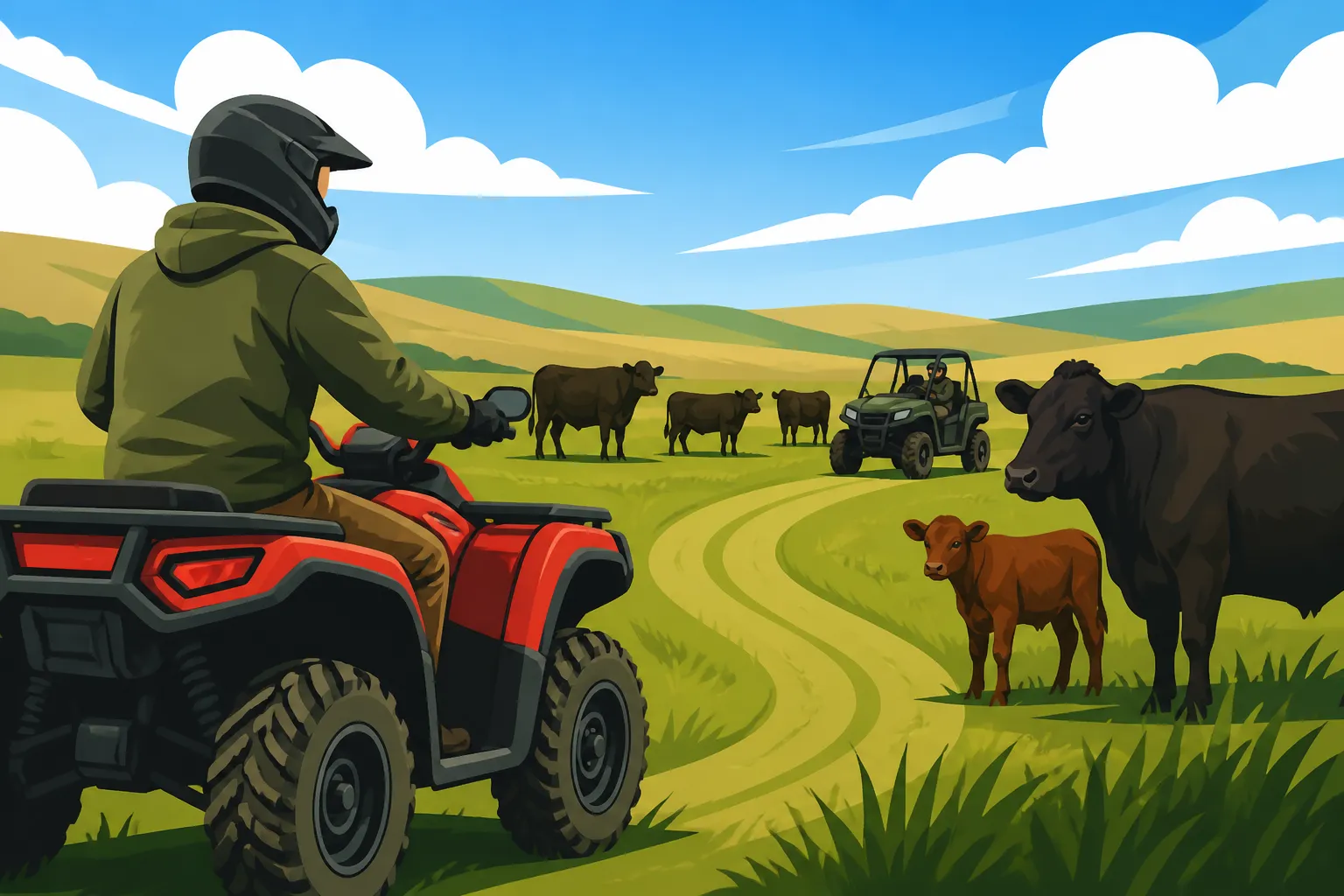
Cattle may look calm while still being easily startled by a fast, noisy machine. A sudden approach can cause them to bunch together, run, scatter or push against a fence. The risk is greater when calves are with their mothers, when animals are gathered near water, or when a bull is close to the herd.
Slow down well before you reach cattle. Keep a wide distance, avoid revving the engine and never drive toward the animals to make them move. If the herd is spread across the trail, stop at a safe distance and wait to see whether there is a clear route that does not push cattle toward a fence, road or narrow opening. If there isn’t, turn around and use another permitted route.
Do not ride between a cow and calf or split a group to squeeze through. Even if the opening seems large enough for the machine, cattle may react unpredictably when separated or crowded. A detour is inconvenient; a frightened animal, damaged fence or collision is much harder to deal with. For practical lease-specific reminders, see [Riding Around Cattle on a Grazing Lease].
Be especially cautious near calves, bulls and water
A mother cow may become protective if she thinks you are getting too close to her calf. A bull can also react defensively, especially if approached at close range or blocked from moving away. Keep people and machines together, leave the animals an obvious path to move away, and never try to pass between a bull and the herd.
Watering areas deserve extra care. Cattle may gather around a dugout, trough or other water source, and the ground can be soft or churned up. Don’t ride through the group or around the edge if doing so would crowd the animals or damage the site. Stop well back and follow the route the leaseholder recommends.
If the cattle start moving toward you, don’t accelerate through them or make sudden turns. Reduce noise, keep a safe escape route open and back away only when it can be done without driving closer to the herd. If you’re unsure what the animals will do, create distance and leave the area. Keep the group ride calm, too: one rider who speeds ahead or circles the herd can undo everyone else’s careful approach.
Handle gates, routes and unexpected encounters carefully
Leave every gate and fence as directed
A gate is part of the livestock-control system, not a shortcut or a casual trail marker. Before riding, ask which gates you may use and whether they should be left open or closed. Follow the leaseholder’s instructions exactly. If you find a gate closed, don’t assume it was left that way by mistake; cattle may be in the pasture, or the gate may be controlling access for a reason.
If you’re authorized to pass through a gate, make sure the whole group knows the procedure. Riders should go through one at a time, keep the machines clear of the gate swing and check that it is secured as instructed before moving on. Don’t leave a gate open while waiting for another rider unless that is what the leaseholder told you to do. A gate left unsecured can let cattle wander into another pasture or onto a road.
Never cut a fence, force a locked gate or ride around a barrier through brush. A fence detour can damage property and create another route for livestock to escape. See [Gates on a Grazing Lease] for more on why this small detail matters. If you’re planning a longer trip, keep the leaseholder’s contact information accessible; [Keeping a Rancher's Phone Number in Your Pocket] is a sensible habit when riding in working ranch country.
Make a calm plan if cattle block the route
When you see cattle ahead, slow down and stop at a distance that gives them room. Avoid honking, shouting, revving or repeatedly moving toward the herd. Give the animals time to settle and use a detour only if the leaseholder has approved it. If the cattle remain across the route, turn around rather than trying to push through.
If animals scatter or a fence is damaged, stop and assess the situation without chasing cattle. Contact the leaseholder as soon as it is safe to do so. If an animal is injured, trapped or loose near a public road, explain the location clearly and follow the leaseholder’s direction. Don’t attempt to herd cattle on your own unless you have the knowledge and permission to do so.
A simple group plan helps prevent confusion: agree on a meeting point before entering the lease, identify who will contact the leaseholder, and make sure no one rides ahead out of sight. If you’re on a group ride, the lead rider should slow the group well before a herd, while the last rider makes sure no one takes an unapproved shortcut around the cattle.
Prepare your machine and group for ranch-country riding
Keep the ride controlled and the equipment appropriate
On a grazing lease, controlled riding matters more than speed. Check your brakes, throttle, steering, tires and lights before heading out, and carry the basic equipment your route and conditions call for. If the ground is wet or rutted, avoid spinning tires near gates, water sources and livestock areas. A stuck machine can turn a short ride into a drawn-out recovery that disturbs cattle and creates pressure to take an unsafe route out.
A winch or recovery equipment may be useful on rough ground, but don’t attach a line to a fence, gate or livestock infrastructure. Choose recovery points intended for that purpose and keep the machine, cable and people well away from cattle. Some riders use accessories from brands such as SuperATV when preparing machines for off-road conditions; whatever equipment you choose, make sure it suits the machine and is installed and used according to its instructions.
Before leaving, confirm that everyone in the group understands the plan for encountering cattle. Keep speeds conservative, maintain enough space between machines to avoid a chain of sudden stops, and don’t let noise or excitement encourage riders to crowd the herd. SuperATV accessories may be one option for outfitting an ATV or UTV for a particular ride, but gear does not replace permission, sound judgment or respect for the leaseholder’s instructions.
Keep road travel and lease access separate
A ride that starts on a grid road does not automatically authorize you to enter adjoining pasture. Road rules and local bylaws apply to road use, while lease access is a separate question. Confirm where you may leave the road, which entrance to use and whether the route connects to a permitted trail. For road-related checks, [What an Officer Can Ask to See on a Grid Road] is a helpful companion topic, and [Saskatchewan ATV Insurance Requirements] can help you review insurance obligations before riding.
If cattle are near a road crossing or entrance, don’t use your machine to move them along the road. Wait for a safe opportunity, keep clear of traffic and contact the leaseholder if the animals are loose or creating a hazard. A rider’s attempt to hurry cattle across a road can put the animals, drivers and other riders at risk.
For a long day, carry a charged phone, water, basic repair and first-aid supplies, and the contact details you may need. SuperATV or any other accessory brand can be considered when choosing equipment for your machine, but keep the priority clear: confirm access, avoid stressing livestock, respect every gate and turn back when the route is not safe or authorized.
Disclaimer
This article is for general informational purposes only and does not constitute professional advice. Laws, prices and regulations vary by location and change over time. Consult a qualified professional for guidance on your specific situation.