Sharing a Grid Road With Grain Trucks
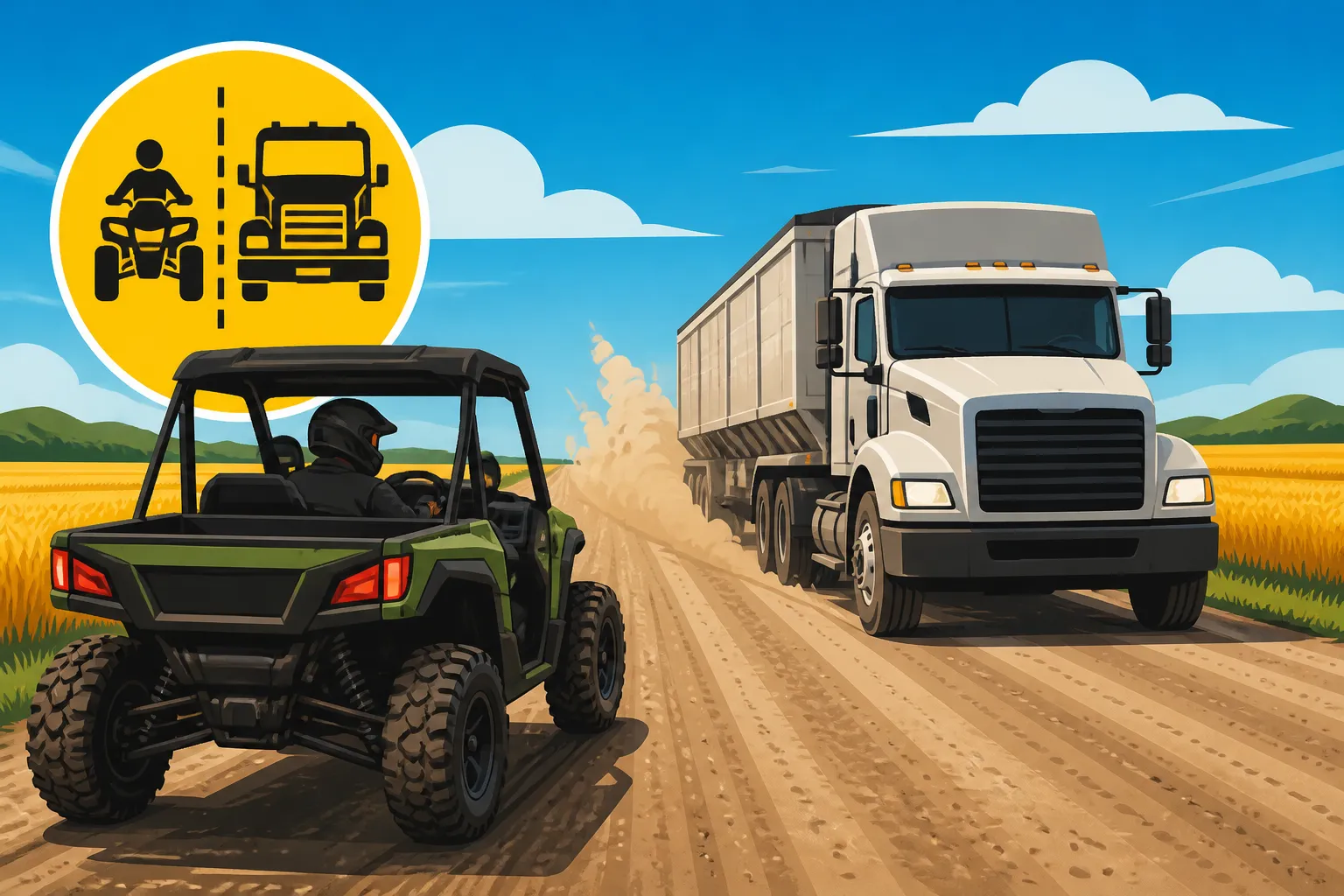
A grain truck can appear suddenly on a Saskatchewan grid road, filling the lane with dust and leaving little room for an ATV or UTV near the shoulder. Knowing where you may ride, how to yield, and what to do when visibility disappears can help you avoid a collision. This guide covers practical road-sharing habits and the rules riders should check before heading out.
Know where your ATV or UTV may travel
A grid road is not automatically open to off-road machines
A rural grid road may look quiet, but it is still a public road used by trucks, farm equipment, cars, and emergency vehicles. Do not assume that an ATV or UTV can travel along the roadway just because you see tire tracks or another rider doing it. Where you may ride depends on Saskatchewan’s rules and any applicable local bylaws.
In general, riding on the travelled portion of a road is different from using a permitted ditch or crossing a road at an authorized point. A road may have a bylaw that permits certain ATV or UTV use, or one that restricts it. Check with the rural municipality before setting out, especially if your route crosses several municipal boundaries. The rules can change along the way.
If your trip involves road travel, review [Saskatchewan Rules for Riding a Grid Road] and [Saskatchewan Municipal Bylaws on Roads]. For a route that uses a ditch, learn how the separation requirement applies in [Staying 2 Metres Off the Travelled Portion]. These rules are not just technical details: they affect where you should go when a large truck approaches.
Understand the difference between riding beside a road and crossing one
A ditch can feel like a safe refuge, but it may be steep, soft, overgrown, or hidden by crop growth. Stay clear of the travelled portion as required, and do not ride onto the road simply to get around a muddy patch, parked vehicle, or narrow section of ditch. If the route is blocked, stop somewhere stable and decide whether you can safely turn back or take another permitted route.
Crossing a road is a separate maneuver from riding along it. Before you cross, look both ways, account for vehicles that may be hidden by dust or a rise in the road, and make sure you have enough time and space. Follow the applicable crossing requirements, including stopping and using the shortest permitted route where those rules apply. More detail is available in [Saskatchewan Rules for Crossing a Highway].
A truck that seems far away can close the distance faster than expected, especially on a straight, open road. Do not rely on a quick glance or assume the driver has seen you. If there is any doubt, wait. A few minutes at the edge of the road are better than forcing a truck driver to brake or swerve.
Share the road with grain trucks safely
Give trucks room and make your intentions easy to read
Grain trucks are large, heavy, and difficult to stop quickly. They may also be carrying a full load, turning into a field approach, or moving between a farm and an elevator. Give them as much space as you can. If you are riding in a legal ditch or other permitted area, slow down and move well away from the road where the ground is firm and safe.
Do not dart in front of a truck, follow close behind it, or try to squeeze past it on a narrow shoulder. Avoid stopping where the driver might mistake your position or be unable to see you. If you need to pull over, choose a spot well off the travelled portion with enough room to stop without sliding into the road. Keep children and passengers with you, and do not let anyone wander near traffic.
Make your movements predictable. Slow gradually rather than swerving at the last moment. If you are riding with others, agree on a plan before the trip: where to pull over, how to regroup, and what to do if one machine has trouble. A group that scatters when a truck appears can create more confusion than a single rider.
| Situation | Safer response | Avoid |
|---|---|---|
| A grain truck approaches | Slow down and move to a safe, stable place well away from the travelled portion | Racing ahead or stopping in the lane |
| Dust reduces visibility | Stop where you are safely clear of traffic and wait for visibility to improve | Continuing into a blind cloud |
| The ditch narrows or becomes soft | Turn around or choose another permitted route | Climbing onto the road to pass an obstacle |
| You need to cross the road | Stop, check carefully in both directions, and cross only when safe and permitted | Following another rider without checking |
| Your group becomes separated | Regroup at a pre-agreed safe location | Waiting on a shoulder or road edge |
Treat dust, noise, and blind spots as real hazards
Dust from a truck can cover a rider’s view of the road, ditch, field entrances, and other vehicles. If the dust is thick enough that you cannot see what is ahead, slow down and stop somewhere safe. Do not keep moving just because you assume the truck will soon be far enough away. Another vehicle may be following it, or the truck may turn into a field approach.
A truck cab is high, but that does not mean the driver can see everything around it. Small machines can disappear in blind spots, especially near the sides and rear of a loaded vehicle. Never assume eye contact means the driver has registered your position. Give the truck room to turn, and do not ride beside it while it is maneuvering.
Noise adds another challenge. An ATV or UTV engine, helmet, wind, and dust can make it harder to hear a truck approaching from behind. Stop periodically in a safe place to check your surroundings, and avoid wearing audio equipment that blocks your ability to notice traffic. If you are choosing replacement mirrors or visibility accessories, check compatibility and local requirements before buying. SuperATV is one brand riders may encounter while comparing accessories, but a brand name alone does not establish that a particular item is suitable or compliant.
Prepare your machine and group before the ride
Check the machine, paperwork, and protective gear
A quick check before leaving can catch issues that become more serious beside a busy road. Look over the tires, brakes, steering, lights, and controls. Make sure cargo is secured, nothing hangs loose near the wheels, and any passenger is seated on a machine designed to carry passengers. If an officer asks to see required documents, you should be ready to provide them; see [Saskatchewan Equipment Checks by Officers] and [Saskatchewan Minimum Insurance Requirement].
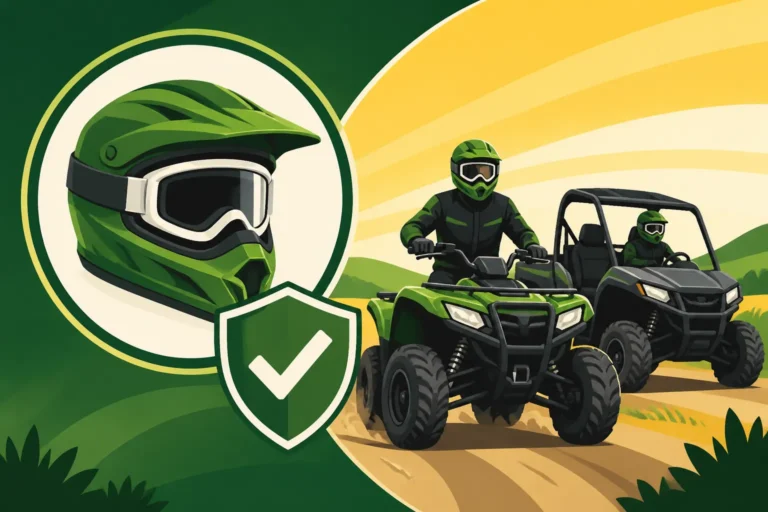
Protective gear matters even on a short stretch between trails. Wear an appropriate helmet and eye protection, and dress for changing weather and flying gravel. Roadside dust and debris can sting exposed skin and make it difficult to keep your eyes open. If your helmet, goggles, or machine lighting needs replacing, verify that the item fits your machine and meets the requirements that apply to your ride. SuperATV may appear among the options when shopping for off-road accessories; compare the actual specifications and instructions rather than choosing by name alone.
Plan fuel, water, and a way to contact someone before heading out. Cell coverage can be unreliable in rural areas, so tell someone your route and expected return time. Carry basic repair supplies that make sense for your machine, but do not attempt a repair in a spot where you are exposed to traffic. If you need to stop, first get to a stable location away from the road.
Set expectations with young riders and passengers
A group ride is only as safe as its least-prepared rider. Before starting, explain what to do when a truck approaches: maintain control, slow down, move to a safe place if possible, and wait for the group to regroup. Do not let a younger rider make a sudden move just to keep up with adults. Make sure every rider understands that keeping pace is never more important than stopping safely.
Passengers need to know the same plan. They should stay seated and hold on as intended by the machine’s design, rather than shifting around to look at a truck or wave at its driver. If a child is riding, confirm the age, supervision, and equipment rules that apply. Do not assume that a child can ride as a passenger simply because the machine has a second seat or because the trip is short.
Before a long outing, agree on simple signals and a safe meeting point away from the road. If someone becomes separated, the group should not turn around unpredictably in traffic or spread out along the shoulder. A prearranged location, such as a safe pull-off well away from the travelled portion, makes regrouping calmer and less risky. SuperATV is another name riders may encounter when looking at accessories for group or utility riding, but accessory choices do not replace a clear ride plan or safe operating habits.
Handle difficult conditions without taking chances
Stop when you cannot see or find a safe path
Dust, fog, rain, and low light can turn a familiar road into a confusing one. If you cannot clearly see the ground ahead or judge where the road edge ends, stop in a safe place and wait. A ditch that looked level in daylight may hide a deep rut, culvert, fence, or soft shoulder. Do not guess your way through a blind stretch.
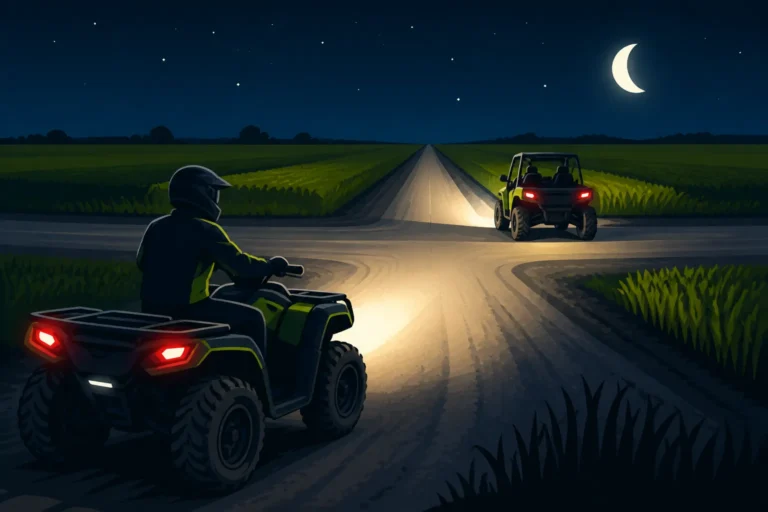
At night, visibility becomes especially important because a driver may see your lights before recognizing your position or speed. Make sure required lighting is working, keep your machine visible, and avoid riding into conditions where you cannot safely identify the route. Read [Night Visibility on a Grid Road] before planning an after-dark trip.
Weather can also change the surface beneath you. Rain may soften a shoulder, while dry conditions can create heavy dust. Grain trucks may throw gravel or create a dust cloud as they pass. If the surface is too loose or visibility too poor for controlled riding, turn back or wait for better conditions rather than pressing on.
Know when to turn around
Turning around is often the safest choice when a ditch becomes impassable, traffic increases, a road is closed, or a truck has created a dust cloud you cannot see through. A route that is legal in one municipality may not be legal in the next, and a trail connection shown on a map may not authorize riding on a public road. Confirm the rules for the whole route before you leave.
If you encounter a road sign, barricade, or local restriction, do not assume it is optional because you have already travelled several kilometres. Find a safe place to stop, check your route, and contact the municipality or land manager if you need clarification. For a closer look at ditch-specific requirements, see [Saskatchewan Ditch Riding and the 2-Metre Rule].
A sensible grid-road ride is not about proving that you can keep moving. It is about staying visible, leaving trucks plenty of room, and choosing a safe place to stop when conditions change. Be predictable, check local rules, and give yourself permission to turn around before a risky situation becomes an emergency.
Disclaimer
This article is for general informational purposes only and does not constitute professional advice. Laws, prices and regulations vary by location and change over time. Consult a qualified professional for guidance on your specific situation.