Saskatchewan Insurance Proof at a Park Office
Arriving at a Saskatchewan park office without the right insurance document can delay a ride or leave you unsure whether your machine is covered. The practical fix is to confirm your policy applies to the ATV or UTV and the riding you plan to do, then carry proof you can show if park staff or an officer asks for it.
What insurance proof at a park office is meant to show
Insurance proof is evidence that an active policy covers the machine and provides the liability protection required for its use. It is separate from a park trail permit, permission to ride on a particular trail, and proof that you own the machine. One document does not replace the others.
Saskatchewan has a minimum liability insurance requirement for ATV operation. The amount and any applicable rules should be confirmed with your insurer or an official source, especially if your policy is old or you are riding a machine insured in another province. A park office may ask to see proof as part of its process, while an officer may request it during a ride. The obligation is not limited to the moment you collect a permit.
For background on the general requirement, see Saskatchewan Insurance Requirements for Riders. For park-related checks, Liability Insurance Produced on Demand in a Park explains why riders should be ready to show evidence when asked.
A useful proof document should make it possible to confirm the basics:
- The policy is in force on the day you ride.
- The insured person or people are identified.
- The covered vehicle is identifiable, ideally by its make, model, or serial number.
- The policy includes liability coverage that applies to the machine’s intended use.
- The document comes from the insurer or broker, rather than being an informal note.
Insurance documents vary by company. A policy declarations page, certificate, or another insurer-issued record may be the right document for your machine. A general auto insurance card may not show that an ATV or UTV is covered. If you are not sure, ask your broker or insurer for a document that specifically confirms coverage for the machine.
The document also does not prove that every kind of riding is insured. A policy may have conditions or exclusions, so check whether it applies to the machine’s use on a designated park trail, whether other named riders are covered, and whether a youth operator or borrowed machine changes the coverage. Do not assume that a policy covering theft or damage also provides the liability protection required for riding.
A permit and insurance solve different problems. A permit, where required, relates to access or use of a designated park trail; insurance relates to financial protection and legal requirements. For permit details, see How to Get a Saskatchewan Park Trail Permit and the park-specific information for Saskatchewan Permit Rules at Moose Mountain or Saskatchewan Permit Rules at Great Blue Heron.
| Document or item | What it helps establish | What it does not establish |
|---|---|---|
| Insurer-issued policy proof | That a policy is active and identifies the covered risk | Permission to use a trail or park |
| Park trail permit, if required | That you have followed the park’s permit process | That the machine is insured |
| Bill of sale or ownership record | Your connection to the machine | Current liability coverage |
| Driver’s licence or identification | The identity of the person presenting documents | Coverage for the machine or riding activity |
What to bring and check before leaving home
The simplest approach is to prepare proof before you tow the machine to the park. A park office may be busy, may not be the place where your insurer can answer policy questions, and may not be able to resolve a mismatch between the machine and the insurance record.
- Check the policy dates. Confirm that the policy is active for the planned riding dates. A renewal notice or payment receipt by itself may not show all coverage details.
- Match the policy to the machine. Compare the make, model, and serial number on the document with the ATV or UTV. If the insurer’s record has an error, contact the insurer before riding.
- Confirm the kind of coverage. Ask whether the policy includes the required liability protection and applies to the riding you intend to do. Check for exclusions involving park trails, off-road use, passengers, other operators, or modifications.
- Check who may operate it. If someone besides the named insured will ride, ask whether that person is covered and whether age or licence rules affect the policy. Insurance approval does not waive Saskatchewan’s operating rules.
- Save a readable copy. Keep a printed copy with your riding papers and a digital backup on your phone. Do not rely on a phone with a nearly empty battery, no signal, or a file that cannot be opened.
- Ask about the park’s process. If the permit instructions are unclear, contact the park office before travelling. Confirm where permits are handled, what documents staff expect, and whether the office accepts electronic proof.
A clear waterproof document sleeve can keep paper records readable in a dusty or wet machine compartment. Basic sleeves are available through office-supply stores and retailers such as Amazon. Store documents somewhere protected, but where you can retrieve them without unloading gear or leaving them exposed to rain.
A useful document set can include insurance proof, your ownership record, any required permit, and contact information for the insurer or broker. You do not need to carry every page of a long policy if your insurer has supplied a shorter certificate that clearly shows the relevant information. Keep the full policy accessible at home or on your phone in case a coverage question comes up.
The rules and permit steps can differ between parks, and some parks may not require a trail permit at all. Do not treat a permit process at one location as proof of the process at another. Saskatchewan Parks That Need No Permit can help you understand why it is worth checking the specific park rather than assuming one province-wide procedure.
What to expect when staff ask to see it
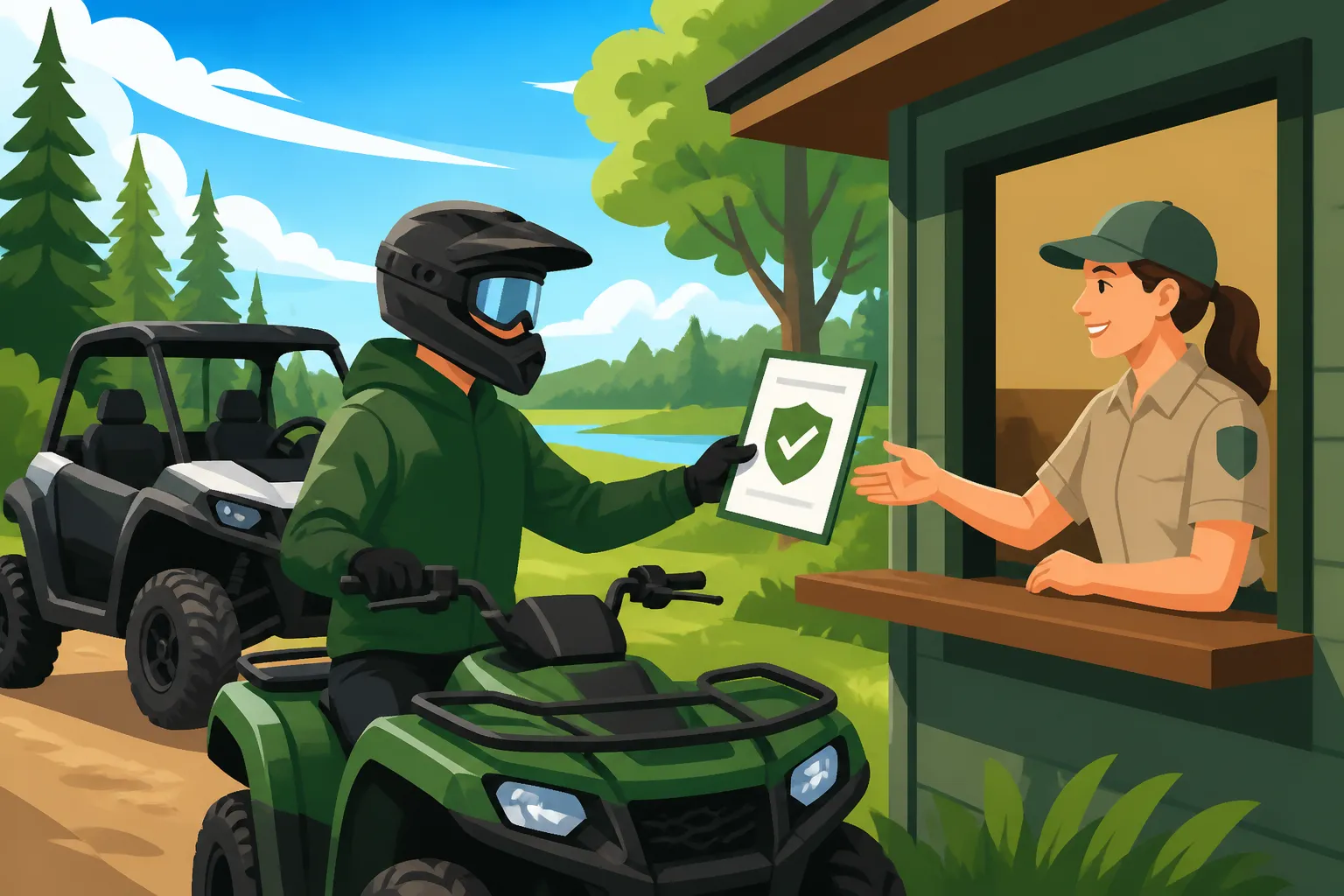
At a park office, staff may be helping with permits, giving trail information, or checking that visitors understand park conditions. If they request insurance proof, present a clear document and be prepared to identify the machine it covers. Answer questions directly. If the name, serial number, or effective dates do not match, explain the discrepancy and contact your insurer rather than guessing.
An office visit is not the only time proof may matter. You could be asked to produce it at a trailhead or during a ride. Keep the document accessible without leaving it loose where it can blow away or get soaked. The practical points in Saskatchewan Insurance Proof on the Trail and Saskatchewan Insurance Shown to a Park Officer apply beyond the permit counter.
If you have only digital proof, show the original insurer-issued file or document rather than a cropped image that hides the policy dates or covered vehicle. A screenshot can be useful as a backup, but it may omit important details or be hard to read. Ask the park office in advance if you need to know whether electronic records are accepted for its process. Carrying a paper copy avoids relying entirely on a device or a cell connection.
If staff cannot verify the coverage from the document you brought, pause and sort it out before riding. Call your insurer or broker, using a contact number you already trust, and ask for a certificate or confirmation that identifies the ATV or UTV and the applicable liability coverage. Do not assume that a bill of sale, a municipal plate, a trail permit, or a registration document from another jurisdiction proves insurance.
If an insurer confirms coverage by phone but cannot send a document immediately, ask what written confirmation it can provide and whether that is sufficient for the park’s requirement. Park staff can explain their process, but they cannot change your policy or decide what your insurer covers.
Common mistakes and a quick pre-ride check
The most common problem is bringing a document that appears official but does not identify the ATV or UTV. Another is carrying a valid policy for the wrong machine, an expired policy, or proof that covers damage to the machine but not the liability protection needed for its operation.
Avoid these assumptions:
- “The machine has a permit, so it must be insured.” A permit and insurance are separate.
- “My truck policy automatically covers the ATV on the trail.” Ask the insurer to confirm coverage for the actual machine and use.
- “The bill of sale is enough.” It can help establish ownership, but it is not insurance proof.
- “A policy for the owner covers every rider.” Confirm who is insured to operate the machine.
- “A phone copy will always be accepted.” Keep a readable backup and check the office’s procedure.
- “The rules are the same at every park.” Check the specific park and trail requirements before you travel.
Before loading up, use this short check:
- The insurance policy is active for the date of the ride.
- The document identifies the machine or clearly links it to the policy.
- The coverage applies to the planned riding and intended operators.
- You have a printed copy and, if useful, a digital backup.
- You have checked the park’s current permit and trail requirements.
- You know how to contact the insurer or broker if staff have a question.
For riders carrying documents on public routes as well as park trails, Carrying Papers on a Grid Road covers the practical value of keeping records accessible. Requirements can differ by location and circumstance, so confirm the park’s instructions and your policy rather than relying on assumptions.
Disclaimer
This article is for general informational purposes only and does not constitute professional advice. Laws, prices and regulations vary by location and change over time. Consult a qualified professional for guidance on your specific situation.