Saskatchewan Has No Adult Safety Course Rule
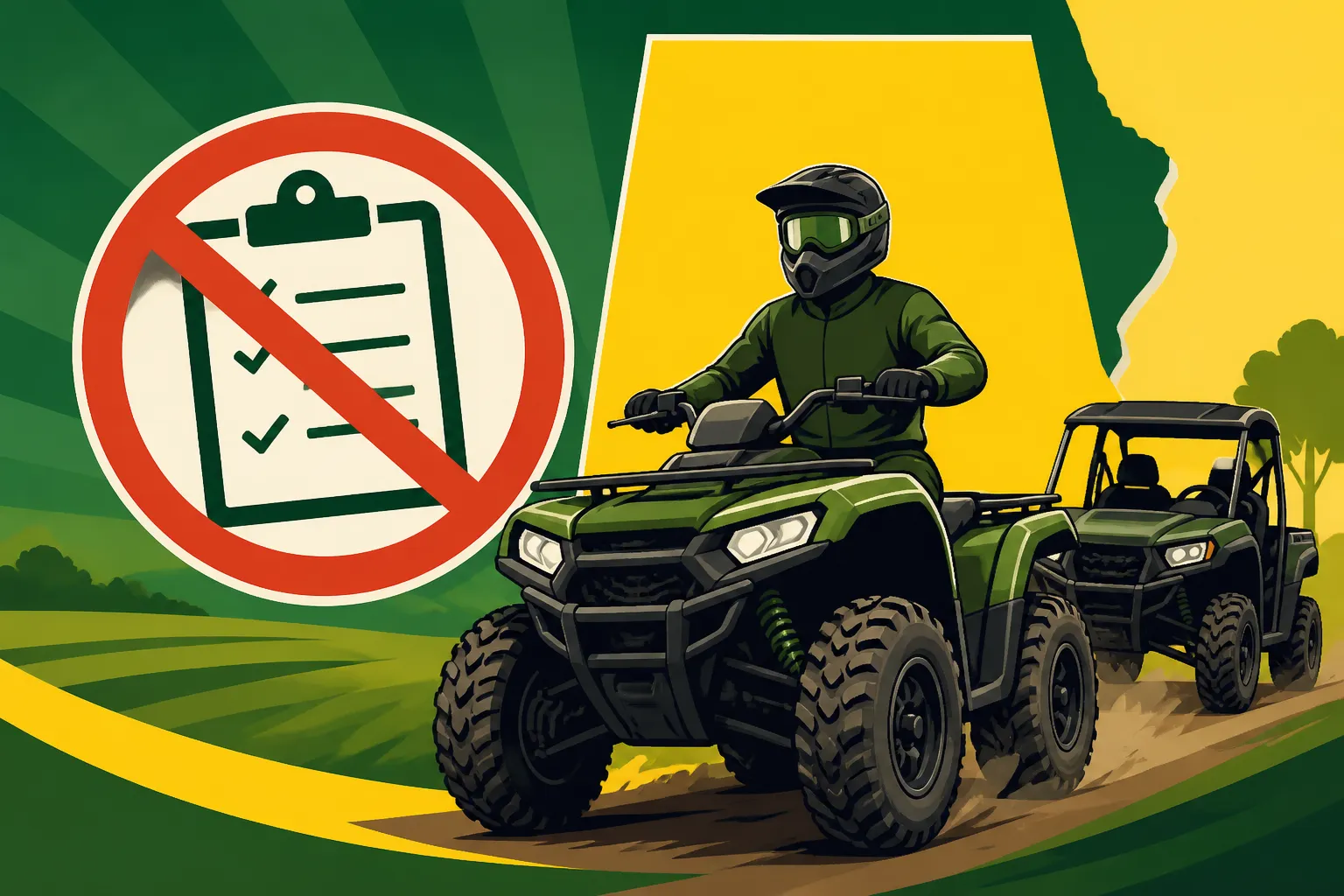
Adults riding an ATV or UTV in Saskatchewan often assume a safety certificate is part of the permit process. It generally isn’t: Saskatchewan does not impose a province-wide ATV safety-course requirement on riders aged 16 and older. The important exceptions and practical limits involve younger riders, particular riding areas, and rules that apply separately to licences, insurance, permits and access.
The short answer: adults do not need an ATV safety certificate
For the province-wide course requirement, the key age line is generally 16 years old. A rider who is 16 or older does not need to complete an ATV safety course simply to operate an ATV under Saskatchewan’s general rules. The same basic answer applies whether the machine is a quad or a side-by-side, subject to the rules that apply to the location and type of use.
That does not mean every rider can ride anywhere, or that an adult is exempt from all other requirements. It means the law does not make an adult ATV safety-course certificate a universal prerequisite. You may still need to meet rules about such things as:
- Your age and, where applicable, driver’s licence.
- Liability insurance and proof of coverage.
- Helmet and eye protection.
- Passengers and machine design.
- Where you ride and whether you have permission.
- Local bylaws, park rules, trail conditions or fire restrictions.
A course can be useful even when it is not mandatory. A new rider can learn how to control a machine on uneven ground, manage hills, use a winch safely and avoid rollover risks. Those are practical skills, not just paperwork. But taking a course voluntarily does not replace a legal requirement that applies to a particular route or rider, and not taking one does not automatically make an adult’s ride unlawful.
There is also a common terminology trap. People use “adult” to mean someone who is 18 or older, but Saskatchewan’s youth-course rules use an age threshold below that. A 16- or 17-year-old may be a minor in other contexts, yet still be on the older side of the ATV course rule. For this specific issue, the useful question is usually whether the rider is under 16, not whether they have reached 18.
A safety certificate is also not a permit. Completing a course does not grant permission to ride on private land, Crown land, a park trail or a road. Similarly, obtaining a local plate or a park trail permit does not prove that a rider has completed a safety course. These are separate questions with separate answers.
For the related age rules and exceptions, see Saskatchewan ATV Age Requirements and Saskatchewan Has No Adult Safety Course Rule. If your main concern is operating on a public road or grid road, check the separate Saskatchewan ATV Road Rules Explained guidance rather than relying on a course certificate to answer a road-use question.
How the under-16 rule differs from the adult rule
The simplest way to understand Saskatchewan’s course rule is to treat it as a youth rule, not as a universal requirement for everyone. Riders under 16 face additional limits. In broad terms, the options for an eligible young rider include being accompanied by a qualified supervisor or completing an approved safety course that meets the applicable requirements.
That distinction matters because people sometimes hear “a safety course is required for ATV riders” and assume it applies to every rider. Others hear “the course is optional” and assume it is optional for a child in every situation. Neither statement is reliable without checking the rider’s age and circumstances.
For a rider who is under 16, check the details before planning a trip:
- Confirm the rider’s age and the kind of machine. Different rules can apply to a child operating a machine and to a child riding as a passenger. A passenger’s age does not automatically make it legal for them to operate.
- Find out which youth option applies. The law may require supervision unless the rider has completed the required approved course. Do not assume that informal instruction from a parent, a certificate from another activity, or an online video counts as course completion.
- Check who qualifies as a supervisor. A supervising adult may need to meet age and driver-licence conditions. Having an adult nearby is not necessarily enough.
- Check the route’s rules separately. A provincial park, municipality, organized trail or landowner may impose additional restrictions.
- Carry the documentation that supports your plan. If a rider is relying on course completion or supervision, know what proof is available and make it accessible.
The details are important for families because a youth may meet one rule and still not meet another. For example, a child might have completed an approved course but be riding in an area with a local restriction. Or a young rider might be accompanied by an adult who does not meet the supervisor requirements. The course rule is only one part of the trip’s legal and safety picture.
Saskatchewan’s youth rules include a specific exception for riders aged 12 and over, and supervision is not simply a matter of having any adult present. The supervisor’s licence history and other qualifications can matter. Review Saskatchewan’s Exception for Riders 12 and Over and Saskatchewan’s 365-Day Supervisor Rule before deciding that a planned escort arrangement is enough.
A qualifying course may provide an alternative to supervision for an eligible young rider, but that does not mean any course will do. The course must meet the applicable approval requirements. Read How a Safety Course Replaces a Supervisor and Which ATV Training Courses the Administrator Has Approved if a youth is planning to rely on certification.
Avoid making a family decision from a general statement like “kids need a course” or “kids can ride with a parent.” Ask what the rule requires for that rider, machine and riding area. The distinction between an approved course, a qualified supervisor and ordinary adult company can determine whether the plan is compliant.
What a safety course does—and does not—prove
A safety course can demonstrate that a rider has completed training. It does not operate as a general licence, registration document or land-access permit. That distinction is useful for adults too: completing a course may help build competence, but it does not give the rider permission to use a trail or road that is otherwise closed to ATVs.
Think of the paperwork as several different categories:
| Item | What it may address | What it does not automatically provide |
|---|---|---|
| Safety-course certificate | Training or a youth-rule requirement, where applicable | Permission to use a particular trail, road or property |
| Driver’s licence | A licensing rule that applies to the rider or type of operation | ATV registration or landowner consent |
| Proof of insurance | Evidence of coverage when required or requested | Permission to ride or proof of course completion |
| Municipal plate or local permit | Compliance with a local scheme in the area it covers | A province-wide ATV registration or a safety certificate |
| Park or trail permit | Permission or compliance for a specified recreation area | A general right to ride elsewhere |
The exact documents you need depend on what you are doing. An adult using a private trail with the landowner’s consent may face a different set of requirements from someone riding a municipal road, a park trail or Crown land. A course certificate is not a substitute for checking the applicable rules.
If you are taking a course voluntarily, ask the provider what the course covers and what documentation you receive. A useful course should explain the practical risks of ATV operation, not just provide a card. Look for instruction that matches the type of riding you expect to do, whether that means family trail riding, farm work, a side-by-side, or a machine used in rough bush conditions.
Do not assume an online completion badge is equivalent to a recognized course. Before paying for training that a young rider intends to use to satisfy a legal requirement, confirm that the course is approved for that purpose and that the certificate will be accepted. A course marketed as “ATV safety” may be educational without meeting a specific legal approval standard.
For adults, the decision to take training is usually a practical one. Consider it if you are new to ATVs, moving from a smaller machine to a heavier side-by-side, returning after a long break, or riding with children. A course can also help experienced riders refresh habits that become less careful over time, such as checking terrain before climbing, slowing down on unfamiliar trails and keeping passengers within the machine’s design limits.
Permits, plates and insurance are separate from training
The word “permit” can mean several different things in Saskatchewan, which is one reason riders get conflicting answers about courses. There is no general province-wide ATV registration system that supplies an ATV plate as proof of a rider’s training. Some municipalities operate local plate schemes, while particular parks and trails may have their own permit processes. Those local requirements do not turn into a province-wide safety-course rule for adults.
A local plate is not a certificate. A trail permit is not a driver’s licence. An insurance slip is not evidence that a rider has completed a course. Keep the documents conceptually separate and check each requirement for the trip you are planning.
For a local plate scheme, confirm which machines and locations it covers, whether visitors are included, and whether the plate has to be displayed in a particular way. A plate issued by one municipality should not be treated as a general pass for every Saskatchewan road or riding area. Start with Saskatchewan Municipal ATV Plates Explained and check the local authority’s current rules before travelling.
For park riding, a permit or use form may be required even though an adult safety certificate is not. Park rules can also cover designated trails, insurance proof, rider supervision and equipment. A general statement about the adult course rule does not override those site-specific conditions. For details, see Saskatchewan Permit Rules at Moose Mountain or Saskatchewan Parks That Need No Permit as appropriate to your destination.
Insurance is another separate matter. Riders should confirm what liability coverage is required for their use and understand what their policy covers. Some locations or activities may require proof of insurance, and a park officer or other official may ask to see it. The absence of an adult course requirement does not remove an insurance obligation. See Saskatchewan ATV Insurance Requirements for the broader insurance question.
If you are riding on or near a road, do not assume a course certificate gives you road access. Road use, highway crossings and ditch riding have their own rules, and municipalities can have bylaws that permit or prohibit particular uses. Check Saskatchewan Municipalities With ATV Bylaws and the local rules for the route. If your trip includes Crown land, private property or a grazing lease, permission and land-access rules are another separate layer.
A useful planning habit is to make a short checklist for the exact ride rather than asking only, “Do I need a permit?” Include the rider’s age, machine type, route, land permission, any local plate scheme, insurance, required protective equipment and any youth-course or supervision condition. This avoids the common mistake of treating one piece of paperwork as if it answers every question.
Visitors and reciprocity: do not assume a course card travels everywhere
Visitors from another province or country often want to know whether their home-region training card will be accepted in Saskatchewan. For an adult, the first point is straightforward: Saskatchewan does not impose a general adult ATV safety-course requirement that a visitor must satisfy just to ride. That does not mean every aspect of a visitor’s ride is automatically covered by home-province rules.
There are several different questions hidden inside “Does Saskatchewan recognize my course?”
- Is the rider required to have completed training under Saskatchewan law?
- Is the rider relying on a course to meet a youth requirement?
- Does the riding area have its own training, permit or supervision condition?
- Does the visitor’s home jurisdiction require a certificate for a machine registered or used there?
- Is the rider operating on a road, trail, park or private property?
For adults, a course from another jurisdiction is generally training documentation, not a Saskatchewan permit. There is no reason to treat it as a universal pass for riding locations. If the rider is under 16 and intends to rely on training instead of supervision, do not assume a course from elsewhere qualifies automatically. Check the current Saskatchewan approval and acceptance requirements before setting out.
Visitors also need to distinguish training reciprocity from vehicle reciprocity. Saskatchewan’s approach to ATV registration differs from places that require provincial vehicle registration or a plate. A home-jurisdiction plate or registration document does not necessarily create permission to ride on a Saskatchewan road, trail or municipal area. Likewise, a Saskatchewan local plate scheme is not a substitute for documents required by the visitor’s home jurisdiction.
For visitors, a sensible pre-trip check is:
- Confirm the rider’s age and whether the youth rule applies.
- If a young rider relies on a certificate, verify that the course is accepted for that purpose.
- Check the specific destination’s permit and access rules.
- Confirm insurance coverage applies in Saskatchewan and for the intended activity.
- Check road, crossing and local-bylaw rules for the route.
- Carry identification and relevant proof of insurance or training where appropriate.
A visitor should also avoid relying on the idea that “my home province lets me do this.” Saskatchewan rules govern conduct in Saskatchewan, while home-jurisdiction rules may still matter for the machine or the rider’s coverage. Ask the insurer and the relevant local or park authority about any point that depends on the visitor’s status.
The same caution applies in reverse when a Saskatchewan rider visits another jurisdiction. Saskatchewan’s lack of a universal adult course requirement does not mean the destination has the same rule. Check local requirements before hauling the machine across a border.
Taking a course voluntarily: when it is worthwhile
Even when adults do not have to take an ATV safety course, training can be a good investment in skill and confidence. The best reason to take one is not to collect a card; it is to improve decisions that matter when the ground changes, visibility drops or a passenger is relying on you.
Training is especially worth considering if you are:
- A first-time rider or new to a more powerful machine.
- Switching from a quad to a side-by-side, or the other way around.
- Riding with children or less experienced passengers.
- Planning to operate on unfamiliar trails, hills, sand or muskeg.
- Using an ATV for work, where fatigue and repeated trips can increase risk.
- Returning to riding after an injury or a long break.
A useful course should cover more than starting and stopping. Ask whether it includes hands-on practice, terrain assessment, hill technique, braking, turning, safe passenger practices, loading and unloading, and what to do when a machine becomes stuck or begins to tip. The right content depends on your riding plans; a short introductory session may not prepare you for every challenge in remote terrain.
Equipment is part of safe riding, but buying protective gear does not replace instruction. When shopping for a helmet, make sure it is designed for the activity and has a clear compliance label, rather than relying on a vague product description. Listings on Amazon can make it easy to compare options, but the seller’s wording is not a substitute for checking the actual helmet label and fit.
The same care applies to goggles and other protective equipment. A product photo or customer review is not proof that an item meets the relevant standard. If you compare gear on Amazon, verify the model and certification information from the manufacturer, check that the product is appropriate for ATV use, and choose equipment that fits securely. For helmets especially, fit and condition matter: a helmet that is loose, damaged or past its useful life may not protect as intended.
Training can also help riders understand the limits of their machines. A side-by-side with seat belts and a cab is not automatically safe in every rollover situation; a quad’s handling can change substantially with a load, a passenger or an attachment. Learn what your owner’s manual says about passenger capacity, towing, maintenance and safe operating conditions.
An adult who completes training should still follow the same basic planning routine as an untrained rider: check land access, inspect the machine, carry required documents, tell someone the route and expected return, and ride within personal ability. A certificate is a useful record, not a promise that a ride will be safe.
A practical way to check your situation before riding
If you are unsure whether a course is required, work through the decision in this order. It keeps the age question from getting tangled up with plates, permits and route rules.
- Identify the rider’s age. If the rider is 16 or older, a province-wide adult course requirement generally is not the issue. If the rider is under 16, check the youth rule and the applicable supervision or approved-course option.
- Identify the activity. Operating a machine, riding as a passenger, crossing a road and riding on a designated trail can trigger different considerations. Do not use a rule for one activity to answer another.
- Identify the location. Write down the municipality, park, trail, private property, Crown land area or road involved. Local rules and land permission can change the answer.
- Check the permit or plate requirement for that location. Find out whether the area has a local plate scheme, park permit, event permission or other condition. Do not infer that a permit proves training.
- Check the rider’s other obligations. Confirm any driver-licence requirement, insurance, helmet, eye protection, lighting, passenger or road-use rules that apply.
- Verify youth documentation in advance. If a young rider relies on a safety certificate, confirm the course is approved for that purpose and ask what proof to carry. If relying on a supervisor, confirm that person meets the qualification requirements.
- Recheck shortly before the trip. Local bylaws, closures, fire restrictions and park conditions can change. A course certificate does not override a temporary closure or an access restriction.
If you are organizing a group ride, communicate the distinction clearly. Adults do not need a course certificate simply because they are joining a group, unless a specific organizer, landowner, event permit or riding area imposes its own condition. The organizer should explain any such condition in advance and not describe it as a universal provincial rule.
For parents, it is worth writing down the plan for each young rider: the rider’s age, whether the course or supervision route applies, who is supervising, and where the group will ride. Make sure the child understands that a course does not make every trail legal, and that a parent’s presence does not automatically satisfy every supervision requirement.
The safest plain-language answer is this: Saskatchewan does not set a general ATV safety-course requirement for riders aged 16 and older, but that answer does not replace checking youth rules, local permits, road rules, insurance or access permission. If a requirement turns on a specific course, site or youth exception, confirm the current rule with the responsible authority before the ride.
Disclaimer
This article is for general informational purposes only and does not constitute professional advice. Laws, prices and regulations vary by location and change over time. Consult a qualified professional for guidance on your specific situation.