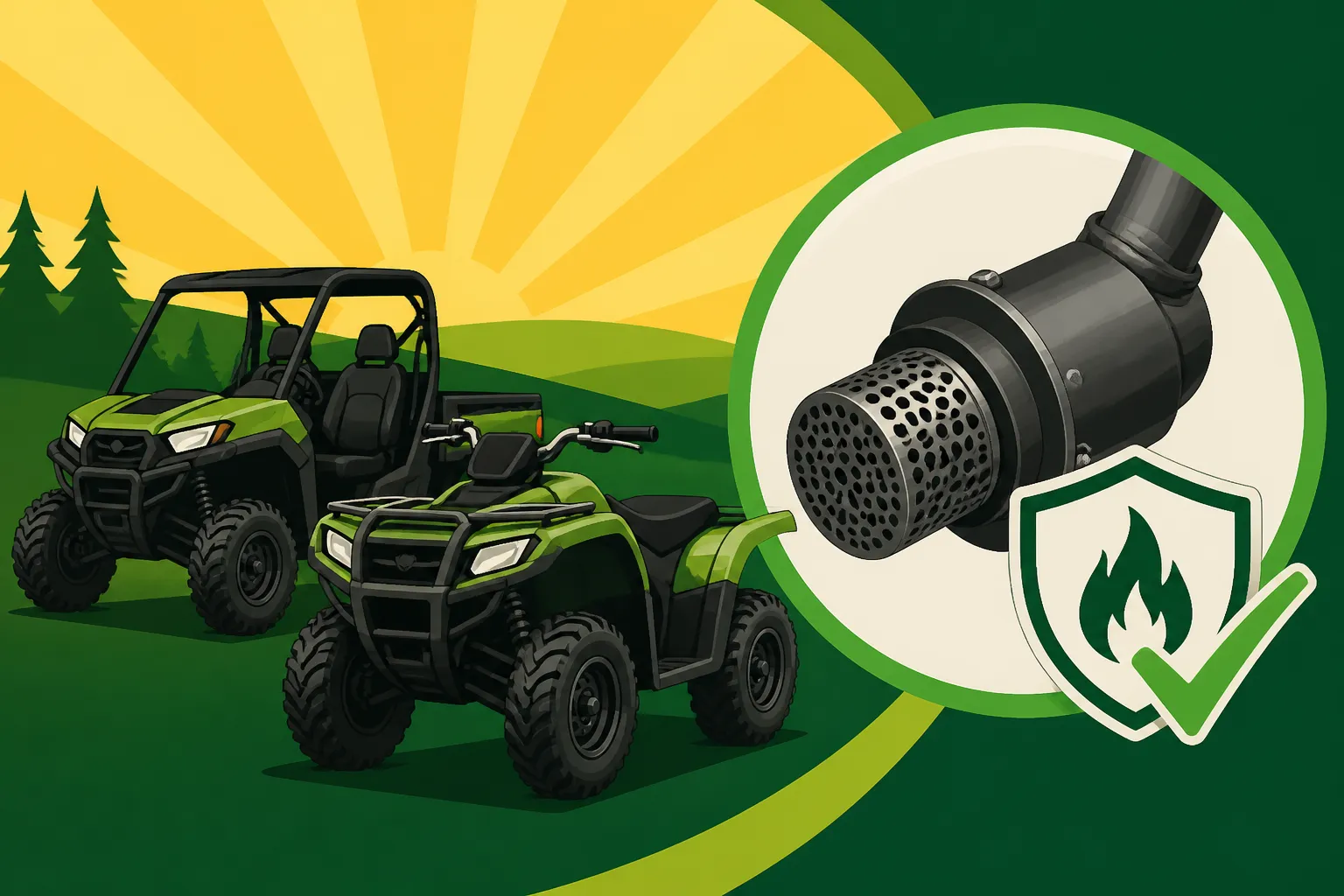
Saskatchewan Spark Arrestor Guidance
A spark arrestor is easy to overlook until you’re planning a ride through wooded or dry country. In Saskatchewan, it matters for more than equipment compliance: a hot exhaust or loose debris can start a wildfire. This guide explains what a spark arrestor does, how to check the one on your ATV or UTV, and what to confirm before riding.
What a spark arrestor does and why riders should care
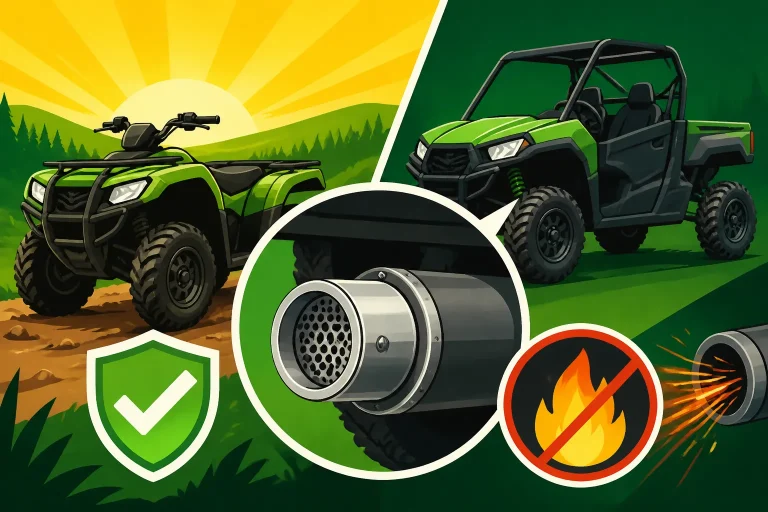
A spark arrestor is a device in an engine’s exhaust system that helps prevent hot particles from leaving the exhaust and igniting dry grass, leaves, needles or other combustible material. Depending on the machine, it may be built into the muffler or fitted as a separate component. It is not the same thing as a muffler: the muffler reduces exhaust noise, while the spark arrestor is intended to reduce the risk of sparks or burning particles escaping.
ATVs and UTVs often travel through places where a small ignition can become a serious fire. Dry vegetation can collect around a trail, and a machine may be running close to grass, brush or forest litter. A hot exhaust system can also contact vegetation if a rider leaves an established route or stops in tall grass. A spark arrestor is one part of fire prevention, not a guarantee that a machine cannot start a fire.
Saskatchewan has fire-prevention rules and restrictions that can apply to equipment and activities in forested areas. The rules may depend on where you are riding, what you are doing, and any current fire orders or closures. Do not assume that owning a spark arrestor automatically makes every ride lawful, or that a machine is exempt because it is privately owned or used for recreation. Check current requirements for your route and the land you will enter. For wider seasonal context, see Saskatchewan Wildfire Season Rules for Riders.
It helps to separate three related questions:
- Does the machine have a spark arrestor? Check the exhaust system and the owner’s manual, rather than relying on appearance alone.
- Is the spark arrestor in working condition? A damaged, missing or badly clogged component may not do its job.
- Is riding allowed at this place and time? A fire ban, land closure, park rule or local order can restrict riding even when the machine is properly equipped.
The distinction matters for both Saskatchewan residents and visitors. A permit or plate from another place does not establish that your exhaust equipment meets Saskatchewan requirements. Likewise, a spark arrestor does not replace permission to access land or compliance with a fire restriction. Before travelling, review Saskatchewan Crown Land Access Rules and the rules for the specific park, trail or municipality you intend to use.
What Saskatchewan riders should verify before riding
There is no sensible one-line answer that covers every ATV, UTV, riding area and fire condition. A machine’s design, the land classification, the activity and any current restrictions can all matter. The safest approach is to check the machine first, then confirm the rules for the location.
Start with current local requirements
Saskatchewan fire rules can impose equipment and fire-prevention obligations, and restrictions can change with conditions. Before a trip, check current official information for the riding area. If you are heading to a provincial park, ask the park office about its machine and fire rules. If the route crosses Crown land, check the applicable land-management information and any orders. A club trail or municipal riding area may also have its own operating conditions.
A general page about fire season can help you understand the framework, but it is not a substitute for a current closure notice. Check whether restrictions apply to the exact area and activity, and whether there are conditions related to engine equipment, travel routes, campfires or other sources of ignition. Use Checking a Fire Ban From Your Phone at the Trailhead as a reminder to verify conditions before unloading, not after you have already started riding.
When requirements are unclear, ask the responsible office or land manager a specific question: “Does this area require my ATV or UTV to have a spark arrestor, and what equipment standard or proof do you expect?” This is more useful than asking only whether the trail is open. A trail may be open while still subject to equipment or fire-safety conditions.
Confirm that your machine’s exhaust equipment is original or suitable
Many machines leave the factory with an exhaust system designed for normal operation, but do not assume that every stock muffler automatically satisfies every rule in every setting. Check the owner’s manual and manufacturer documentation for a statement about a spark arrestor or approved exhaust configuration. If the exhaust has been changed, ask the exhaust or machine manufacturer whether the replacement retains the required function.
The same caution applies to aftermarket silencers, exhaust tips, replacement mufflers and modified systems. A part that fits physically may not provide spark-arresting protection. A decorative screen or generic mesh inserted into an exhaust should not be treated as equivalent to a suitable spark arrestor unless the manufacturer or applicable authority confirms that it is appropriate.
If you bought the machine used, ask whether the exhaust system is stock and whether any components were removed. Inspect for signs of modification, missing fasteners or a cut or altered muffler. A seller’s assurance that “it passed inspection” may not answer the question if you do not know what was checked, when it was checked or where you plan to ride.
Treat a closure as a closure
A spark arrestor is not a permission slip. During hazardous conditions, authorities or land managers may restrict access or activities to reduce ignition risk. If a trail or area is closed, do not ride there because your machine has the right equipment. If the area is open with special conditions, follow those conditions and confirm that your machine qualifies.
This is particularly important for riders who cross between different types of land in one outing. A route can pass from a municipal area to a trail network or Crown land, and the conditions may not be identical. Before you go, identify who manages each part of the route and where to check for changes. Saskatchewan Park Regulations for Machines can help you distinguish park-specific rules from general riding practices.
| Situation | What to check | Practical next step |
|---|---|---|
| Stock ATV or UTV exhaust | Manual or manufacturer information confirming the exhaust configuration | Keep the manual or a digital copy available |
| Modified or replacement exhaust | Whether the system retains a suitable spark-arresting function | Ask the exhaust manufacturer or a qualified dealer |
| Riding in forested or dry areas | Current equipment rules, fire restrictions and area closures | Check official notices before unloading |
| Trail crossing several land types | Rules and restrictions for each section | Confirm with the relevant land manager or municipality |
| Spark arrestor recently serviced | Correct installation, secure fasteners and unobstructed condition | Recheck before the next ride |
How to inspect an ATV or UTV spark arrestor
A quick look at the tail end of the exhaust is not always enough. Some spark arrestors are internal, and some parts are difficult to identify without the manual. Use the manufacturer’s procedure, and let the exhaust cool completely before handling or opening anything.
Identify the component before taking anything apart
Find the owner’s manual for the exact make, model and year. Look for sections on the exhaust system, spark arrestor maintenance, cleaning, inspection or service intervals. The manual can tell you whether the arrestor is integrated into the muffler, accessed through a service plug, or handled another way. If you do not have the printed manual, check whether the manufacturer provides a digital version.
Do not confuse an exhaust outlet screen with proof that the machine has a compliant spark arrestor. A screen can serve a different purpose, and the arrestor may be inside the muffler. Conversely, a machine may have a removable arrestor that is not visible from the outside. If you cannot tell what is installed, ask a qualified ATV or UTV technician to identify it.
This is also a good time to check whether the exhaust system is original. Look for a manufacturer label, part number or records from previous repairs. If the system has been replaced, identify the exact replacement part. A receipt showing that an exhaust was purchased is not evidence by itself that the component meets the requirements for a particular riding area.
Check for damage, looseness and blockage
Once the machine is cool and parked safely, inspect what the manual says you can inspect. Look for a missing service plug or screen, cracked parts, loose hardware, corrosion, an obvious gap between exhaust components, or signs that someone has drilled, cut or altered the system. Check that any service cover or fastener is correctly installed after maintenance.
A blocked arrestor can affect engine performance and may cause the machine to run poorly. Carbon and other deposits can build up, especially if the machine is used heavily, runs for long periods at low speeds, or does not receive the maintenance specified by its manufacturer. Follow the manual’s cleaning instructions. Do not use an improvised method that could damage the screen or allow parts to fall into the exhaust.
If a component is damaged, missing or uncertain, do not treat the machine as ready for a fire-sensitive ride. Have it inspected or repaired before heading out. A poor repair can create a second problem by allowing hot exhaust to escape where it should not. Never run the engine indoors while inspecting or servicing the exhaust.
Recheck after exhaust work
Any time the muffler or exhaust system is removed, repaired or replaced, verify that the spark arrestor is back in place and installed as designed. This sounds obvious, but service work can leave a small component on a bench or reinstall it incorrectly. Ask the shop what was done and whether the arrestor was checked. Keep the service record with your machine paperwork.
A recently installed aftermarket exhaust deserves particular attention. Confirm that the manufacturer describes the specific part as having a spark arrestor or as compatible with the applicable requirement. Do not infer this from a product photo, a general statement that the exhaust is “off-road,” or a seller’s short listing. If the part’s status is unclear, get confirmation from the manufacturer or the relevant authority before riding in an area where the requirement applies.
An online marketplace such as Amazon may have replacement exhaust parts, screens or accessories, but a listing’s fitment claims do not settle whether the component is suitable for your machine or your destination. Match the part to the exact model and year, confirm that it is designed for the intended exhaust system, and check the manufacturer’s documentation. If there is no dependable documentation, a qualified dealer or repair shop is a better place to start.
Buying or replacing a spark arrestor
A replacement part is not just a matter of finding something that fits the outlet. The part needs to work with the exhaust system, match the machine and satisfy the requirements that apply where you ride. Buying the wrong screen can waste money, reduce performance or leave you uncertain about compliance.
Match the part to the machine
Before ordering, write down the machine’s make, model, year and, if available, the exhaust system’s part number. Confirm whether the arrestor is a separate service item or integrated into a muffler. For a used machine or a modified exhaust, identify the system currently installed rather than ordering based only on the original factory configuration.
Ask the manufacturer or a qualified dealer these questions:
- Is this component intended for my exact machine and exhaust system?
- Does the exhaust retain a spark-arresting function when this part is installed?
- Is there a specific maintenance or cleaning procedure?
- Does replacement require a new gasket, seal or other hardware?
- Is there documentation I can keep with the machine?
Those questions help avoid relying on vague descriptions such as “universal,” “screened” or “spark arrestor style.” A universal part may require modification, and modification can create a poor fit or alter the exhaust in an unintended way. Avoid cutting, drilling or forcing parts into place unless the manufacturer’s instructions specifically call for it.
Amazon can be useful for comparing parts and locating manuals or small maintenance items, but treat marketplace listings as a starting point, not a compliance decision. Check the seller’s fitment details and the manufacturer’s product documentation. If the listing does not identify a recognized manufacturer, a clear part number or the exact compatible models, verify the details before buying.
Be cautious with aftermarket exhaust systems
A louder or higher-flow exhaust may change more than the sound of the machine. It can affect emissions, performance, noise, engine tuning and whether a spark-arresting component remains installed. Before changing an exhaust, consider the riding areas you use and whether the modified system will meet their rules. If the answer is uncertain, do not assume you can solve the issue by adding a generic screen later.
Keep the original exhaust components if you replace them, along with receipts and installation information. That record can help a technician identify what was changed and may make it easier to restore the machine to its original setup. It can also help when selling the machine, because a buyer may reasonably ask about modifications and equipment.
If your priority is dependable trail use, keeping a manufacturer-approved configuration is often the straightforward choice. An aftermarket part may be appropriate, but it should come with clear compatibility information and be installed as directed. A bargain component with unclear specifications may be false economy if you cannot confirm that it performs the function you need.
Store useful records
Keep a copy of the owner’s manual, part information and service receipts in a place you can access. That might be a folder with your machine documents or a digital copy on your phone. These records are not a substitute for an official approval where one is required, but they help you answer practical questions about what is installed and how it is maintained.
If you ride in a managed area, ask whether staff expect a particular label, proof or inspection. Do not assume they will accept an online order confirmation as proof that a component is appropriate. A clear manufacturer document or service record is more useful.
Fire prevention goes beyond the arrestor
A spark arrestor reduces one source of risk. It does not prevent every fire, and it cannot make careless riding safe. Hot exhaust parts, engine components and brakes can ignite dry material even if no sparks escape. Fire prevention is a combination of equipment, route choices, maintenance and attention to conditions.
Before riding, remove dry grass, leaves and other debris that may have collected around the engine, exhaust, skid plate or underbody. Pay close attention after riding through long grass or brush. Debris trapped against a hot part can smoulder after the machine is parked. Let the machine cool in a clear area, not on dry vegetation.
During a ride:
- Stay on permitted routes and avoid driving through dry grass or brush unnecessarily.
- Do not park over dry vegetation, especially while the engine or exhaust is hot.
- Watch for unusual smells, smoke, hot debris or exhaust damage.
- Stop safely if you suspect the machine is overheating or shedding hot material.
- Carry appropriate fire-suppression equipment when the route and conditions call for it.
- Follow any fire ban, closure, posted condition or instruction from land managers.
The exact equipment you carry may depend on the ride, the machine and the applicable rules. A spark arrestor should not lead you to leave out basic precautions. Review Fire Suppression Gear on a Machine and Carrying a Shovel and an Extinguisher on Board when preparing for a remote or fire-sensitive ride.
Pay attention to changing conditions as well as posted notices. Wind, dry vegetation and a recent period without moisture can increase the consequences of a small ignition. If a route feels too risky, change the plan. A day’s ride is not worth creating a fire that threatens people, property, wildlife or the riding area.
Combustible material can also build up while you are out. A machine that was clean at the trailhead may collect grass or brush after a few kilometres. Make checks part of natural stops, particularly after travelling through tall vegetation or rough ground. Your Legal Duty to Check for Combustible Debris covers why those checks matter. A quick inspection is especially sensible before loading the machine onto a trailer, when debris can be harder to see and may remain against hot parts.
If you see smoke, flames or signs of a fire, stop riding and respond safely. Do not put yourself in danger trying to fight a fire that is spreading or beyond your ability to control. Contact emergency services or the appropriate authority and provide clear location details. Avoid driving through smoke or across a fire line, and follow directions from responders.
Common mistakes to avoid
The most frequent spark-arrestor mistakes are not complicated; they come from assuming that one visible feature answers every question.
Assuming every stock exhaust is enough
A stock system is a good place to start, but check the manual and current local requirements. A previous owner may have modified it, or a small part may have been removed during service. Confirm what is actually on the machine.
Treating a screen as proof
A mesh screen at the outlet may not be the appropriate arrestor for the machine. It may be a different component, may not be secured properly or may not meet the relevant specification. Identify the part by its documentation, not appearance alone.
Ignoring service after a repair
An exhaust system that worked before service may not be correctly reassembled afterward. Check that the appropriate components are present and secure. Ask the repair shop what was removed and reinstalled, especially if the work involved the muffler or exhaust outlet.
Believing equipment overrides a closure
A compliant machine still cannot be ridden in a closed area. Fire restrictions and access rules may apply independently of your equipment. Check both before travel, and do not rely on an old map, last year’s route notes or a friend’s memory.
Relying on a vague online description
Marketplace descriptions can be incomplete or written for a broad range of machines. Search results from Amazon or another seller do not confirm that a part fits your particular exhaust or satisfies an area-specific rule. Verify the exact part number and obtain manufacturer information.
Forgetting other fire hazards
The exhaust is only one potential ignition source. Debris around hot components, careless parking, riding through dry vegetation and ignoring fire conditions can all create risk. Keep the machine clean, ride thoughtfully and be ready to change your plans.
For a trailhead inspection perspective, What a Park Officer Checks at a Trailhead can help you think beyond one exhaust component. If you are unsure which office to contact, ask the park, municipality, club or land manager responsible for the route rather than assuming one organization covers the entire area.
A practical pre-ride checklist
Use this checklist when preparing an ATV or UTV for a Saskatchewan ride. It is not a substitute for official rules or the machine manual, but it gives you a useful routine.
- Identify the route and land manager. Know whether you will be on a park trail, municipal land, Crown land, private property or more than one type of land.
- Check current fire information. Look for restrictions, closures and equipment conditions that apply to the exact area.
- Confirm the exhaust setup. Use the manual or manufacturer information to identify the spark arrestor and its correct configuration.
- Inspect the exhaust while cool. Look for damage, missing parts, loose fasteners, unauthorized changes and signs of blockage.
- Check after recent service. Make sure the system was reassembled correctly and the appropriate components are installed.
- Remove combustible debris. Clear dry grass, leaves and brush from around the exhaust and underbody.
- Carry sensible safety gear. Bring equipment suitable for the length and remoteness of the ride, and make sure you know how to use it.
- Keep records available. Have the manual, service information and part details accessible if you need to confirm what is installed.
- Reassess conditions during the day. If fire conditions worsen or a closure takes effect, stop and follow the new direction.
For riders visiting Saskatchewan, the same checks apply even if the machine is registered or insured elsewhere. Do not assume that a home-province plate or permit answers questions about equipment, land access or local fire restrictions. Confirm the route and its rules before setting out, and contact the relevant authority if a spark-arrestor requirement is unclear.
The practical standard is simple: know what is fitted to your machine, keep it in good condition, and check the rules where you plan to ride. If you cannot verify that the exhaust arrangement is suitable, or if the area’s current requirements are unclear, postpone that ride until you have an answer. That small bit of preparation protects the trail, the land and everyone who depends on it.
Disclaimer
This article is for general informational purposes only and does not constitute professional advice. Laws, prices and regulations vary by location and change over time. Consult a qualified professional for guidance on your specific situation.