Where to Stage a Big Group at Narrow Hills
A large ATV group can reach Narrow Hills Provincial Park only to discover that the chosen pull-off is too small for trailers, the group is blocking other visitors, or phone service has faded before anyone has checked the route. This guide explains how to choose a practical meeting point, organize arrivals, handle permits and maps, and keep a big ride manageable from the trailhead onward.
Choose a staging point that fits the whole convoy
Confirm the official access point before you leave
For a large group, the best staging point is not simply the first wide spot someone remembers. It needs to work for the entire convoy: tow vehicles, trailers, machines, riders getting ready, and other park visitors who may be arriving at the same time. Before travelling, contact the park office or check the latest park information to confirm which access and parking areas are appropriate for ATV staging. Do not assume that a roadside pull-off, campground entrance, or trail junction is meant for a group gathering.
Narrow Hills has designated ATV trails, so plan to unload and begin riding from a permitted access area rather than creating a new route from a convenient parking spot. The trail network is often described as having about 50 kilometres of riding, but trail access, closures, and local instructions can affect what is usable for your visit. For background on the network, see Narrow Hills’ 50 Kilometres in Saskatchewan.
When you call or check park information, ask practical questions rather than just asking where to ride: Can a group with several trailers park there? Is there enough room to turn around without backing through traffic? Are there designated unloading areas? Are there current restrictions, construction, or other conditions that affect access? A quick confirmation can save a long drive with a trailer only to find that the intended spot is unsuitable.
Evaluate space for trailers, people, and moving machines
A staging area needs room for more than the parked vehicles. Riders will be unloading, checking helmets, securing loose gear, and moving machines between trailers and the trail entrance. If everyone gathers in the same narrow space, even a spot that looks large from the road can become congested quickly. Use Saskatchewan Trailheads With Trailer Parking as a reminder to check trailer suitability specifically, rather than treating ordinary vehicle parking as proof that a location can handle a convoy.
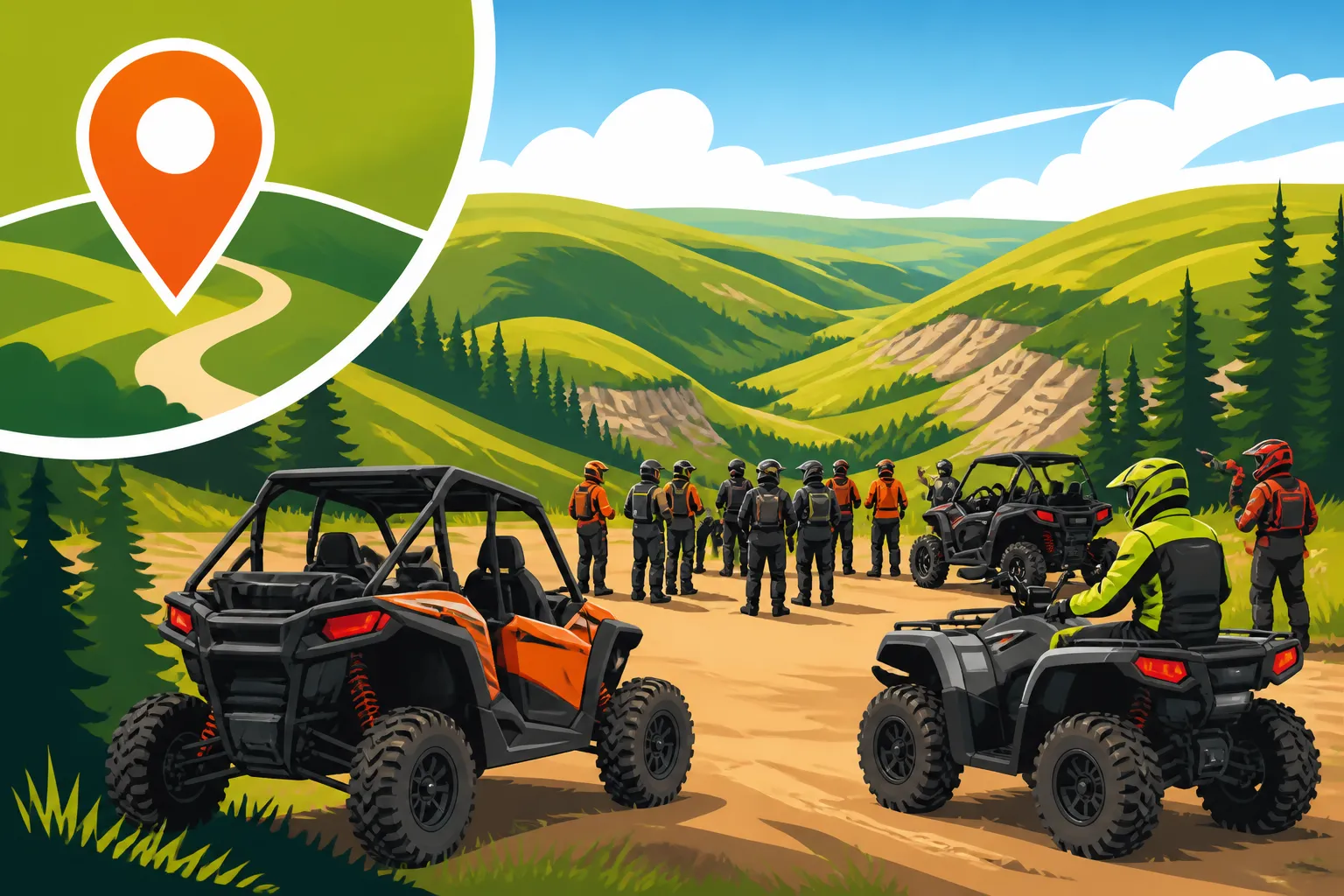
Think through the physical layout before you commit. Can a truck and trailer enter and leave without crossing the path of riders unloading? Can late arrivals park without forcing everyone else to move? Is there a safe place for the group leader to give a short briefing away from traffic? If the answer to several of these questions is no, split the group into smaller arrival waves or choose another confirmed location.
Also leave space for visitors who are not part of your ride. A public access area is not a private staging lot, and a large group can unintentionally take over the available room. Keep vehicles within marked parking areas, avoid blocking gates or signs, and do not extend parking onto vegetation or trail edges. If the space is already filling when you arrive, regroup in a suitable place outside the busy access area instead of squeezing more trailers into it.
| Staging need | What to check before travelling | A practical group plan |
|---|---|---|
| Trailer parking | Whether the confirmed access area can accommodate your trailer count | Ask participants to share approximate vehicle and trailer numbers |
| Unloading space | Whether machines can be unloaded without blocking traffic or trails | Unload in a controlled order and keep a clear path through the area |
| Late arrivals | Whether someone can arrive after the main group without causing disruption | Set a latest arrival time and a separate meeting procedure |
| Briefing space | Whether the group can gather safely away from moving vehicles | Keep the briefing short and out of the travel lane |
| Cell coverage | Whether riders can communicate at the meeting point and along the route | Set a no-signal plan before leaving home |
| Park requirements | Current permit, acknowledgement, and trail-use instructions | Assign one person to confirm requirements for everyone |
Organize arrivals before the first machine comes off a trailer
Give everyone one clear meeting plan
Big-group confusion often starts with vague directions: “Meet near the lake,” “look for the trail,” or “park where there’s room.” Those instructions may work for two friends, but they are frustrating when several vehicles are arriving from different roads and some riders have never visited Narrow Hills. Send one agreed meeting location, a backup plan, and a time window well before the ride. Include the name of the confirmed access point, not just a pin or a description that could refer to several places.
Use Saskatchewan Group Ride Planning to build a simple plan for the day. Name a ride leader and a sweep rider, decide who will check that everyone has arrived, and share the route or intended loop before departure. If the group is large, divide riders into smaller pods with their own lead and tail riders. That makes it easier to keep track of people at intersections and reduces the chance that one long line becomes separated.
Tell participants what to do if they are late or cannot find the group. For example, set a point at which late arrivals should wait or turn back rather than driving around the park looking for machines. Make it clear that no one should ride off alone to search for a missing vehicle. A written plan is especially useful if phone service is weak or the group’s messaging app stops updating.
Set arrival waves and a staging routine
A group that arrives all at once can jam a small parking area. If participants are travelling from different directions, assign arrival waves and ask each driver to park as directed when they arrive. Have one organizer greet vehicles and point them toward available spaces. Avoid leaving people to make last-minute parking decisions while trucks and trailers are moving through the same area.
Once parked, use a consistent unloading routine. Drivers can secure tow vehicles and trailers first, then riders can unload machines in an agreed sequence. Keep keys, helmets, and paperwork organized, and remind riders to stay clear of moving trailers. A brief safety and route briefing is useful; a long discussion beside a busy access lane is not. If the group needs more time to get ready, complete some preparation at home so the staging area does not become a workshop.
Plan what happens if the staging point is full. The backup should be a verified, legal place to wait, not an improvised turnout or a nearby private driveway. Make sure everyone knows that the group may delay departure or reduce its size if the parking arrangement cannot safely accommodate the convoy. That can feel inconvenient after a long haul, but it is better than blocking access or forcing vehicles into unsafe positions.
Prepare permits, maps, and a route everyone can follow
Check park requirements before the ride
Do not assume that having an ATV and insurance is all the group needs. Confirm the park’s current trail-use process before you travel, including whether a permit, acknowledgement form, or information session is required. Procedures can vary by riding area and may change, so have one organizer verify the details directly rather than relying on what someone remembers from a previous season. The articles Saskatchewan Park Use Acknowledgement Forms and Signing the ATV Use Acknowledgement Form First can help you identify the kind of preparation to ask about.
Make sure each participant understands what they need to carry or show if asked. Riders should not assume that one person’s paperwork covers the entire group. Check insurance requirements and keep proof accessible, along with emergency contacts and any information the park requires. If a participant is bringing a youth rider, confirm applicable supervision and park rules before setting off rather than trying to solve the question at the trailhead.
Keep a short checklist with the organizer: park requirements confirmed, participants briefed, route selected, emergency plan shared, and group count checked. If the park office gives specific instructions, pass them along in plain language. “We’ll figure it out when we get there” is a poor plan when the group includes new riders, out-of-area visitors, or several machines with different levels of preparation.
Match the route to the least experienced rider
A big group may include experienced riders who know how to handle rough ground and newcomers who are still learning how their machine responds. Choose a route that suits the least experienced participant, not the person who wants to cover the most distance. Check Saskatchewan Trail Difficulty Ratings and review the intended ride with the group before unloading. If the route’s condition or difficulty is uncertain, shorten the plan or choose a more conservative option.
Use Saskatchewan Trail Conditions Before You Haul as a prompt to check for closures, maintenance, weather impacts, and access changes before packing the trailer. Conditions can make a familiar trail slower or harder than expected. A route that appears manageable on a map may involve muddy sections, tight turns, or delays that matter when the group has a fixed return time.
Digital mapping can help riders understand the area, but it should not replace official park directions or posted signs. Some riders use onX Offroad to review a route before leaving home and to keep their group oriented while riding. If you use it, prepare the relevant map ahead of time and make sure each rider knows the agreed route. Do not treat an app’s displayed line as permission to ride anywhere: stay on designated trails and obey closures and signs.
For a large group, also choose a regrouping point or procedure. At junctions, the lead rider should stop where the group can gather without blocking the trail. The sweep rider can confirm that the last machine has arrived before the group continues. If riders become separated, everyone should know whether to wait at the last marked junction, return to the previous regroup point, or follow another agreed instruction.
Keep the group safe, considerate, and ready to adapt
Set expectations for trail behaviour
Before departure, agree on basic group rules: maintain a safe following distance, do not pass without a clear signal, and stop at the designated regroup points. Riders should know who is leading and who is sweeping, and should avoid changing the route without informing the group. In wooded or uneven terrain, visibility can be limited; a rider who speeds ahead may not notice that someone behind has stopped.
Remind everyone that the park is shared space. Keep machines on designated trails, avoid disturbing wildlife, and yield appropriately to other users. Saskatchewan Wildlife on the Trail is a useful read before travelling through habitat where animals may appear suddenly. If the group encounters wildlife or another trail user, slow down and give the situation room rather than crowding it for a closer look.
A considerate group also manages noise and parking. Start machines only when riders are ready, avoid unnecessary idling, and keep the staging area clean. Pack out food wrappers and other waste, and make sure tie-downs or loose equipment are not left behind. These small habits matter when a large group is using a public recreation area.
Make a backup plan for poor conditions or a crowded access area
Weather, trail conditions, or an unexpectedly busy parking area can make the original plan impractical. Decide in advance who can call a change and how the group will hear about it. If the official access point is full, do not split up without a clear alternative. The organizer should pause the ride, direct vehicles to the verified backup, or postpone the start if no safe staging option is available.
Bring a paper route note or offline navigation option in case mobile coverage is unreliable. onX Offroad may be one tool a rider uses to review the planned route, but every group still needs a shared understanding of the route and a procedure for getting back to the staging point. Have riders save key details before leaving coverage, and carry enough supplies to handle a delay rather than assuming the group will stay on schedule.
Finally, count riders and machines before leaving the staging area and again when the ride ends. Confirm that everyone has returned before vehicles depart. If a machine has a mechanical problem, decide whether the group will stop together or send a small support team while the others wait at a safe location. A flexible plan, a clear leader, and a properly chosen staging area make a big outing at Narrow Hills far less stressful for everyone.
Disclaimer
This article is for general informational purposes only and does not constitute professional advice. Laws, prices and regulations vary by location and change over time. Consult a qualified professional for guidance on your specific situation.