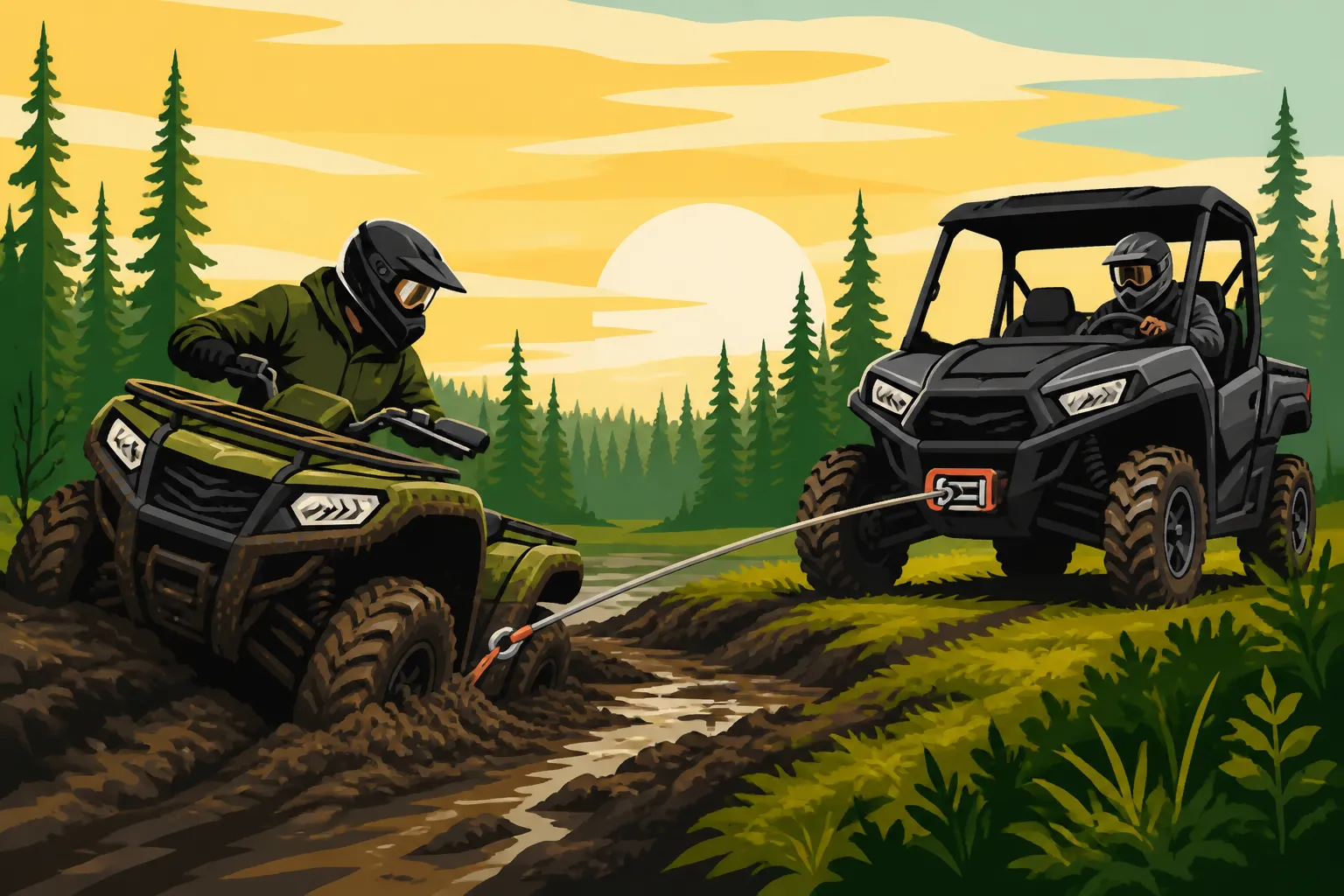
Winching a Stuck Quad Out of Northern Bush
A quad that looks only slightly bogged down can become firmly trapped in northern Saskatchewan muskeg, mud, or wet brush after a few wheel spins. The safest recovery starts before you pull: stop, assess the ground and anchor, clear people from the line of fire, and use equipment rated for the job. This guide walks through a careful winch recovery and what to do when conditions make pulling unsafe.
Stop and assess before winching
Avoid turning a small problem into a buried machine
When a quad loses traction, the instinct is often to give it more throttle. In soft ground, that can dig the tires deeper, pack mud around the frame, and make the machine harder to pull. Stop as soon as forward movement fades. Keep the engine running only if it is safe to do so, and avoid sudden steering or throttle inputs while you decide what is happening.
Look at how the quad is stuck. Are the tires merely slipping, or is the belly resting on mud? Is one side sinking? Is the machine leaning toward a ditch, tree, or water? Check for hazards beneath and around it, including concealed stumps, roots, branches, and deep ruts. A pull that seems straightforward from the front may drag a machine sideways into an obstacle.
Before attaching a winch, remove loose cargo that could shift and ask passengers to get off. If anyone is on the machine, make sure they know what you plan to do and where to stand. Keep bystanders well away from the winch line, anchor, and the direction the quad could move. A winch line or attachment can fail under load, and the machine itself may lurch when it breaks free.
If you are exploring a designated route, check local access and closure information before heading farther into the bush. Saskatchewan ATV Trails: Crown Land and Ditches is a useful starting point for understanding that trails, ditches, and Crown land do not all have the same access rules. Fire restrictions, land permissions, and posted closures can also affect whether you should continue along a route or turn back.
Decide whether a winch pull is appropriate
A winch is useful when the machine is stuck but can be pulled steadily toward stable ground. It is not a substitute for a safe anchor or a way to drag a quad through an unknown hazard. If the vehicle is close to deep water, on a steep or unstable slope, pinned against a tree, or leaning enough that it may roll, stop and reassess. A stronger pull can make a dangerous situation worse.
Check the winch manufacturer’s instructions and the ATV’s owner’s manual. Identify the intended recovery points and confirm that the winch, line, hook or connector, and any accessories are in suitable condition. Do not assume a cargo rack, suspension part, axle, or decorative bumper can take a recovery load. Use an approved recovery point, and do not attach to a component simply because it is convenient to reach.
| Situation | Safer next step |
|---|---|
| Tires are slipping on soft ground, with a stable route out | Clear loose debris, choose a suitable anchor, and winch slowly |
| The quad is resting on its belly | Reduce resistance only if it is safe, then pull steadily toward a clear route |
| The machine is leaning, near water, or against an obstacle | Stop and reassess; get experienced help if the risk is not clear |
| No reliable anchor is available | Do not improvise with a small tree or unverified object |
| The winch or recovery gear is damaged | Do not load it; use another safe recovery plan |
A little preparation can prevent the same problem from happening again. Before a northern ride, review your route, carry a paper map, and make sure your group knows how to turn around if the trail becomes unsafe. Saskatchewan Trail Conditions Before You Haul and Saskatchewan Trail Closures After a Storm can help frame those pre-ride checks.
Set up the winch and anchor carefully
Choose an anchor that will hold
The anchor needs to withstand the force of the pull without shifting, tipping, or breaking. A healthy, substantial tree may be suitable when the terrain and setup allow it, but size alone does not guarantee that its roots are secure. Avoid dead, leaning, or visibly damaged trees, and never wrap a bare winch cable or synthetic line directly around a tree. Use a tree-saver strap or another attachment method approved for the equipment.
Do not use a small sapling, loose stump, fence, signpost, or another quad as an anchor unless the setup is specifically designed and rated for that purpose. In northern bush, wet soil can make a seemingly sturdy tree less dependable than it looks. If the anchor starts to move, the strap shifts, or the ground begins to give way, stop the pull and release tension safely before changing the setup.
Choose a pull direction that moves the quad toward stable ground and avoids sharp side loads where possible. A sideways pull can tip or twist the machine, particularly if one tire is caught in a rut or the frame is resting on an obstacle. If you cannot make a reasonably straight, controlled pull with the available anchor, it may be safer to seek help than to rig a complicated route in the bush.
Connect and clear the line
Inspect the winch line from end to end. Look for fraying, kinks, crushing, corrosion, or other damage, and do not use a line that appears compromised. Keep the line as straight as practical between the winch and anchor. Use only compatible connectors and rated recovery accessories, and follow the instructions for how they should be attached.
Keep hands, clothing, and tools away from the winch drum and moving line. If you need to guide the line, follow the winch manufacturer’s procedure and use a safe method that keeps your fingers clear. Never step over a tensioned line or stand directly in line with it. Keep everyone else outside the working area, including people who think they can “help” by standing beside the stuck machine.
A winch-line damper can help reduce the movement of a line if it fails, but it does not make a bad anchor or damaged line safe. Position it as its manufacturer directs, then move people away before applying tension. If your setup uses a snatch block or changes the line direction, make sure every component and anchor is suitable for the resulting forces. Do not assume that adding a pulley makes the recovery automatically safer.
For rides where phone service may be unreliable, prepare before leaving home. A downloaded map in onX Offroad may help you orient yourself when you are offline, but it does not replace checking land access, closures, or the physical trail conditions. Carry a paper map as a backup, tell someone your route, and agree on a check-in plan with your group.
Pull the quad out in a controlled way
Use steady tension and keep people clear
Once the anchor and connections are checked, make sure the route out is clear. Have one person operate the winch while another, positioned well away from the line and machine, watches for movement or new hazards. Agree on simple signals beforehand. If the operator cannot see the observer, use a reliable communication method rather than relying on shouted instructions over a running engine.
Take up slack slowly, then apply steady tension. Avoid jerking the line, repeatedly accelerating the quad, or trying to shock the machine free. Sudden loading can damage equipment or cause the vehicle to surge when it breaks loose. If the tires can turn without digging deeper, gentle throttle may help, but the winch should do the pulling. Stop if the quad begins to lean, twist, sink further, or move in an unexpected direction.
Pause often enough to inspect the setup. Check whether the anchor is shifting, the strap is moving, the line is winding correctly, or the machine is dragging into an obstacle. Do not reach toward a loaded line or attempt to reposition a strap under tension. If something needs adjustment, stop the winch and safely release tension before approaching the equipment.
If the machine does not move with a controlled pull, do not keep increasing force without understanding why. The belly may be trapped, the wheels may be wedged, or the chosen pull direction may be wrong. You may be able to clear loose material from around the tires or frame, but only do so from a safe position and without reaching under an unsupported machine. If the quad is unstable or the setup is beyond your experience, stop and call for assistance.
After recovery, check the machine and route
When the quad reaches stable ground, stop the winch and make sure it cannot roll or slide before disconnecting anything. Release tension according to the winch instructions. Inspect the line, anchor strap, connectors, winch mounting area, and recovery point for damage. If anything has stretched, frayed, bent, or shifted, do not assume it is ready for another pull.
Look over the quad before riding again. Check for packed mud or vegetation near the wheels and moving parts, and watch for damaged controls, bent components, leaking fluids, or a loose winch mount. If the machine made an unusual noise or took a hard impact, avoid riding it until you have checked what happened. A quad can appear fine after a recovery while still having damage that becomes obvious once it is moving.
Think about why the machine got stuck. Was the route too wet, the rut deeper than it appeared, or the group following too closely? Turn around if the ground is deteriorating or the trail is becoming difficult to travel without damage. In sensitive areas, repeated attempts can widen a muddy track and create more trouble for other riders. Saskatchewan Riding After Heavy Rain offers useful context for deciding when wet conditions call for a change of plan.
If the recovery happened on an unfamiliar route, note the location and conditions for your group’s future planning. onX Offroad can be part of that navigation routine if you have saved the relevant map before losing service; mark or record what will help you retrace your route, but verify access before returning. For a broader preparation checklist, Saskatchewan Group Ride Planning and Saskatchewan Trail Etiquette Locals Expect can help your group discuss spacing, communication, and how to handle difficult sections.
Prepare for a northern Saskatchewan recovery
Pack equipment that suits your machine and group
A recovery kit is only useful if it fits the quad, winch, and conditions. Before a ride, check the winch instructions and choose compatible recovery gear, such as a suitable tree-saver strap, connectors, gloves, and a line damper where appropriate. Inspect the kit at home rather than discovering a damaged strap at the edge of a muskeg crossing.
Carry basic tools and supplies for the kind of riding you plan to do, along with first aid, water, warm layers, and a way to communicate when service is unavailable. For longer trips, tell someone where you are going and when you expect to return. Northern bush can feel isolated even when the trail looks familiar, and a small delay can become serious if someone is cold, injured, or separated from the group.
Your route plan should include a realistic turnaround point. Check whether the area has designated trails, seasonal restrictions, or access conditions that affect where you may ride. Saskatchewan Crown Land Riding Explained can help clarify why Crown land should not be treated as open access everywhere. If you are planning a ride in a provincial park, check the park’s specific machine rules and designated routes before unloading.
Practise the setup before you need it
A quiet practice session at home or on suitable, permitted ground is far less stressful than learning while a quad is sinking. Read the winch manual, locate the approved recovery point, and practise attaching the strap and connectors without loading the line. Make sure every rider knows where to stand, how the winch is operated, and what signal means “stop.”
Practise safe positioning with the actual people in your group. The person operating the winch should be able to focus on the controls, while a spotter stays outside the line’s path and watches for movement. Agree that anyone can call for an immediate stop if the anchor shifts, the machine leans, or a person enters the work area. A recovery plan should not depend on someone guessing what the operator wants.
Finally, decide in advance when not to winch. If there is no trustworthy anchor, the machine is at risk of rolling, equipment is damaged, or the group cannot keep people clear, stop and seek assistance. Turning back or waiting for help can be frustrating, especially after hauling machines deep into the bush, but it is a better outcome than pushing a recovery beyond what the equipment and terrain can safely handle.
Disclaimer
This article is for general informational purposes only and does not constitute professional advice. Laws, prices and regulations vary by location and change over time. Consult a qualified professional for guidance on your specific situation.