Saskatchewan Crown Land Occupant Permission
Saskatchewan Crown Land Occupant Permission
Crown land may look open on a map, but some parcels are leased or otherwise occupied, and riding across them can affect livestock, land management and other users. Before taking an ATV or UTV onto land in Saskatchewan, work out who manages the area, whether access is allowed and what permission you need. This article explains how to check and ask before you ride.
What occupant permission means on Crown land
Crown land is publicly owned, but that does not mean every parcel is open for any kind of recreation at any time. Some land is allocated or leased for activities such as grazing. An occupant may have responsibilities for managing the land, livestock, fences or improvements. A rider who enters without checking can create problems even if the land appears unfenced and unoccupied.
For practical purposes, treat occupied Crown land as land where you need to identify the occupant and get permission before entering unless you have confirmed that a route or public access is expressly allowed. This is especially important on a grazing lease. The Crown-land owner and the person who holds an interest in the land are not the same thing: permission from a government office does not necessarily substitute for permission from the occupant, and permission from an occupant does not override a closure or other legal restriction.
The key is to separate three questions:
- Is the land Crown land, private land or another type of managed area?
- Is the land occupied, leased, closed or subject to access conditions?
- Is the particular activity you plan to do allowed there?
A map may help with the first question, but it may not tell you whether a lease is active, whether the holder permits recreational access, or whether a temporary closure applies. Check the relevant land information and contact the appropriate office or occupant when the status is unclear. The general rules are covered in Saskatchewan Crown Land Access Rules and Saskatchewan Crown Land Riding Explained.
Permission is not a replacement for the rules that apply to riding. You still need to follow ATV operating requirements, respect restricted areas and use an authorized route. A leaseholder cannot give you permission to ride somewhere a law, order or closure prohibits. Likewise, finding a track on the ground does not establish that it is a public ATV trail.
| Situation | What to do before riding |
|---|---|
| Crown land that appears unoccupied | Confirm the land status, access rules and any closures; do not assume that appearance settles the question |
| Occupied or leased Crown land | Identify the occupant and ask for permission before entering |
| Grazing lease | Get consent from the leaseholder, agree on where and when you may ride, and avoid livestock and infrastructure |
| Designated club or park trail | Confirm the trail is open and that your machine and planned use are permitted |
| Private land beside Crown land | Get the landowner’s permission before crossing or entering |
| Closed area or posted restriction | Stay out, even if an occupant or another rider suggests otherwise |
This approach may take a little extra time, but it is safer than relying on an old route, a social-media post or a rider’s assumption. For more on access to a grazing lease, see Saskatchewan Grazing Lease Permission.
How to identify the occupant and ask
Start by locating the parcel as precisely as you can. A road name or a nearby lake may not be enough: the boundary can run close to a trail, yard, pasture or private parcel. Note the legal land description or map location, nearby roads, and the point where you hope to enter. If you are already at the site, record the location rather than riding farther in to look for a contact.
Depending on the area, useful starting points may include the land information available through the relevant Saskatchewan government office, a local rural municipality, a park office, or a trail organization responsible for a designated route. Ask which office handles the parcel if the first contact cannot confirm its status. A municipal office may help identify local restrictions or direct you, but it does not automatically grant permission on Crown land.
If the land is leased, ask how to reach the leaseholder. Do not assume a gate sign, a neighbour’s comment or an old phone number provides current permission. The occupant may have changed, or the conditions may have changed since the last time someone rode there. If you cannot confidently identify the occupant, wait until you can verify it rather than treating silence as consent.
A clear request is more likely to get a useful answer than a general question like “Can I ride around here?” Explain:
- The exact area or access point you want to use.
- The date or time period you have in mind.
- Whether you are riding an ATV, side-by-side or another machine.
- How many machines and riders are in your group.
- Whether you plan to cross the parcel, follow a particular track, stop, camp or hunt.
- Whether you need to open a gate or cross a bridge or other improvement.
Ask directly what is permitted and what is off limits. Permission to cross a parcel may not mean permission to explore it, leave an established route, bring a group, camp, or return on another date. Ask whether the occupant wants you to avoid particular areas, livestock, equipment, water sources or times of day. If the answer is no, thank them and choose another route.
When permission is granted, writing down the details is a practical safeguard. A text or email can record the location, dates, number of riders and any conditions. If permission is verbal, make a note immediately and repeat the conditions back to confirm you understood. Do not share the occupant’s contact details publicly without consent.
For a grazing lease, the advice in Getting Consent From a Grazing Lease Holder is particularly relevant. It is also worth planning how you will make contact before setting off; Reaching a Rancher Before You Cross Their Lease covers why waiting until you reach a gate can be too late.
Riding responsibly after permission is granted
Permission is a specific agreement, not a general licence to roam. Follow the route and conditions you agreed on. If the occupant says to stay on a particular track, do not take a shortcut across pasture. If the allowed dates or group size are limited, stick to them. Ask again before returning outside the original arrangement.
Gates deserve special care. Ask whether a gate should remain as found or whether there is another instruction. If you are authorized to open one, close it securely unless the occupant tells you otherwise. A gate left open can allow animals to move onto roads or into areas where they should not be. Never cut a fence, climb over a barrier or use an access point that is clearly closed to you.
Keep a generous distance from livestock. Slow down well before reaching animals, avoid sudden acceleration or loud revving, and do not chase or herd them. If animals are blocking your route, stop and give them time to move; if they do not, contact the occupant rather than pushing through. Avoid riding close to feeding, watering or handling areas, and do not let dogs run among livestock.
Stay off crops, yards and infrastructure unless you have been specifically told otherwise. That includes fences, water systems, gates, buildings, equipment and sensitive ground. Do not assume that a visible track is an authorized trail or that another machine’s tire marks show permission was granted. If the route becomes muddy or damaged, turn around or ask for direction instead of widening it.
Noise and group size matter. A route that is manageable for one machine may not suit a larger group, especially near livestock or a residence. Keep the group together, use the agreed access point and avoid unnecessary stops in working areas. If another rider joins your group, confirm that the permission covers them before continuing.
Permission can also have limits that are easy to overlook. A landholder may allow access for travel through a parcel but not for hunting, camping, target practice or retrieving game. These are distinct activities, and permission for one does not automatically include another. Check Saskatchewan Hunting Access by Machine and Saskatchewan Game Retrieval by Machine if your plans involve hunting or retrieving an animal.
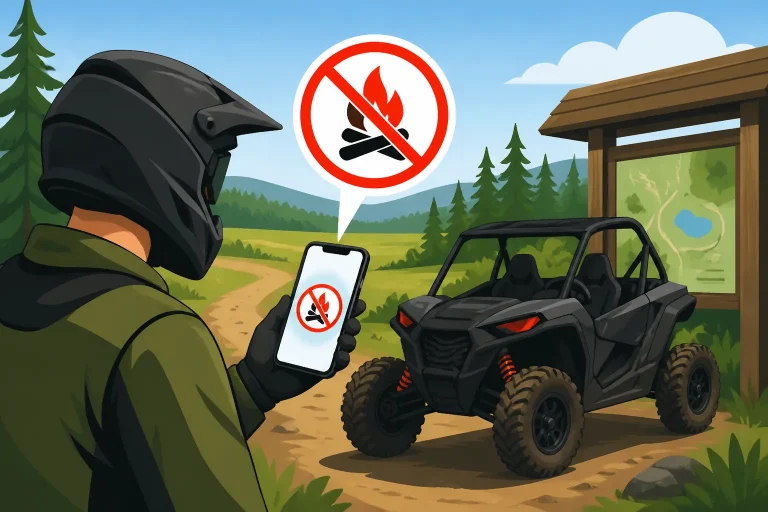
If you find a new sign, a gate that has been locked, a fresh closure notice or other indication that conditions have changed, stop and reassess. Do not rely on permission you received for another location or an earlier visit. Government restrictions and wildfire-related closures can affect Crown land regardless of an occupant’s approval. Before heading out, check Saskatchewan Fire Ban Lookups and Saskatchewan Wildfire Season Riding Restrictions when fire conditions may affect access.
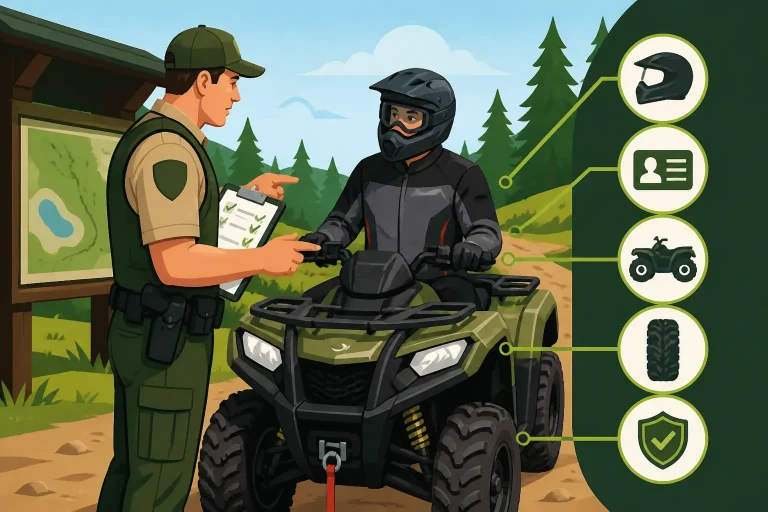
A permission record can help clarify an agreement, but it is not proof that every part of the ride is lawful. Carry the information you need to explain where you are going and whose permission you received. Also carry the documents required for your machine and your trip. See Saskatchewan Proof of Ownership on the Trail and Proof of Insurance Is What Saskatchewan Officers Ask For for related paperwork questions.
Common access mistakes and what to do instead
Assuming Crown land is automatically open
The word “Crown” describes ownership, not unrestricted access. Some areas have leases, closures, designated uses or other conditions. Check the parcel and applicable rules before riding. If you cannot confirm the status, do not use uncertainty as permission.
Treating a public road or trail as permission to leave it
A road or designated trail may provide lawful access through an area without opening the surrounding land to off-route riding. Stay on the route you are allowed to use, and ask before leaving it. A route shown online may be outdated, informal or on land where access has since changed.
Asking the wrong person
A nearby resident, another rider or a person who once held a lease may not be authorized to approve access now. Confirm who currently occupies the land. If an office cannot identify the right contact, ask it to direct you to the responsible department or process rather than accepting a guess.
Treating permission as permanent
Conditions can change with grazing, maintenance, weather, wildfire risk or land management. Ask for permission for the trip you actually plan to make, and check again if the timing, route or group changes. A previous yes is not necessarily a standing invitation.
Crossing private land to reach Crown land
A Crown parcel may be surrounded by private land, or the route to it may cross a private yard, field or access road. Permission to ride on the Crown parcel does not grant permission to cross the private parcel. Get consent from the private landholder as well, or find an authorized access point.
Assuming a leaseholder can waive every restriction
An occupant may set conditions for access to the land they manage, but cannot cancel a government closure, authorize a prohibited activity or change the rules for a public road. Check both the occupant’s conditions and the legal restrictions that apply to the location. Related information on closures is available at Saskatchewan Administrator Orders on Crown Land.
If you discover that you have entered the wrong parcel, stop and leave by the route you used where possible. Do not continue deeper into the land or argue that another person gave you permission. If the boundary is unclear, contact the occupant or relevant office from a safe place and explain the situation. Being straightforward and leaving promptly is usually better than making a difficult access mistake worse.
Before any ride involving occupied Crown land, use this simple sequence:
- Identify the parcel and check whether it is Crown land, private land, leased or closed.
- Confirm the rules for the activity and route you intend to use.
- Contact the current occupant when access permission is needed.
- Agree on the exact route, dates, group and conditions.
- Keep a record of the permission and follow every condition.
- Recheck closures and access status before leaving.
Frequently Asked Questions
Do I need permission to ride on all Crown land in Saskatchewan?
Not every parcel has the same access status or conditions. Confirm whether the land is occupied, leased, closed or covered by a designated route before riding. If it is occupied, the cautious approach is to identify the occupant and ask before entering.
Does permission from a grazing leaseholder let me ride anywhere on the lease?
No. Permission may apply only to a specific route, date, group or activity. Ask what is allowed, follow those limits, and keep away from livestock, fences and other improvements.
Is permission from an occupant enough if the land is closed?
No. Permission from an occupant does not override a legal restriction, government order or closure. Check for current restrictions as well as the occupant’s conditions.
Can I rely on another rider’s permission?
Do not assume that someone else’s permission covers you or your group. Confirm directly that the occupant has approved your planned ride, including the number of machines and the route.
Disclaimer
This article is for general informational purposes only and does not constitute professional advice. Laws, prices and regulations vary by location and change over time. Consult a qualified professional for guidance on your specific situation.