Saskatchewan Permit Questions Riders Ask
Saskatchewan riders often hear about permits, plates and trail passes as if they mean the same thing. They do not. The right answer depends on where you plan to ride: a provincial park, a municipality, Crown land or private property. Here are the common permit questions, what each requirement covers and what to check before loading your ATV or UTV.
Does Saskatchewan require a province-wide ATV or UTV permit?
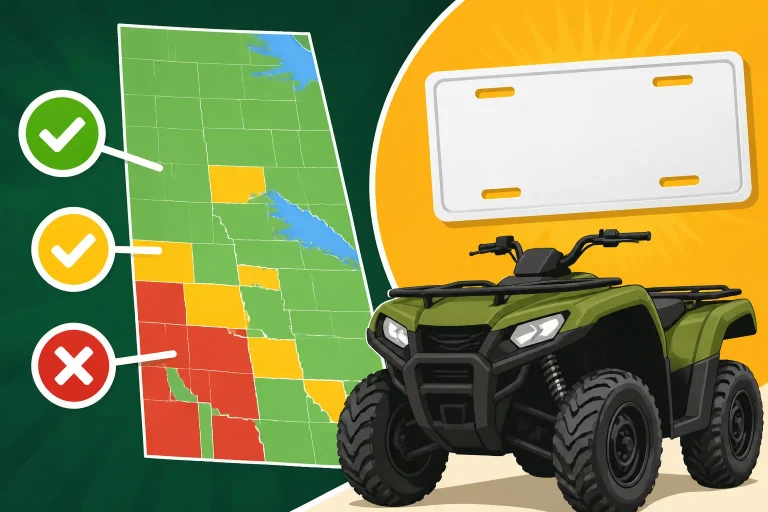
No province-wide ATV or UTV registration permit or trail pass is required simply to own or ride an off-highway machine in Saskatchewan. The province does not issue ATVs a general registration plate, and a snowmobile registration is not an ATV permit. That does not mean every trail or road is open to unpermitted riding: a park, municipality, land manager or event organizer may have separate rules.
It helps to separate four things that riders sometimes call a “permit”:
- Provincial registration: Saskatchewan does not register ATVs and UTVs as it does snowmobiles. There is no provincial quad plate to buy or renew. See Saskatchewan Has No ATV Plate or Decal and Saskatchewan Has No Provincial Trail Pass.
- Municipal plate or permit: Some municipalities operate their own local plate schemes. These are local permissions, not provincial registration, and a plate issued by one community may not authorize riding elsewhere. Saskatchewan Municipal ATV Plates Explained
- Park trail permit or acknowledgement: Certain provincial parks have specific processes for riding designated machine trails. A permit, acknowledgement form or information session may be part of that process, depending on the park and current rules.
- Land access permission: On private land, occupied Crown land or a grazing lease, the landholder or responsible authority may need to allow access. A municipal plate or park permit does not grant permission to cross land.
A permit also does not replace the rules that apply to the rider and machine. Age, supervision, insurance, helmets, equipment, road use and posted restrictions can still matter. Start with the place you intend to ride, then check what permission or paperwork that place requires.
| Where you plan to ride | What to check | What the permission does not automatically cover |
|---|---|---|
| Provincial park | Designated routes, park-specific permit or acknowledgement process, operating rules | Roads, trails or areas closed to machines |
| Municipality with a plate scheme | Local application, eligible machines, covered streets or areas, expiry and renewal | Riding in another municipality or on provincial land |
| Crown land | Land status, closures, access conditions and any required consent | Occupied areas or land governed by a separate agreement |
| Grazing lease | Permission from the leaseholder and any posted restrictions | Other leases or private land along the route |
| Private property | Permission from the owner or lawful occupant | Public roads, neighbouring properties or a park trail |
| Organized ride | Event organizer’s permissions and any land or park approvals | Independent riding before or after the event |
Do I need a permit to ride in a Saskatchewan provincial park?
Not everywhere, and the process is park-specific. Saskatchewan parks may designate particular trails for machine use and restrict ATVs and UTVs on other roads, hiking trails, campground areas, beaches or sensitive sites. Some parks have a trail permit or acknowledgement process; others may not require the same paperwork. A permit, where applicable, is for the permitted use and location, not a general licence to ride throughout the park.
Before travelling, check the park’s current directions for:
- Whether ATVs or UTVs are permitted at all
- Which trails or routes are designated for machines
- Whether you must attend an information session or sign a use acknowledgement
- Where and how to obtain or display a permit
- Whether proof of insurance must be available
- Seasonal openings, closures and operating hours
- Rules for riders who are minors and any supervision requirements
- Equipment, washing or other requirements before entering a trail system
The sequence can matter. If a park requires an information session or a signed form before issuing a permit, arriving at a trailhead without completing that step may leave you unable to ride. Do not assume that a permit is available at every entrance, that an old permit remains valid, or that the same process applies at another park.
For current steps and the distinction between a park permit and permission to use a particular trail, see How to Get a Saskatchewan Park Trail Permit. The park’s own office or official visitor information is the best place to confirm the process for your planned visit. A local club or rider can be useful for trail conditions, but it should not be your only source for current access rules.
A few practical points can prevent a wasted trip:
- Name the exact park and route. “Riding in the north” is not enough to establish that a trail is open to ATVs.
- Confirm the permit process before leaving home. Ask whether a session, form or pickup is required and where it happens.
- Check your machine against the park rules. An eligible ATV does not automatically mean every UTV or modified machine is allowed on every route.
- Carry the required proof. If the park expects a permit or insurance evidence, keep it accessible rather than buried in a trailer or vehicle.
- Recheck before the ride. Closures, fire restrictions, trail conditions and seasonal rules can change.
A park permit is not a substitute for following signs or staying on designated trails. If a trail is closed, a permit does not reopen it. Likewise, a park permit does not authorize you to ride on a neighbouring municipality’s roads or across private land to reach another trail.
Do municipal ATV plates work as permits everywhere?
No. A municipal plate or permit applies under the rules of the municipality that issues it. Saskatchewan has no province-wide ATV plate system that makes a local plate valid across the province. Even where a municipality’s scheme allows riding on specified local roads or trails, its plate does not automatically authorize travel in a neighbouring community, provincial park or on Crown land.
Municipal schemes vary. Before paying or riding, confirm the answers to these questions with the municipality:
- Which machine types and uses are covered?
- Which roads, trails or areas are open?
- Are there excluded streets, beaches, lakeshores or other zones?
- What documents does the municipality ask you to provide?
- Where is the plate or permit issued, and where must it be displayed?
- When does it expire, and how is it renewed?
- Does the scheme apply to visitors or only to local residents?
- Are there separate operating rules, speed limits or age restrictions?
A municipal plate is best understood as a local permission device, not proof that a machine is registered by the province. It also does not establish ownership, provide insurance, or override a road closure. Keep the bill of sale or other ownership records separate from the municipal permit.
If you intend to travel between communities, plan the route one jurisdiction at a time. A plate from your home community may not carry you through the next one, and a route that looks continuous on a map can cross different municipal boundaries or land types. For specific local schemes, see Saskatchewan Municipalities With ATV Bylaws and Saskatchewan Bylaw Lookups Before You Ride.
Visitors should be especially cautious about assuming that a plate from home will be accepted. Saskatchewan does not have a provincial quad registration plate with which to establish broad ATV registration reciprocity. A visitor’s home-state or home-province paperwork may be relevant to the machine’s status there, but it does not replace local permission to ride in a Saskatchewan municipality. Check the local rules before relying on an out-of-province plate. Saskatchewan Plate Rules for Visitors
When in doubt, ask the municipality to identify the exact area where a visitor may ride. “We sell plates” does not answer whether a particular road is open, and “the plate is valid” does not necessarily mean it is valid beyond that municipality’s boundaries.
Do visitors need a Saskatchewan permit, and is there reciprocity?
There is no general Saskatchewan ATV registration permit for a visitor to obtain, because the province does not issue province-wide ATV registrations. That does not create an automatic reciprocal right to ride. Visitors still need to follow Saskatchewan’s riding rules and obtain any permission required for the particular place they plan to use.
Think of reciprocity as a question about a specific requirement, not a blanket agreement between jurisdictions. A visitor may arrive with a home registration or plate, but that paperwork does not necessarily satisfy a Saskatchewan park’s permit process, a municipality’s local scheme or a landholder’s access conditions. Similarly, a Saskatchewan municipal plate should not be assumed to work in another jurisdiction.
For a visiting rider, the practical checklist is:
- Confirm that the machine may be operated in Saskatchewan under the rules that apply to it.
- Check rider licensing, age, supervision, helmet and insurance requirements before setting out.
- Ask the park or municipality whether visitors must follow a separate permit process.
- Confirm whether the planned route crosses private, occupied Crown or leased land.
- Carry relevant proof of insurance and ownership, along with any local permit or acknowledgement.
- Check for closures and restrictions on the day of the ride.
A general local permit is not the only paperwork a peace officer or park official may ask about. Insurance proof, the rider’s licence, compliance with equipment rules and evidence of permission can all be relevant. See Saskatchewan Insurance Rules for Visitors for the insurance question, and Saskatchewan Proof of Ownership on the Trail for the separate issue of showing who owns the machine.
If you are visiting from Alberta, Manitoba or another nearby jurisdiction, do not rely on what is permitted at home. Rules can differ, and even a lawful route in your home jurisdiction does not settle where you can ride after crossing the provincial boundary. Before hauling, identify the destination and ask the local authority about the specific trail or road.
Do Crown land, grazing leases and private land require permits?
There is no single permit that grants access to all land in Saskatchewan. The requirement depends on who manages the land, whether it is occupied or leased, whether access is restricted and whether a closure or order is in effect. A route that appears to cross open country on a map can still pass through land where permission is needed.
On Crown land, first establish that the specific area is open to the activity and that no land-use restriction, order or closure applies. Some areas are occupied or managed under agreements, so public ownership alone does not mean unrestricted ATV access. Ask the relevant land manager or responsible office when the status is unclear. [Saskatchewan Crown Land Riding Permission]
Grazing leases need particular care. A grazing lease is not simply an open public trail, and riders should not treat a gate, track or pasture as permission to enter. Contact the leaseholder and get consent before crossing or riding on the lease. Respect livestock, fences, gates and any conditions the leaseholder sets. [Saskatchewan Grazing Lease Access Rules]
Private land is straightforward in principle: get permission from the owner or lawful occupant before riding. Permission to cross one property does not extend to adjacent land, and permission for one occasion does not necessarily authorize repeated access. If you are planning a route that links several properties, confirm each section rather than assuming that one person can grant access for all of it.
A permit or permission from one land manager does not cancel another restriction. For example:
- A park permit does not authorize crossing a private field to reach the park.
- A municipal plate does not grant access to an occupied Crown land site.
- A landowner’s permission does not open a provincially closed area.
- A trail map does not guarantee that every connecting track is available to motorized users.
When access depends on a conversation, keep a record of who granted permission, what area it covers and any conditions. Written consent is useful when practical, especially for a group ride or a recurring route. Do not assume that an old permission still applies after a landholder, lease or access arrangement changes.
What should I check before a permit or organized ride?
Start by matching the paperwork to the route. A common mistake is to obtain one permit and assume it covers the whole day, even though the ride crosses a park boundary, a municipality or land under a separate management arrangement.
Use this sequence before you load:
- Map the route by land type. Mark provincial park sections, municipal roads, Crown land, leases and private property.
- Identify the decision-maker for each section. This may be a park office, municipal office, land manager, leaseholder or private owner.
- Ask what approval is required. Find out whether it is a permit, plate, acknowledgement, written permission or simply compliance with posted access conditions.
- Confirm the practical details. Check where to get the permit, what documents to bring, whether it must be displayed and whether the process needs to be completed in advance.
- Check other riding requirements. Verify insurance, rider eligibility, equipment, route restrictions and operating hours.
- Recheck closures. Fire restrictions, trail damage or seasonal rules can change access after you have made plans.
- Carry proof. Keep permits, permission records and insurance evidence somewhere accessible during the ride.
Organized rides may need additional arrangements beyond what an individual rider needs. The organizer should confirm permission for the route, group size, parking or staging, insurance and any park or land-manager conditions. A participant’s personal municipal plate or park permit does not necessarily authorize the organizer to run an event. See Saskatchewan Event Permits for a Ride before advertising or hosting a group ride.
If your plan depends on a road, trail or shortcut that is not clearly described in current information, ask before riding it. A short call or email to the responsible office can settle whether the route is open, whether a permit is needed and which proof to carry. For a visit to a park, contact that park. For a municipal plate, contact the municipality that issues it. For leased or private land, contact the person responsible for that land.
The safest working rule is simple: treat each permission as limited to the place and purpose for which it was issued. A Saskatchewan park permit, municipal plate, landholder’s consent and insurance policy solve different problems. None of them is a universal pass.
Frequently Asked Questions
Is there one ATV permit that covers all of Saskatchewan?
No. Saskatchewan does not issue a province-wide ATV registration permit or trail pass. Parks, municipalities and land managers may have separate requirements.
Can I use my municipal ATV plate in another Saskatchewan town?
Do not assume so. Municipal plates are local schemes, and their coverage depends on the issuing municipality’s rules. Confirm before riding outside its boundaries.
Does an out-of-province ATV plate give me reciprocal access?
Not automatically. Home registration does not replace a Saskatchewan park permit, local municipal permission or landholder consent. Check the specific rules for your destination.
Does a park permit let me ride anywhere in the park?
No. It applies only under that park’s rules and does not open closed roads, undesignated trails or areas restricted to machines.
Do I need written permission for a grazing lease or private land?
Get permission from the person responsible for the land before riding. Written permission is useful, particularly for group or repeat access, and should clearly cover the route and conditions.
Disclaimer
This article is for general informational purposes only and does not constitute professional advice. Laws, prices and regulations vary by location and change over time. Consult a qualified professional for guidance on your specific situation.