Proof of Insurance Is What Saskatchewan Officers Ask For
A Saskatchewan ATV or UTV may not need a provincial registration plate, but that does not mean you can ride without insurance or leave your proof at home. The practical question is what you can show when an officer asks. This guide explains what to carry, how visitors should check their policies, and why a municipal plate or park permit does not replace insurance.
What Saskatchewan officers may ask you to show
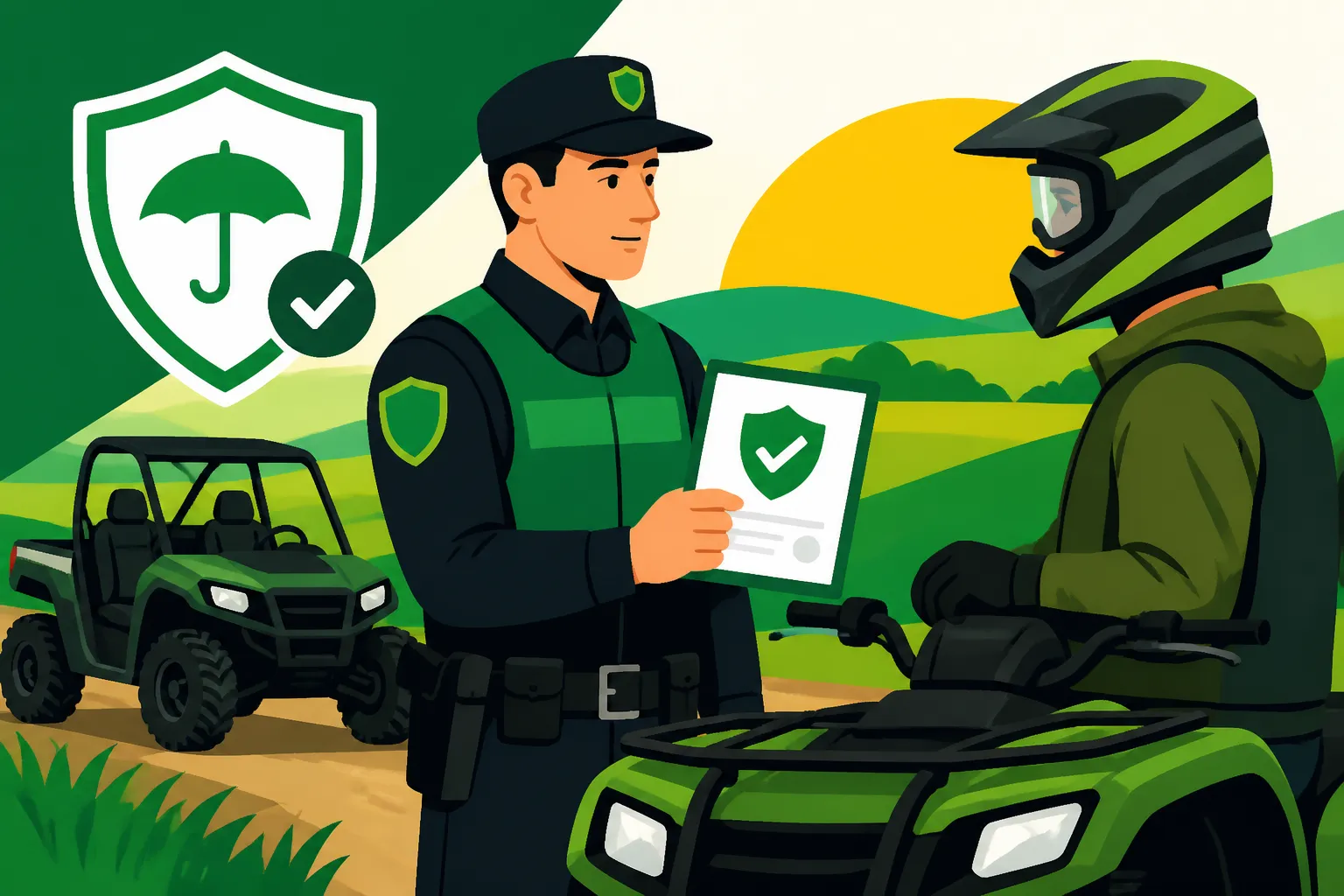
For a ride on a machine covered by Saskatchewan’s off-road vehicle rules, be prepared to show evidence of the required liability insurance. The central point is simple: a bill of sale, municipal plate, park permit, or registration document from another province is not proof of insurance. Have an insurance document available that identifies the insured machine or otherwise clearly confirms that the policy covers it.
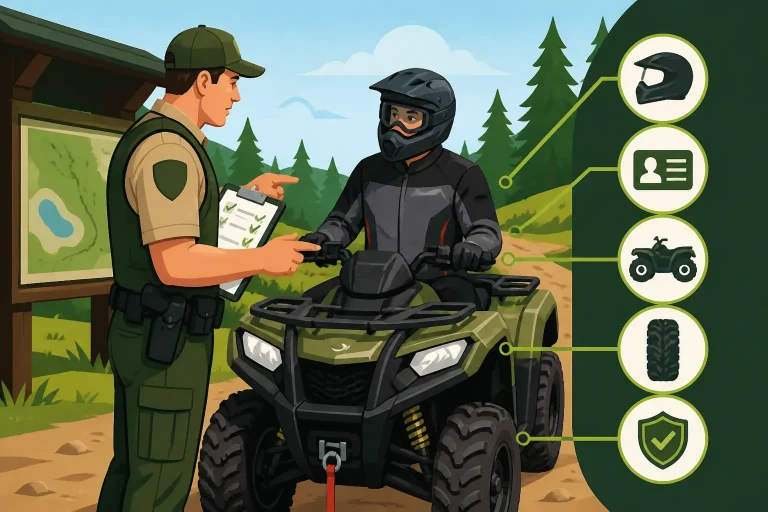
Insurance is not the only thing an officer may ask about. Depending on where you are riding and what is happening, you may also need to show your driver’s licence, answer questions about the machine or your route, and demonstrate that you are allowed to use the land or trail. An insurance card does not authorize you to ride somewhere that is closed or requires permission.
The exact details of the stop matter. A peace officer enforcing road rules, a park officer checking trail requirements, and a municipal official enforcing a local plate bylaw may each be checking different things. For the general provincial insurance rule, see Saskatchewan ATV Insurance Requirements. For the broader requirement, including the amount of coverage, see Saskatchewan Minimum Insurance Requirement.
| What you have | What it can establish | What it does not establish |
|---|---|---|
| Insurance card or policy certificate | Evidence that a policy exists and may cover the machine | Permission to ride on closed or private land |
| Bill of sale | Evidence of a purchase or ownership transfer | Current insurance coverage |
| Municipal plate or permit | Compliance with a local scheme, where one applies | Provincial registration or insurance by itself |
| Park trail permit or acknowledgement | Compliance with a park’s permit process, where required | Insurance unless the policy document itself confirms it |
| Out-of-province registration or plate | Registration under the other jurisdiction’s system | That the policy covers the machine and the way it is being used in Saskatchewan |
A useful habit is to carry your insurance proof and ownership paperwork together, while keeping them clearly separate. If an officer asks for insurance, hand over the insurance evidence rather than expecting a bill of sale or a plate to answer the question. For help distinguishing those documents, see Saskatchewan Proof of Ownership on the Trail.
What insurance proof needs to show
The most useful proof is a document that makes it easy to connect three things: the policy, the insured person or owner, and the ATV or UTV being ridden. Depending on your insurer, the evidence may be an insurance card, a certificate, a policy document, or another official document the insurer provides.
Before you head out, check that the information is current and readable. Confirm that the document identifies the machine accurately, including its description or serial number if those details appear on the insurer’s paperwork. Make sure the named insured makes sense for the person using the machine and that the policy has not expired, been cancelled, or changed since you last printed the document.
If your insurance document lists several machines, take the pages that show the relevant machine and policy details. Do not assume that a card listing only a policyholder’s name will answer every question if it does not identify what is insured. Ask your insurer what document best confirms coverage for your particular ATV or UTV.
Carry paper, and know how to access the digital copy
A digital document can be convenient, but it is a poor plan to rely on a phone that is nearly out of battery, has no signal, or is locked behind an app you cannot open. If your insurer provides electronic proof, download it before leaving home. Keep a paper copy as a backup, especially for remote riding where cell service may be unreliable.
A paper copy should be protected from water, mud, fuel, and tearing. A small waterproof document wallet or sleeve can work. Some riders keep one in a secure compartment on the machine; others keep it on their person so it stays with them if the ATV is parked or disabled. If you buy a document pouch through an outdoor retailer or Amazon, check that it closes securely and fits the paperwork without folding the important details out of view.
Avoid leaving your only copy loose in an exposed storage area. A hard rain, a tipped machine, or a spilled drink can make an otherwise valid document unreadable. At the same time, do not attach a document in a way that could be lost on rough terrain. The goal is quick access without making the paper vulnerable.
Keep a backup, but protect personal information
A second copy can save a frustrating ride if your primary document is damaged. Store a paper duplicate somewhere separate from the first, or keep an accessible digital copy on a device you can use offline. If you use a phone, protect it in a sealed case and make sure you can open the file without a data connection.
Insurance documents may contain personal information. Do not leave them visible in an unattended vehicle or share a full policy document casually. For a roadside or trail check, show the relevant proof when requested, and follow the officer’s reasonable instructions. If you are unsure what information is needed, ask politely which page or document would help confirm coverage.
You can also keep your broker or insurer’s contact details with your paperwork. That will not replace proof of insurance, but it may help resolve a genuine discrepancy, such as a machine identification number that was entered incorrectly or a recently renewed policy that has not yet produced updated documents.
What the insurance requirement means in practice
The insurance rule is easy to misunderstand because people use “insurance” to mean several different things. For legal compliance, the key issue is liability coverage: protection for certain claims if your use of the machine causes injury or damage to someone else. Saskatchewan’s ATV rules set a minimum liability requirement. Your policy documents and insurer can confirm that your particular coverage meets the applicable requirement.
Liability coverage is not the same as coverage for damage to your own machine. Collision, fire, theft, and other physical-damage protections may be optional or depend on the policy you buy. A quad can have liability coverage without having coverage for its own repairs after a rollover. Conversely, a home, farm, or general liability policy should not be assumed to satisfy the ATV requirement just because it might respond to some other type of claim.
The word “insured” is not enough on its own. The policy needs to cover the machine and the activity in question. An ATV policy may treat recreational trail riding differently from work use, commercial use, racing, or operation by a particular rider. The policy may also contain exclusions or conditions involving unlicensed operators, age, passengers, modifications, or use outside the territory where the policy applies. These details are policy-specific, so ask the insurer or broker rather than guessing.
Liability and damage to your own machine are different questions
A rider may hear that a machine is “fully insured” and assume that every kind of loss is covered. That phrase can mean different things in casual conversation. Ask specifically:
- Is the required third-party liability coverage in force?
- Which ATV or UTV is insured?
- Who is allowed to operate it?
- Does the policy cover the type of use planned, such as trail riding, farm work, or business use?
- Are passengers covered under the policy’s terms?
- Does the policy apply while riding in Saskatchewan?
- Is damage to the machine itself covered, and what exclusions or deductibles apply?
Those questions matter whether you ride a small utility quad, a sport ATV, or a side-by-side. Do not assume a policy for one machine automatically extends to every machine in a household. If you borrow an ATV, ask the owner to verify coverage before you ride. If you lend yours, check the policy’s rules for other operators.
Insurance does not grant access
A valid policy is not a pass to ride on every road, trail, lease, or parcel of land. You still need to follow applicable laws, municipal bylaws, park rules, posted closures, and landowner requirements. Likewise, a permit or local plate does not prove that the machine is insured.
This distinction is especially important when riding in a group. One rider may have insurance but not permission to cross a particular property. Another may have permission from a landowner but no policy that covers the machine. Treat insurance, ownership, permission, and local permits as separate checks.
For guidance on what can happen if an uninsured or improperly covered machine is involved in a crash, see Saskatchewan Insurance Claims Without a Plate. A missing provincial quad plate does not remove the possibility of a serious liability claim.
Visitors and out-of-province machines
Visitors often assume that a plate or registration from home answers every Saskatchewan requirement. It does not. Your home jurisdiction’s registration may be relevant to whether you can bring and operate the machine, but you should separately confirm that your insurance covers riding in Saskatchewan and that it meets the applicable local requirement.
Before travelling, contact your insurer or broker and describe the trip plainly. Say where you will ride, whether the machine will be used on trails, public roads, private land, or for work, and whether anyone other than the named insured will operate it. Ask whether the policy applies in Saskatchewan and whether any territorial, use, rider, or equipment exclusions matter.
Do not rely on a generic answer such as “you’re covered in Canada” without checking what that means for an off-road vehicle. A policy may cover travel across provincial borders but still have limits on the type of machine, the activity, or who may operate it. Ask for confirmation in writing if there is any uncertainty, and carry the document that demonstrates the coverage.
For more on out-of-province coverage and local rules, see Saskatchewan Insurance Rules for Visitors. If you are coming from another province, you may also find Saskatchewan Rules for an Out-of-Province Machine useful. Reciprocity does not mean that every plate, permit, or insurance policy is automatically treated the same way in every situation.
Borrowed and rented machines need extra checking
A borrowed machine creates two separate questions: is the ATV insured, and does the policy cover you as its operator? The owner may have a policy that restricts who can ride, or that excludes certain uses. Ask before taking the keys. If the owner cannot confirm the answer, call the insurer together.
For a rental, read the rental agreement and ask what insurance is included, what it covers, and what remains your responsibility. A rental contract or damage waiver is not necessarily the same thing as liability insurance. Make sure you understand whether coverage applies to your intended route and whether the machine may be taken onto the land or trail you plan to use.
If you are riding someone else’s machine, carry proof that relates to that machine. A photo of your own policy for a different quad will not establish coverage for the borrowed one. If the owner supplies a document, check that it is current and identifies the correct ATV or UTV.
What to do when an officer asks for proof
A document check is easier when the paperwork is organized before the ride. Stop in a safe place, follow instructions, and provide the requested document without reaching suddenly into a bag or compartment. If the paper copy is stored on the machine, tell the officer where it is before retrieving it.
If you use digital proof, unlock the device and open the document before handing the phone over, if practical. You can offer to display the relevant page. Keep the device in your hands unless the officer asks to inspect it. If there is no service, explain that you downloaded the document in advance and show the saved file. That is one reason an offline copy is more useful than a link to an insurer’s website.
If the proof appears to have an error, do not argue from memory about what the policy “should” say. Point out the specific discrepancy, such as a mistyped serial number or an outdated name, and ask what would resolve it. The officer may need to confirm the details, and the insurer may need to correct the document. Contact your broker as soon as you can.
If you cannot find the document
Stay calm and be direct. Say that you believe the machine is insured but cannot locate the proof, then explain what you do have. Do not present a bill of sale or permit as if it were insurance evidence. Those papers may help establish other facts, but they answer different questions.
A missing document does not necessarily mean the machine is uninsured, but it can make a roadside check harder and may lead to follow-up or enforcement action. Do not continue riding on the assumption that the problem will sort itself out. If you cannot confirm coverage, stop using the machine until you have verified that the policy is active and that the proof is available.
If you learn that the policy is expired, cancelled, or does not cover the machine, arrange coverage before riding again. Do not try to solve the problem by borrowing someone else’s insurance card or by relying on another rider’s policy. The document must correspond to actual coverage, not just look official.
Keep your answers factual
An officer may ask who owns the machine, who is operating it, where you are headed, or whether you have permission to use a particular trail or property. Answer truthfully and show the document that addresses the question. If you are unsure whether a question relates to insurance, access, ownership, or local rules, ask for clarification in a respectful way.
A routine check is not the right time to debate a bylaw you have not read or assume a municipal permit applies beyond its area. If you receive a ticket or disagree with an enforcement decision, follow the instructions on the paperwork and use the proper process to seek clarification or dispute it. Avoid escalating the interaction on the trail.
Parks, municipal plates, and other permits
Saskatchewan does not issue a province-wide ATV registration plate in the same way it registers some other vehicle types. Some municipalities operate local plate or permit schemes, and particular parks may have their own permit or acknowledgement process. Those systems can serve local purposes, but none should be treated as a substitute for insurance evidence.
A municipal plate may be required within the municipality that issues it, or on particular roads and areas governed by its bylaws. It does not automatically authorize riding in a neighbouring municipality. It also does not demonstrate that your liability policy is active. Learn what the local scheme covers before relying on it; Saskatchewan Municipal ATV Plates Explained covers the distinction in more detail.
Park requirements are separate too. A park may require a permit, a signed acknowledgement, proof of insurance on demand, or compliance with designated-trail rules. A free permit, where one is available, does not make insurance unnecessary. Check the requirements for the specific park before you unload, because rules can differ between riding areas and can change.
The same separation applies to Crown land, grazing leases, private property, and club trails. You may need permission or may be restricted to designated routes. Insurance can help respond to certain claims, but it does not give you a right to enter land. Before a trip, check the relevant access rules as well as the insurance documents.
Don’t confuse a trail permit with insurance
A permit normally shows that you have completed a local step, such as registering with a municipality or completing a park process. An insurance document shows that an insurer has issued coverage subject to its terms. These are different records, even if both are carried in the same pouch.
If a permit application asks for insurance information, that does not mean the permit itself becomes insurance. Keep the underlying policy proof. Similarly, if a park officer asks to see insurance, showing a permit with your name on it may not establish that the machine is covered.
When riding in a place with a local plate scheme, check the exact bylaw and office instructions. Confirm whether the plate is tied to you, the machine, or a particular municipality; whether it is valid where you plan to ride; and whether there are separate insurance or equipment checks. Local details matter, so do not assume the rules from one lakeside community apply elsewhere.
A practical pre-ride insurance checklist
Build the insurance check into your normal loading routine. It takes less time to verify the paperwork at home than to discover a problem at a trailhead or during a stop.
- Confirm the policy is active. Check the dates and contact your insurer if renewal, payment, or cancellation status is unclear.
- Match the policy to the machine. Verify that the ATV or UTV you are taking is included and that its identification details are accurate.
- Check the planned use. Ask whether the policy covers recreational riding, work use, passengers, borrowed operators, or commercial activity as relevant.
- Confirm Saskatchewan coverage. This is particularly important for visitors and people whose machines are insured elsewhere.
- Carry the insurer’s proof. Bring a current card, certificate, or other document the insurer identifies as evidence of coverage.
- Save an offline copy. Do not depend on cell service or a live account login to access the document.
- Bring a paper backup. Protect it in a secure, water-resistant place.
- Keep ownership papers separate. A bill of sale and insurance document prove different things.
- Check local requirements. Confirm any municipal plate, park permit, landowner permission, or trail restriction separately.
- Recheck when the machine or rider changes. A new ATV, policy renewal, borrowed machine, or additional operator can change what applies.
A small document wallet can keep a paper card and the relevant policy page together. Some riders use a sealed pouch stored in a secure compartment, while others keep the documents on their person. If you choose a storage pouch from a dealer, outdoor shop, or Amazon, make sure it will remain closed and protected through mud and rain. Do not store the only copy somewhere that is difficult to reach during a stop.
You can make the process easier by keeping a simple folder for each machine. Include current insurance proof, the bill of sale or other ownership records, and any local permit paperwork. Replace outdated pages when the policy changes. If you manage several machines, label the folders clearly so you do not accidentally carry proof for the wrong ATV.
For a household with several riders, explain where the documents are and how to retrieve the digital copy. A passenger or family member may need to help locate paperwork if the operator is injured or the machine is disabled. A spare phone cable or power bank can help keep a digital copy accessible, but it is not a replacement for a paper backup in a remote area. If you keep a compact cable or document pouch with your riding kit, an Amazon order may be one way to replace a missing item; the important part is that the proof is readable and actually available when needed.
The safest mental checklist is: insurance, ownership, permission, and local permits are four separate things. Carry the relevant proof for each. A bill of sale may help show who owns the machine, insurance evidence helps establish coverage, permission establishes access, and a municipal or park permit may satisfy a local process. One document rarely proves all four.
If an insurer or broker gives you advice that conflicts with a bylaw or an officer’s request, ask for clarification before the next ride. Your insurer can explain the policy; the municipality or park office can explain its local rules; and the relevant provincial authority can clarify the applicable law. Keeping those questions directed to the right place prevents a common mistake: assuming a document issued for one purpose answers every other question.
Disclaimer
This article is for general informational purposes only and does not constitute professional advice. Laws, prices and regulations vary by location and change over time. Consult a qualified professional for guidance on your specific situation.