Riding Unplated on Municipal Land Costs $300
A $300 no-plate fine can turn a short ATV or UTV ride into an expensive mistake, but it is not a province-wide charge for every unplated machine in Saskatchewan. The key is knowing which municipality’s land and bylaws apply, whether that place requires its own plate, and whether your plate is valid there.
What the $300 no-plate fine means
Saskatchewan does not issue a general provincial ATV plate, and a municipal plate is not required everywhere in the province. Some municipalities have local plate schemes and bylaws that restrict riding on specified municipal land unless the machine displays the required plate or permit. In an area with a $300 penalty for riding unplated, the fine applies under the applicable local rule—not as a universal Saskatchewan ATV fine.
That distinction matters. A rider might be legally allowed to operate an ATV under provincial rules but still be in breach of a local bylaw by riding on a road, trail, or other land where the municipality requires its plate. Conversely, having a local plate does not automatically give permission to ride wherever you want.
The $300 figure is associated with local no-plate enforcement, including the Lakeland-area rules identified in local plate information. It should not be treated as the fine in every Saskatchewan community. Municipal bylaws, plate requirements, coverage areas, and penalties can differ. Before relying on a figure or assuming a plate is needed, check the municipality responsible for the exact place where you plan to ride.
A local plate scheme is separate from provincial vehicle registration. Saskatchewan’s lack of a provincial ATV registration system does not prevent a municipality from setting local access conditions for land under its authority. For a broader explanation of that distinction, see Saskatchewan Municipal ATV Plates Explained and Saskatchewan Has No Provincial Trail Pass.
| Question | Practical answer |
|---|---|
| Is there one Saskatchewan-wide ATV plate? | No general provincial ATV plate is issued. |
| Can a municipality require a plate? | A municipality may have a local scheme and bylaws for land under its authority. |
| Is $300 the fine everywhere? | No. The amount depends on the applicable local rule. |
| Does a plate guarantee access? | No. Other local restrictions, closures, and provincial rules still apply. |
| Does a plate prove ownership? | Not by itself. Keep separate proof of ownership and insurance where required. |
The safest interpretation is simple: treat $300 as a meaningful risk where the local bylaw says it applies, not as a blanket province-wide penalty. If you cannot confirm whether the route falls within a plate area, pause and check before unloading or riding onto municipal land.
Why a municipal plate can matter even without provincial registration
A plate scheme can be confusing because the word “plate” sounds like provincial registration. In this context, it usually refers to a local permit or identifying plate issued under a municipality’s own system. The municipality may use it to control access to designated roads or lands, identify participating machines, support local trail maintenance, or enforce local rules.
That does not change the province-wide status of the ATV or UTV. The plate does not create provincial registration, a transferable vehicle title, or permission to ride on every road or trail. It also does not replace insurance, proof of ownership, a driver’s licence where required, or other equipment and operating requirements.
This is why riders should avoid asking only, “Is my ATV registered?” A more useful set of questions is:
- Who owns or controls the land I am about to ride on?
- Does that municipality require a local plate or permit there?
- Does the requirement cover my type of machine?
- Is my plate accepted in that specific location?
- Are there additional road, trail, speed, or seasonal restrictions?
Municipal schemes are not universal. Some municipalities sell plates; others may not operate one. Even where a scheme exists, the plate may apply only within a defined area or to particular routes. The list of places with schemes can change, so check the local authority rather than assuming that a nearby community’s rules apply. Which Municipalities Actually Sell You a Quad Plate is a useful starting point, but confirm the current rules with the municipality before riding.
A municipal plate is also not a substitute for a park trail permit. Provincial parks may have their own entry, acknowledgement, or trail-use requirements, and some designated trails have rules that differ from nearby municipal land. Saskatchewan has no single provincial trail pass that covers all riding areas; see Saskatchewan Has No Provincial Trail Pass and Saskatchewan Park Trail Permits Are Free for the separate park-permit context.
The same caution applies to private land, Crown land, and grazing leases. A plate does not grant landowner consent or override restrictions on access. If your route crosses different land types, check the rules at each point rather than treating the plate as an all-purpose permission slip.
Where the $300 risk applies and where it may not
The location of the machine matters more than the rider’s home address. A rider can travel from another municipality, province, or country and still be subject to local rules while riding in Saskatchewan. The relevant questions are what land the machine is on, which authority manages it, and what local bylaws apply there.
A municipal plate requirement may apply on designated municipal roads or land, but it should not be assumed to apply to every surface within the municipality. Some roads may be closed to ATV use; some may be open only under stated conditions; and some lands may be private or provincial rather than municipal. A plate does not make a prohibited road legal to ride.
Nor should a rider assume that a municipal plate from one community works in another. Local plate schemes can have different boundaries, terms, and rules. A plate purchased for one area may not be recognized elsewhere. Check the issuing municipality and the municipality where you plan to ride, especially if a route crosses a boundary. See Does a Lakeland Plate Work at Candle Lake? for the kind of local compatibility question worth asking.
Visitors should make the same check. A plate or registration from another province does not necessarily satisfy a Saskatchewan municipality’s local permit rule. At the same time, a visitor should not buy a local plate on the assumption that every area requires one. Saskatchewan Plate Rules for Visitors explains why local requirements and a visitor’s home paperwork are separate questions.
For a planned route, use this practical breakdown:
| Where you intend to ride | What to verify |
|---|---|
| Municipal road or land | Whether the municipality allows ATV or UTV use there and requires its plate |
| Private land | Permission from the landowner and any applicable provincial rules |
| Crown land | Access restrictions, closures, and any required permission |
| Provincial park trail | Whether the route is designated for machines and whether a park permit or form is required |
| Route crossing several areas | Each local boundary, plate rule, road restriction, and closure |
A map line or trail description may not tell you who controls the land. If a route is unclear, contact the relevant municipality or land manager. Do not rely on a plate to settle a land-access question.
Local bylaw details deserve particular attention. Municipalities may prohibit riding in specified areas, set speed limits, limit access by time or season, or require signs and permits. A machine can be properly plated and still be ticketed for riding where the bylaw prohibits it. [Saskatchewan Municipal Prohibited Areas] and Saskatchewan Bylaw Lookups Before You Ride can help frame what to check.
How to check the rule before you ride
A few minutes of checking can prevent a confusing stop or an avoidable fine. Use the following process before setting out, particularly if you are visiting a riding area or crossing between municipalities.
- Pin down the exact route. Identify the trailhead, roads, connecting routes, and destination. A place name alone may cover land managed by more than one authority.
- Identify who controls each section. Ask whether it is municipal, provincial, private, Crown, park, or lease land. If the route changes land type, treat each section as a separate check.
- Contact the municipality responsible for the route. Ask whether ATVs and UTVs are allowed on the specific land or road, whether a local plate is required, and what penalty applies for riding without it.
- Confirm the plate’s coverage. If you already have a municipal plate, ask whether it is valid for that specific area and whether any conditions apply. Do not assume neighbouring municipalities accept it.
- Check current restrictions. Look for road closures, seasonal limits, fire-related closures, prohibited areas, and local speed rules. A plate cannot override a closure.
- Keep records together. Carry the required insurance evidence and useful ownership documents, and keep any local permit or receipt available in the form the municipality accepts.
When contacting a municipality, ask direct questions rather than relying on a general statement such as “ATVs are allowed here.” For example:
- Does the bylaw allow a quad or side-by-side on this particular road or land?
- Is a local plate mandatory for this route?
- Does the rule apply to visitors and out-of-province machines?
- Is the plate valid only within your municipality, or accepted in a named neighbouring area?
- Where must the plate be displayed?
- Are there restrictions on the route, time of day, season, or machine type?
- What is the current penalty for operating without the required plate?
- Is the route open now, or affected by a closure?
If the municipality gives you a verbal answer, write down the office or staff contact and the date you checked. For an important trip, ask where to find the bylaw or posted rule in writing. That is more reliable than an old social-media post, a trail comment, or a rider’s recollection from a previous season.
Do not confuse a plate receipt with proof that every condition has been met. Keep the plate properly displayed if the municipality requires it, but also carry other documents that may be requested. Saskatchewan Proof of Ownership on the Trail covers why ownership evidence remains useful even though Saskatchewan does not issue a provincial ATV title or registration document. For details on the local application process, What to Bring to Get Your First Quad Plate is a useful companion.
What to do if you receive a no-plate ticket
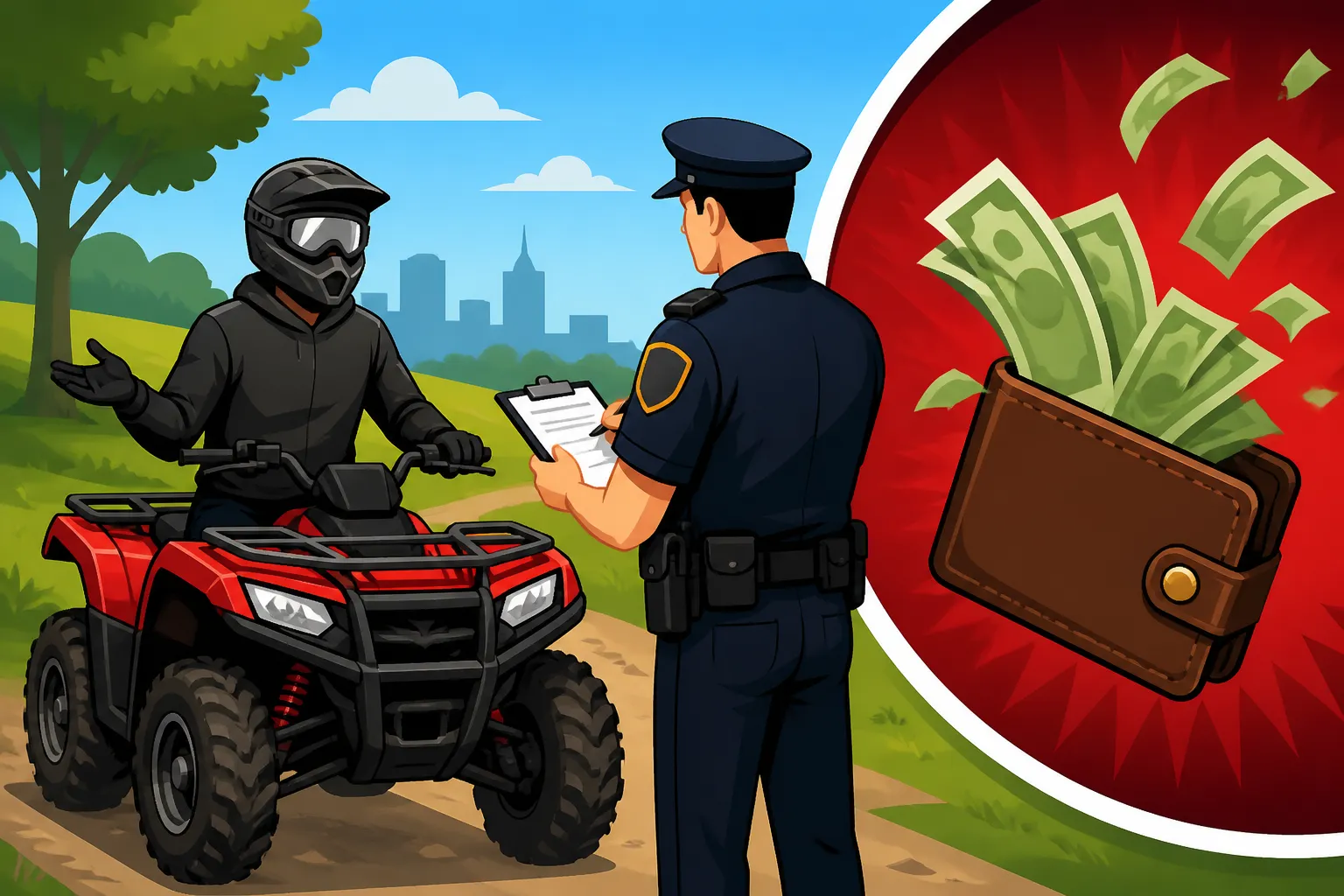
If an officer issues a ticket for riding without a plate, do not assume the matter is resolved by buying a plate afterward. A later purchase may help you comply going forward, but it does not necessarily cancel a ticket for an earlier ride.
First, read the ticket carefully. Check the alleged location, date, time, bylaw or offence cited, response deadline, and instructions for payment or dispute. Do not ignore a deadline while trying to get an explanation. If the citation is unclear, contact the issuing authority or the office listed on the ticket and ask how to obtain the bylaw wording and the process for responding.
Next, make a factual record while details are fresh:
- Where the machine was stopped and the route taken
- Whether the area was clearly marked
- Whether you had a plate or permit, and where it was displayed
- What the officer said about the rule
- Any photographs, maps, receipts, or messages that help establish the circumstances
- The names of people who were with you, if relevant
If you believe the ticket is mistaken, follow the dispute process shown on the ticket. Do not rely on a general argument that Saskatchewan does not register ATVs: a local bylaw may still require a local plate on municipal land. A relevant question is whether the bylaw applies to the exact place and machine involved, and whether the alleged conduct matches the rule.
If the ticket appears to be for riding in a prohibited area rather than lacking a plate, paying for a plate may not address the allegation. The same is true if the concern is insurance, unsafe operation, or another local or provincial requirement. Identify the specific offence rather than treating every ticket as a registration issue.
If you do not understand the process or the consequences, get advice from a qualified professional. A ticket can have response steps and deadlines that are not obvious from a brief description. Do not assume that an informal conversation with an officer or municipality replaces the official process.
The best prevention is to separate three questions before riding: Is the machine allowed on this route? Is a local plate required here? And do you meet all other operating requirements? A “yes” to one does not answer the others.
Frequently Asked Questions
Is the $300 fine charged across all of Saskatchewan?
No. The $300 amount is associated with a local no-plate rule and should not be treated as a province-wide fine. Check the current bylaw for the municipality and land where you plan to ride.
Does every ATV or UTV need a municipal plate?
No. Saskatchewan does not have one general provincial ATV plate requirement, and local schemes are not universal. A municipality may require a plate for certain land or routes. Confirm that the rule covers your machine and location.
Will a municipal plate let me ride on any local road?
No. A plate does not override road restrictions, closures, speed limits, private-property boundaries, or other bylaw conditions. Confirm that the specific route is open to ATVs or UTVs.
Does an out-of-province plate count?
Not automatically. A home-province plate or registration may not satisfy a local Saskatchewan permit rule. Ask the municipality whether it recognizes the document for that specific area.
If I buy the plate after getting ticketed, does the fine go away?
Do not assume so. Buying a plate may help you comply in the future, but it does not automatically cancel a ticket. Follow the response instructions and deadline on the citation.
Disclaimer
This article is for general informational purposes only and does not constitute professional advice. Laws, prices and regulations vary by location and change over time. Consult a qualified professional for guidance on your specific situation.