Which Municipalities Actually Sell You a Quad Plate
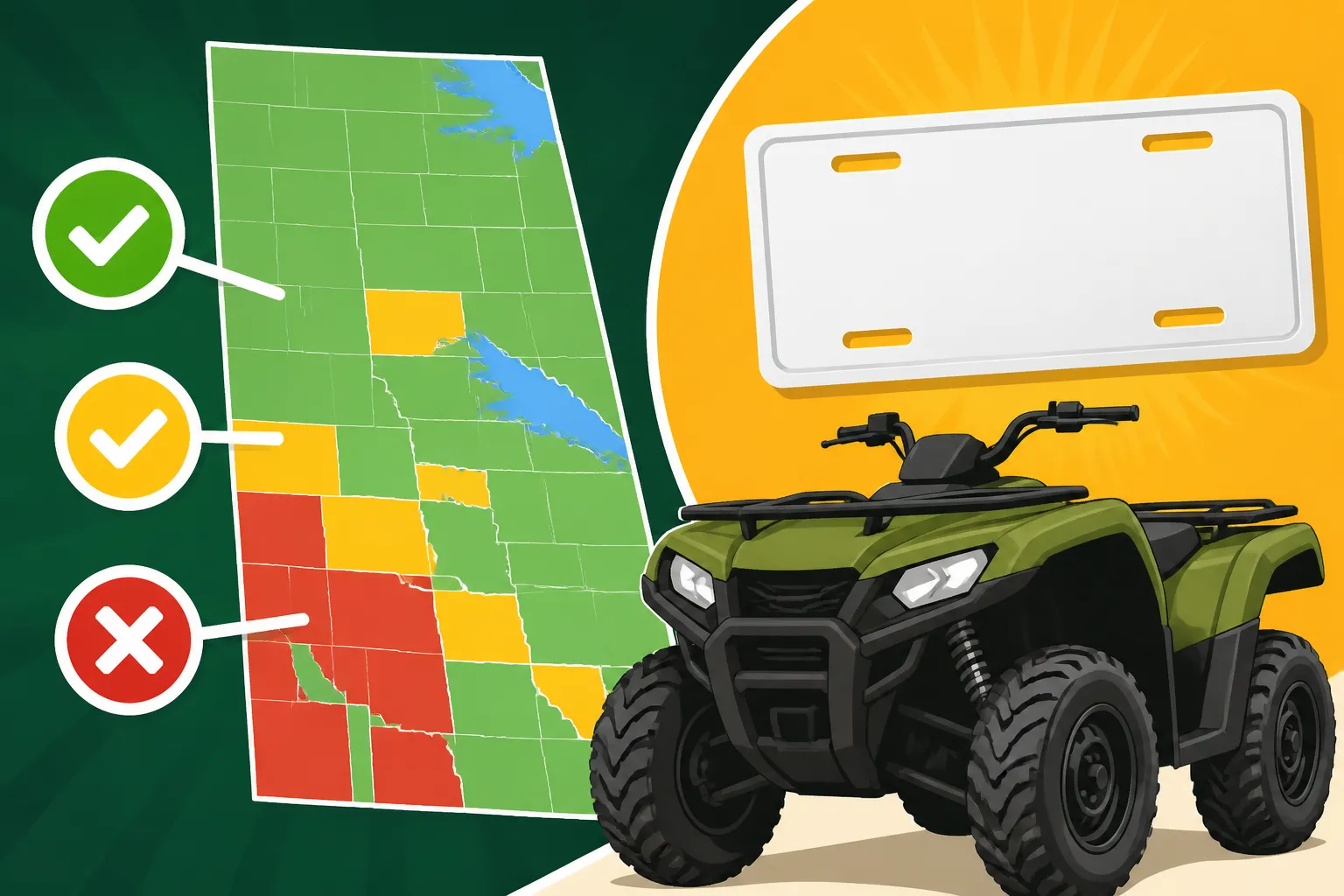
A Saskatchewan rider looking for a quad plate can run into a confusing mix of municipal schemes, local permits and provincial rules. The key point is that Saskatchewan does not issue a province-wide ATV plate. A small number of local governments have their own systems, and a local plate or permit applies only where that municipality’s rules allow it.
The short answer: municipal plates are local
There is no single provincial office where you can buy a quad plate for riding throughout Saskatchewan. The province does not register ATVs in the way it registers some other vehicles, and a municipal plate is not a provincial registration document. Local plates and permits exist to serve local purposes, such as regulating or supporting riding within a particular municipality.
Two clear examples to check are the District of Lakeland No. 521 and the Resort Village of Candle Lake. The District of Lakeland has a municipal plate scheme. Candle Lake has a local ATV permit system, and materials about it may use the words “permit” and “plate” in ways that sound similar. Check with the issuing office to confirm what document it currently provides and where it is valid.
| Local government | Local system to ask about | What the rider should verify |
|---|---|---|
| District of Lakeland No. 521 | Municipal ATV plate | Eligibility, permitted areas, current cost, expiry and renewal process |
| Resort Village of Candle Lake | Local ATV permit or plate | Where it may be used, who can obtain it, current cost and how to display it |
| Another municipality | A possible local scheme, if one exists | Whether the municipality issues anything at all and what its bylaw permits |
These examples should not be treated as a list of every local scheme, or as confirmation that every scheme is open to every rider. Municipal programs can change, and one municipality’s plate does not automatically work in another. For an overview of how local systems differ from provincial registration, see Saskatchewan Municipal ATV Plates Explained and Saskatchewan Has No ATV Plate or Decal.
The distinction matters because a plate can look official without giving broad riding permission. It may identify a machine in a local program, satisfy a local bylaw in certain places, or be tied to use of local trails or roads. It does not, by itself, make an ATV legal to operate on every road, trail, Crown land area, park or private property in Saskatchewan.
Before making a trip to an office, contact the municipality that controls the area where you plan to ride. Ask whether it issues a plate or permit now, whether you qualify, where it applies, and what proof or paperwork you need. If you are looking at a particular system, Does a Lakeland Plate Work at Candle Lake? addresses why a document from one local program should not be assumed valid in another.
The two local systems to check first
District of Lakeland No. 521
The District of Lakeland operates a municipal ATV plate scheme. That makes it a practical first call for riders whose plans involve the district. It does not mean Lakeland plates are a substitute for provincial registration, or that they authorize riding anywhere outside the district’s rules.
Ask the district’s office for the current bylaw and application details before purchasing or renewing a plate. In particular, confirm:
- Whether the scheme is available to you, based on where you live or where you intend to ride.
- Which roads, trails or other areas the plate covers.
- Whether any areas are expressly prohibited.
- What documents the office needs to issue a plate.
- How the plate must be displayed.
- When it expires and how renewal works.
- Whether the plate is linked to a particular machine or owner.
The expiry date is especially easy to overlook. Do not assume that a plate remains valid indefinitely or that its renewal date matches your insurance policy, riding season or another municipality’s schedule. For current details, see Saskatchewan Lakeland Plate Expiry in April and Saskatchewan Municipal Plate Renewals.
Even with a valid Lakeland plate, the rider must obey the rules that apply to the specific route. Local authorization may be limited to particular roads or areas, and it does not override provincial rules, land restrictions, signs or private-property permission. Check the applicable restrictions before riding, including [Saskatchewan Municipal Prohibited Areas].
Resort Village of Candle Lake
Candle Lake has a local ATV permit system. Riders may hear the local document described as a plate, but the important question is not the label: it is what the village currently issues and what its rules allow the holder to do.
Contact the village office before you buy, renew or travel with an ATV. Confirm whether the permit is available to residents, visitors or both; which areas it covers; what display requirements apply; and whether there are separate restrictions for roads, beaches, lakeshores or other locations. A permit does not mean every street or shoreline is open to ATVs.
Also ask where and when permits can be obtained. Office hours, payment options and collection arrangements can affect a trip, especially if you plan to arrive with a trailer and ride the same day. The local details are covered in Saskatchewan Candle Lake Permit Fees and Picking Up a Plate at the Candle Lake Office. Confirm any current cost and process directly with the village.
What about other towns and rural municipalities?
A municipality may regulate ATV use without selling a plate. It may instead permit or prohibit riding on specified roads, set operating conditions, or rely on provincial rules and landowner permission. So a bylaw that allows some ATV use does not necessarily mean there is a local plate to buy.
Do not infer that a nearby town or rural municipality runs a scheme just because another one does. Call the municipal office and ask directly: “Do you issue an ATV plate or permit, and what places does it authorize me to ride?” If the answer is no, ask which bylaw or authority controls the route you have in mind. Saskatchewan Rural Municipalities and Plates explains why municipal approaches can differ.
How to find out whether a plate is available and valid
A useful search result or a neighbour’s old permit may point you in the right direction, but neither confirms that a scheme is current or applies to your machine. Use the issuing municipality as the final source for its own plate or permit rules.
Ask the office specific questions
A general question such as “Do you have ATV plates?” may not get you all the information you need. Use a short checklist:
- Do you currently issue an ATV plate or permit? Ask whether it is a plate, permit, sticker or another document. Local terms may differ.
- Who can apply? Find out whether applicants must live in the municipality, own property there, be visiting for a defined purpose, or meet other conditions.
- Which machine does it cover? Ask whether the scheme applies to your ATV or side-by-side and whether there are machine-specific restrictions.
- Where is it valid? Request the areas, roads or routes covered, along with any maps or bylaw references.
- What is excluded? Ask about prohibited roads, beaches, parks, trails, private land and other restricted areas.
- What documents are required? Confirm whether you need identification, proof of ownership, insurance information or other paperwork.
- What does it cost, and how do you pay? Municipal charges and payment methods can change, so check directly rather than relying on an old post or receipt.
- How must it be displayed? Ask where the plate or permit belongs and whether the municipality expects any additional document to be carried.
- When does it expire? Confirm the expiry date and renewal process before assuming it will cover a full season.
- Does it apply to a visitor or an out-of-area rider? Get a clear answer for your circumstances, not just a general statement that “ATVs are allowed.”
If the office directs you to a bylaw, read the relevant parts rather than relying only on a summary. The bylaw may specify particular streets or operating conditions, and those details can matter more than the fact that a permit is available.
Check the exact route, not just the municipality name
A plate may be issued by a municipality but not cover every location within its boundaries. A road may be excluded, a trail may be managed under separate rules, or a piece of land may be privately owned. Permission for one route should not be treated as permission for the whole region.
If a trip crosses a municipal boundary, check the rules on both sides. Do not assume that the plate remains valid just because the next area is nearby or connected by the same road. When a route passes through a provincial park, Crown land, a grazing lease or private land, separate access rules may apply. Start with Saskatchewan Municipalities With ATV Bylaws for the local-law question and Saskatchewan Crown Land Access Rules for Crown land access.
Keep the answer in a useful form
If the municipality confirms that a permit applies to your trip, keep a note of the office’s instructions, the relevant bylaw or map, and any required paperwork. A copy of the permit can be useful, but it is not a substitute for proof that you own the machine, proof of insurance or any other document required for the ride. For the ownership side, see Saskatchewan Proof of Ownership on the Trail.
A municipal plate does not replace other riding requirements
It is easy to focus on the visible plate and miss the rules that apply to operating the machine. A local plate or permit is only one possible requirement. It does not automatically replace provincial obligations, insurance, road-use rules, age restrictions, equipment requirements or permission to use the land.
Provincial rules still matter
Riders must follow Saskatchewan’s applicable ATV operating rules even when they have a municipal plate. Requirements can cover matters such as who may operate the machine, insurance, helmets, lighting, passengers and how an ATV may be used on or near a road. Local rules can add restrictions, but a municipal document does not cancel provincial requirements.
Check the rules for the kind of trip you plan to take. An ATV permitted on a designated municipal route is not thereby permitted to travel on every highway or road. The broader road-use rules are explained in Saskatchewan ATV Road Rules Explained.
Insurance and ownership documents serve different purposes
A plate or permit is not proof of insurance, and it does not establish ownership by itself. Carry any insurance proof required for your ride and keep ownership records available. If you bought the machine used, a bill of sale and reliable serial-number information can help document the transaction. Saskatchewan Insurance Requirements for Riders explains the insurance question; Saskatchewan Bills of Sale Do the Work covers the ownership paperwork.
This distinction matters if an officer, land manager or local authority asks to see documentation. The municipal plate may answer one question, such as whether you have obtained a local permit. It does not necessarily answer whether the machine is insured, whether you own it, or whether you may ride in the place where you have stopped.
Land access is separate from local permission
A municipality cannot grant you permission to cross private land simply by issuing a plate. Nor should a plate be treated as permission to use a grazing lease, a Crown land area with restrictions, or a trail managed by another organization. Check the landowner or managing authority and follow posted signs and closures.
For a route that involves private property, get permission from the landowner before riding. For Crown land, confirm whether the area is open and whether an order or other restriction applies. [Saskatchewan Private Land Permission] and Saskatchewan Crown Land Riding Explained are useful starting points.
A practical checklist before paying for a plate
Before buying a local plate or permit, work through these steps. They help avoid paying for a document that does not cover your ride or arriving at a trailhead without the paperwork you need.
- Write down your route. Identify the municipality, roads, trailheads and land types you expect to use. “Near Candle Lake” or “in Lakeland” may not be precise enough.
- Contact every relevant local office. Ask whether it issues a current ATV plate or permit and whether your route falls within the scheme.
- Get the rules for your machine and situation. Clarify whether the scheme covers your ATV or side-by-side, and whether visitors can apply.
- Confirm costs and payment details with the issuer. Do not rely on an old price, an online comment or the cost paid by another rider.
- Check the expiry and renewal conditions. Make sure the document will be valid for the planned dates and find out what happens when it expires.
- Ask how to display or carry it. Follow the municipality’s instructions rather than guessing from another rider’s setup.
- Check insurance and ownership paperwork separately. Keep the documents needed to establish coverage and ownership.
- Review provincial and land-access rules. A local plate cannot open a closed trail, park area, road or private property.
- Check for closures before setting out. Fire restrictions, temporary closures and local notices can affect access even when your permit is current.
- Reconfirm if the trip is later in the season. Rules and office procedures can change; a past visit does not guarantee the same conditions now.
If you cannot get a clear answer, do not treat silence as approval. Ask the office which bylaw applies or who manages the route. If the municipality does not issue a plate, that does not automatically mean ATV riding is prohibited there; it means you need to determine what local and provincial rules govern your intended use.
Frequently Asked Questions
Is there a Saskatchewan-wide quad plate?
No. Saskatchewan does not issue a province-wide ATV plate. Some municipalities operate local plate or permit systems, but their documents apply according to local rules.
Which municipalities should I contact first?
The District of Lakeland No. 521 and the Resort Village of Candle Lake are two clear local systems to check. Confirm current availability, eligibility and permitted areas with each office.
Can I use a Lakeland plate at Candle Lake?
Do not assume so. A plate or permit issued by one municipality does not automatically apply in another. Ask both offices about your specific route.
Does a municipal plate prove that my ATV is insured?
No. A local plate or permit and insurance are separate. Carry the insurance proof required for your ride and check the rules that apply to your route.
If a municipality has no plate, can I still ride there?
Possibly, but a lack of a plate scheme is not permission to ride. Check the local bylaw, provincial rules, land access and any closures for the specific place you plan to use.
Disclaimer
This article is for general informational purposes only and does not constitute professional advice. Laws, prices and regulations vary by location and change over time. Consult a qualified professional for guidance on your specific situation.