Saskatchewan Registers Snowmobiles, Not ATVs
It's incredibly frustrating, isn't it? You buy an ATV, excited to hit the trails or get some work done around the farm, and then you try to do the "responsible" thing and register it with the province, only to find a complete dead end. Everyone knows you have to register your snowmobile, so why is it so different for your quad? This guide is here to clear up that confusion, explaining why Saskatchewan has no provincial ATV registry, what paperwork actually does matter, and how to navigate ownership and transfers in this unique system.
The Core Truth: No Provincial ATV Registration in Saskatchewan
Many new riders, or even long-time ones, hit a wall when they try to register their ATV with the province. They go online, call SGI, and come up empty-handed. It's frustrating when you're trying to do things "by the book," but the book just doesn't seem to exist for quads here. You're left wondering if you've missed something, or if there's some secret office you're supposed to visit.
The simple, often surprising, truth is that [Saskatchewan Does Not Register ATVs] at a provincial level. This isn't an oversight; it's how the system is set up. You won't find a provincial registration office, a special form, or an annual fee to register your quad with the province of Saskatchewan. This fundamental difference sets ATVs apart from other common vehicles in the province.
This can feel really counter-intuitive, especially if you've lived in other provinces or if you're familiar with how vehicles like cars, trucks, and even snowmobiles are handled here. It leaves a lot of riders scratching their heads, wondering how to prove ownership or follow the rules when there doesn't seem to be a central authority for their machine. It’s a reality that creates a lot of questions for both buyers and sellers.
The [Saskatchewan's All Terrain Vehicles Act] runs 36 sections and was established to govern the safe operation of ATVs. Surprisingly, none of those sections lay out a provincial registration requirement for the machines it covers. It's a key distinction that shapes how all other ATV-related paperwork and responsibilities are handled in the province. Understanding this legislative void is the first step to making sense of the system.
Understanding Saskatchewan's Unique Approach to ATVs
Saskatchewan's approach to ATVs stands out among Canadian provinces, largely due to this lack of a centralized registry. For many other types of vehicles, the provincial government maintains detailed records of ownership, facilitating everything from law enforcement efforts to tax collection and consumer protection. ATVs, however, operate in a distinct administrative category.
This unique stance means that the traditional methods of verifying ownership or tracking a vehicle's history, which rely heavily on a provincial database, simply don't apply to ATVs here. When you buy or sell a quad, you won't be visiting an SGI office to transfer a title or update a registration. The process is much more decentralized and relies heavily on private documentation.
It's a system that places a greater onus on the individual owner to maintain meticulous records. Unlike a car that has an SGI registration history, an ATV's ownership chain is primarily established through private transactions and the documents exchanged during those sales. This can be a significant point of stress or confusion for new owners or those accustomed to more structured systems.
This administrative reality has profound implications for every aspect of ATV ownership, from proving you own it, to ensuring it's not stolen, to selling it down the road. It means riders need to be proactive and informed, rather than relying on a provincial body to manage these details for them.
Why No Province-Wide Quad Plate Is Issued
The decision to not register ATVs at a provincial level isn't new; it's been the status quo for a very long time. Unlike snowmobiles, which have a provincial registry with corresponding plates and fees, ATVs were treated differently when the legislation was first crafted. This divergence has created a distinct regulatory landscape for quad owners in Saskatchewan that has persisted for decades.
Without a centralized registry, there's no official provincial database of ATV owners, no provincial plate to affix, and no standard annual renewal process. This lack of a system directly impacts how theft is tracked, how ownership changes hands, and even how municipalities approach local regulations. It's a constant point of discussion among riders and officials alike, with many advocating for change.
Many riders express a desire for a provincial system, often for reasons of theft prevention, ease of ownership transfer, or simply to bring ATVs in line with other recreational vehicles. However, until the provincial government decides to implement such a system, riders must understand and navigate the current framework. You can't get a provincial quad sticker to buy because it simply doesn't exist, which can be perplexing for those coming from other jurisdictions.
This historical policy choice is often tied to [Why Saskatchewan Never Built a Quad Registry] in the first place, potentially stemming from how ATVs were initially perceived and used when the Act was developed. Their prevalence as farm implements or tools for remote work might have led to a different regulatory path compared to dedicated recreational vehicles like snowmobiles.
Why the Confusion Exists: Snowmobiles Versus ATVs
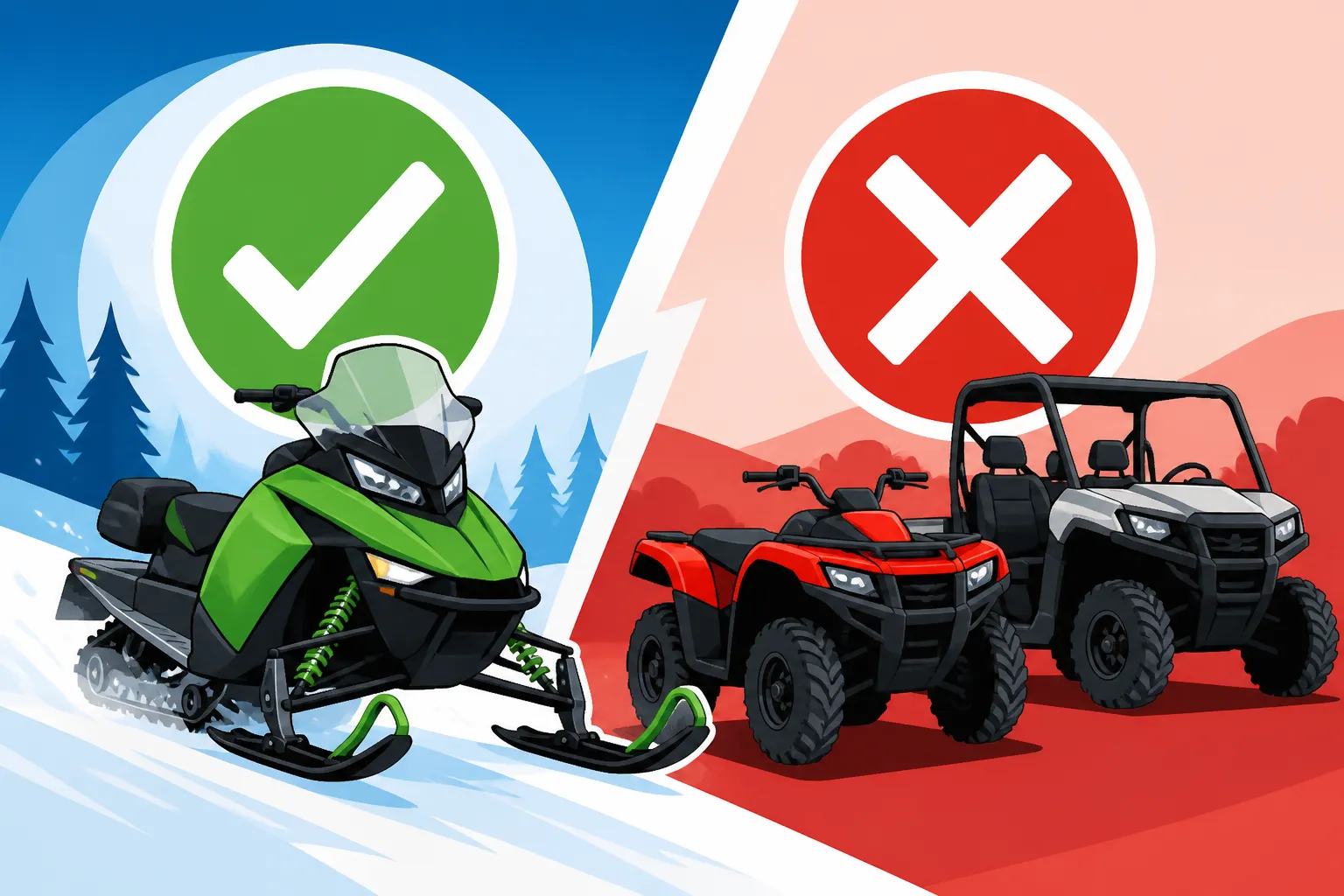
This is where a lot of the confusion really starts to brew for riders in Saskatchewan. You buy a snowmobile, and it's crystal clear: you have to register it with SGI. You get a registration card, a decal, and it's a routine part of getting your sled ready for winter. This established process just makes sense to most people, offering a clear path to legal ownership and operation.
The process for snowmobiles is straightforward and widely understood. You head to an SGI issuer, provide your details, pay a fee (which often includes liability insurance!), and boom, you're registered. This established system offers a sense of security and accountability that many ATV owners wish they had for their machines, leading to the frequent question: "If snowmobiles need it, why not quads?"
The presence of this clear, mandatory registration system for one type of off-road vehicle (snowmobiles) but not another (ATVs) creates a significant mental hurdle. Riders naturally assume that if one requires it, the other surely must too. This disparity is often the root cause of countless inquiries to government agencies and dealerships, leading to frustration when the answer is "no."
For example, [A Saskatchewan Snowmobile Registration Runs $150 a Year] and crucially, it comes with [Two Hundred Thousand of Liability Bundled In]. This comprehensive package highlights just how different the approach is for snowmobiles compared to the complete lack of provincial registration for quads, making the distinction even more stark for residents.
The Striking Contrast: Snowmobile Registration
When you consider the robust provincial registration system for snowmobiles, the absence of one for ATVs becomes even more puzzling. For snowmobiles, the registration process isn't just about identification; it's a comprehensive package that includes mandatory liability insurance, ensuring that riders are financially protected in the event of an accident. This provides a baseline of responsibility and safety across the province.
The provincial snowmobile registry also offers a central point of data for law enforcement, helping to track stolen machines and investigate incidents. This centralized approach simplifies administration and provides a clear framework for all snowmobile owners, making it easy to understand what's required and how to comply. It's a system that works efficiently for the vast network of snowmobile trails and recreational use.
This clear-cut system means that when you purchase a snowmobile, whether new or used, the transfer of ownership goes through SGI, providing a verifiable record of who legally owns the machine. This level of oversight offers peace of mind for buyers and sellers, as well as helping to deter theft by making it harder to sell a stolen sled without proper documentation.
Ultimately, the contrast between the two systems highlights that the provincial government is capable of implementing and managing a comprehensive off-road vehicle registry. The fact that it exists for snowmobiles, but not ATVs, underscores the deliberate nature of the current regulatory divide. [Saskatchewan Snowmobile Registration Compared] to ATVs shows two very different philosophies at play.
Historical Reasons for the Regulatory Divide
While the exact historical reasons for this divergence aren't always explicitly stated in easily accessible documents, it likely stems from the era in which the respective legislation was first developed and the prevailing attitudes towards these machines at the time. Snowmobiles gained popularity earlier as recreational vehicles used on defined trails, prompting a need for a structured system for safety, land access, and funding for trail development.
ATVs, on the other hand, initially often seen more as utilitarian farm or work machines, might have been given a different classification or had their recreational aspects come to prominence later in the regulatory timeline. For decades, the primary use of ATVs was often on private land or for specific agricultural and industrial tasks, making a universal provincial registry perhaps seem less urgent to policymakers at the time.
This initial categorization or oversight could be why the provincial government never established a dedicated ATV registry, setting them on separate paths from snowmobiles. As the recreational use of ATVs exploded, the existing framework remained, creating the current situation where local solutions or private documentation fill the gaps.
This difference means that while snowmobile organizations often work closely with SGI on trail development and safety initiatives (with funding often derived from registration fees), ATV enthusiasts don't have that same direct provincial registration link. It's a key factor in why the riding community continues to lobby for a change, hoping to bring ATVs under a similar, more unified provincial framework that could also support trail infrastructure.
What Replaces a Provincial Registration? Proof of Ownership
Since there's no provincial registration certificate or title for an ATV in Saskatchewan, your bill of sale becomes the single most important document you possess. This piece of paper is your definitive proof that you legally own the machine. Without it, you could face significant challenges proving your right to the quad, especially if it's ever stolen or involved in an incident.
Think of your bill of sale as your ATV's birth certificate and deed rolled into one. It needs to clearly identify the buyer and seller, the date of the sale, the purchase price, and most critically, a full and accurate description of the ATV, including its make, model, year, and its Vehicle Identification Number (VIN) or serial number. [Your Bill of Sale Stands In for a Registration] in every practical sense, serving as the official record of transfer.
If you're buying from a private seller, it's absolutely crucial that you ensure this document is comprehensive and properly filled out. Don't accept a scrap of paper with just a name and a price. Insist on a detailed bill of sale, and keep it safe! This document will be essential for insurance claims, future sales, or any situation where ownership needs to be verified. Many reliable templates are available online from sources like LawDepot.
Without a registry, there's no central database to check ownership against. So, a solid [Saskatchewan Bills of Sale Do the Work] to protect both the buyer and the seller, establishing a clear chain of custody for the machine. This emphasis on detailed private documentation is a cornerstone of ATV ownership in the province.
The Bill of Sale: Your Most Important Document
The bill of sale is not just a formality; it's the legal document that formalizes the transfer of ownership of your ATV. Without a provincial registry to issue a title, this document carries immense weight. Imagine trying to report a stolen ATV without proof you ever owned it, or trying to sell your quad years down the line without a clear paper trail – it would be incredibly difficult and fraught with potential disputes.
A proper bill of sale should include the full legal names and contact information of both the buyer and the seller. It's also vital to include the date of the sale, the agreed-upon purchase price, and a clear statement that the seller is transferring full ownership, free of any liens or encumbrances. This protects both parties by documenting the terms of the agreement.
The most critical details, however, relate to the ATV itself. This includes its make, model, year, colour, and most importantly, its unique Vehicle Identification Number (VIN) or serial number. This number is what definitively identifies the machine and ties it to the transaction. Double-check that the VIN on the bill of sale matches the physical VIN stamped on the ATV's frame. Any discrepancy could cause major problems later on.
It's also a good idea for both the buyer and seller to sign and date the bill of sale, and perhaps even have a witness sign it. Keep the original in a safe place, and carry a copy with you when riding. If you ever have to prove ownership, this document will be your primary evidence, making it the most critical piece of [Saskatchewan Proof of Ownership Without a Registry].
Other Key Documents to Keep Handy
Beyond the bill of sale, there are a few other documents that, while not strictly "registration," are incredibly useful to have and can act as supporting evidence for your ATV's history and ownership. If you bought your ATV new from a dealer, you'll likely have a new vehicle information statement (NVIS) or similar manufacturer's certificate of origin. This document proves the ATV has never been registered before and is essential for its first sale, providing a clear starting point for its ownership history.
Your insurance policy is another non-negotiable document. While ATVs don't have mandatory provincial registration that bundles insurance like snowmobiles do, all operators are required to carry liability insurance. Having your proof of insurance readily available is vital, especially if you encounter a peace officer or are involved in an accident. [Saskatchewan Insurance Requirements for Riders] are clear and non-negotiable, and carrying proof is mandatory.
Any past service records, owner's manuals, or even photographs of the ATV can also serve as supporting documentation for ownership and condition. While not primary proof, they contribute to a comprehensive record. For instance, if a dispute arises, showing a continuous record of maintenance under your name helps to solidify your claim of ownership.
When selling, providing a buyer with a full history – including the original bill of sale, maintenance records, and proof of any past lien releases – adds confidence and legitimacy to the transaction, even without a provincial title. A well-documented ATV is always easier to sell and helps establish [How to Prove You Own an ATV in Saskatchewan] effectively.
Municipal Plates: A Local Solution to a Provincial Gap
While the province doesn't issue ATV registration, some individual municipalities and rural communities in Saskatchewan have taken matters into their own hands. These local governments, particularly those with a high volume of recreational ATV use, have implemented their own permit or plate schemes. This is a crucial distinction that can catch many riders off guard if they aren't aware of the specific local rules.
The primary reason these municipalities create their own systems is often to manage local road access, generate revenue for trail maintenance, or simply to have a better handle on the ATVs operating within their specific boundaries. These local rules are designed to address the specific needs and concerns of that community, whether it's managing noise, ensuring safety on local roads, or funding local infrastructure.
If you plan to ride your ATV in certain towns or rural municipalities, you might find yourself needing to acquire one of these local plates or permits. For example, many resort villages or areas with significant seasonal populations often have such bylaws in place to regulate the influx of recreational vehicles. Ignoring these local requirements can lead to fines and other penalties, despite the lack of provincial registration.
It's absolutely critical to check the specific bylaws of any municipality you plan to ride in. What's perfectly legal in one RM might require a permit just a few kilometres down the road. These municipal plates are not provincial; they only hold sway within that specific jurisdiction. [Municipal Plates Fill the Gap the Province Left] by creating a layer of local accountability and management for ATV use.
When a Local Plate Becomes Necessary
The need for a local plate or permit typically arises when you intend to operate your ATV within the boundaries of a specific municipality that has enacted such a bylaw. This usually applies to riding on municipal roads, designated trails within the municipality, or sometimes even in ditches or other public areas within their jurisdiction. It's a departure from the provincial non-registration rule, creating a patchwork system across the province.
For residents and visitors alike, understanding these localized requirements is paramount. You might have your ATV insured and your bill of sale handy, but if you're riding in a municipality with a plate bylaw and don't have one, you could still be issued a ticket. These bylaws are often enacted to address issues like traffic safety, noise control, and accountability for machines operating on municipal infrastructure.
These local permits often serve as a funding mechanism. The fees collected from these plates can directly support local initiatives, such as the development and maintenance of ATV trails, signage, or other recreational amenities. This provides a direct benefit to the local riding community and helps manage the impact of ATV use on local resources.
Therefore, before you load up your quad and head to a new riding area, particularly a resort village or an organized rural municipality, take a few minutes to contact their municipal office or check their website for any specific ATV bylaws. It's the best way to avoid an unexpected fine and ensure you're riding legally and responsibly within their jurisdiction.
Examples of Municipal Plate Schemes
A good example of a municipality with its own ATV permit system is the Resort Village of Candle Lake, a popular destination for ATV enthusiasts. They require a local permit for ATVs operating within their boundaries, and this permit often comes with specific rules about where and when you can ride, as well as speed limits on certain roads. This system helps the village manage the high volume of recreational traffic and ensures safe cohabitation among all residents and visitors. [Candle Lake Charges $25 for an ATV Permit] as a way to manage local riding and infrastructure, demonstrating how these local schemes can operate.
Another community with its own bylaws and plate requirements is the District of Lakeland. Similar to Candle Lake, their system aims to regulate ATV use on municipal roads and lands, often specifying prohibited areas and conditions of operation. These local schemes often involve an application process, a fee, and the issuance of a physical plate or sticker that must be displayed on your machine. Riders need to be aware that these local rules can be strictly enforced, and ignorance is rarely an excuse for a fine.
The costs and renewal periods for these municipal plates vary widely from one community to another. Some might be annual, others might be valid for a longer period. It's always best practice to contact the specific municipal office before you trailer your quad there to understand their requirements, including where permits can be purchased (e.g., at the village office) and accepted payment methods. [Saskatchewan Municipal Plate Costs] are an important budgeting consideration for many riders who frequent these areas.
These municipal systems highlight the decentralized nature of ATV regulation in Saskatchewan. A plate from the District of Lakeland, for instance, is generally not valid in Candle Lake, and vice-versa. This necessitates riders doing their homework for each specific location they plan to enjoy their machine, which can be an added layer of administrative burden for avid riders who explore different parts of the province.
Navigating Ownership Transfers Without a Registry
Since there's no central provincial registry, buying an ATV from a private seller in Saskatchewan requires extra vigilance. You can't just check with SGI to verify the seller's ownership or if there are any liens on the machine. This means the burden of due diligence falls almost entirely on you, the buyer, to ensure you're making a legitimate purchase and not acquiring a machine with hidden issues.
Always insist on a detailed bill of sale, as discussed, and ensure the seller's name on the bill of sale matches their identification. Furthermore, verify the VIN/serial number on the machine matches the bill of sale. A common issue is a seller who can't produce a clear bill of sale from their own purchase. This should raise a red flag, as it breaks the chain of ownership and makes your claim to the ATV tenuous. [Saskatchewan Paperwork for a Buyer] must be comprehensive and scrutinized carefully.
It's also wise to perform a lien search (such as through the Personal Property Registry, or PPR) yourself, even without a provincial registration. While an ATV isn't registered provincially, a financial institution can place a lien against an unregistered machine using its serial number. This step protects you from inadvertently buying a machine that still owes money, which could be repossessed by a creditor.
If you're [Buying From a Private Seller in Saskatchewan], take your time, ask questions, and don't feel pressured to complete the transaction without all the necessary paperwork. A little caution upfront can save you a lot of headache and potential financial loss later on. LawDepot can provide templates for proper bills of sale, ensuring all the critical details are captured legally and clearly.
Buying from a Private Seller: Due Diligence is Key
When you're looking at a used ATV from a private seller in Saskatchewan, you're essentially stepping into a handshake agreement backed by paper. The absence of a provincial title means that the robustness of your purchase hinges entirely on the documentation you receive and the checks you perform. This is why "buyer beware" is a particularly strong motto in this context.
Beyond the bill of sale and VIN verification, consider asking the seller for any previous service records, owner's manuals, or even old insurance documents. These can all help establish the history of the machine and the seller's legitimate claim to ownership. If the seller can't provide any history, or if their story seems inconsistent, it's wise to be extra cautious.
It's also a good practice to physically inspect the ATV thoroughly for any signs of tampering with the VIN plate or unusual damage that might suggest it's been in a major accident or is part of a chop shop operation. If something feels off, trust your gut. There's always another ATV out there.
Finally, discuss the process of a lien search with the seller. A transparent seller should have no issue with you conducting a PPR search using the ATV's VIN to ensure it's free of any registered financial claims. This simple step is one of the most powerful protections a buyer has in a non-registered system.
Selling Your ATV: Providing Clear Paperwork
When you're the one selling your ATV, your responsibility is to provide the buyer with clear, undisputed proof of ownership. This means having your original bill of sale (or a clear chain of bills of sale from previous owners if you weren't the first owner) ready to go. A well-prepared seller instills confidence in a buyer, especially when a provincial registry isn't there to back things up.
Prepare a comprehensive bill of sale for the new owner, detailing the ATV's information, the sale price, and the date. Both you and the buyer should sign and date it, and it's a good idea to have a witness or even sign in duplicate so both parties have an original copy. Being meticulous here can prevent headaches down the road for both parties, solidifying the transaction's legitimacy.
If you've financed the ATV and paid it off, ensure you have documentation from the lender confirming the loan has been discharged and any lien released. This adds another layer of security for the buyer, showing the machine is free and clear of any financial encumbrances. Providing this full disclosure upfront creates trust and streamlines the selling process.
In essence, when you're selling, you are effectively creating the new "title" for the ATV in the form of the bill of sale. Your thoroughness in providing accurate and complete paperwork will not only help your buyer but also protect you from any future disputes regarding the sale. Remember, without a provincial title, your paperwork is king for establishing [Saskatchewan Proof of Ownership Without a Registry].
The Role of Insurance and Serial Numbers
While provincial registration isn't required for ATVs, liability insurance absolutely is. The [Saskatchewan All Terrain Vehicles Act] mandates that any person operating an ATV on public land, or land other than their own, must have a minimum amount of liability coverage. This is not optional; it's a legal requirement designed to protect you and others in case of an accident.
Unlike snowmobiles, where the basic liability coverage is often bundled with the provincial registration fee, ATV owners must typically acquire a standalone insurance policy from a private insurer. This might be an add-on to your existing homeowner's or auto policy, or a dedicated off-road vehicle policy. Always ensure your coverage meets or exceeds the provincial minimum, which helps protect you from significant financial risk if you're deemed at fault in an incident.
A peace officer can ask to see proof of your insurance at any time, especially if you're operating on public trails, ditches, or roads where permitted. Failing to produce valid insurance can result in fines and other penalties. It's wise to carry a copy of your insurance card or policy document with you whenever you ride. [Saskatchewan Insurance Proof on the Trail] is a must-have, just like it is for any other vehicle.
The serial number (or VIN) is also paramount. In the absence of a provincial registry, this unique identifier is crucial for proving ownership, tracking the machine for insurance claims, and assisting law enforcement. It serves as the primary means of identifying your specific ATV within a system that lacks a centralized database.
Mandatory Insurance Requirements
Understanding your insurance obligations for ATVs in Saskatchewan is non-negotiable. Many riders mistakenly believe that because there's no provincial registration, there are no insurance requirements, but this is a dangerous misconception. The law is very clear: you need liability insurance. This coverage protects you financially if you cause an accident that results in injury to others or damage to their property.
The minimum amount of liability insurance required for ATVs operating off private land is typically specified within the Act or its associated regulations. While this amount provides a basic level of protection, many riders choose to purchase higher limits for increased peace of mind, especially given the potential for significant costs in serious accidents. It’s always a good idea to discuss your options with a reputable insurance broker.
Getting this insurance is usually done through a private insurance company. You might already have a relationship with a broker for your home or car insurance, and they can often add your ATV to an existing policy or help you find a dedicated off-road vehicle policy. Be sure to specifically ask about coverage for ATVs and clarify what scenarios are covered, such as riding on trails versus municipal roads.
Always carry physical or digital proof of your insurance with you when you operate your ATV. If you are stopped by law enforcement, they will ask for it, and being able to produce it immediately can prevent unnecessary delays or fines. This is a simple but vital step in responsible ATV operation in Saskatchewan.
The Critical Importance of the VIN/Serial Number
The Vehicle Identification Number (VIN) or serial number is the unique identifier for your ATV, much like a fingerprint for your machine. In the absence of a provincial registration, this number becomes even more critical for every aspect of ownership and use. It's how your machine is identified for insurance purposes, for lien searches through the Personal Property Registry, and for law enforcement in the unfortunate event of theft.
Before purchasing an ATV, always locate and verify the VIN/serial number on the machine itself. These numbers are typically stamped into the frame or on a durable plate, usually in an easily accessible location. Ensure it matches any paperwork provided by the seller, including the bill of sale. Be extremely wary of machines with defaced, altered, or missing VINs, as this is a very strong indicator of a stolen vehicle or illicit activity.
Recording this number in multiple safe places, not just on your bill of sale, is a smart practice. Consider taking a photograph of the VIN and keeping it on your phone or in a cloud storage account. This can be invaluable if your physical documents are lost or damaged. Some owners even engrave their driver's license number near the VIN as an additional identifier, though this doesn't replace official documentation.
In the unfortunate event that your ATV is stolen, law enforcement will use the VIN to identify and track it. While the lack of a central registry can complicate theft recovery compared to registered vehicles, a clear, untampered VIN and good records greatly assist police in their efforts. It’s the single most important piece of identifying data for your machine, making [Saskatchewan Serial Number Records] absolutely vital for every quad owner.
Dispelling Common Myths and Misconceptions
It’s completely understandable that many riders hold onto common myths and misconceptions about ATV registration in Saskatchewan. When the provincial system is so different from what many expect or what exists for other vehicles, gaps in understanding are bound to occur. One of the most prevalent myths relates to needing a provincial plate for riding in ditches.
Many riders mistakenly believe they need some form of provincial plate to legally ride their ATV in the ditches alongside public roads. This isn't true for a provincial plate, as none exists. What might be true, however, is that certain municipalities have local bylaws that require a permit or plate even for ditch riding within their specific boundaries. This is where the confusion often lies: mistaking a local requirement for a provincial one.
The confusion often arises from observing other vehicles that do require plates, or from misunderstanding the nuances of municipal versus provincial regulations. While you don't need a provincial plate for ditch riding, you absolutely need to comply with the [Saskatchewan ATV Road Rules Explained] and carry valid liability insurance. Ignorance of these rules, whether provincial or municipal, is not an excuse for breaking the law.
Always check local bylaws for the area you intend to ride. What applies in the RM of X might not apply in the RM of Y. It's a patchwork system that requires riders to be diligent about local regulations rather than expecting a single provincial rule for a "ditch plate" that simply doesn't exist on a province-wide level.
"I Need a Plate for My Ditch Rider"
The idea that you need a "ditch plate" for your ATV is a persistent myth that often causes confusion. This stems from a misunderstanding of how provincial versus municipal regulations work. Provincially, there is no such thing as a specific "ditch plate" issued by SGI or any other provincial body for ATVs. Therefore, if you're asked for a provincial ditch plate, you can confidently state that none is issued.
However, the myth gains traction because some local municipalities do have bylaws that require a permit or a local plate for ATVs operating within their specific boundaries, which might include ditches alongside municipal roads. These are strictly local requirements, not provincial ones. It's crucial for riders to differentiate between the two to avoid unnecessary fines.
For example, a rural municipality might have a bylaw stating that any ATV operating on a municipal road allowance (which includes ditches) must have a permit or a municipal plate issued by that specific RM. This plate helps the municipality manage local traffic, address noise complaints, and potentially fund local trail initiatives. It is not, however, a provincial permit for ditch riding across Saskatchewan.
Therefore, when planning a ride that involves ditches, your primary concern should be to verify the bylaws of the specific municipality you're in, rather than searching for a non-existent provincial "ditch plate." Always carry your proof of insurance, adhere to general ATV operation rules, and respect local signage and regulations.
"An ATV Can't Be Financed Without a Title"
This is another common misconception that can deter prospective buyers or cause undue stress for those looking to purchase an ATV. While it's true that traditional vehicle financing often involves a title or registration document that lenders hold as security, financing an unregistered ATV in Saskatchewan is absolutely possible and a very common practice. The lack of a provincial title does not equate to an inability to secure a loan.
Banks, credit unions, and dealerships regularly finance ATVs and UTVs for individuals and businesses across Saskatchewan. They secure their loan by registering a lien against the machine's VIN through the Personal Property Registry (PPR), not by holding a provincial title that doesn't exist. This process is standard for various types of equipment that don't have provincial registrations, such as farm machinery or certain types of heavy equipment.
When you apply for financing, the lender will typically ask for the ATV's VIN, your personal financial information, and they will conduct a credit check. Once approved, they will register their interest in the ATV by recording a lien against its VIN in the PPR. This legally protects their investment by ensuring that if you default on the loan, they have the right to repossess the machine.
So, if you're looking to purchase a new or used quad and need financing, don't let the lack of a provincial title stop you. Reputable dealers and financial institutions are well-versed in [Financing an Unregistered Machine in Saskatchewan] and will guide you through their specific requirements, demonstrating that the system adapts to this unique regulatory environment.
Future Outlook: Is a Provincial ATV Registry Coming to Saskatchewan?
The conversation around implementing a provincial ATV registration system is not new in Saskatchewan. Rider groups, safety organizations, and even some rural municipalities have, for years, advocated for a change. Their arguments often center on enhanced safety, improved theft tracking, a consistent revenue stream for trail development, and bringing ATVs in line with snowmobiles and other registered vehicles that benefit from such systems.
The Saskatchewan All Terrain Vehicle Association (SATVA), for instance, has been a strong voice in this discussion, highlighting the benefits of a province-wide system for both riders and law enforcement. A unified registry would simplify things for everyone, removing the current patchwork of local rules and the general confusion about ownership, making it easier for riders to know and follow the rules.
For many riders, the current system feels like a missed opportunity. A dedicated registration fee, similar to snowmobiles, could generate significant funds that could be directly reinvested into expanding and maintaining designated ATV trails across the province, something many riders desperately want. This revenue could also support safety education programs and other initiatives that benefit the entire ATV community.
The potential for a more organized and accountable riding environment is a strong motivator for proponents of change. It offers the promise of clearer regulations, better enforcement, and a more sustainable future for ATV recreation in the province. [Saskatchewan Lobbying for ATV Registration] continues to be a topic of discussion among stakeholders and the provincial government.
Rider Advocacy for a Unified System
The call for a provincial ATV registry often comes from the very people who spend the most time on their machines: the riders themselves. Many feel that a unified system would bring much-needed clarity and consistency to a landscape currently fragmented by municipal bylaws and the absence of provincial oversight. This collective desire for a more organized approach is a powerful force for potential change.
A primary argument from rider advocacy groups is the benefit to theft recovery. With no central database of ATV ownership, tracking stolen machines is significantly harder for law enforcement compared to vehicles with provincial registration. A registry would provide police with a valuable tool for identifying owners and returning stolen property, giving riders more confidence in their investment.
Beyond security, advocates emphasize the potential for dedicated funding. Imagine if ATV registration fees, much like snowmobile fees, directly contributed to a fund for creating and maintaining designated ATV trails across Saskatchewan. This could transform the riding experience, providing more safe, legal, and enjoyable places for riders to explore, moving away from reliance on private land permissions or less-defined areas.
These groups often engage with provincial politicians and policymakers, presenting their case for why a registry would serve the best interests of riders, rural communities, and overall public safety. Their efforts highlight that the demand for a change to [Why No Province-Wide Quad Plate Is Issued] is driven by a genuine desire for improvement and growth within the ATV community.
Challenges and Considerations for Implementation
Despite the clear benefits articulated by advocates, implementing a provincial ATV registry is not a simple undertaking. It would involve significant legislative changes to [Saskatchewan's All Terrain Vehicles Act], requiring new sections to define registration requirements, processes, and penalties. This alone can be a lengthy and complex process involving extensive consultation and political will.
Beyond legislation, there's the monumental task of creating a new administrative system. This would involve designing and implementing databases, developing registration forms, training staff (likely within SGI), and establishing clear procedures for initial registration, transfers, and renewals. The costs associated with setting up and maintaining such an infrastructure could be substantial, requiring careful budgeting and resource allocation.
There are also practical considerations for integrating existing ATVs into a new system. How would the hundreds of thousands of currently unregistered ATVs be brought into compliance? Would there be a grace period, or would owners face immediate penalties? What would be the registration fee, and how would it be allocated to ensure fairness and effectiveness? Would it include mandatory liability insurance like snowmobiles, requiring integration with the insurance sector? These are complex questions that require careful planning and broad consultation with all stakeholders.
Ultimately, while a provincial registration system for ATVs might seem like a logical step to many, it's a policy decision that requires political will, significant resources, and a careful balancing of various interests. Until such a change occurs, riders in Saskatchewan must continue to navigate the current framework, relying on robust bills of sale, mandatory insurance, and adherence to local municipal bylaws.
ATV vs. Snowmobile Registration: A Clear Difference
To summarize the key differences that often cause confusion for riders, here's a comparison between how ATVs and snowmobiles are treated at the provincial level in Saskatchewan:
| Feature | ATV in Saskatchewan (Provincial) | Snowmobile in Saskatchewan (Provincial) |
|---|---|---|
| Provincial Registry | No | Yes (through SGI) |
| Provincial Plate/Decal | No | Yes (required decal) |
| Proof of Ownership | Bill of Sale (primary) | SGI Registration Certificate |
| Mandatory Insurance | Yes (private policy required) | Yes (bundled with registration fee) |
| Annual Provincial Fee | No | Yes (annual, includes insurance) |
| Lien Tracking | Via VIN/Serial # (PPR) | Via VIN/Serial # (SGI registry, PPR) |
| Local Permits Possible | Yes (municipal bylaws common) | Less common (provincial system is robust) |
| Primary Legislation | The All Terrain Vehicles Act | The Snowmobile Act |
Disclaimer
This article is for general informational purposes only and does not constitute professional advice. Laws, prices and regulations vary by location and change over time. Consult a qualified professional for guidance on your specific situation.