Saskatchewan Fire Ban Lookups
A fire ban can change where you can ride, what you can do at a trailhead and whether a planned trip is worth the drive. For Saskatchewan ATV and UTV riders, the challenge is finding a current notice that applies to the exact area—not just checking a general fire-danger forecast. Use the steps below to check the right authority, read the restriction and recheck before you unload.
Start with the exact riding area
A fire notice is useful only if it covers the place you plan to ride. Start with the trailhead, park, municipality or land area—not a broad search for “Saskatchewan fire ban.” Restrictions can differ between nearby areas because different authorities manage them, and the notice for one location may not apply to another.
Before looking up a ban, write down:
- The trailhead or access point you will use
- The park, municipality, rural municipality or other land area involved
- The routes or destinations on your plan
- Any nearby Crown land, private land or grazing lease you may enter
Then check current information from the relevant official source. Depending on your destination, that may mean the provincial government’s wildfire or fire-ban information, the park authority, a municipality, a rural municipality, or the land manager. If an area has a local office, its staff can help clarify whether a notice covers a specific trail or road.
A province-wide search can be a good first step, but do not assume it answers every local question. A regional map or general status page may not show every municipal order, park restriction or temporary trail closure. Likewise, an old social-media post or a screenshot shared by another rider may be out of date.
Saskatchewan’s wildfire season is generally described as running from April 1 to October 31, but that calendar is not a substitute for checking conditions and current notices. Restrictions can change during the season. For seasonal planning, see Saskatchewan Wildfire Season Rules for Riders and Saskatchewan Fire Season Riding Restrictions.
| Source to check | What it can help confirm | What it may not settle |
|---|---|---|
| Provincial wildfire or fire-ban information | Current regional notices and broader wildfire-related restrictions | Whether a local trail, park route or municipal road has a separate rule |
| Park office or park information | Park-specific closures, permitted routes and local notices | Rules on land outside that park |
| Municipality or rural municipality | Local restrictions, road access and municipal notices | Conditions on provincial or other managed land |
| Land manager or lease contact | Whether access is allowed on a specific area or route | General fire restrictions elsewhere in the region |
| Trail club or local riding group | Recent trail observations and practical access updates | Whether a report replaces an official order |
Use informal updates as a prompt to investigate, not as the final authority. If a club member says a trail is open, check whether the trail is also affected by a current fire notice, park rule or land closure. If official sources appear to conflict, contact the authority responsible for the land before riding.
This matters particularly when a route crosses boundaries. A ride may start on a municipal road, continue through a park or designated trail area, and approach Crown land or a lease. One notice may apply to only part of that route. For general trail access, Saskatchewan Crown Land Riding Explained and Saskatchewan Crown Land Access Rules provide useful context, but current notices still need to be checked for the specific trip.
Check the authority and read the whole notice
Fire-related notices do not all mean the same thing. A fire ban may restrict fires, while a wildfire-related closure or riding restriction may limit access or machine use. A fire-danger rating or weather warning can signal elevated risk without itself stating that ATV riding is prohibited. Read the notice itself and identify what it actually restricts.
When you find a notice, check these details:
- Who issued it? Look for the government body, park authority, municipality or land manager responsible.
- Where does it apply? Read the boundaries, named areas, roads, trails or land descriptions. Do not rely on a map symbol without checking its legend and accompanying wording.
- What activities are restricted? The notice may cover campfires, open burning, access, off-road vehicles, specific trails or several activities.
- When does it take effect? Check the start date and time, and whether it remains in force until lifted or has a stated end time.
- Are there exceptions or conditions? A notice may describe permitted activities or equipment, but do not assume an exception applies to your machine or situation.
- Where will updates appear? Note the official page, office or contact method you will check again before departure.
The word “ban” alone does not tell you whether you can ride. For example, a fire ban focused on open flames may not, by itself, close every ATV trail. A separate order may restrict access or machine use because of wildfire conditions. On the other hand, a trail that is normally open may be closed by an authority even if a general fire-ban page does not list it. The specific wording and the land authority matter.
Do not treat a fire-danger rating as permission to ride, either. A lower rating does not override a posted closure, and a high rating does not automatically tell you which activities are prohibited. Check both the hazard information and the applicable rules.
For Crown land, look for orders or notices that relate specifically to access and use. A fire restriction can affect more than campfires, and access conditions may change independently of what a general fire-ban notice says. See Saskatchewan Fire Bans That Close Riding and Saskatchewan Crown Land Occupant Permission when your route involves land where access depends on a land manager or occupant.
Parks can have their own operating rules and closures. Check the park’s current information before loading the machine, and confirm whether the route you intend to use is designated for ATV or UTV riding. A park being open to visitors does not necessarily mean every trail or road is open to off-road machines.
If a notice uses a broad description such as a district, zone or named area, confirm that your trail falls inside it. When the boundary is unclear, contact the issuing authority. A quick call or message before leaving can prevent an avoidable trip—and help you avoid riding somewhere that has been closed for safety.
Understand what the notice means for an ATV or UTV
Once you find a current restriction, match it to your planned activity. Do not rely on assumptions such as “we are only passing through,” “we will not make a fire,” or “the machine is stock.” The order may regulate access or vehicle use regardless of whether you intend to stop, camp or use an open flame.
Separate these questions:
- Is the area open to riders? Check for a closure or order that limits access.
- Is the route open to machines? A park or land area may remain open to other visitors while certain trails or roads are closed to off-road vehicles.
- Are particular activities prohibited? A notice may address fires, cooking, smoking, equipment or other sources of ignition.
- What are your responsibilities while riding? Fire prevention duties may apply even when there is no local riding closure.
- Does the restriction cover the whole trip? Confirm each jurisdiction and land type along the route.
A riding restriction and a fire-prevention duty are related but not interchangeable. Even when riding is allowed, riders should take reasonable steps to avoid starting a fire. Hot components, exhaust, sparks, dry vegetation and debris caught on a machine can create hazards. Check the applicable rules and keep the machine maintained; a current notice does not replace your responsibilities under fire-related laws and regulations. For more detail, see Saskatchewan Wildfire Act Duties for Riders.
Inspect the machine before setting out and during the day. Clear dry grass, leaves and other combustible material from areas where it can collect, especially around the engine and exhaust. If the machine has been used in tall, dry vegetation, stop in a safe place and check again. Do not park over dry grass or leave a hot machine unattended in a combustible area.
Carry equipment suitable for the ride and any applicable requirements. A shovel or extinguisher can be useful in an emergency, but carrying equipment does not give you permission to ride in a closed area or disregard an order. Check Carrying a Shovel and an Extinguisher on Board for practical preparation, and [Saskatchewan Wildfire Penalties for Riders] for why fire-related rules should be taken seriously.
If your route includes private land or a grazing lease, confirm access separately. Permission to cross land does not necessarily override a fire restriction, and a fire notice does not grant permission to enter. Check with the appropriate landowner or lease contact and respect gates, signs and closures. Saskatchewan Grazing Lease Access Rules explains the separate access question.
When an order is unclear, do not try to infer an exception from a short headline or a social post. Ask the issuing authority whether the notice applies to your machine, route and planned activity. Keep the answer with your trip notes if the clarification is important, and follow any posted signs at the entrance.
Recheck before departure and have a backup plan
Fire information can change after you first make plans. Check the official source again on the day you travel, especially after hot, dry or windy conditions, or when wildfire activity is nearby. If you are heading to a remote trailhead, do not wait until you have unloaded to discover that the access route or riding area has closed.
A practical pre-ride routine is:
- Confirm the destination and every land area on the route.
- Check the current provincial wildfire or fire-ban information.
- Check the park, municipality or land manager’s own notices.
- Read the full order, including its boundaries, dates and activity restrictions.
- Contact the responsible office if the map or wording is unclear.
- Recheck shortly before departure and again at the trailhead if service is available.
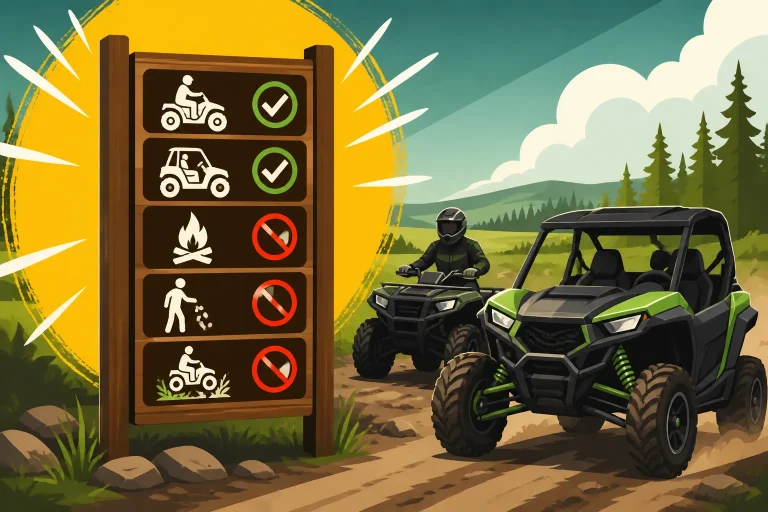
- Follow signs and directions on site, even if an online page appears unchanged.
If a closure appears after you have started travelling, do not ride around a gate, barrier or posted restriction to reach the trail. Use a lawful alternate destination only after confirming that it is open and that you have permission to access it. A nearby trail is not automatically a suitable substitute; it may be under a different authority or subject to its own restrictions.
Plan a backup route before leaving home. Choose another area within a reasonable distance, then check that area’s status and access rules as carefully as the original destination. That way, a closure does not pressure the group into making a rushed decision at the trailhead.
For remote rides, save the official information or contact details before entering an area with poor service. A downloaded screenshot can help you remember what you checked, but it cannot prove that a notice is still current. If you have no reliable way to confirm a fast-changing restriction, choose a lower-risk plan or postpone the ride.
Do not rely on a single app, map or social-media group as the final word. Digital tools may help you locate information, but the authority’s current notice and on-site signs should guide your decision. Recheck the source rather than forwarding an old image or assuming a previous season’s rules still apply.
The safest decision is straightforward: if you cannot confirm that your route is open and your planned use is allowed, do not ride there until you can. For broader planning around changing conditions, Planning a Saskatchewan Season Around Fire Risk and Saskatchewan Fire Ban Lookups are useful starting points; for this specific trip, the current notice from the responsible authority is what matters.
Disclaimer
This article is for general informational purposes only and does not constitute professional advice. Laws, prices and regulations vary by location and change over time. Consult a qualified professional for guidance on your specific situation.