Checking a Fire Ban From Your Phone at the Trailhead
A fire-ban check made at home can be out of date by the time you reach a Saskatchewan trailhead. Poor reception, changing conditions and rules that differ between public land, parks and municipalities make a quick phone search easy to misread. Use a reliable source, confirm the restriction applies to your exact riding area, and have a plan for checking again if conditions change.
Check the right source for the riding area
A fire restriction is only useful to you if it applies where you intend to ride. A provincial notice, a park rule and a municipal fire ban may cover different areas or prohibit different activities. Start with the land you will use, not just a general search for “Saskatchewan fire ban.”
Before leaving home, identify whether the route is on Crown land, in a provincial park, on a club trail, or within municipal boundaries. A ride can cross more than one area, so a single notice may not answer every question. For background on seasonal restrictions and rider responsibilities, see Saskatchewan Wildfire Season Rules for Riders and Saskatchewan Crown Land Access Rules.
Use the official information channel responsible for the area wherever possible. Depending on the location, that may mean checking provincial wildfire information, a park’s official updates, or the relevant municipality’s notices. A club or local social media post can be a useful alert, but treat it as a lead to verify rather than the final word. Posts can be old, refer to a different area, or omit the exact limits of a restriction.
| Where you plan to ride | What to verify | Why a general search may not be enough |
|---|---|---|
| Crown land | Current provincial restriction or closure, the affected area, and any stated conditions | A notice may apply to a defined area rather than all Crown land |
| Provincial park | Current park notices and rules for the specific park and trail | Park restrictions can be more specific than a province-wide notice |
| Municipal land or trails | The municipality’s current notices and bylaws | Local restrictions may differ from provincial notices |
| Club trail or organized ride | The trail operator’s current update, plus the rules for the land underneath it | A trail update may not replace a land manager’s order |
When you check a map, make sure you know what its boundary represents. A fire-centre map can help you locate the area, but it may not be the restriction notice itself. Confirm the restriction’s written wording and the land it covers. Which Fire Centre Map Covers Your Riding Area can help you understand why matching the right map to your destination matters.
Also distinguish a fire ban from a closure. A fire ban may restrict fires or particular activities without closing every trail. A closure may prohibit access to an area altogether. Some notices can include conditions affecting off-road vehicles, equipment or travel. Do not assume that being allowed to ride means every other activity is allowed, or that a ban on open fires automatically means riding is prohibited. Read the notice for its actual terms.
For park rides, check the park’s own information rather than relying only on a province-wide search. Park access, designated trails and permit requirements are separate questions from whether a fire restriction is in place. See Saskatchewan Park Regulations for Machines for the broader rules that may affect where you can ride.
Make the phone check useful at the trailhead
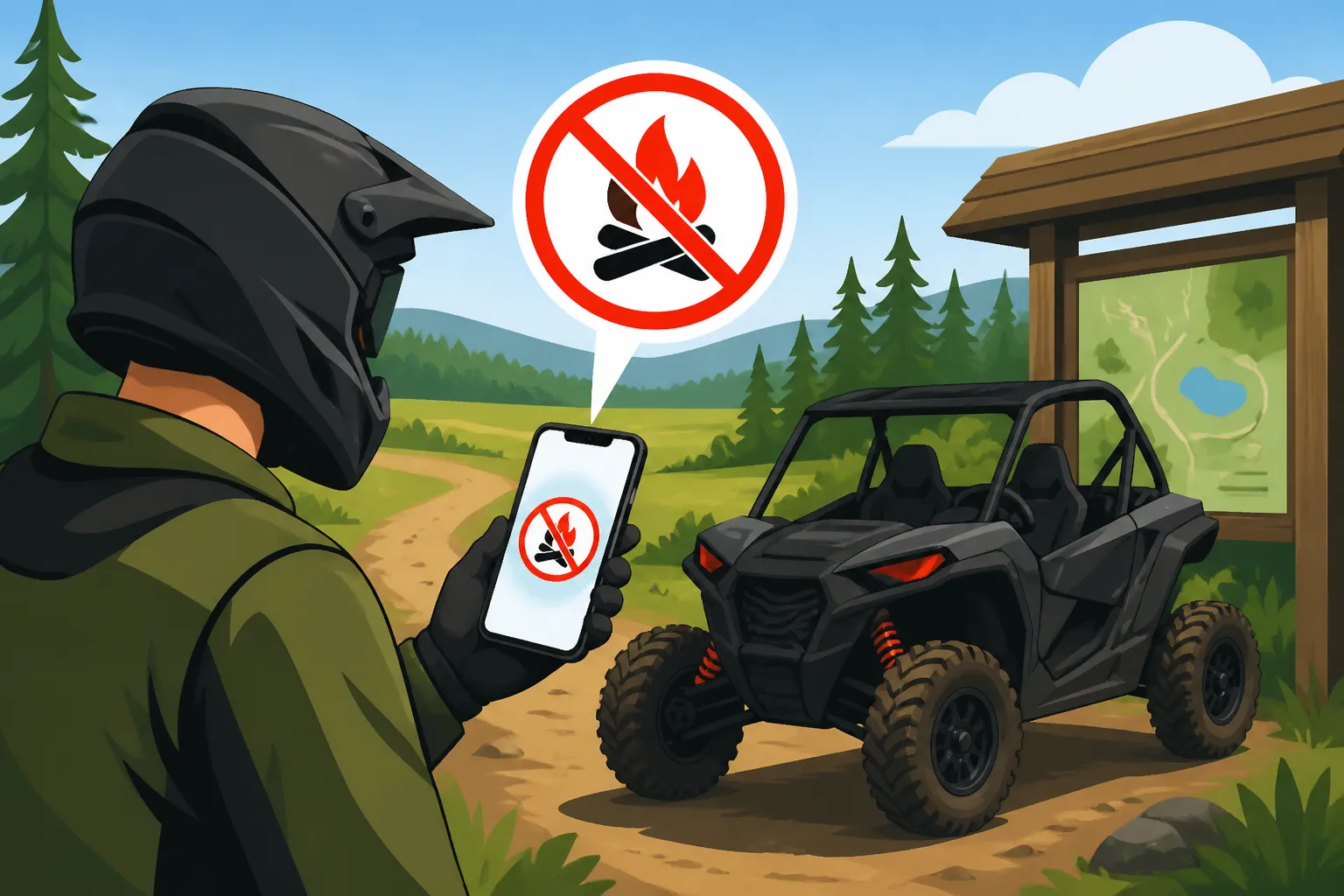
A phone can help you confirm current information, but only if it has a connection and you know what to look for. Do the first check before loading the machine, then make a second check at the trailhead if reception allows. A fresh check matters because conditions and restrictions can change after you set out.
Use a simple sequence rather than relying on a search result headline:
- Confirm your exact destination. Note the trailhead, park, municipality or land area, and the route you expect to take.
- Open the responsible official source. Look for the current notice, not only a search-engine summary or repost.
- Check the date and status. Make sure the notice is current and has not been replaced or lifted.
- Match the affected area to your route. Check boundaries, named locations and any map details. If the route crosses into another jurisdiction, check that area too.
- Read the full restriction. Look for what is prohibited, where it applies, when it takes effect, and any stated exceptions.
- Check for separate trail or access closures. A fire restriction and a trail closure are not necessarily the same notice.
- Save the information you may need. Keep the official notice or relevant contact details accessible in case reception disappears.
A headline such as “fire ban in effect” does not answer whether a specific trail is open or whether operating a particular machine is restricted. Read the supporting details. If the notice is unclear, contact the relevant park office, municipality, land manager or trail operator before unloading. It is better to pause than to guess at the boundary or the meaning of a restriction.
A phone search can also surface old pages. Check the publication or update date, and look for language that confirms the notice is still active. If an official page links to a map or order, open that material rather than assuming the short summary contains every condition. Saskatchewan Fire Ban Lookups offers more context on where to check, while Saskatchewan Trail Conditions Before You Haul is useful for checking trail information before making a long drive.
Do not treat a map screenshot as definitive if it is unclear when it was captured. A saved screenshot can help you remember a boundary, but it cannot show that a restriction remains current. If a notice gives a phone number or directs riders to a particular office, use that channel when the online information is ambiguous.
Plan for weak reception and changing conditions
A trailhead may be outside reliable cell coverage, and coverage can drop further along a route. Prepare before leaving service. Save the official pages or maps you need for offline access if your phone allows it, and write down a relevant contact number. Keep a paper map or other offline navigation option if the route requires one. These steps do not replace a current check, but they reduce the chance of being stranded without basic information.
Avoid assuming that an online page will load just because your phone shows a signal. A weak connection may load a search snippet while failing to open the actual notice. If you cannot get the official information at the trailhead, do not rely on a partial result or an old screenshot to decide that the ride is permitted. Use the contact information you saved, return to a location with service, or postpone the ride until you can confirm the rules.
Conditions can change during a day of riding. Smoke, wind, dry vegetation or a newly posted closure may be a reason to stop and reassess, even when you checked the rules earlier. If a new notice appears, follow the instructions for the area and leave a closed zone by a safe, permitted route. Do not ride around a closure sign or assume that a trail is exempt because it is maintained by a club.
Fire restrictions can also set requirements for machine use or equipment. Read the applicable wording carefully and inspect your machine for debris that could create a risk. The obligation to prevent a fire is not limited to carrying a phone or checking a map. Saskatchewan Wildfire Act Duties for Riders explains the broader responsibilities, and Saskatchewan Wildfire Penalties covers why ignoring an applicable restriction can have serious consequences.
A practical pre-ride plan should include:
- The official source for each land area on your route.
- A saved copy or offline access to relevant notices and maps.
- Contact details for the park, municipality, land manager or trail operator.
- A backup route that does not pass through an area that may be closed.
- A decision point: if you cannot confirm access or the restriction, you do not ride that area.
The backup route should be checked in advance too. A route that appears to avoid a restricted area may still cross a boundary or use a trail that is closed for another reason. If you are riding with a group, share the plan before setting out so everyone knows what to do if the route changes.
Decide whether to ride, reroute or turn back
Once you have checked the source and read the full notice, make a clear decision. Ride only if you can confirm that the route is open and your intended activity is allowed under the applicable restrictions. If the notice is unclear, the map does not match your route, or the official information cannot be reached, choose a different confirmed destination or postpone the trip.
Do not interpret silence as permission. An absent notice in a search result does not prove there is no restriction. Search results may be incomplete, and a local authority may publish updates through a different channel. Check all the land managers relevant to your route, especially if you are moving between a park, Crown land and a municipality.
If a restriction is active, read it as written. It may prohibit one activity but allow another, or it may close a defined area. Do not extend an exception beyond the wording, and do not assume that permission from a landholder overrides a public closure. Where access depends on permission, confirm that separately; Saskatchewan Grazing Lease Access Rules and Saskatchewan Private Land Permission explain why permission and general fire restrictions are different issues.
When an order or closure affects your planned trail, reroute only to an area you have confirmed is open. If no suitable option is confirmed, turn back. That may mean losing the day’s ride, but it avoids putting people, property and land at risk—and reduces the chance of having to manage a preventable incident in an area with limited access or phone service.
A useful final check is to ask yourself three questions before unloading:
- Do I know which authority manages the land I am about to enter?
- Have I read a current notice that applies to this exact area?
- Can I explain what the notice permits or prohibits without guessing?
If any answer is no, keep the machine on the trailer until you can confirm the details. A phone is a practical tool at the trailhead, not a substitute for understanding the rule or respecting a closure.
Disclaimer
This article is for general informational purposes only and does not constitute professional advice. Laws, prices and regulations vary by location and change over time. Consult a qualified professional for guidance on your specific situation.