Reaching a Rancher Before You Cross Their Lease
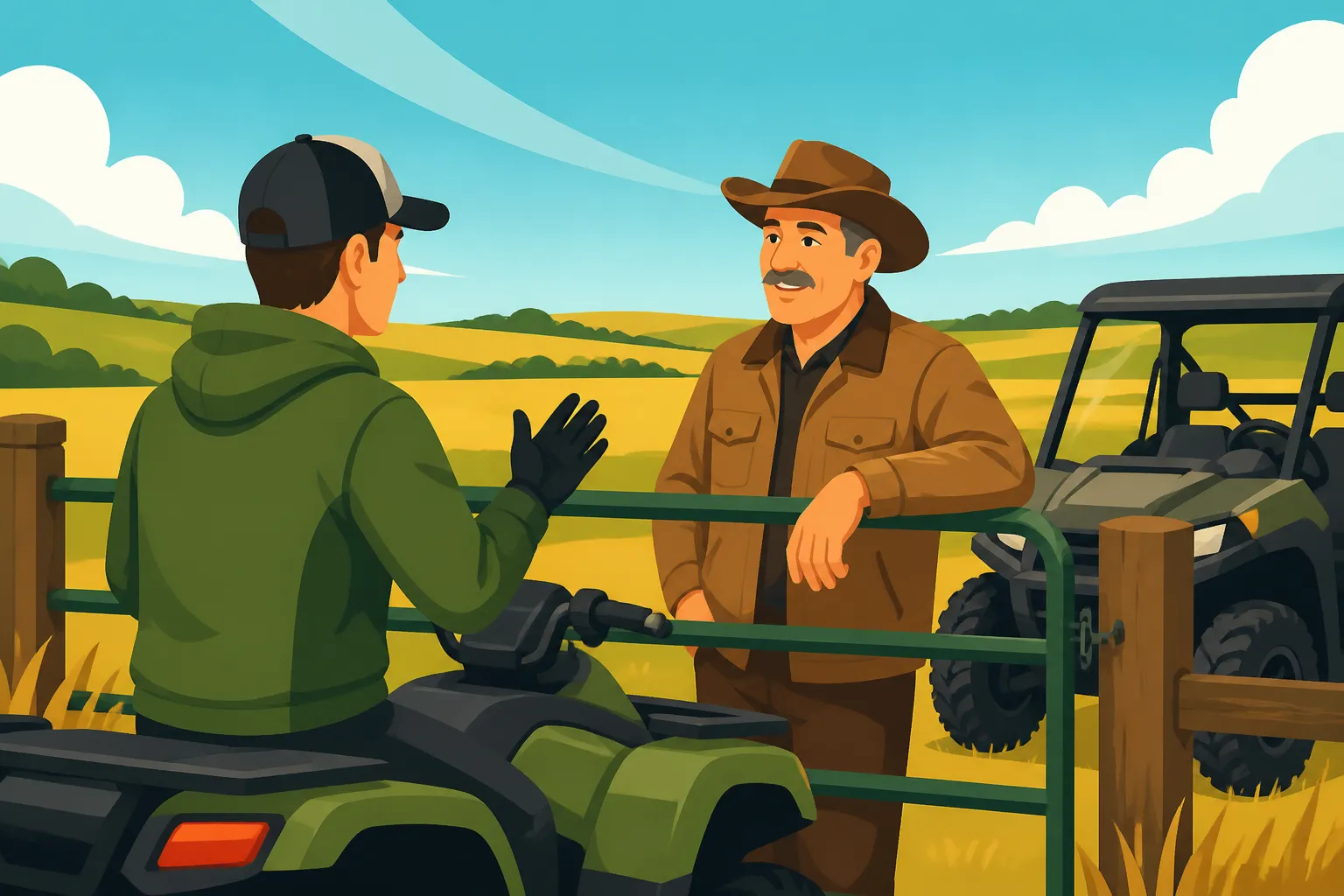
A route that looks open on a map may cross a grazing lease where cattle, fences, and the leaseholder’s operations take priority. Before taking an ATV or UTV across, identify who manages the land and ask for permission directly. A clear conversation can prevent conflict, protect livestock, and help you avoid assuming that public land means unrestricted access.
Why you should contact the leaseholder first
A grazing lease is Crown land leased for livestock use, but that does not mean every route across it is automatically open to recreational riding. Access can depend on whether the land is occupied, the leaseholder’s use of it, posted restrictions, and other rules that apply to the area. The practical step is to check the access rules and speak with the leaseholder before you enter. For background, see Saskatchewan Grazing Lease Access Rules and Occupied Crown Land and Permission.
This matters even when you only plan to cross a small corner of a lease. A route can pass close to cattle, a watering point, a pasture gate, or equipment that is not obvious from the road. A rider who enters without checking may disturb livestock or interfere with work, even if the intention is simply to reach another trail.
Do not rely on a map line, an old track, or another rider’s previous experience as proof that you have permission. Maps can help you identify a possible route, but they do not necessarily show current access conditions or tell you who has authority over the land. A route that was usable last season may be unsuitable now because livestock have been moved, a gate has changed, or work is underway.
Permission also does not replace other rules. You still need to follow applicable laws, municipal bylaws, land-use restrictions, fire precautions, and vehicle requirements. A leaseholder’s approval for one crossing does not authorize riding wherever you like across the lease or entering a nearby private parcel.
| Before you ride | What to confirm |
|---|---|
| Land status | Whether the route crosses a grazing lease, private land, or another restricted area |
| Leaseholder | Who currently manages the lease and how they prefer to be contacted |
| Route | The exact entry point, crossing path, and exit point |
| Timing | The day or period permission applies, and whether livestock or work may change the plan |
| Conditions | Speed, gates, livestock, passengers, group size, and any areas to avoid |
| Other rules | Whether local restrictions or closures affect the route |
If you are unsure how a grazing lease differs from private land or other Crown land, check Saskatchewan Crown Land Riding Permission and Saskatchewan Private Land Permission. When details are unclear, pause and verify instead of treating uncertainty as consent.
Finding and contacting the right person
Start by identifying the parcel or lease area you intend to cross. Use available land and access maps to understand where the route goes, but treat them as planning tools rather than permission. Mark the route on a map or take note of nearby roads, landmarks, gates, and the direction of travel. The more precise you are, the easier it is for the leaseholder to give a useful answer.
If you do not know who holds the lease, ask the relevant local office or someone with direct knowledge of the area how to reach the current leaseholder. A nearby resident, local rancher, or riding club may help point you in the right direction, but that information is not a substitute for permission from the person responsible for the land. Avoid assuming that the first person you reach can authorize access; confirm that they manage the lease or are authorized to speak for the leaseholder.
Contact the leaseholder well before the day you plan to ride. A last-minute request can be difficult to answer when someone is working livestock, away from the phone, or dealing with changing conditions. If your trip is time-sensitive, have a different route ready rather than treating a delayed response as approval.
Use the contact method the leaseholder prefers. If you call and do not reach them, leave a short, clear message and allow time for a reply. A text can be useful for sharing a map pin or written route details, but do not assume that a message has been seen. If you speak in person, make the same details clear and follow up in writing if the route or conditions are complicated.
A good request gives the person enough information to decide without making them guess. Include:
- The date and approximate time you want to cross.
- The number of ATVs or UTVs in your group.
- The route you intend to use, including where you will enter and leave.
- Whether you are crossing through or stopping anywhere.
- Whether you have passengers, a trailer, or any special equipment.
- Your phone number and an alternate plan if the route is unavailable.
Ask directly whether the route is acceptable and whether any conditions apply. If the answer is unclear, ask a follow-up question rather than interpreting a vague response as permission. For more on what to confirm, see Getting Consent From a Grazing Lease Holder.
Agree on the route and conditions
Permission is most useful when it is specific. “You can cross” may not answer whether you can use a particular trail, bring a group, stop for lunch, or return on a different route. Confirm the details before you head out, especially if the lease covers a large area or your planned route could pass several gates or pastures.
| Ask about | Why it matters |
|---|---|
| Exact route | Keeps the crossing within the path the leaseholder approved |
| Gates and barriers | Prevents leaving a gate open or damaging a fence |
| Livestock location | Helps avoid stressing or separating animals |
| Speed and noise | Reduces disturbance near cattle, buildings, and work areas |
| Stops and turnaround points | Avoids blocking access or stopping in a sensitive spot |
| Group changes | Makes sure permission covers the riders and vehicles actually attending |
| Return trip | Confirms whether the same route is approved in both directions |
Ask what to do if you encounter cattle, a vehicle, or a closed gate. In general, do not chase livestock, crowd animals, or try to move a herd. Give animals room and follow the leaseholder’s instructions. If cattle are gathered across the route, or conditions have changed, stop at a safe distance and contact the leaseholder rather than pushing through.
Treat gates as an important part of the agreement. Ask whether you should leave a gate as you found it, close it behind you, or avoid it altogether. Never assume that a gate is open for recreational access. Do not cut fences, force a barrier, or use a different entrance because it seems more convenient.
Keep the riding group within the conditions agreed upon. If you asked for a quiet crossing by two machines, do not arrive with a larger group or turn it into a trail ride. If your plans change, ask again. Permission for one date or route should not be treated as a standing invitation for future trips.
A written message can help avoid confusion, particularly where the route is not obvious. Keep a text or email that records the agreed date, route, and conditions. If permission is given by phone or in person, write down the details for your own reference and confirm any uncertain points. This is not a substitute for following the rules; it simply helps you remember what was agreed.
For broader riding considerations, review Saskatchewan Rules for Riding a Grazing Lease and Reading Posted Land Signs Before You Unload. If you are riding with others, share the conditions with every driver before entering the lease, not after someone has already opened a gate or turned off the agreed route.
If permission is denied or conditions change
A leaseholder may say no, limit access, or ask you to use a different route. Respect that answer. Do not argue that the route appears on a map, that someone else crossed last week, or that you are only passing through. The leaseholder may know about livestock, repairs, or work that is not visible from the road.
If the answer is no, ask whether there is another route they would allow or whether another time would work. If there is no suitable alternative, use a different legal route. Do not enter while waiting for a reply, and do not treat silence as permission.
Conditions can change after permission is given. Livestock may be moved, a gate may be closed, or a temporary restriction may be put in place. Check in again if there has been a significant delay between the request and your ride. On the day, obey signs and barriers, and turn around if the route no longer matches what was approved. Contact the leaseholder if you need clarification.
If you cannot reach the leaseholder, plan around that uncertainty. Do not cross on the assumption that the person will not mind. Choose a route where access is clear, or postpone the crossing until you can confirm. A little extra planning is better than creating a problem for the rancher or your riding group.
For recurring routes, ask whether the leaseholder is comfortable with future requests and how they want riders to check in. Do not assume that permission carries over from one season to the next. Keep contact information current, and confirm again when the route, group, timing, or land conditions differ. Keeping a Rancher’s Phone Number in Your Pocket can help you stay organized, but having a number does not itself grant access.
Before you leave, make sure every rider knows the approved route and any restrictions. Carry the leaseholder’s contact details in case plans change, but do not use a phone while operating a machine. If anyone in the group is unsure where to go, stop in a safe place and sort it out before continuing.
A careful request should be easy to answer: explain where you want to go, when, with whom, and how you will cross. Then follow the answer exactly. That approach respects the leaseholder’s work, protects livestock and property, and gives your group a much better chance of completing the ride without an avoidable access dispute.
Disclaimer
This article is for general informational purposes only and does not constitute professional advice. Laws, prices and regulations vary by location and change over time. Consult a qualified professional for guidance on your specific situation.