Saskatchewan Youth Certification Options
Saskatchewan Youth Certification Options
A young rider in Saskatchewan may be able to operate an ATV without an adult escort by completing an approved safety course, but not every course or certificate qualifies. The choice depends on the rider’s age, the course’s approval status and where the machine will be used. Here’s how to check the options and avoid treating training as a substitute for every other riding rule.
What Saskatchewan’s youth rules mean
Saskatchewan’s youth rules are not simply “under 16 cannot ride” or “a course lets any child ride.” The key distinction is the rider’s age and whether the youth meets an exception under the applicable rules. For riders from 12 to 15, supervision and approved training are especially important. A child younger than 12 should not assume a course makes them eligible to operate an ATV.
For the age thresholds and related conditions, see Saskatchewan ATV Age Requirements. The rules concern operating the machine, not merely being a passenger. Passenger eligibility is a separate question and depends in part on whether the machine was designed to carry a passenger.
A youth may have two main routes where the rules permit riding: operate with a qualifying supervisor, or complete an approved safety course that can serve as an alternative to supervision. The course route is not a general exemption from the Act. It does not automatically give a young person a driver’s licence, permission to use every road or trail, or approval to ride on land without the owner’s consent.
| Option | What it may allow | What to verify |
|---|---|---|
| Ride with a qualifying supervisor | A youth in the eligible age range may operate while meeting the supervision conditions | The supervisor’s age, licence history, presence and ability to supervise |
| Complete an approved safety course | For an eligible youth, course completion may replace the supervisor condition | That the exact course is approved for the statutory exception and that the rider has acceptable proof |
| Wait until the youth meets the general age rule | Avoids relying on a youth-specific exception | Any licence, equipment, insurance, land-access and road-use rules that still apply |
The practical takeaway is that “I took an ATV course” is not enough on its own. The course must satisfy the relevant approval requirement, and the rider must still be old enough to use the route being relied on. Before enrolling or riding, check Saskatchewan Youth Training Requirements and the current official information for the applicable rule.
Age, supervision and training are separate tests
Think of the youth rules as several questions, not one certificate check:
- Is the rider old enough to operate under a youth exception? The age threshold matters even if the youth has completed training.
- Is the youth riding with a qualifying supervisor, or relying on an approved course? These are different paths, and the conditions for one should not be assumed to apply to the other.
- Does the course qualify? A course can teach valuable skills without necessarily meeting the legal approval test.
- Is the ride itself permitted? Land access, local bylaws, insurance, equipment and road restrictions still matter.
A course completion card can be useful evidence of training, but it does not erase these separate checks. A rider should not infer that a certificate overrides a restriction based on age, location or machine type.
The supervisor route
A supervisor is not just any adult who happens to be nearby. Saskatchewan’s rule includes conditions for the person supervising, including a licence-history requirement. Review Saskatchewan’s 365-Day Supervisor Rule before choosing this option. A parent or other adult should not assume that being an experienced rider automatically qualifies them.
Supervision also needs to be real and effective. The adult should understand where the youth is riding, be able to monitor the youth and be ready to intervene. A distant adult, a person who cannot keep the youth in sight when needed, or someone who does not meet the rule’s qualifications may not provide the required supervision.
This route may suit a family that rides together and can keep the youth close. It may be less practical if the young rider is expected to ride separately or if the adult cannot meet the conditions for the entire ride. Those are reasons to check the approved-course option, not reasons to stretch the meaning of supervision.
Choosing an approved safety course
The course option can give an eligible youth a way to meet the training alternative instead of riding under supervision. The critical word is approved. A course provider may advertise an ATV safety class, and the class may be useful, but neither its name nor its general safety content proves it qualifies for Saskatchewan’s statutory exception.
Before paying or registering, confirm that the exact course is accepted for the relevant youth rule. The approval may depend on the course itself, the provider, or the certificate issued after completion. A course that qualifies for a different province, employer, club or insurance policy may not automatically satisfy Saskatchewan’s requirement.
For the approval question, consult Which ATV Training Courses the Administrator Has Approved. If the provider cannot clearly identify how its course meets the Saskatchewan requirement, check with the responsible official source before relying on it. It is much easier to resolve that question before a youth begins riding than after an officer asks for proof.
Questions to ask before enrolling
Ask the course provider and, where needed, the official authority:
- Is this exact course approved for the youth exception in Saskatchewan?
- Is approval current, and does it cover the ATV or UTV the youth plans to operate?
- What minimum age or other eligibility conditions apply to the course?
- What proof does the youth receive after passing?
- Does the proof identify the rider and course clearly?
- Must the youth carry the certificate while riding, or is another form of proof acceptable?
- Does the course authorize riding without a supervisor, or does it only provide general safety training?
- Are there additional rules at a park, on a municipal route or on another managed property?
Do not settle for an answer such as “the certificate is recognized” without asking who recognizes it and for what purpose. Recognition by an insurer or a private riding organization is not necessarily the same as approval under the law.
Classroom, practical and online training
A useful ATV course should help a young rider understand more than how to start, steer and stop. Topics may include controls, protective equipment, terrain, safe speed, braking, turning, carrying a passenger, avoiding hazards and what to do after a breakdown or collision. Practical instruction can help a youth apply these ideas, but the type of instruction does not by itself decide whether a course meets the legal approval requirement.
Online material may be convenient for learning basic concepts, but completion of an online module should not be treated as a legal substitute unless the course is specifically approved for that purpose. The same caution applies to videos, manuals, retailer lessons and informal coaching. These can supplement training without necessarily creating the certificate needed for the statutory exception.
If a family wants training mainly for skill and confidence, compare what is taught, how the youth is assessed and whether the program includes practical instruction. If the family needs the course to replace supervision, make approval the first question, not an afterthought. A course can be worthwhile for safety and still fail to meet that legal need.
Keep proof and make sure it matches the rider
After completion, keep the certificate or other course record in a safe place. Check that the rider’s name is correct and that the document identifies the program or provider. If there is uncertainty about whether the document is enough, ask the relevant authority what proof should be available during a ride.
A photo or digital copy can be a helpful backup, but do not assume it will always be accepted instead of the original or another required form. Keep a record of the provider’s course details and any approval information, too. This is especially useful if the youth rides in different locations or the family changes machines.
A certificate belongs to the person who completed the training. It is not a permit for a sibling, a general family pass or proof that the ATV itself is registered. Saskatchewan has no provincial ATV registration system, but ownership and riding paperwork can still matter. See Saskatchewan Proof of Ownership on the Trail for the separate question of showing that a machine belongs to you.
What training does not replace
The course exception is narrow. It addresses a youth operating condition; it does not turn every otherwise restricted ride into a legal one. A rider who has completed an approved course still needs to meet the rules that apply to the machine, the location and the activity.
Driver licensing and road use
A course certificate is not a driver’s licence. It should not be treated as permission to drive an ATV on a public road, ditch or highway whenever the youth wishes. Road and roadside use has its own restrictions, and a municipality may have bylaws that affect whether ATV riding is allowed on particular routes.
Before riding near a road, check Saskatchewan ATV Road Rules Explained. A route that looks like an easy connection between trails may have a different legal status from a designated trail or private track. For youth riders, do not assume that being trained or supervised makes a prohibited road route permissible.
The same principle applies to a UTV. The machine’s size or side-by-side seating does not make it a road vehicle for every purpose, and a youth’s course certificate does not change its classification. Confirm that both the vehicle and the location are allowed under the rules that apply.
Land access and local conditions
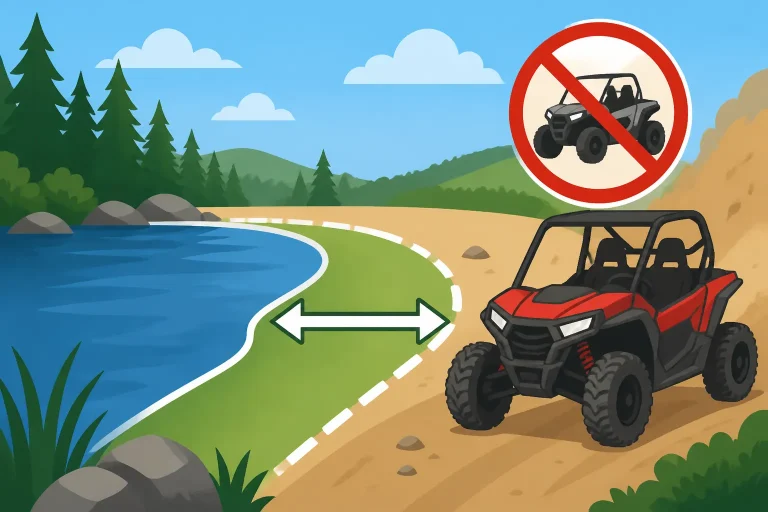
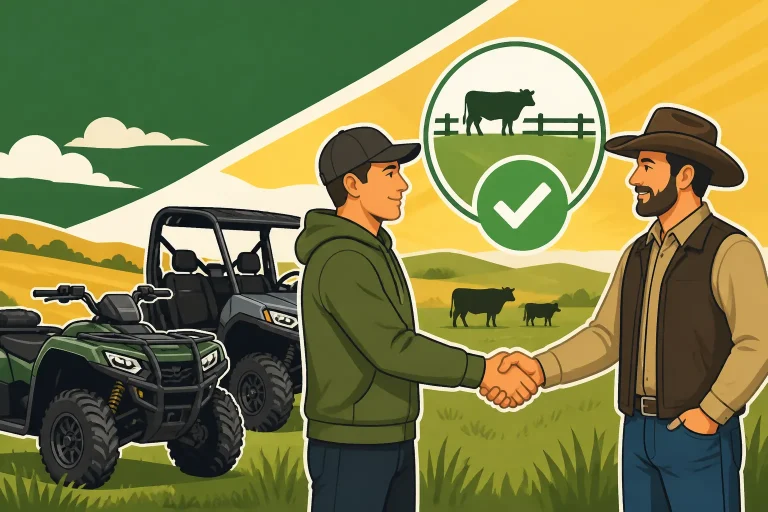
Training does not grant permission to cross private land, enter a grazing lease or use a trail that is closed. Get the landowner’s permission where required and check any conditions attached to the property or route. Public land also has restrictions, seasonal closures and area-specific orders that may apply regardless of the rider’s age or qualifications.
Parks can have their own entry and operating requirements. A park may require a permit, an acknowledgement form, insurance proof or compliance with trail-specific rules. Youth supervision requirements at a park can be more specific than the general rule, so contact the park office before assuming that a course certificate is enough. Check Saskatchewan Provincial Park Machine Rules when planning a park ride.
This is a common source of confusion: a youth may satisfy the general training alternative but still need to meet a park’s separate requirements. Confirm the rules for the exact destination, not just the rules for Saskatchewan in general.
Insurance, equipment and safe operation
A certificate does not provide insurance. Check that the ATV or UTV has the coverage required for the intended use and that the policy applies to a youth operator. The policy may have conditions related to age, training, machine type or who is allowed to operate it. Ask the insurer or broker rather than assuming the course automatically satisfies policy terms.
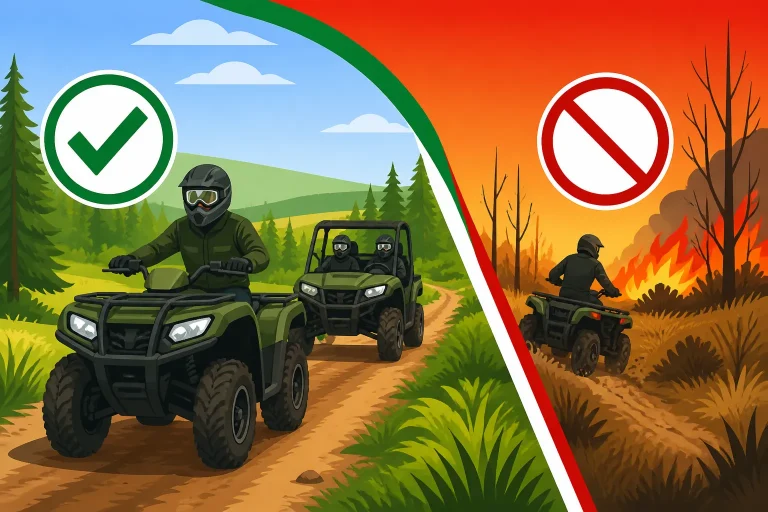
Protective equipment and safe operation rules also remain in force. A youth needs suitable protective gear, including a compliant helmet where required, and should ride a machine suited to their size, skill and experience. A course cannot compensate for a machine that is too powerful or difficult for the rider to control.
Adults should also consider practical limits that go beyond the legal minimum: the terrain, weather, visibility, distance from help, cellphone coverage and the youth’s ability to handle an unexpected situation. A legal exception is not a recommendation that every rider of the minimum eligible age is ready for every machine or trail.
A practical way to choose the right option
Use this sequence before the first ride. It helps separate the legal question from the family’s comfort and the destination’s rules.
- Confirm the youth’s age and the applicable route. Check whether the youth is within the age range for the relevant exception. Do not assume a course can make a younger child eligible.
- Choose supervision or training. If using a supervisor, confirm that the person meets the conditions and can supervise properly. If using a course, verify approval for the exact Saskatchewan requirement before enrolling.
- Check the proof. Find out what document the youth receives and what should be carried or available during a ride.
- Confirm the machine and insurance. Make sure the youth is permitted to operate that type of ATV or UTV under the applicable rules and the insurance policy.
- Check the specific route and destination. Review land access, municipal bylaws, park rules, trail closures and road restrictions.
- Set limits for the ride. Choose a suitable machine and route, agree on boundaries and communication, and make sure the youth knows how to stop and ask for help.
If the youth has not completed an approved course and no qualifying supervisor is available, do not treat an informal lesson as a substitute. Wait until the family can meet one of the legal routes. That may mean arranging qualifying supervision, confirming a course in advance or postponing the ride.
Common mistakes to avoid
- Assuming any safety course counts. Verify approval for the Saskatchewan youth exception.
- Assuming a certificate overrides age restrictions. Training does not necessarily make an otherwise ineligible child eligible to operate.
- Treating a parent as automatically qualified to supervise. Check the licence-history and other supervisor conditions.
- Confusing a training certificate with a permit or registration. They serve different purposes.
- Assuming the general rule settles park or municipal requirements. Check the location’s own rules.
- Assuming training changes road access. Road and ditch restrictions still apply.
- Leaving proof at home without checking what is expected. Keep the certificate and relevant information accessible.
For a 12-year-old, start with Saskatchewan Rules for a 12-Year-Old Rider. For a 14-year-old, check Saskatchewan Rules for a 14-Year-Old Rider. The details can depend on whether the youth rides with a supervisor, relies on an approved course or visits a location with extra conditions.
Frequently Asked Questions
Can a youth ride alone after completing an ATV course?
Only if the youth is eligible for the course-based exception and the exact course is approved for that purpose. The certificate does not remove other age, location, insurance or operating restrictions. Confirm the current requirement before the youth rides without a supervisor.
Does an online ATV course count?
Not automatically. Online training may be educational, but it counts as the legal alternative only if the exact course meets Saskatchewan’s approval requirement. Ask the provider and verify with the responsible official source.
Can a child younger than 12 ride after getting certified?
Do not assume so. The training exception does not necessarily override the minimum age rule. Check the applicable age provision before enrolling a younger child or allowing them to operate a machine.
Does the certificate let a youth ride on roads or in parks?
No, not by itself. Road use, park entry, land access, permits, insurance and local bylaws are separate matters. Check the rules for the particular route or destination.
Should the youth carry the certificate while riding?
Keep the proof available and confirm what form is accepted. A certificate or digital copy may help show completion, but families should verify whether the original or another document is required.
Disclaimer
This article is for general informational purposes only and does not constitute professional advice. Laws, prices and regulations vary by location and change over time. Consult a qualified professional for guidance on your specific situation.