Disputing a Ticket Written Under the Act
A ticket written under Saskatchewan’s All Terrain Vehicles Act can be confusing, especially when the officer’s description does not match what you remember happening. The safest first move is to preserve the ticket, note the response deadline, and work out exactly which rule and facts are in dispute. This guide explains how to review the allegation, organize evidence, and prepare a clear response.
Start by identifying the ticket and the allegation
Read the ticket line by line
Before deciding whether to dispute a ticket, check the exact offence, the law or bylaw named, the date and location, and the instructions for responding. A ticket involving ATV operation under the provincial Act may raise different questions from one issued under a municipal bylaw or another traffic law. The wording matters: “riding on a road,” “operating without required equipment,” and “failing to obey a sign” are not interchangeable allegations.
Look for the response deadline and the court or office named on the ticket. Do not assume that paying, calling the issuing officer, or sending an email automatically stops the clock. If the ticket offers options, follow the printed instructions or contact the court office listed to clarify procedure. Keep a copy of whatever you send and make a note of when and how you sent it.
If the ticket is hard to read, has a location you do not recognize, or appears to identify the wrong machine or person, write down the issue while it is fresh. A small error may or may not affect the case, so do not assume a ticket disappears because one detail looks incorrect. Ask the court office how to raise a concern through the proper process.
Work out which rule applies where you were riding
The location can be as important as the conduct. A rider travelling along a grid road, crossing a highway, using a ditch, or operating on a trail may face different rules. Municipal bylaws can also affect road access, speed limits, and prohibited areas. Start with the exact place the ticket identifies, then compare the alleged conduct with the rule cited.
For example, a rider ticketed for operating in a ditch may need to establish where the machine was in relation to the travelled portion of the road. A rider cited for using a street may need to check whether a local bylaw allows ATV travel on that specific street. General statements such as “quads can ride in ditches here” are less useful than evidence about the particular location, direction of travel, signs, and road layout. [Saskatchewan ATV Road Rules Explained] and [Saskatchewan Municipal Bylaws on Roads] can help you identify the kinds of rules to check.
| What the ticket appears to concern | Details to verify | Evidence that may help |
|---|---|---|
| Ditch or roadside riding | Exact position of the machine and road edge | Photos, map, measurements, witness observations |
| Crossing a highway | Crossing point, route, and whether the machine stopped | Location photos, route notes, witness statements |
| Restricted road or area | The exact road, bylaw, sign, or restriction cited | Sign photos, bylaw wording, map, travel notes |
| Equipment or safety requirement | What equipment was allegedly missing or non-compliant | Photos, receipts, manuals, inspection records |
| Rider or owner responsibility | Who operated or controlled the machine | Statements, messages, trip details, ownership records |
Preserve evidence before memories fade
Build a timeline while details are fresh
Write a factual timeline as soon as you can. Include when you started the ride, where you travelled, where the officer stopped you, what you were doing immediately before the stop, and what was said. Keep the wording neutral. “I was near the east entrance to the trail at about midday” is more useful than “the officer was obviously wrong.”
Record the conditions that could affect what happened: visibility, weather, road or trail surface, traffic, posted signs, and whether other vehicles or riders were nearby. If you were following a route on a phone or GPS device, preserve the route history before an app overwrites or deletes it. Save original files where possible rather than relying only on edited screenshots.
A timeline is not a substitute for evidence, but it helps you notice gaps. You may realize that your companion saw the machine’s position, that a sign was facing away from approaching traffic, or that your route took you to a different crossing than the ticket suggests. If you are unsure about a detail, mark it as uncertain rather than filling it in from memory later.
Collect photos, records, and witness details
Photograph the location from more than one angle, if it is safe and lawful to return. Capture road edges, signs, intersections, trail entrances, and landmarks that help identify the spot. Include context: a close-up of a sign may show its wording, while a wider view can show whether it was visible from the rider’s approach. Note when each photo was taken and avoid altering the originals.
Ask witnesses to write down what they personally observed, in their own words. A useful account states where the person was, what they could see, and what they remember—not what they think the law means. Keep names and contact details, but do not coach anyone or ask them to adopt your version of events. If a passenger or riding companion may be a witness, preserve their account promptly while memories are still clear.
If the dispute involves equipment, preserve photographs taken before the stop, purchase records, maintenance notes, and the relevant manual. For an aftermarket component, documentation from the manufacturer or seller may help identify what was installed, but it does not by itself prove that the setup satisfied a legal requirement. If an accessory came from SuperATV, keep the invoice and product documentation with your other records. SuperATV paperwork may help identify a component or its intended use, but the key question remains what the law required and what was on the machine at the time. [Saskatchewan Equipment Checks by Officers] and [Proof Shown to a Peace Officer] are useful topics to review when an allegation concerns inspection or proof.
Decide how to respond and prepare your position
Compare the alleged facts with the legal requirement
Separate what the ticket alleges from what you believe happened. Then identify the point that actually matters. If the allegation concerns a ditch-riding restriction, for instance, the useful question may be the machine’s location relative to the travelled portion, not whether you were generally on a “roadside.” If it concerns a municipal restriction, the exact bylaw and the street or area named may matter more than the rules in a neighbouring municipality.
Read the cited provision and note each element that appears relevant. You do not need to turn your response into a legal essay. A short, organized explanation is usually clearer than a long account of every frustration surrounding the stop. State the allegation, identify the disputed fact or rule, and connect that point to the evidence you have.
For instance: “The ticket says I was riding on the travelled portion. My photos show the machine’s position at the location identified, and my route record shows where I stopped before the crossing.” That is more focused than arguing that you have ridden there for years without a problem. Prior experience may explain why you believed the route was permitted, but it does not necessarily establish what the rule required on the day of the ticket.
Choose a response based on the ticket’s instructions
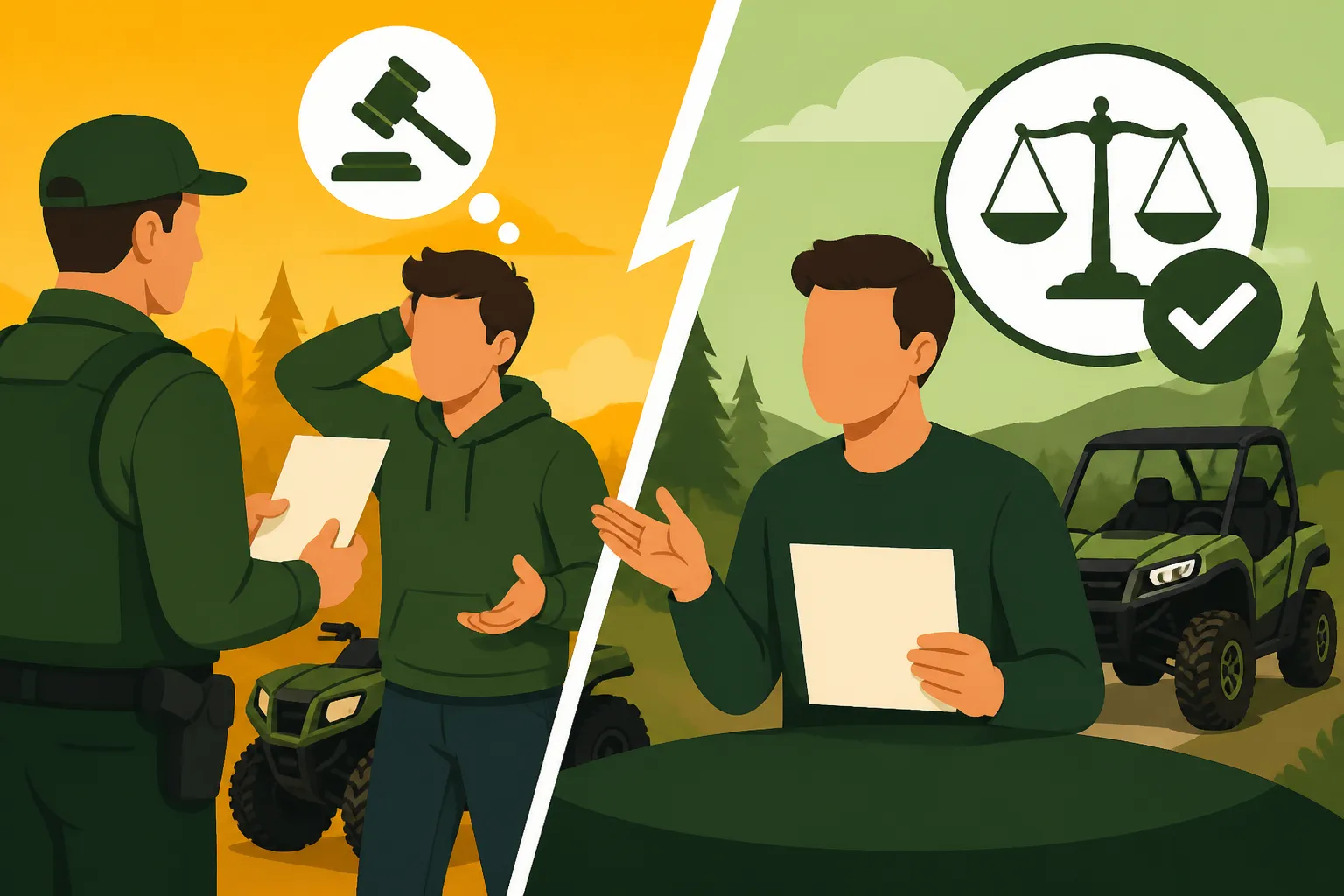
Some tickets provide a way to pay, dispute the allegation, or request a court process. The available options and steps depend on the ticket and the applicable procedure, so use the instructions printed on it and contact the named court office if anything is unclear. Ask specific questions, such as how to file a dispute, how to confirm it was received, and whether there are documents you should bring or submit.
Do not rely on an informal conversation with the officer as your only response. An officer may be able to explain what was observed or identify the provision cited, but the court or designated process controls how a dispute is handled. Keep a record of calls, dates, names, and any filing confirmation. If you miss a deadline or are unsure whether you have already missed it, contact the court office promptly rather than ignoring the ticket.
If the case could have serious consequences for your licence, work, insurance, or ability to ride, consider speaking with a lawyer or another qualified professional who handles provincial offence matters. That can be particularly important when the ticket involves an accident, a repeat allegation, a seizure, or several charges arising from one ride. [The Maximum Fine Under the Act Is $1,000] gives context about the Act’s potential fine ceiling, but the amount and consequences for a specific allegation depend on the charge and applicable process.
Avoid common mistakes and prepare for the hearing
Keep the response calm, specific, and supported
At a hearing or in a written response, focus on the disputed facts and the rule named. A clear sequence helps: identify where you were, explain what happened, show the relevant evidence, and state why that evidence matters. Bring organized copies of your ticket, notes, photos, route records, and witness information. Keep originals safe and make a simple index so you can find each item quickly.
Avoid treating assumptions as facts. A local resident may tell you that a road is “always open,” but that does not establish the wording of a bylaw or whether a temporary restriction applied. Likewise, a photograph of a sign taken after the event may not prove what was visible on the day of the stop. Explain what the evidence does show and acknowledge its limits.
If the officer’s description differs from yours, do not make the dispute personal. Explain the specific difference and point to evidence that can help resolve it. For example, say that the ticket places you north of a crossing while your GPS record and photographs indicate a different point. Specific discrepancies are easier to assess than broad claims that the officer misunderstood everything.
Check related issues without letting them distract you
A ticket may raise more than one issue. An officer may have asked for insurance or other proof, while the ticket itself alleges a separate operational offence. Keep those issues distinct. Having valid insurance does not automatically defeat an allegation about where you rode, and a disagreement about the route does not establish that you met every equipment or age requirement. [Saskatchewan Insurance Proof on the Trail] and [Saskatchewan Accident Reporting Duties] cover related responsibilities that may matter in other circumstances.
Also distinguish a ticket from seizure or impoundment. If a machine was seized, there may be a separate process and separate deadlines for seeking its release. Do not assume that disputing the ticket automatically addresses the machine’s status. [When a Peace Officer Can Seize Your Quad] and [Getting a Seized Quad Released by the Board] explain why those issues should be handled separately.
Finally, avoid posting a detailed account of the incident publicly while the matter is unresolved. Social media posts, group messages, and edited photos can create confusion or conflict with your evidence. Preserve relevant communications, but keep your explanation consistent and factual. Whether you are defending a ditch-riding allegation, a restricted-road ticket, or an equipment charge, the strongest preparation is usually careful recordkeeping and a clear explanation tied to the actual wording of the ticket.
Disclaimer
This article is for general informational purposes only and does not constitute professional advice. Laws, prices and regulations vary by location and change over time. Consult a qualified professional for guidance on your specific situation.