Night Visibility on a Grid Road
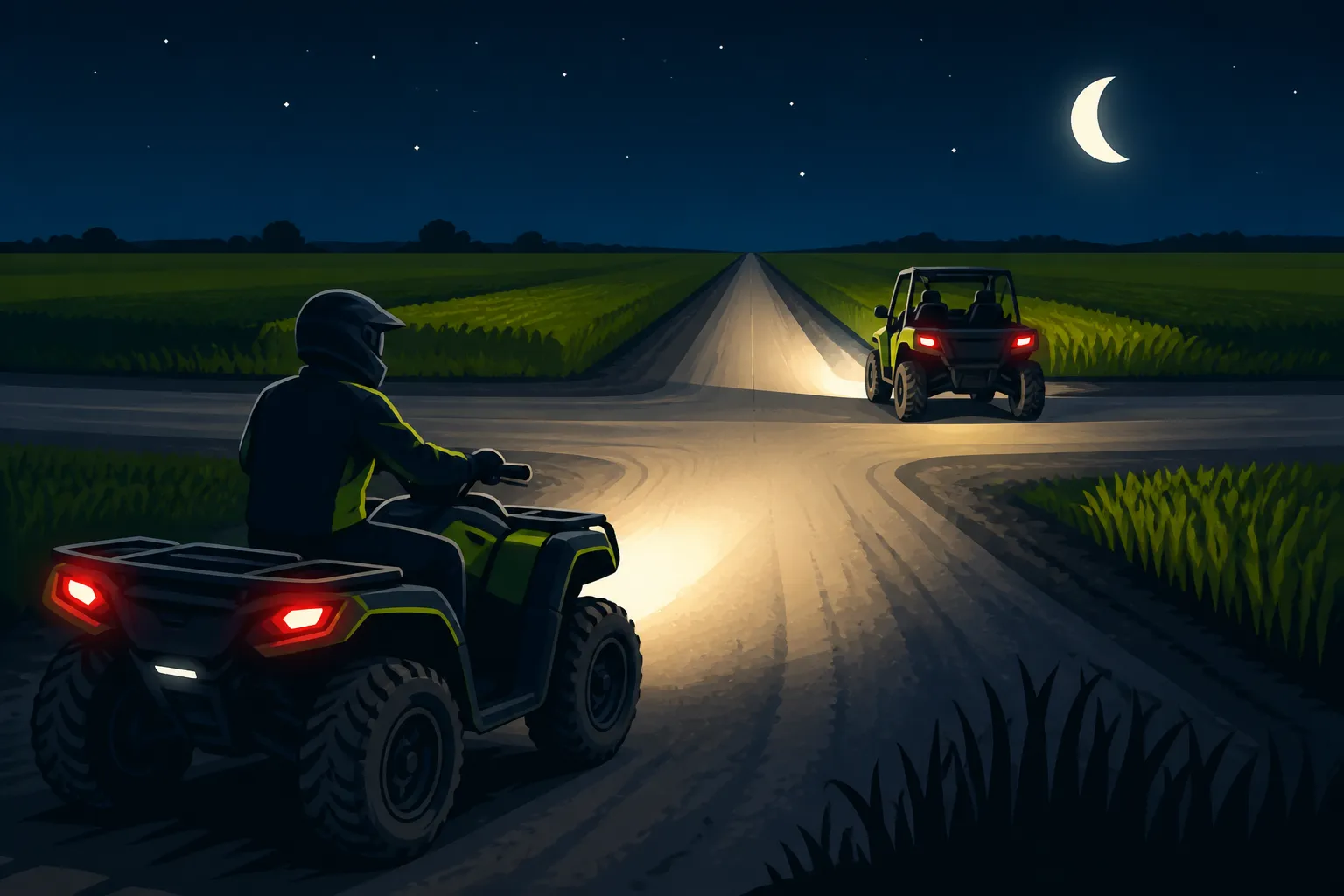
A night ride on a Saskatchewan grid road can become uncomfortable fast: dust hangs in your lights, oncoming traffic is hard to judge, and a ditch that looked open at dusk can hide ruts or debris after dark. This guide explains how to improve visibility, what to check before setting out, and why good lighting never replaces following the road rules.
Understand the rules before riding after dark
Know when lighting is required
Saskatchewan’s ATV rules include requirements for riding after dark. The relevant time is not simply “when it feels dark”: lighting rules apply from half an hour after sunset to half an hour before sunrise. Make sure you understand what equipment your machine needs and when it must be used. [Half an Hour After Sunset] and [Saskatchewan Lighting Rules at Night] are useful starting points for reviewing that distinction.
Before leaving, check that the lights required for your machine are fitted, working, and unobstructed. A headlight that switches on is not necessarily enough if its lens is cracked, its beam is poorly aimed, or mud has dulled the output. Check the rear lighting too, and ask a qualified dealer or mechanic if you are unsure whether your setup meets the applicable equipment rules.
Lighting rules are only one part of riding legally. An ATV or UTV does not become road-legal just because it has bright lamps. The route, the road or ditch, local bylaws, and any posted restrictions all matter. Review [Saskatchewan Rules for Riding a Grid Road] before planning a route that follows public roads.
Keep legal positioning separate from visibility
A common mistake is to treat a wide, open grid road as permission to ride wherever it feels easiest. Saskatchewan has rules about where an ATV may travel in relation to the travelled portion of a highway. The two-metre requirement is particularly important when considering how far to stay from that portion. See [2 Metres From the Travelled Portion] and [Saskatchewan Ditch Riding and the 2-Metre Rule] for more detail.
At night, judging that distance can be harder. The edge of the travelled portion may disappear into shadow, weeds, snow, or loose gravel. Don’t rely on your headlight alone to estimate where you are. If the ditch is uneven or visibility is poor enough that you cannot confidently maintain a safe, lawful line, stop somewhere safe and reconsider the route rather than edging closer to traffic.
A municipal bylaw may also affect whether riding is allowed on a particular road or in a particular area. Rules can differ between communities, and a familiar route may pass through more than one jurisdiction. Check [Saskatchewan Municipal Bylaws on Roads] before assuming that the same permissions apply from one grid road to the next.
Follow the required direction of travel
Night riding makes it harder for other road users to understand where you are and where you are headed. Follow the direction-of-travel requirements that apply to the road and the place you are riding. Do not assume that being in a ditch means you can choose either direction or that a driver will see you soon enough to react.
Think about the view from a vehicle approaching from behind or from a side road. A driver may see your rear light before noticing the ATV itself, especially if the road is dusty or the machine blends into the surrounding dark. Staying predictable, signalling your intentions clearly where possible, and avoiding sudden turns helps reduce confusion.
If you are not certain how a rule applies to a particular road, don’t guess at the roadside in the dark. Check the applicable rules before the ride, and contact the relevant municipality or authority for local restrictions. Good planning is safer than relying on another road user to interpret an unexpected movement.
Prepare your machine for useful visibility
Inspect the lights before every ride
A quick walk-around can catch problems that are easy to miss from the driver’s seat. Switch on the lights and check that the front and rear lamps work. Look for cracked lenses, loose mounts, damaged wiring, and mud or dust over the light surfaces. If the machine has different lighting modes, test each one you expect to use.
Clean lenses before leaving, then check them again if the ride is especially dusty or muddy. A thin film of grime can soften the beam, while mud can block it almost completely. Carry a cloth and a small light so you can inspect and clean the lamps safely if conditions change during the ride.
If you have added aftermarket lighting, make sure the installation does not interfere with the original equipment or create confusing glare for other people. Riders comparing accessory options, including products from SuperATV, should check that any part is suitable for their exact machine and that its use fits applicable lighting requirements. A bright accessory is not automatically a compliant one.
Aim for visibility without blinding others
More light is not always better. A poorly aimed auxiliary lamp can shine directly into the eyes of an oncoming driver, making it harder for both of you to see. It can also bounce off dust, fog, or blowing snow and create a bright curtain in front of the machine.
Test the beam angle in a safe, private area before riding near traffic. The light should help you see the ground and hazards ahead without pointing needlessly high. If you add lighting, have the installation checked and adjusted rather than judging it only by how impressive it looks when the machine is parked.
SuperATV is one brand riders may encounter while researching aftermarket accessories, but the key question is not the name on the box. Check fitment, installation instructions, wiring requirements, and whether the equipment is appropriate for the way you intend to ride. If you are unsure about beam aim or electrical work, ask a qualified professional.
Make the whole machine easier to notice
Headlights help you see, while rear lighting and reflective details help others notice you. Wear clothing that stands out from the surroundings and consider reflective elements that can catch a vehicle’s lights. Keep reflective material clean and visible rather than covered by a dusty jacket, backpack, or mud.
On a UTV, passengers should also think about visibility. A passenger leaning out, wearing dark clothing, or carrying gear that blocks a lamp can make the machine harder to see from certain angles. Secure cargo so it cannot shift over a light or interfere with the driver’s view.
Do not attach reflective material or accessories in a way that blocks required equipment, creates a distraction, or compromises safe operation. If you are looking at add-ons from SuperATV or another supplier, verify the intended placement and fit for your machine. The goal is a clear, recognizable outline—not a collection of bright lights that distracts other road users.
| Visibility check | What to look for | Why it matters |
|---|---|---|
| Front lighting | Working lamps, clean lenses, secure mounts, sensible aim | Helps you see the route and makes the machine easier to detect |
| Rear lighting | Working, unobstructed rear lamps | Helps following traffic recognize your position |
| Reflective details | Clean, visible material on clothing or gear | Can make you easier to notice when vehicle lights reach you |
| Cargo and passengers | Nothing covers lamps or blocks the driver’s view | Keeps visibility and control from being compromised |
| Added accessories | Correct fit, secure wiring, appropriate beam direction | Reduces glare, electrical issues, and equipment conflicts |
Plan a safer grid-road ride after dark
Choose the route for the conditions
A route that is manageable in daylight may be a poor choice after dark. Before leaving, consider how much traffic it carries, whether the ditch is passable, how often you will encounter side roads, and whether the surface is likely to be rutted, muddy, or covered in snow. A shorter route with a clear stopping point may be preferable to a long stretch where there is nowhere safe to pull over.
Avoid planning around an assumption that you can simply follow the road shoulder. The travelled portion and the area beside it are not interchangeable, and riding location rules still apply after sunset. If the lawful route is obstructed or difficult to distinguish, stop in a safe place and find another option instead of drifting closer to traffic.
Check for local restrictions and posted signs before unloading. A road or trail can have limitations that are not obvious from a map, and permission in one municipality does not necessarily carry into the next. For a broader look at road-specific requirements, see [Saskatchewan ATV Road Rules Explained].
Give yourself room to react
Slow down when your view is limited. Your stopping distance depends on speed, surface, tires, slope, and the condition of the machine. A headlight may reveal a pothole only when you are already close to it, especially if the road is dusty or the ditch is uneven.
Leave extra space behind other riders. Dust kicked up by the machine in front can reflect your own light back at you and make the trail harder to read. If you cannot see clearly, increase the gap or stop somewhere safe until the dust settles. Avoid riding so close that you have no time to respond if the lead rider brakes or turns.
Take particular care at intersections and crossings. Reduce speed well before reaching them, look for traffic in every direction, and follow the rules that apply to the crossing. Do not assume a vehicle driver has noticed you just because you can see its headlights. [Saskatchewan Rules for Crossing a Highway] covers the crossing rules riders should understand before setting out.
Carry a simple backup plan
Bring a charged phone, but don’t depend on having service along the whole route. Tell someone where you plan to ride and when you expect to return. If you are riding with a group, agree on a stopping place and a plan for what to do if someone loses sight of the others.
A small flashlight or headlamp can help with a roadside inspection, but it does not replace the machine’s required lighting. Carry basic supplies appropriate to the trip, such as water, warm layers, and a way to address a minor breakdown. A mechanical problem is more stressful when it happens in the dark and traffic is passing nearby.
Before you leave, know what information an officer may ask for and keep relevant paperwork accessible without creating a distraction while riding. [What an Officer Can Ask to See on a Grid Road] and [Saskatchewan Equipment Checks by Officers] can help you prepare. Stop in a safe place before reaching for documents or checking your phone.
Troubleshoot common visibility problems
Dust, fog, and snow are reducing what you can see
If dust is hanging in the air, slow down and increase your distance from other machines. Bright beams aimed into dust can make visibility worse by lighting up particles directly in front of you. Let the cloud clear before continuing, and avoid riding so close to another machine that you are trapped in its dust.
Fog and blowing snow can also flatten the view, making it difficult to judge distance and contrast. Do not respond by simply driving faster or adding more forward-facing light. If you cannot see enough to identify the route and respond to hazards, stop safely and wait for conditions to improve or end the ride.
Keep the lights clean, but remember that cleaning cannot solve every visibility problem. Some conditions call for changing the plan. If you regularly ride in challenging conditions, ask a qualified shop about safe lighting setup and maintenance; riders researching equipment from SuperATV should still check that any accessory is suitable for the machine and the intended use.
One of your lights stops working
If a required light fails, do not treat a phone flashlight or another rider’s lamps as a substitute. Move to a safe location, away from traffic, and inspect the obvious causes only if you can do so without putting yourself at risk. A loose connection or dirty lens may be simple to address, but damaged wiring or a repeated failure needs proper attention.
Think about the return trip before setting out. If a lamp is unreliable, a ride that starts before dark can still become a night ride if the group is delayed. Test the lights before departure and make sure the machine is ready for the latest time you might reasonably be on the road.
If you cannot restore the required lighting, arrange a safe alternative rather than continuing in conditions where the machine cannot be seen or operated as required. Do not stop in the travelled portion of a road to troubleshoot. Prioritize getting yourself and the machine out of traffic safely.
You cannot tell where the road edge is
Stop in a safe place if you lose track of the edge, the ditch line, or the route you intended to follow. Continuing by guesswork can put you closer to traffic, into a rut, or onto land where riding is not permitted. Use a map or navigation tool only while stopped, and do not assume a digital route reflects current conditions or local restrictions.
When you resume, travel slowly enough to confirm the route and maintain the required separation from the travelled portion. If you still cannot identify a safe, lawful line, turn back or arrange another way to reach your destination. There is no benefit in pressing on simply because the trip is nearly finished.
If you are riding with others, agree that any rider can call for a stop when visibility becomes unsafe. A group should not pressure someone to continue through a confusing section. Clear communication, working lights, and a willingness to change plans are more useful than trying to “tough it out” in the dark.
Disclaimer
This article is for general informational purposes only and does not constitute professional advice. Laws, prices and regulations vary by location and change over time. Consult a qualified professional for guidance on your specific situation.