Saskatchewan Lobbying for ATV Registration
It's a common frustration for ATV and UTV owners in Saskatchewan: the lack of a provincial registration system. You've got this valuable machine, you want to use it legally and safely, and yet, there's no central database, no provincial plate, and no easy way to prove ownership beyond a bill of sale. This guide dives into the ongoing discussions and efforts to lobby for a provincial ATV registration system, exploring why it's a persistent topic and what changes people are hoping to see.
The Current Landscape: Why No Provincial ATV Registration Exists in Saskatchewan
For years, riders across Saskatchewan have grappled with the unique situation of ATV ownership in the province. Unlike snowmobiles, which have a clear provincial registration requirement, all-terrain vehicles simply don't. This isn't an oversight or a temporary measure; it's how the system was established and has largely remained, creating both freedoms and headaches for owners.
Historical Reasons for No Provincial Registry
The historical context is crucial to understanding why we're in this situation. When the [Saskatchewan's All Terrain Vehicles Act] was initially penned way back in 1988, the landscape of off-road vehicle use was vastly different. ATVs were perhaps less common, and their integration into public land use and recreation hadn't reached the scale we see today. The focus of the Act was more on rules of operation and safety, rather than creating a comprehensive ownership registry. This decision set a precedent that has continued for decades, leaving Saskatchewan as one of the few places without a province-wide ATV plate or decal.
Many folks are often surprised to learn that [Why Saskatchewan Never Built a Quad Registry] in the first place. There wasn't a strong political will or perceived necessity to create the infrastructure for a provincial registry at the time, leading to the system we have where a bill of sale is the primary proof of ownership. This means that if you're looking for an official "title" or registration document, you'll be searching for something that simply doesn't exist at the provincial level.
Consequences for Riders and Law Enforcement
The absence of a provincial registration system has some pretty significant consequences, both for everyday riders and for the authorities trying to keep things orderly. For riders, one of the biggest issues is simply proving ownership. If you buy a used quad, your [Saskatchewan Bills of Sale Do the Work] to confirm that you're the new owner. But this can feel less secure than a government-issued document, especially in situations like theft or cross-border travel. Imagine trying to explain to an officer in another province that your ATV has no registration because Saskatchewan doesn't issue one – it can be a bit of a head-scratcher.
For law enforcement, the lack of a central registry creates challenges in identifying owners, especially in cases of stolen machines or rule infractions. When an ATV is involved in an incident, tracing it back to an owner can be a much more involved process without a readily available database. This can lead to delays in [Saskatchewan Stolen Machine Reports] and make recovery more difficult. While officers certainly have other tools, a provincial plate would streamline many aspects of their work.
The Arguments For: What Proponents of ATV Registration Want to Achieve
Despite the long-standing absence of a provincial registry, there's a strong and persistent movement to introduce one. The arguments for registration often stem from a desire for increased accountability, improved safety, and better resource management. People aren't just looking for another hoop to jump through; they're looking for solutions to real problems.
Enhancing Safety and Accountability
One of the primary drivers behind the push for ATV registration is the desire to enhance safety and accountability on trails and public lands. When machines are registered, it creates a traceable link between the vehicle and its owner. This can act as a deterrent against unsafe or illegal riding practices, as the operator is more easily identifiable. For instance, if someone is riding recklessly on Crown land or causing damage, an officer has a much clearer path to address the issue if the machine carries a unique, registered identifier. This can contribute to better enforcement of rules regarding [Saskatchewan Crown Land Access Rules] and general conduct.
Furthermore, a registration system could tie into mandatory safety training or insurance requirements more effectively. While [Saskatchewan Insurance Requirements for Riders] are already in place, proof of insurance might be more easily verifiable if it's linked to a provincial registration. Groups lobbying for registration often highlight that it could lead to fewer accidents and a greater sense of responsibility among riders, improving the overall reputation of the ATV community. This move could potentially foster a culture where riders are more likely to comply with rules, knowing their machine is officially recognized.
Funding for Trails and Infrastructure
Another compelling argument for provincial ATV registration revolves around funding for trail development and maintenance. Currently, many dedicated ATV trails and riding areas rely on volunteer efforts, club memberships, and sometimes grants. This often means resources are stretched thin, and the expansion or proper upkeep of trails can be a slow process. A provincial registration fee, much like what is seen with snowmobiles, could generate a consistent revenue stream specifically earmarked for off-road vehicle infrastructure.
Imagine having a portion of every registration fee go directly into a fund to build new trails, maintain existing ones, and even provide amenities like shelters or staging areas. This is a vision shared by many ATV enthusiasts who see the potential for a dedicated funding source to transform the riding experience in Saskatchewan. This is particularly relevant given that [Saskatchewan Snowmobile Registration Compared] to ATV non-registration often brings up the point that snowmobile fees directly support their extensive trail network. Such a system could also support educational initiatives and signage, making trails safer and more enjoyable for everyone. Advocacy groups might use tools like those from LawDepot to formalize their proposals, detailing how funds could be collected and allocated for provincial infrastructure.
Addressing Theft and Recovery Challenges
The theft of ATVs and UTVs is a real concern for many owners across Saskatchewan. Without a provincial registry, tracing stolen machines and prosecuting thieves can be significantly more challenging. Currently, when an ATV is stolen, its information is added to police databases, but the lack of a unique, mandatory identifier makes it harder to quickly verify ownership or track down a machine if its identifying numbers have been tampered with.
A provincial registration system would assign a unique plate or decal to each ATV, making it much easier for law enforcement to identify and recover stolen property. If every machine had a distinct, government-issued identifier, it would deter thieves and make it harder for them to resell stolen goods. This improved traceability could significantly increase the chances of successful recovery and provide peace of mind for owners. [Saskatchewan Theft Recovery Without a Registry] is a constant uphill battle, and a registration system is seen by many as a vital step towards mitigating this issue.
The Challenges and Counterarguments: Why Provincial Registration Isn't a Simple Solution
While the arguments for ATV registration are strong, it's also important to acknowledge that implementing such a system isn't without its challenges. There are valid concerns and counterarguments that often come into play, making this a complex issue with no single, easy answer.
Cost and Administrative Burden
One of the most immediate concerns with introducing a provincial ATV registration is the associated cost and administrative burden. Establishing and maintaining a new government registry requires significant investment in infrastructure, staffing, and ongoing management. Who will bear these costs? Will the registration fees be high enough to cover the administrative overhead without becoming an undue burden on ATV owners? These are questions that need careful consideration.
There's also the potential for increased red tape for owners. While some see a benefit in formalizing ownership, others may view it as just another bureaucratic hurdle. Saskatchewan is a large province, and ensuring access to registration services for all residents, including those in remote areas, would be a logistical challenge. Furthermore, the existing network of [Saskatchewan Municipal Plate Schemes] provides localized solutions in some areas, and any provincial system would need to integrate with or supersede these without causing confusion or duplication of effort.
Rural vs. Urban Riding Realities
Saskatchewan's vast landscape means there's a huge diversity in how ATVs are used. From recreational trail riders near urban centres to farmers and ranchers using machines as essential tools on their land, the "ATV user" is not a monolithic group. This creates a challenge for a one-size-fits-all provincial registration system. For a farmer who uses their quad exclusively on private property, the perceived benefit of a provincial plate might be minimal, while the cost and administrative effort could feel like an unnecessary burden.
Consider a rancher who depends on their quad for daily operations across thousands of acres. They might argue that a provincial registration serves little purpose for them, as they rarely, if ever, operate on public roads or trails where such a system would be most relevant for enforcement. This contrasts sharply with a recreational rider who frequently uses public trails and would likely welcome a system that funds trail maintenance and enhances safety. Any proposed system would need to carefully consider these different user groups and perhaps offer exemptions or different tiers of registration to address these varied realities.
Resistance to Further Government Oversight
Finally, there's an inherent resistance among some segments of the population to increased government oversight and regulation. For many, the appeal of ATV riding is its freedom and connection to the outdoors, and the idea of more rules and requirements can be met with skepticism. There's a concern that registration could be a gateway to further restrictions on where and how ATVs can be ridden, or that it could lead to higher taxes and fees down the road.
Some might also point to the existing rules and argue that the issue isn't a lack of registration, but rather a lack of enforcement of current regulations, such as [Saskatchewan's Minimum Insurance Requirement] or [Saskatchewan Helmet and Eye Protection Rules]. They might argue that adding a registration layer won't solve underlying behavioral issues. Balancing the desire for increased accountability with the principles of individual freedom and minimal government intervention is a delicate act that any lobbying effort must navigate.
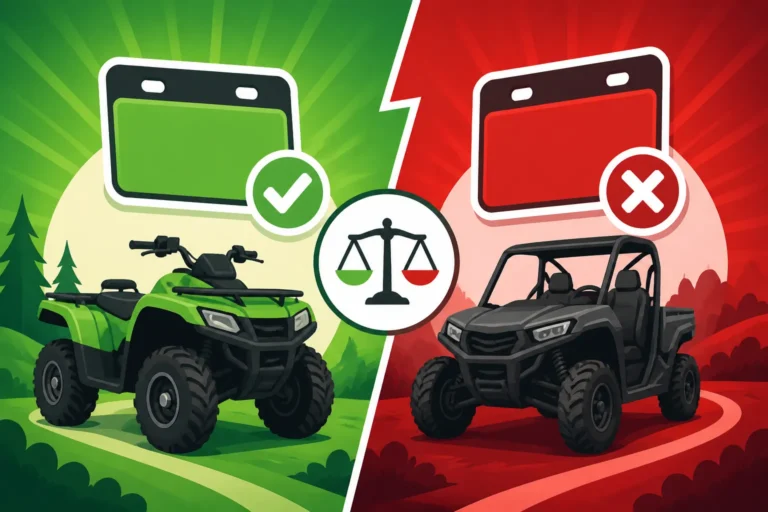
Here's a comparison of the current situation versus what a potential registration system might offer:
| Feature | Current Situation (No Provincial Registration) | Proposed Provincial Registration System (Potential) |
|---|---|---|
| Proof of Ownership | Primarily [Saskatchewan Bills of Sale Do the Work] | Government-issued certificate, often with a plate or decal |
| Theft Recovery | Relies on serial numbers; challenging to trace without central database | Easier identification and tracing with unique, visible identifier |
| Trail Funding | Relies on clubs, volunteers, limited grants; inconsistent | Dedicated revenue stream from registration fees for trail development |
| Enforcement | More difficult to identify owners in incidents; often relies on in-person ID | Clear link between machine and owner for accountability |
| Administrative Burden | Minimal provincial bureaucracy for ATV owners | New provincial department/system required, potential fees and paperwork |
| Accountability | Largely self-regulated; harder to track unsafe riders | Increased accountability due to traceable ownership |
| Municipal Plates | Some [Saskatchewan Rural Municipalities and Plates] have local schemes | Provincial system could integrate or supersede local schemes |
The Path Forward: What Lobbying Efforts Look Like and What's Next
So, if there's no provincial registration now, and there are strong feelings on both sides, what does the future hold? Lobbying for ATV registration isn't a one-time event; it's an ongoing dialogue involving various stakeholders, from riders and clubs to rural municipalities and government officials.
How Lobbying Efforts Are Organized
Lobbying for ATV registration in Saskatchewan typically involves organized groups and associations that represent the interests of riders. These groups, such as the Saskatchewan All-Terrain Vehicle Association (SATVA) and local ATV clubs, play a crucial role in collecting feedback from their members, compiling data, and presenting a unified voice to decision-makers. They often prepare detailed proposals that outline the benefits of registration, drawing parallels with [Saskatchewan Snowmobile Registration Compared] and addressing common concerns.
These groups might meet with Members of the Legislative Assembly (MLAs), government ministers, and policy advisors to explain their position. They might also engage in public awareness campaigns to educate the broader public about the issues and gather support. Sometimes, these efforts involve collaborating with other organizations, such as agricultural groups or law enforcement agencies, to present a more comprehensive picture of how registration could benefit various sectors. Using resources like LawDepot can assist these organizations in formalizing their petitions, drafting letters to representatives, or even structuring the internal governance documents needed to support such a large-scale advocacy effort.
Engaging with Rural Municipalities and the Province
Rural municipalities (RMs) are particularly important in this discussion because they are on the front lines of ATV use and regulation. Many RMs have their own bylaws regarding ATV operation, especially concerning road access and speed limits. Some, like the District of Lakeland, have even implemented their own [Saskatchewan Municipal Plate Schemes] to help manage local riding and generate funds for local trails. These local solutions highlight the need for some form of identification and accountability, even if it's not province-wide.
Lobbying efforts often involve engaging with the Saskatchewan Association of Rural Municipalities (SARM) to garner their support for a provincial system. If a broad consensus can be reached among RMs, it significantly strengthens the argument for provincial action. The province, in turn, needs to weigh the various perspectives, consider the economic impacts, and assess the feasibility of implementing a new system. This often involves consultations, studies, and ongoing discussions to find a solution that works for the diverse needs of Saskatchewan residents.
Potential Future Scenarios
Looking ahead, there are several potential scenarios for ATV registration in Saskatchewan. One possibility is the continued incremental growth of municipal plate schemes. As more RMs face the challenges of managing ATV use, they might adopt local registration programs, creating a patchwork of regulations across the province. While this offers localized solutions, it doesn't provide the province-wide consistency that many riders and law enforcement agencies desire.
Another scenario is the eventual implementation of a provincial registration system. This would likely come after sustained lobbying efforts, perhaps driven by new data on safety incidents, theft rates, or a clear consensus from stakeholder groups. Such a system could mirror aspects of snowmobile registration, with annual fees that contribute to trail development and maintenance funds. However, the exact form it takes—whether it's a simple decal or a full plate—would be subject to extensive debate and policy development. Regardless of the outcome, the conversation around [Saskatchewan Lobbying for ATV Registration] is likely to continue as long as ATVs remain a popular and integral part of life on the prairies.
Disclaimer
This article is for general informational purposes only and does not constitute professional advice. Laws, prices and regulations vary by location and change over time. Consult a qualified professional for guidance on your specific situation.