Asking a Club Volunteer About Trail Conditions
Before hauling an ATV or UTV across Saskatchewan, it helps to know whether the route is open, passable and legal for your machine. A club volunteer can often share useful local observations, but those reports have limits. Ask focused questions, check when the information was gathered, and confirm permits, closures and access rules with the responsible office.
What a Club Volunteer Can Tell You
A club volunteer may know a particular trail network well: where recent rain has left water or mud, whether a bridge or section has been damaged, and which routes have changed since the last ride. Volunteers may also help explain trail markings, staging areas and local riding etiquette.
That information is valuable, but it is not the same as an official status report. Volunteers may not inspect every section, and conditions can change after a call or message. A trail that was firm in the morning may become difficult after rain, while wildfire restrictions or an access closure can take effect independently of what a volunteer last saw.
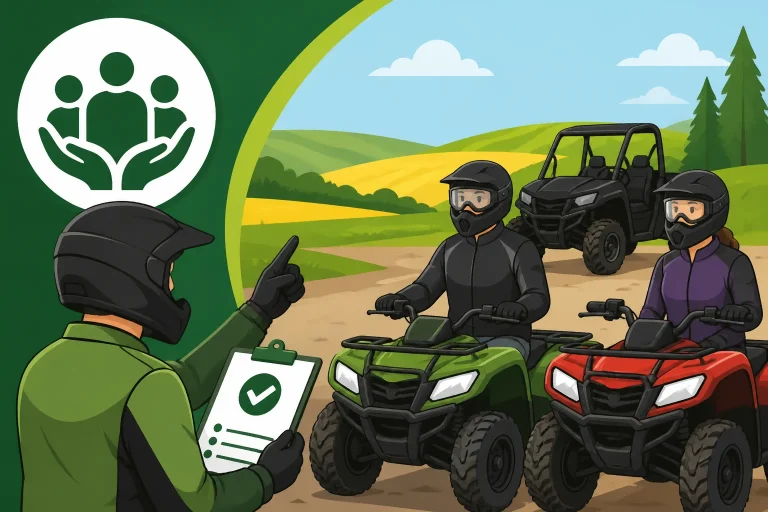
Start by naming the riding area and the date you plan to go. “How are the trails?” is broad; “We’re planning to unload at this staging area on Saturday and ride a standard-size side-by-side. Is the main loop passable after the rain?” gives the volunteer something specific to answer.
It also helps to separate three questions that often get mixed together:
- Condition: Is the route physically rideable, given recent rain, snow, washouts or fallen trees?
- Access: Is the land or trail open to riders right now?
- Permission: Do you need a permit, plate, club membership or other authorization?
A volunteer’s firsthand report may be especially useful for condition. Access and permission can depend on the land manager, park rules, municipal bylaws, a trail agreement or a temporary closure. Ask who is responsible for confirming each item rather than assuming one answer covers all of them.
| Ask about | Useful detail to request | What still needs checking |
|---|---|---|
| Recent conditions | Date and location of the latest report; mud, water, snow or damage | Conditions can change before your ride |
| Access | Which trail sections are open and whether a closure is temporary | Current notices from the land manager |
| Machine suitability | Whether the route is suitable for your ATV or UTV’s size and capability | Posted restrictions and your own operating limits |
| Permits | Which permit or authorization applies to that particular area | Requirements from the park or other responsible authority |
| Route planning | Staging location, loop options and likely trouble spots | Maps, signs, fuel and emergency access |
| Fire restrictions | Whether restrictions have been reported nearby | Current official fire notices and orders |
If you are still choosing a destination, ask which parts of the network are appropriate for your group and what the volunteer knows about the route’s current status. A local club may maintain or support trails under an agreement, but that does not automatically make every nearby road, cutline or piece of Crown land an authorized trail. For background, see Saskatchewan Club Trails on Crown Land and The Trail Agreement Behind Crown Land Riding.
Questions to Ask Before You Leave
A short, organized conversation is easier for a volunteer to answer than a long list of assumptions. If you contact a club by phone, email or social media, include the planned date, the area you intend to ride, the type of machine and the size of your group. Avoid sending a vague request for “the best trails” if you mainly need to know whether a particular route is open.
Use this sequence to get the most useful information:
- Ask when the report was last checked. Find out whether the volunteer rode the route, heard from another rider or is sharing older information. A report from yesterday is different from one based on last month’s conditions.
- Ask which sections the report covers. “The trails are good” may refer to only one loop or one trailhead. Confirm whether the specific route you plan to use is included.
- Describe your machine and group. Mention whether you are bringing ATVs, side-by-sides or both, and whether anyone is a beginner or needs a less demanding route.
- Ask about obstacles, not just overall quality. Mud, standing water, ruts, washouts, low branches, narrow turns and damaged crossings can matter more than a general rating.
- Ask about current access notices. Find out whether the volunteer has heard of a closure or restriction, then ask which office or authority can confirm it.
- Ask what you need to arrange before arriving. This may include a permit, a use form, insurance proof, a club contact or a specific staging location.
- Ask where to check again on the day. A club page, a park office or a posted notice may have newer information than a message you received earlier.
For conditions, ask for details rather than a simple “good” or “bad.” “A low section was holding water after the last rain, and the north loop was passable on a recent ride” is more useful than “it’s fine.” You can then decide whether that route suits your machine, experience and tolerance for delays.
Ask whether the report applies to a full-size ATV, a larger UTV, or both. A narrow trail may be comfortable on a quad but difficult or unsuitable for a wide side-by-side. A volunteer can describe what has been observed, but you should not treat that description as permission to ride a route that signs or rules exclude.
If you are travelling with children or inexperienced riders, ask about the character of the route: tight turns, steep or uneven sections, road crossings, isolated stretches and likely stopping places. Those details help with planning, but they do not replace Saskatchewan’s operating rules. Review Saskatchewan Rules of Operation on a Trail and Saskatchewan ATV Age Requirements if rider age, supervision or machine operation is part of your plan.
A useful final question is: “What should I verify with the land manager or park office before we unload?” That invites the volunteer to distinguish local knowledge from official decisions, and it can point you toward the right place to confirm requirements.
Permits, Closures and the Limits of Reciprocity
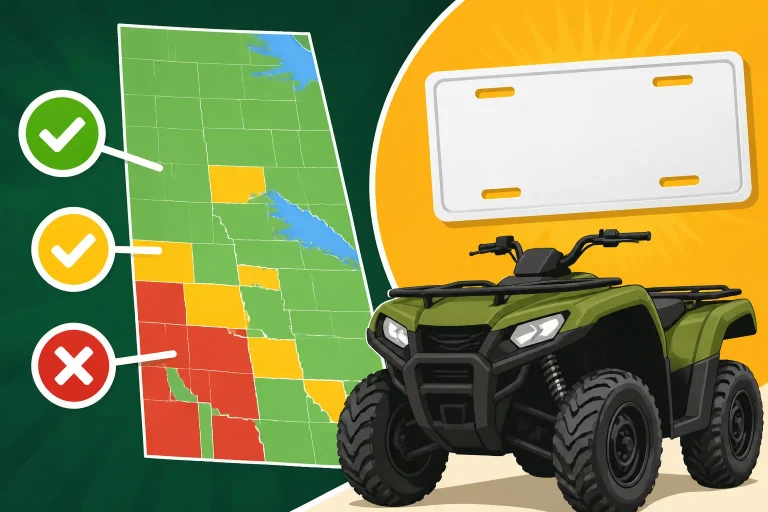
Do not assume that a club membership or permit from somewhere else automatically provides access across Saskatchewan. Saskatchewan has no province-wide ATV trail pass, but that does not mean every trail or public land area is open without conditions. Individual parks and local jurisdictions can have separate rules, and a riding area may require a permit or acknowledgement form even when the permit is free.
A club volunteer can explain what riders commonly do at a particular trailhead or direct you to the relevant office. Before relying on that information, check the requirements for the exact location and date. The distinction matters: a club may maintain a trail, while a park or government authority controls access; a municipality may have its own plate scheme or road bylaw; and a temporary wildfire restriction can override a usual riding plan.
For a quick overview of the provincial pass question, see Saskatchewan Has No Provincial Trail Pass. For designated park routes, consult Saskatchewan Park Trail Permits Are Free and Saskatchewan Parks With Designated Trails Only. A free permit is still a requirement when it applies, and it may involve steps such as attending an information session, signing a form or displaying the permit.
Reciprocity is worth asking about when you are visiting from another province. A home-province registration, plate or membership should not be treated as a substitute for Saskatchewan requirements. Likewise, a local municipal plate may only apply within the area that issues it. Ask the volunteer what visiting riders usually need, then verify the answer with the relevant park, municipality or other authority. Saskatchewan Plate Rules for Visitors and Saskatchewan Visitors and Insurance cover related questions.
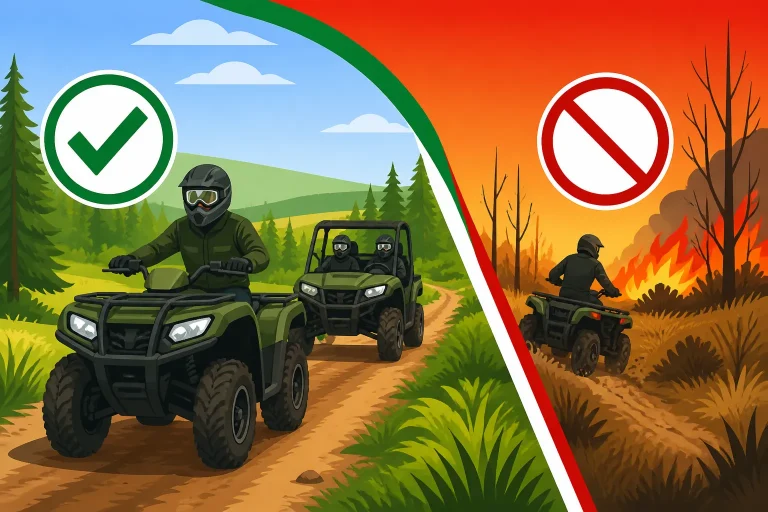
The volunteer is also not necessarily the right person to confirm every type of closure. A club may know that a section was recently damaged, but official access restrictions can come from park notices, Crown land orders, wildfire measures or municipal bylaws. For Crown land, review Saskatchewan Crown Land Access Rules; for fire restrictions, check Saskatchewan Fire Ban Lookups. If an area is closed, do not rely on an informal report that riders have gone through recently.
When information conflicts, use the most current official notice for legal access and treat a fresh local report as a practical warning about conditions. For example, an official map may show an open trail, while a volunteer reports a washed-out section. The map does not make the trail safe or passable; the volunteer’s report does not necessarily establish a legal closure. Plan around both facts, and choose another route if the situation is unclear.
Turn the Answers Into a Ride Plan
After you speak with a volunteer, write down the details that could affect your decision: when the report was made, which section it covers, what machine it applies to and what remained uncertain. A note such as “south loop checked recently; wet low spot near the crossing; confirm park access before departure” is more actionable than “trails okay.”
Then confirm the pieces that can change quickly or carry legal consequences:
- Check the land manager’s current notices for closures and access conditions.
- Confirm permits, forms and display requirements for the destination.
- Review municipal rules if your route uses a town street, local road or designated riding area.
- Check wildfire restrictions and other temporary orders shortly before leaving.
- Confirm insurance, rider qualifications and required equipment for your group.
- Make sure the staging area is actually available and suitable for your trailer.
If the volunteer recommends a route, ask for a map reference, trail name or clear start and end points. Trail names can be informal, and a spoken direction may not match signs on the ground. Download available trail information before travelling, and carry an offline map or paper backup if reception may be limited. Do not assume a phone will have service at the trailhead or along the route.
For changing conditions, ask about a reliable contact method rather than expecting a volunteer to monitor messages continuously. Club volunteers may be unpaid and have other responsibilities. They may not be able to answer on short notice, inspect a trail on demand or provide emergency support. Contacting them early gives you time to confirm details elsewhere and make a different plan if needed.
If the answer is uncertain, treat that uncertainty as part of the decision. You can shorten the route, choose a known open area, postpone the trip or unload somewhere else. Avoid attempting an unfamiliar detour just because a marked section is blocked. The detour may cross private land, an occupied Crown land area, a grazing lease or a place where machines are not permitted. When necessary, confirm permission with the landholder or responsible authority; Saskatchewan Grazing Lease Access Rules explains why access to a lease should not be assumed.
On the day of the ride, check signs at the staging area and along the trail. A posted restriction can be newer or more specific than an older message. If signs, maps and verbal information do not line up, pause and contact the office responsible for the land rather than guessing. Keep your route flexible, tell someone where you expect to ride, and turn back if conditions exceed your group’s ability or the machine’s capability.
A club volunteer’s best contribution is often a practical local picture: what riders have recently encountered and where to ask next. Use that knowledge to make a better plan, not as a substitute for confirming access, permits or closures. For a broader starting point on route selection and land types, see Saskatchewan ATV Trails: Crown Land and Ditches.
Disclaimer
This article is for general informational purposes only and does not constitute professional advice. Laws, prices and regulations vary by location and change over time. Consult a qualified professional for guidance on your specific situation.