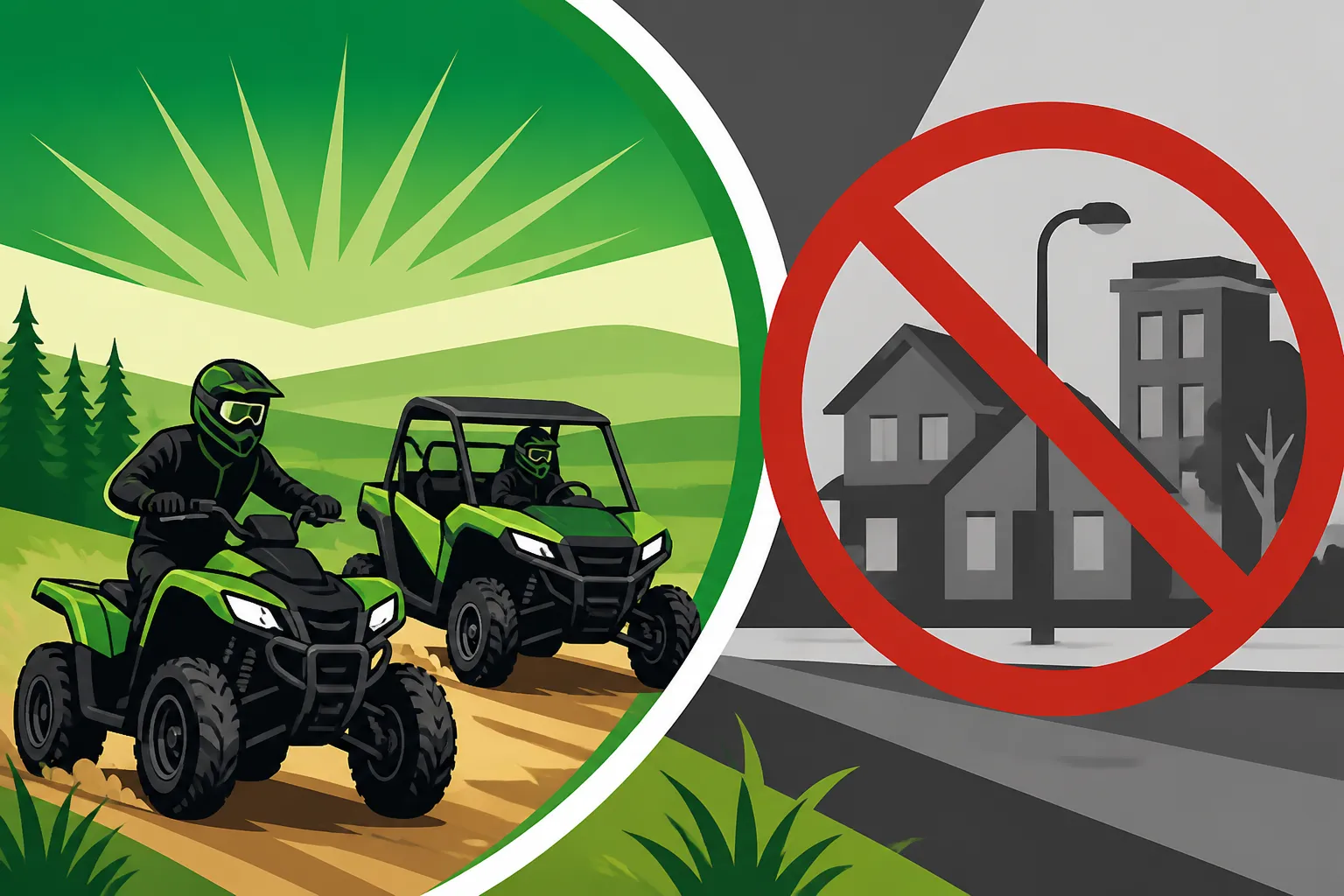
Saskatchewan Municipal Prohibited Areas
Municipal rules can make an ATV or UTV ride legal on one street and prohibited a few blocks away. In Saskatchewan, there is no single province-wide list of municipal areas where off-road machines cannot go. The safest approach is to check the local bylaw and route restrictions before unloading or turning onto a street.
Why prohibited areas depend on the municipality
Provincial rules and municipal bylaws do different jobs. Saskatchewan’s ATV rules set province-wide requirements, while a municipal council may control where machines can travel within its jurisdiction. A route that is open in one community may be closed in another, and a municipality may allow travel on some roads while banning it on others.
A municipal plate, permit, or permission to ride in one area is not a general pass for every road or public space. Local rules can apply even if your machine is otherwise legal to operate. Similarly, a route that is open to regular traffic is not automatically open to ATVs or UTVs.
The details to check may include:
- Which streets or road sections are open to off-road machines
- Whether a machine may use a ditch, shoulder, or travelled portion
- Whether parks, beaches, lakeshores, sidewalks, or other public spaces are closed
- Speed limits and permitted travel times
- Local permit or plate conditions
- Any temporary closure or posted restriction
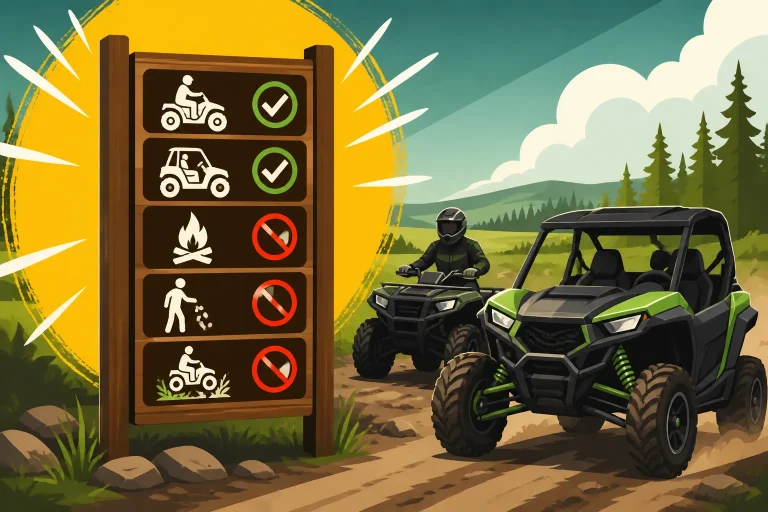
These rules can be set out in a bylaw, an order, or other official notice. A sign may help identify a restriction, but don’t assume that the absence of a sign means riding is allowed. Before relying on a sign or an informal map, confirm how the municipality defines the area and what rules apply there. For more context, see Saskatchewan Bylaws That Prohibit Riding and Saskatchewan Sign Requirements for Prohibitions.
Municipal rules are not limited to cities. Towns, villages, resort communities, and rural municipalities may each have local rules that affect ATV and UTV travel. Start with the relevant local authority rather than assuming that one municipality’s rules apply throughout the region. Saskatchewan Municipalities With ATV Bylaws explains why it matters to identify the rules for the specific community you plan to cross.
Places and routes that may be restricted
A prohibition may cover a particular type of place, a named route, or a defined area. The exact boundaries and exceptions depend on the local rule. Treat the categories below as prompts for checking, not as a province-wide list of places that are always closed.
Streets and road sections
A bylaw may name specific streets that machines can or cannot use. It may also distinguish between a road and its ditch, or allow travel only on designated sections. Don’t assume that permission to ride on one street extends to the next street, a connecting road, or the entire community.
Some local rules may set conditions by road type or location. For example, a bylaw might describe a permitted route by street name or set limits for certain roads. Check the actual route wording and map, if available, rather than relying on a general statement that a town permits ATV riding. Saskatchewan Rules for Riding a Town Street offers related province-wide context, but the local bylaw still determines which municipal streets are open.
Parks, beaches, and lakeshores
Municipal parks and recreation areas may have restrictions designed to separate machines from pedestrians, protect amenities, or limit noise and disturbance. Beaches and lakeshores may have their own rules, including boundaries that differ from the nearby road or parking area.
Do not treat a path, campground road, boat launch, or open-looking area as a machine route unless the local authority confirms it is permitted. A general municipal permission to ride on certain roads does not necessarily include a park or beach. Check the wording and any posted boundaries before entering. For more on this category, see Saskatchewan Beach and Lakeshore Rules.
Public spaces and routes near homes
Restrictions may also apply to sidewalks, trails, school areas, or other public spaces. A route beside a road can be legally different from the road itself. Likewise, access to a private driveway or open field does not establish a right to continue across neighbouring land.
If a planned trip passes close to homes, businesses, or community facilities, confirm whether the bylaw identifies a restricted zone or limits travel to specific routes. A route shown informally by another rider may reflect an old rule, a private agreement, or a temporary exception that does not apply to you.
Temporary closures
A route that is normally open may be closed for an event, road work, safety concern, or other local reason. Seasonal restrictions may also apply. Ask whether a posted closure is temporary, whether it applies to all machines, and where the restriction begins and ends. If you cannot confirm that the route is open, choose another route rather than testing the boundary.
| Area or route | What to verify locally | Common mistake |
|---|---|---|
| Town street | Whether the street is named as an allowed route | Assuming all streets are open |
| Ditch or shoulder | Whether travel there is allowed and where | Treating the ditch as part of an open road route |
| Park or trail | Whether machines are permitted in that specific area | Assuming a public trail allows motorized use |
| Beach or lakeshore | The boundary and any setback or closure | Riding through because the nearby road is open |
| Temporary closure | Dates, limits, and affected machine types | Relying on an old map or a previous visit |
How to check a prohibited area before riding
A few minutes of checking is easier than turning around after reaching a closure. Use the municipality responsible for the road or property, and be precise about the route you want to take. A broad question such as “Can I ride here?” may produce an answer that applies only to one street or one type of machine.
- Identify the local authority. Work out whether the route is inside a city, town, village, resort community, or rural municipality. If it crosses more than one jurisdiction, check each one. Saskatchewan Rural Municipality Rules can help explain why rural routes may need a separate check.
- Find the current bylaw or official route information. Look for the municipal website or contact the local office. Ask specifically about ATVs and UTVs, including side-by-sides, and whether the rules differ by road, ditch, park, or other area.
- Describe the exact route. Give street names, intersections, trailhead names, or landmarks. Ask whether the route is open for the entire distance and where any prohibited section begins.
- Ask about conditions. Confirm whether a local plate or permit is required, whether travel is limited by time or season, and whether there are speed or equipment conditions. If the route is temporarily closed, ask when the closure ends.
- Check signs when you arrive. Look for signs at entrances, intersections, and boundaries. If the signs conflict with information you received, stop and ask the municipality or choose a different route until you can verify which instruction applies.
- Keep useful information accessible. Save the bylaw page, map, or written response on your phone. This won’t make a prohibited route legal, but it can help you follow the correct boundary and explain how you checked.
When contacting a municipal office, concise questions are more useful than asking for a general permission. For example: “Is an ATV allowed on this named road between these two intersections, and does permission include the ditch?” You can also ask whether the answer applies to a UTV and whether any restrictions change by season or time of day.
Check the date and scope of any map or route list. An old screenshot, trail app, or social-media post may not reflect an amended bylaw or a temporary closure. If the municipal website does not clearly answer the question, contact the office that administers the road or public space. Saskatchewan Bylaw Lookups Before You Ride has more on checking local rules.
What to do when the rule is unclear
Don’t use the municipal boundary as the only guide. Some routes may pass from municipal roads onto provincial or private land, and each section may have different rules. Permission from a landowner does not necessarily override a road prohibition, and a municipal route permission does not grant access across private property. Check each part of the trip separately.
If a bylaw lists open routes, treat the list as specific rather than illustrative unless the municipality says otherwise. A road not named on the list may not be an allowed route. If the bylaw instead describes closed areas, confirm the boundaries and any exceptions. Do not assume an exception applies to your machine or purpose without checking the wording.
A municipal permit or plate scheme also has a limited purpose. It may address local identification or access requirements, but it does not automatically authorize travel in every prohibited area. Confirm which municipality issued the plate, where it is valid, and whether the route itself is open. Saskatchewan Municipal Plate Schemes explains the distinction between local schemes and province-wide rules.
If you encounter a closure while riding, stop before entering the restricted area and turn around where it is safe to do so. Do not move or ignore a sign, ride around a barrier, or follow another machine through a restricted entrance. If the boundary is unclear, note the location and contact the municipality before returning.
For a planned ride through several communities, make a route checklist:
- Name every municipality or rural municipality on the route.
- Identify the streets, trails, and public spaces you expect to use.
- Check local bylaws and any current closure notices.
- Confirm permit conditions and whether they apply to your machine.
- Keep a backup route that avoids uncertain areas.
The practical rule is straightforward: permission to ride somewhere does not establish permission to ride everywhere nearby. Check the route, not just the destination, and confirm local restrictions before setting out.
Disclaimer
This article is for general informational purposes only and does not constitute professional advice. Laws, prices and regulations vary by location and change over time. Consult a qualified professional for guidance on your specific situation.