Saskatchewan Visitors From Manitoba
A Manitoba plate, permit or insurance card does not automatically settle every question about riding an ATV or UTV in Saskatchewan. The practical answer depends on where you plan to ride: provincial rules, municipal bylaws, park conditions and landowner permission can all matter. Here’s what Manitoba visitors should check before crossing the border or unloading at a trailhead.
What Manitoba visitors need to know about plates and permits
Saskatchewan does not issue a province-wide ATV registration plate or sticker. That means there is no Saskatchewan ATV registration for a Manitoba visitor to apply for simply because they have arrived in the province. It also means there is no general Saskatchewan ATV plate that a Manitoba plate can replace or match.
The important distinction is between provincial registration and local requirements. Some Saskatchewan municipalities have their own plate or permit schemes, while others do not. The rules can depend on the municipality and the roads or areas you plan to use. A permit from one place should not be assumed to work somewhere else.
| Where you plan to ride | What to check before setting out |
|---|---|
| A Saskatchewan town or municipality | Whether a local ATV plate or permit is required, and which roads or areas it covers |
| A provincial park with designated ATV trails | Whether that park requires a trail permit, acknowledgement form or information session |
| Crown land | Whether the specific area is open to riding and whether an order or closure applies |
| Grazing lease or occupied Crown land | Whether you need permission from the leaseholder or land occupant |
| Private land | Whether the owner has given you permission |
| Roads or ditches | Whether Saskatchewan rules and local bylaws allow ATV use on that specific route |
Your Manitoba registration, if your machine is registered there, may be useful documentation. But don’t treat it as a blanket authorization to ride on Saskatchewan municipal roads or trails. Ask the municipality, park office or land manager what it accepts from an out-of-province rider. The question is not only whether your machine is recognized as lawful at home; it is whether the place where you intend to ride allows it.
For more background on the province’s system, see Saskatchewan Does Not Register ATVs and Saskatchewan Municipal ATV Plates Explained.
A local plate scheme is not necessarily a substitute for the rules that apply elsewhere. If you plan to ride in more than one municipality, check each one separately. Confirm whether the permit applies to visitors, whether it covers an ATV and a side-by-side, where it must be displayed, and whether it is valid on the route you intend to use. A town office or rural municipality can clarify its own bylaw; a neighbouring municipality may have different rules.
The same caution applies to parks. Saskatchewan does not have one general provincial ATV trail pass that covers every riding area. Some park trails have their own entry steps, while other parks do not allow machines on trails. Check the specific park’s requirements before travelling. Saskatchewan Has No Provincial Trail Pass explains why a permit issued for one riding location should not be assumed to cover another.
Saskatchewan rules still apply to visiting riders
A visitor does not get to choose between Manitoba’s operating rules and Saskatchewan’s rules based on which are more convenient. When riding in Saskatchewan, plan around the Saskatchewan requirements that apply to your machine, the place you are using it and the rider’s age and qualifications. Manitoba documentation is not a pass on local operating rules.
Saskatchewan has requirements related to operator licensing, minimum age, insurance, helmets and where ATVs may travel. The details can depend on the situation, so review the rules that fit your ride rather than relying on a friend’s summary or a memory of a previous trip. Start with Saskatchewan ATV Road Rules Explained, then check the specific guidance on Saskatchewan ATV Insurance Requirements and Saskatchewan ATV Helmet Law.
Pay particular attention to roads and ditches. A route that looks like an easy connection between two trails may be a highway, a municipal road or land where ATV use is restricted. Saskatchewan’s rules and local bylaws determine where riding is allowed. A Manitoba plate or road-use document does not make an otherwise prohibited Saskatchewan route legal. Check the exact road and municipality before you ride, especially when a route passes through a town or crosses a highway.
Age rules also deserve a direct check if someone under 16 is travelling with your group. Do not assume a Manitoba youth permit, course card or riding arrangement automatically satisfies Saskatchewan’s requirements. The Saskatchewan rules may allow specified exceptions for younger riders, but the conditions matter. Confirm the rider’s age, supervision or course status, and the type of riding planned before departure.
Insurance is another area where visitors should check their actual policy rather than infer coverage from a plate. Make sure the machine and intended use are covered in Saskatchewan, and bring proof that can be shown if requested. If you are borrowing a machine, confirm that the owner’s policy covers you as the operator. The policyholder, not just the rider, may need to understand any restrictions on lending the machine. [Saskatchewan Insurance Rules for Visitors] and Proof of Insurance Is What Saskatchewan Officers Ask For are useful starting points.
Carry readable proof of insurance and ownership, and keep any home-province registration or permit documents with the machine. A phone photo can be a backup, but a paper copy is sensible where reception is poor or a device battery runs out. These documents do not replace a required local permit; they help show what machine you have and that you are insured.
Land access and trail permits are separate questions
Permission to ride is not the same thing as registration, insurance or a trail permit. A machine can be properly insured and documented while still being on land where riding is not allowed. Before unloading, identify who manages the area and whether it is open to motorized use.
On private land, get the landowner’s permission. On occupied Crown land or a grazing lease, access can involve the leaseholder or land occupant, not just a general map showing Crown land. A public road or established trail nearby does not automatically grant access across adjacent land. For details, see Saskatchewan Crown Land Access Rules and Saskatchewan Grazing Lease Permission.
Provincial parks need their own check. Some designated trails have permit or information requirements, and riding may be limited to marked routes. Do not assume that a park is open to ATVs just because it has roads, campgrounds or other recreation facilities. Check the park’s current machine rules, trail status and permit process before loading up. If a permit is required, confirm where to obtain it and whether the process must be completed before arrival. How to Get a Saskatchewan Park Trail Permit provides more context.
Fire conditions, closures and temporary restrictions can also change access. A trail that was open on a previous visit may be closed due to fire danger, damage or an order affecting the area. Check the park, municipality or relevant land manager shortly before you travel, not just when you begin planning. When signs or barriers indicate a closure, treat them as current instructions rather than relying on an old map.
For a quick comparison, keep these questions separate:
| Question | What it tells you |
|---|---|
| Is the machine registered or documented in Manitoba? | What home-province paperwork you should carry |
| Is a Saskatchewan municipal plate or permit required? | Whether local rules apply to the area or road |
| Is the rider insured for use in Saskatchewan? | Whether the policy covers this operator, machine and type of riding |
| Is the route open to ATVs or UTVs? | Whether riding is permitted on that road or trail |
| Do you have landowner or leaseholder permission? | Whether you may use land outside an authorized public route |
| Does the park require a permit or other step? | Whether you can use its designated machine trails |
A practical checklist before leaving Manitoba
A short check before the trip can prevent a long drive to a trailhead where your group cannot legally ride. Use this sequence for each area, especially if your route crosses municipal boundaries or includes a park.
- Choose the actual riding area. Name the municipality, park, trail system or land parcel rather than planning around a broad region. Different rules can apply only a short distance apart.
- Ask about local plates or permits. Contact the town or rural municipality if you expect to ride on local roads or use a municipal scheme. Explain that you are visiting from Manitoba and describe the machine.
- Confirm park access separately. Ask whether ATVs or UTVs are permitted, which trails are designated, and whether a permit, acknowledgement or information session is required.
- Check land permission. For private land, occupied Crown land or a grazing lease, contact the person with authority over access. Do not assume a nearby trail gives permission to cross the property.
- Review Saskatchewan operating rules. Check the rules for the rider’s age, licence status, insurance, protective equipment and intended route. Make sure each rider in the group meets the requirements.
- Confirm insurance and bring proof. Ask your insurer whether the policy covers riding in Saskatchewan and whether the operator, passenger use and machine type are covered.
- Pack the relevant paperwork. Bring home-province registration or ownership information, insurance proof, local permits and any park documentation. Keep names and contact details for the relevant office or land manager.
- Recheck closures before unloading. Look for current trail notices, fire restrictions, road bans and posted signs. A permit does not override a later closure.
If you cannot get a clear answer about a municipal permit or road, take the time to ask the authority responsible for that specific place. A provincial rule, a municipal bylaw and a park condition answer different questions. One approval does not necessarily settle the others.
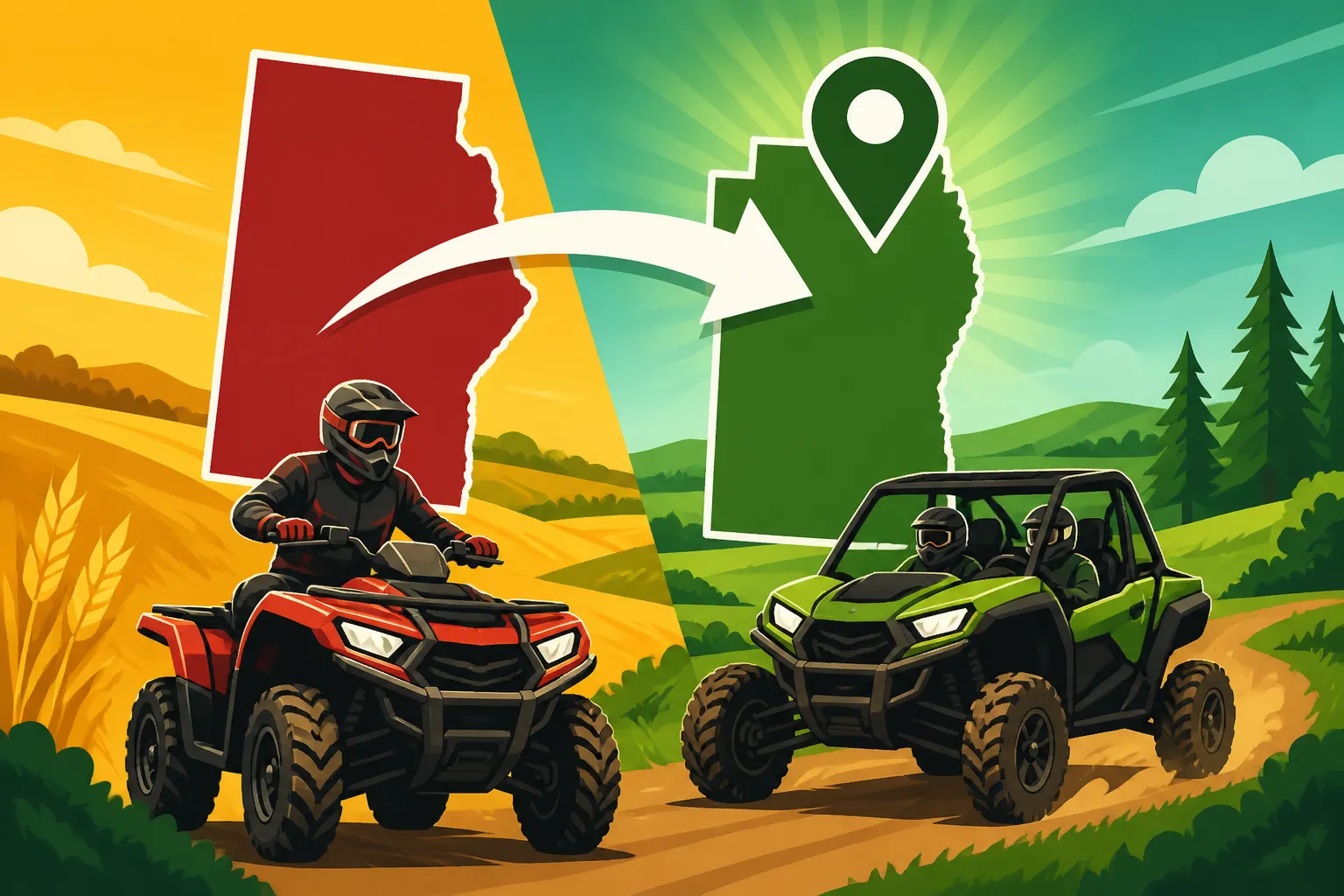
The simplest way to think about a Manitoba visit is this: bring your Manitoba paperwork, but plan to ride under Saskatchewan’s rules and the local requirements of each place you enter. There is no province-wide Saskatchewan ATV plate for visitors to obtain, yet that does not mean every road, trail or parcel is open. Check the route, access permission, insurance and any local permit before you tow your machine across the border.
Disclaimer
This article is for general informational purposes only and does not constitute professional advice. Laws, prices and regulations vary by location and change over time. Consult a qualified professional for guidance on your specific situation.