Saskatchewan Filming Permits on Crown Land
Planning to film an ATV or UTV ride on Saskatchewan Crown land? A camera does not automatically make a ride a production, but commercial filming, organized activity, equipment, or land disturbance can change what permission is needed. The key is to identify who manages the exact location and ask before you arrive. This article explains what to check, whom to contact, and how to avoid confusing filming approval with riding access.
Does filming on Saskatchewan Crown land require a permit?
There is no single answer for every filming project. Requirements can depend on the land’s designation, the purpose and scale of the filming, and what the crew plans to do there. A person casually recording a ride for personal use is not necessarily in the same situation as a commercial crew staging vehicles, blocking a route, bringing equipment, or promoting a production.
The first step is to identify the location precisely. “Crown land” describes land owned by the Crown, but it does not mean every parcel has the same manager, access rules, or permitted uses. A location might be subject to separate rules because it is within a provincial park, an ecological reserve, a wildlife management area, or another managed area. Some land may also be occupied or leased. Each situation can affect who has authority to approve access and filming.
If an ATV or UTV will be used, check the riding rules independently of the filming question. Authorization to film does not automatically make it legal to ride a machine on a closed road, trail, or area. Likewise, being allowed to ride somewhere does not necessarily authorize a commercial production to set up there. Start with Saskatchewan Crown Land Access Rules and Saskatchewan Crown Land Riding Explained to understand why the land designation and proposed route matter.
Personal recording versus a production
For a small personal recording, the practical questions are usually whether riding is allowed at that location, whether the route is open, and whether the camera activity interferes with other users or damages the land. A handheld camera or action camera used while riding is different in scale from a production that brings a crew, vehicles, lighting, temporary structures, or paid talent.
Commercial purpose is a reason to make an early inquiry, not a guarantee that a permit is or is not required. A production may be advertising, a documentary, a television segment, an online series, or paid promotional content. The way the footage will be used can matter, but so can the practical footprint: crew size, duration, vehicles, equipment, and any effect on public access or the land.
A small crew can still need to ask for authorization if its activities go beyond ordinary public use. For example, a crew might want to reserve a staging area, place equipment off an established route, film in a sensitive habitat, or temporarily control access to a trail. Conversely, simply carrying a camera should not be treated as proof that a formal filming permit is required. Describe the actual plan and let the land manager determine what approval applies.
The land manager matters
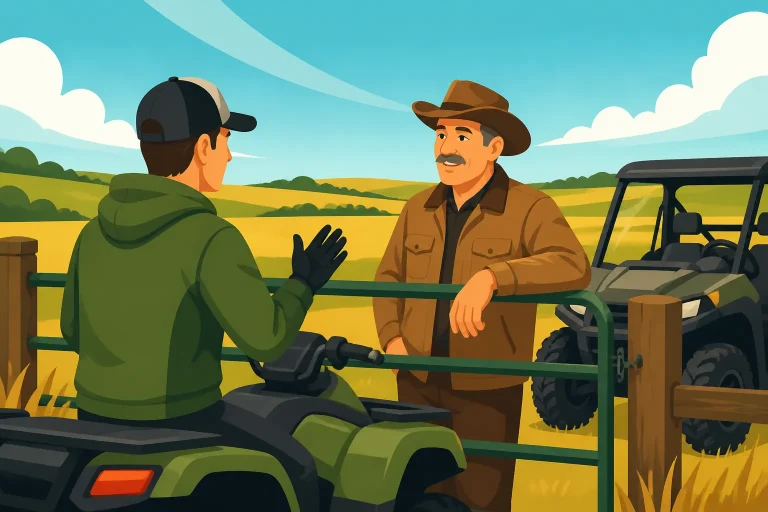
Before asking about a filming permit, confirm who manages the place you want to use. For provincial Crown land outside a park, the relevant provincial office may be responsible for land access or resource management. A provincial park has its own management and visitor rules, and a municipal area or privately managed trail system may have a different contact altogether.
Do not assume that a Crown land access permission covers filming, or that a filming approval overrides other restrictions. Where a landholder, leaseholder, or occupant has a role in managing access, their permission may also be relevant. Saskatchewan Crown Land Occupant Permission explains why occupied Crown land can involve an additional permission step.
If your planned shoot is an organized ride, event, guided activity, or commercial tour rather than a simple filming visit, ask about that activity specifically. The approvals for an event or commercial guiding operation may be separate from filming authorization. See Permits for an Organized Ride on Crown Land and Saskatchewan Commercial Guiding Rules for the related questions.
What to confirm before you film
When contacting a land manager, give enough information for them to assess the real activity. A vague request such as “Can we film on Crown land?” may not identify the location, access route, or potential impacts. Clear details can help the office explain whether you need permission, a permit, another approval, or simply to follow ordinary access rules.
Prepare the following information:
- The exact location, including nearby roads, trail names, landmarks, or coordinates if available.
- The proposed dates and times, including setup and pack-out.
- The purpose of the filming and how the footage will be used.
- The number of crew members and vehicles.
- Whether ATVs, UTVs, support trucks, trailers, or other motorized equipment will enter the area.
- The route you plan to use and where vehicles will be parked or unloaded.
- Any proposed staging, lighting, generators, props, signs, temporary structures, or equipment placed on the ground.
- Whether you expect to cross, occupy, or temporarily restrict a route used by others.
- Any planned drone use, including the proposed launch and landing areas.
- How you will avoid disturbing wildlife, vegetation, soil, water, and other land users.
Ask direct questions rather than relying on a general response about access. For example:
- Is this specific site managed by your office, or should another land manager be contacted?
- Is the proposed ATV or UTV route open to riding for this purpose?
- Does filming or commercial use require written authorization?
- Are there restrictions on crew size, parking, staging, equipment, or hours?
- Does the location have seasonal, fire-related, wildlife, or other temporary closures?
- Are additional permissions needed from an occupant, leaseholder, municipality, or park office?
- Is there a separate process for drone operations?
- What documentation should the crew carry or display on site?
The distinction between an organized event and filming can be easy to miss. A production that invites participants, schedules a group ride, or uses a trail in a way that affects other users may need to ask about event requirements as well as filming. Saskatchewan Event Permits for a Ride is relevant when the filming plan includes a coordinated ride rather than a small crew recording an otherwise ordinary trip.
Keep the response you receive. If the office gives verbal direction, note the date, the person or office contacted, the location discussed, and any conditions stated. If permission is required, ask for the approval in writing and keep a copy with the production lead. A written record helps prevent confusion if staff or conditions change before the shoot.
Filming permission is not riding permission
Treat the shoot as two separate checks: permission to film and permission to ride. They may involve the same land manager, but approval for one does not necessarily settle the other.
| Question | What to verify |
|---|---|
| Can the crew enter the location? | Confirm public access, land designation, closures, and any required permission. |
| Can the ATV or UTV use the proposed route? | Check the rules for that land and route; filming approval alone does not authorize riding. |
| Can the crew set up equipment? | Ask about staging, parking, generators, lighting, props, and equipment placed on the ground. |
| Can the production control access? | Do not assume a crew can block a trail or reserve public space without specific approval. |
| Can a drone be used? | Check aviation requirements and land-manager restrictions separately. |
| Can the footage be used commercially? | Describe the intended use when requesting permission; do not assume personal-use rules apply. |
This distinction matters especially in parks and other protected or managed areas. A park may restrict machines to designated routes or prohibit them in certain places, even if filming is otherwise possible. If the shoot is in a provincial park, contact the park office and ask about both the filming activity and the machine route. Saskatchewan Provincial Park Machine Rules provides context on why park access rules should be checked separately.
The same is true for Crown land that is open to some kinds of use but subject to temporary restrictions. A route may be affected by a closure, a land-management order, a fire risk, or a local restriction. Check conditions close to the filming date, not only when scouting. Saskatchewan Wildfire Season Rules for Riders is useful when planning a shoot during fire season, while Saskatchewan Crown Land Prohibition Regulations covers the broader issue of restrictions on Crown land.
Drone filming has its own layer of rules. A land manager’s permission to access a location does not replace aviation requirements, and compliance with aviation rules does not automatically grant permission to launch from or film on a particular parcel. Check both before adding drone footage to the production plan. Also account for bystanders, wildlife, and other users; a legal flight can still create a land-use or safety problem if it disrupts the area.
Do not assume that a municipal plate, trail pass, park permit, or machine registration—where applicable—serves as a film permit. These documents address different questions. A local permit may relate to riding or access, while production authorization concerns the activity being filmed and its effects on the land. Confirm the exact purpose of every approval you are relying on.
A practical planning checklist
Use this process before committing to a location or announcing a shoot:
- Pin down the location. Identify the parcel, park, trail, road, or staging area. A broad description such as “north of town” is not enough to establish which rules apply.
- Identify the manager. Contact the office responsible for that land, and ask whether another authority or occupant must also be involved.
- Describe the full production. Include the filming purpose, crew, machines, support vehicles, equipment, route, and any activity that might affect other users.
- Ask about separate approvals. Confirm access, riding, filming, events, commercial activity, and drone use as distinct questions.
- Check current restrictions. Reconfirm closures and conditions near the shoot date, particularly if fire, weather, wildlife, or seasonal access could affect the location.
- Get written confirmation where needed. Keep approval and any conditions accessible to the crew on location.
- Brief the crew. Make sure operators and production staff understand permitted routes, parking, boundaries, and any conditions.
- Leave the site as found. Remove equipment and waste, avoid unnecessary disturbance, and do not leave props, markers, or temporary installations behind.
If the location or plan changes, ask again. Moving from an established trail to an off-trail filming spot, adding a support vehicle, increasing the crew, or staging an organized ride can change the nature of the activity. Approval for one setup should not be treated as blanket permission for a different one.
For an ATV or UTV production, the safest approach is to make the request specific and early. Provide a route map, explain what the camera crew will do, and ask the land manager to identify any other permissions required. That avoids the two common mistakes: assuming that all Crown land is open for any kind of filming, and assuming that a camera automatically requires the same permit everywhere.
Disclaimer
This article is for general informational purposes only and does not constitute professional advice. Laws, prices and regulations vary by location and change over time. Consult a qualified professional for guidance on your specific situation.