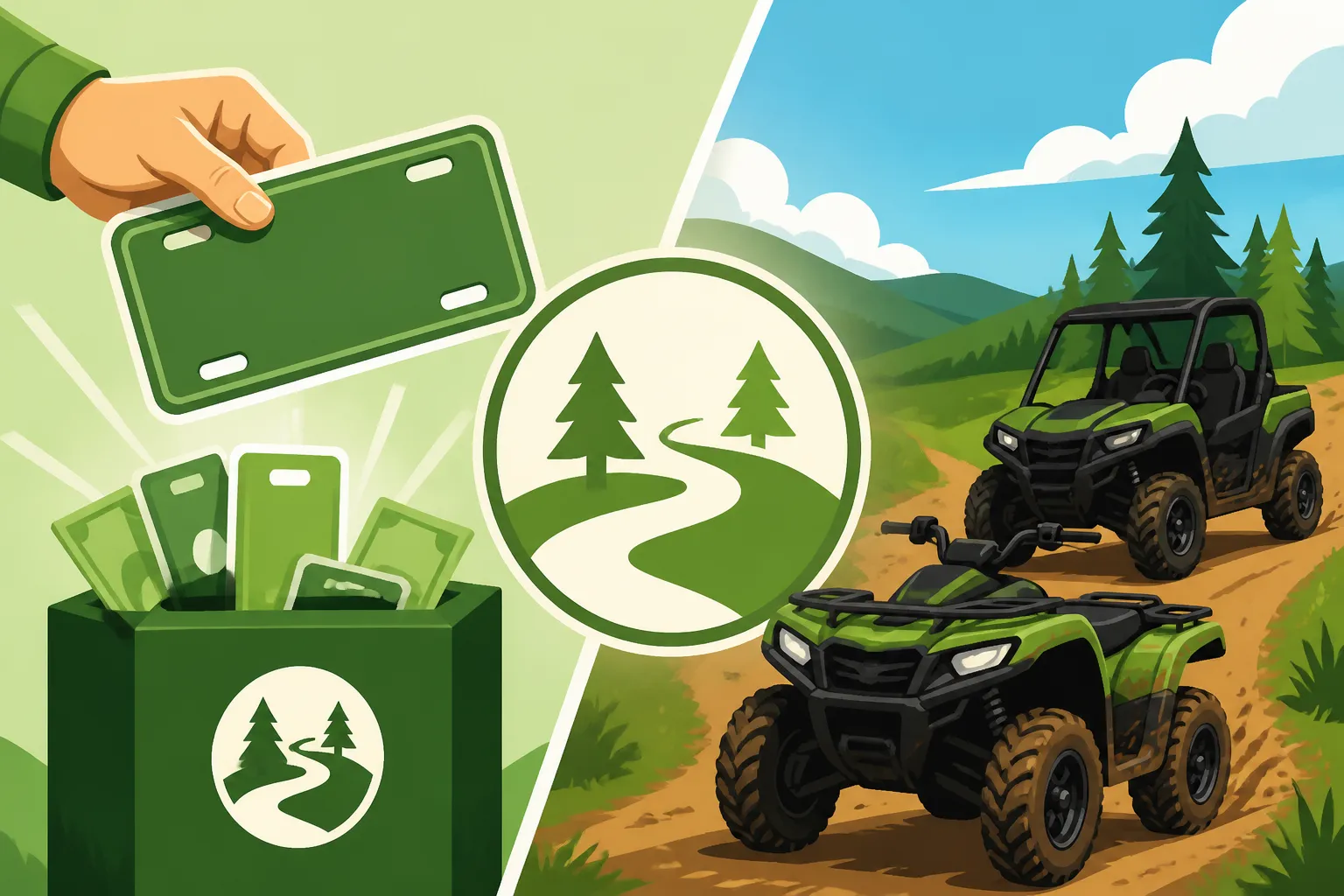
Plate Money Spent on Local Trails
A local ATV plate can look like a small administrative detail, but riders often want to know what the fee actually pays for. In Saskatchewan, there is no province-wide quad plate, and municipal programs differ. Here’s how local plate revenue may support trails, what it does not automatically guarantee, and how to check where your money goes.
What a local ATV plate means in Saskatchewan
Saskatchewan does not issue one province-wide ATV plate that gives riders general access everywhere. Some municipalities operate their own plate or permit schemes, usually tied to local rules and places where riding is allowed. A plate from one community should not be treated as a province-wide registration or permission to ride in another.
That distinction matters when interpreting the fee. A local charge may help fund services or trail work in the area that runs the scheme, but the plate itself is not proof that every trail in the province is open to you. Check the local requirements before riding, even if your machine already displays a plate from elsewhere. Saskatchewan Municipal ATV Plates Explained covers how these local schemes differ from provincial registration.
The word “plate” can also make a municipal permit sound more transferable or comprehensive than it is. The municipality may use it to identify machines authorized under a local bylaw, support enforcement, or raise money for local recreation. The exact purpose depends on the program’s rules. A local plate does not necessarily function like a vehicle registration document, and it may not transfer with a machine when it is sold. Why a Plate Does Not Follow the Machine explains why a seller’s plate should not be assumed to belong to the buyer.
| Question | What to assume | What to verify locally |
|---|---|---|
| Is there one Saskatchewan-wide ATV plate? | No province-wide quad plate is issued | Whether the municipality has its own scheme |
| Does a local plate allow riding anywhere? | No; local permission is limited by applicable rules | Which roads, trails, and areas are open |
| Does the fee always go directly to trails? | Not necessarily | Whether revenue is earmarked or included in a general budget |
| Does a plate move to a new owner? | Do not assume it does | The local transfer, surrender, or reapplication rules |
| Does the plate replace insurance or safety requirements? | No | The separate requirements that apply to your ride |
For riders, the practical question is not only “What does the plate cost?” It is also “What permission does it give me, where does that permission apply, and how is the revenue handled?” Those answers can be different from one municipality to another.
How plate money may support local trails
A municipal plate program can help fund the local work that makes riding possible. Depending on the program and the municipality’s budget, revenue may contribute to trail maintenance, signs, mapping, access management, or other recreation-related work. It may also help pay for administration and enforcement connected with the program.
Those are plausible uses, not a promise that every plate fee is placed in a dedicated trail account. A municipality may collect fees under a bylaw and account for the money through its broader budget. Some programs may set out a specific trail purpose; others may not publicly promise a direct dollar-for-dollar link between each plate and a particular trail project.
Trail work also involves more than cutting a path through the bush. A local riding area may need route planning, permission or agreements for access, signs at junctions, maintenance after weather damage, and communication about closures. There can be ongoing costs even when there is no visible construction. In a small municipality, staff time and coordination may be as important as equipment or materials.
Revenue from plates may also be only one part of the funding picture. A trail system could rely on municipal funds, volunteer work, club contributions, grants, donations, or other sources. Conversely, a local scheme may collect only modest revenue and be unable to cover every maintenance need. A plate fee should not be taken as proof that a trail is fully maintained, patrolled, or guaranteed to stay open.
The connection between local plates and trails is described in Municipal Plates Fill the Gap the Province Left and Why Plate Revenue Funds Local Trails. The important qualification is that the title or purpose of a program does not tell you precisely how a particular municipality budgets and spends its proceeds. Check the local bylaw, fee information, and budget rather than assuming the money is automatically reserved for trail work.
Direct trail funding versus general municipal revenue
The key distinction is whether a fee is earmarked. If a bylaw or municipal policy says proceeds support a particular trail purpose, that gives riders a clearer expectation. If the municipality collects the fee as general revenue, council may still choose to fund trails, but the fee is not necessarily tied to a specific trail expense.
Even an earmarked fund does not mean every dollar will be spent immediately. The municipality might accumulate money for a larger project, use it for eligible administrative costs, or adjust plans when access changes. Ask what the municipality counts as trail spending, and whether that includes planning and administration as well as physical maintenance.
A visible sign, grading work, or new route may take time to appear after fees are collected. That delay does not by itself show that the money was misused. But a program should be able to explain its purpose and provide a reasonable account of how revenue is handled.
How to find out where your municipality spends the money
Start with the rules for the specific plate or permit. Look for the bylaw, application information, or municipal notice that explains why the fee is charged and what riding it authorizes. If the wording is unclear, ask the municipal office rather than relying on another rider’s interpretation. A nearby town or rural municipality may have different conditions.
Then ask how the fee is recorded. A useful question is whether proceeds are kept in a separate account, assigned to a trail budget, or included in general municipal revenue. Ask what kinds of costs the program covers and whether the municipality can point to current or planned trail work. These questions are more useful than asking only whether “the money goes to trails,” because the answer may depend on what counts as trail-related spending.
You can also ask whether the municipality publishes a budget, annual report, council minutes, or project updates that show relevant spending. Some offices can answer a straightforward question directly; others may need to refer you to the clerk, administrator, or council. Keep the request specific and neutral. For example:
- Ask whether the plate fee is earmarked for trails or goes into general revenue.
- Ask which expenses the program is intended to support, including administration or enforcement.
- Ask where to find the relevant bylaw, budget line, or council decision.
- Ask whether there are current trail projects, planned maintenance, or known access changes.
- Confirm which routes the plate covers and whether other permissions are required.
For a practical checklist of questions, see Questions Worth Asking a Rural Municipality. If you are unsure whether a local plate is available or required in the area where you plan to ride, Which Municipalities Actually Sell You a Quad Plate is a useful related topic. Do not assume that a scheme exists just because another municipality has one.
The amount charged is only one part of the value. Consider whether the permitted routes are useful to you, whether they connect to a broader riding area, and what conditions apply. A fee may support a local system even if you personally use only a short stretch of it. But if the plate covers a limited area, it may not be worth buying until you know the boundaries and rules.
What the fee does not guarantee, and what riders should do
Paying for a local plate does not automatically guarantee that a trail will be open every time you visit. Access can depend on municipal rules, land permissions, seasonal conditions, construction, fire restrictions, or other closures. Nor does a plate necessarily authorize riding on provincial land, private property, or roads outside the municipality’s scheme. Check the rules for each part of your route.
It also does not replace other obligations that may apply to the rider or machine. Insurance, age and supervision rules, equipment requirements, and safe operation rules are separate from a municipal plate. Before heading out, confirm the riding rules for the area and carry the proof or paperwork that applies. Saskatchewan Municipalities With ATV Bylaws and Saskatchewan Bylaw Lookups Before You Ride can help explain why local checks matter.
If you want to support trail access, paying a valid local fee is one way to participate in the scheme. You can also ask how to report damaged signs or blocked routes, respect land access conditions, and avoid creating unauthorized tracks. A municipality or club may welcome volunteers, but confirm where and when work is permitted. Unapproved trail building can create access and safety problems rather than solving them.
When you buy or sell a machine, treat the plate as a local authorization that may have its own rules, not as permanent proof that the machine is registered across Saskatchewan. Ask the municipality whether the plate must be returned, cancelled, or replaced when ownership changes. Surrendering a Municipal Plate When You Sell and Saskatchewan Municipal Plate Renewals address common questions about changes and renewals.
A simple way to judge a local program is to separate three questions:
- What does the fee authorize? Identify the municipality, routes, and conditions covered.
- How is the revenue handled? Find out whether it is earmarked, budgeted for trails, or pooled with other revenue.
- What can you expect in return? Look for clear rules, maintained information, and a process for updates or concerns, rather than assuming a fee guarantees a particular trail standard.
If answers are hard to find, ask the municipal office for the relevant bylaw or budget information before paying. The municipality can clarify its own scheme; it cannot necessarily answer for a neighboring jurisdiction or give permission for land it does not control.
Local plate revenue can be part of the support that keeps nearby riding opportunities available, but the details are local. Check the program’s stated purpose and actual rules, and treat every plate as limited to the authority that issued it. That gives you a clearer picture of what your fee contributes and where you can ride.
Disclaimer
This article is for general informational purposes only and does not constitute professional advice. Laws, prices and regulations vary by location and change over time. Consult a qualified professional for guidance on your specific situation.