Occupied Crown Land and Permission
Occupied Crown land can look like open riding country, but public ownership does not automatically mean you can take an ATV or UTV across every part of it. The key is whether the land is occupied, who holds the relevant interest, and what route and activity they have permitted. Here’s how to check before you unload or cross a lease.
What occupied Crown land means for riders
Crown land is land owned by the provincial government. Some of it is subject to an occupancy or other land disposition, such as a lease, permit or licence. The person or organization holding that interest is commonly called the occupant or disposition holder.
For riders, the practical distinction is that access to occupied Crown land may require the occupant’s permission. A map showing Crown land does not, by itself, tell you that ATV or UTV riding is allowed. Nor does being near a public road or established trail mean you can leave it and explore the surrounding land.
That does not mean every part of Crown land has the same access rules. The land’s status, the type of disposition, posted restrictions, current closures and the route you intend to use all matter. Start with Saskatchewan Crown Land Access Rules and Saskatchewan Crown Land Riding Explained if you need a broader overview of access beyond occupied land.
Identify the land and the route
Before planning a ride, work out exactly where you want to go. A general destination such as “the bush north of the lake” is not enough to establish who controls access or whether the route crosses occupied land. Use current mapping and identify the access point, the route and any places where you plan to stop or turn around.
Then check the land status with the appropriate provincial land office or other official source. Ask whether the area is occupied, what kind of disposition applies and how to contact the holder. A map can help you narrow down the question, but confirm uncertain boundaries with an official source before riding. Boundaries are easy to misread when you are looking at a phone screen, especially where a route passes between public roads, Crown land and private parcels.
| What you find | What it means for your ride |
|---|---|
| Crown land with an active occupant or disposition holder | Contact the holder and confirm whether your planned access is allowed. |
| Crown land with no obvious occupant listed | Do not assume every activity is open; check for other restrictions, closures or designated routes. |
| A public road or right of way through or beside the area | Stay on the public route unless you have permission to leave it. |
| A posted closure or restriction | Follow it, even if another map shows the land as Crown land. |
| A route that crosses private land or a grazing lease | Obtain the relevant permission before crossing. |
The term “occupied” can cover different arrangements, and the person to contact may not be obvious from a map. If you cannot confirm the holder or boundary, ask the responsible land office for direction rather than treating uncertainty as permission. Occupied Crown Land and Permission and Saskatchewan Crown Land Riding Permission cover related questions about identifying the right contact and getting consent.
Public ownership is not unrestricted access
It is tempting to think, “The province owns it, so I can ride there.” That is not a safe assumption. Public ownership and permission to use a particular occupied parcel are separate questions. A rider may be able to travel on a lawful public route while still needing permission to enter land beside it.
Likewise, seeing tire tracks, an unlocked gate or another rider does not prove that access is authorized. The tracks may be from the occupant, an authorized worker or someone who did not have permission. A gate may be open for livestock or equipment, not for recreational traffic.
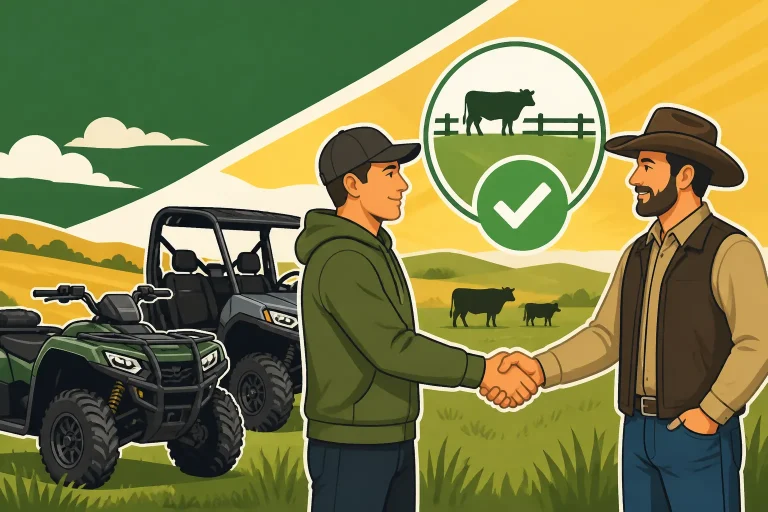
If the route crosses a grazing lease, treat that as a specific access issue, not as an informal shortcut. Saskatchewan Grazing Lease Access Rules explains why permission and conditions can matter there. For a practical approach to contacting the lease holder, see Getting Consent From a Grazing Lease Holder.
How to ask for permission
A useful permission request is specific. The holder needs to understand who is asking, what machine will be used, where the rider wants to go and when. A vague request to “ride the area sometime” can leave important questions unresolved.
- Find the correct holder or contact. Confirm the land status and ask the relevant land office how to reach the occupant if that information is not clear.
- Describe the proposed ride. Give the date or date range, number of riders, type of machines and intended route. Include a map or clear directions where possible.
- Ask what is allowed. Confirm whether access is permitted, whether you must remain on a particular trail or road, and whether stopping, camping, towing or bringing a group is included.
- Ask about conditions. Check for livestock, gates, sensitive areas, seasonal restrictions, fire concerns or other instructions.
- Keep a record. Save a text or email, or write down the date, name and exact conditions of a verbal conversation. Permission is easier to follow when its limits are clear.
- Reconfirm if plans change. A different route, a larger group or a new date may fall outside what the holder agreed to.
Permission is not necessarily an all-purpose pass. It may apply only to one route, one day, certain riders or a particular activity. If the holder says you may use a road to reach a destination, do not assume that includes riding through adjoining fields or trails.
A short written request can be as simple as:
I’m asking permission for two ATVs to travel on the route shown on the attached map on Saturday. We plan to enter at the west access point, stay on the existing track and leave by the same route. Please let me know whether this is allowed and whether there are gates, livestock or other conditions we should know about.
Keep the response with you during the ride. A digital copy can be useful, but a phone that is out of battery or has no service is not much help. Consider saving the message offline and carrying a printed copy in a waterproof document pouch; retailers such as Amazon sell these, though any suitable pouch will do.
Clarify what “yes” covers
Before setting out, make sure you and the holder mean the same thing by “access.” Ask whether permission covers:
- Every person in your group, or only the person who made the request.
- The specific ATV or UTV route, including the entry and exit points.
- A passenger, trailer or support vehicle.
- A short stop to regroup or deal with a mechanical problem.
- A return visit on another day.
- Travel during the season you have in mind.
If the holder gives conditions, repeat them back or ask for them in writing. For example, “Stay on the main track and close the gate behind you” is more actionable than “Be careful around the cattle.” Do not guess at a condition’s meaning when a quick follow-up can clear it up.
Respect a refusal or a change in conditions
An occupant may decline a request or limit access. If they say no, choose another route or riding area. Do not enter anyway because the land is Crown-owned, because the gate is open or because someone else appears to be using the trail.
Permission can also change. A holder may need to restrict access because of livestock movements, maintenance, wet ground, fire risk or another concern. If you receive new instructions before the ride, follow them. If you arrive and find a closure sign, a blocked route or an unexpected activity underway, stop and contact the holder rather than trying to work around the restriction.
Riding after permission is granted
Permission answers only the access question. It does not replace other rules that apply to the machine, rider, route or location. You still need to follow applicable ATV and UTV operating requirements, municipal bylaws, posted restrictions and any park or land-use rules. Saskatchewan ATV Road Rules Explained is a useful starting point for road and operating rules.
Keep to the agreed route
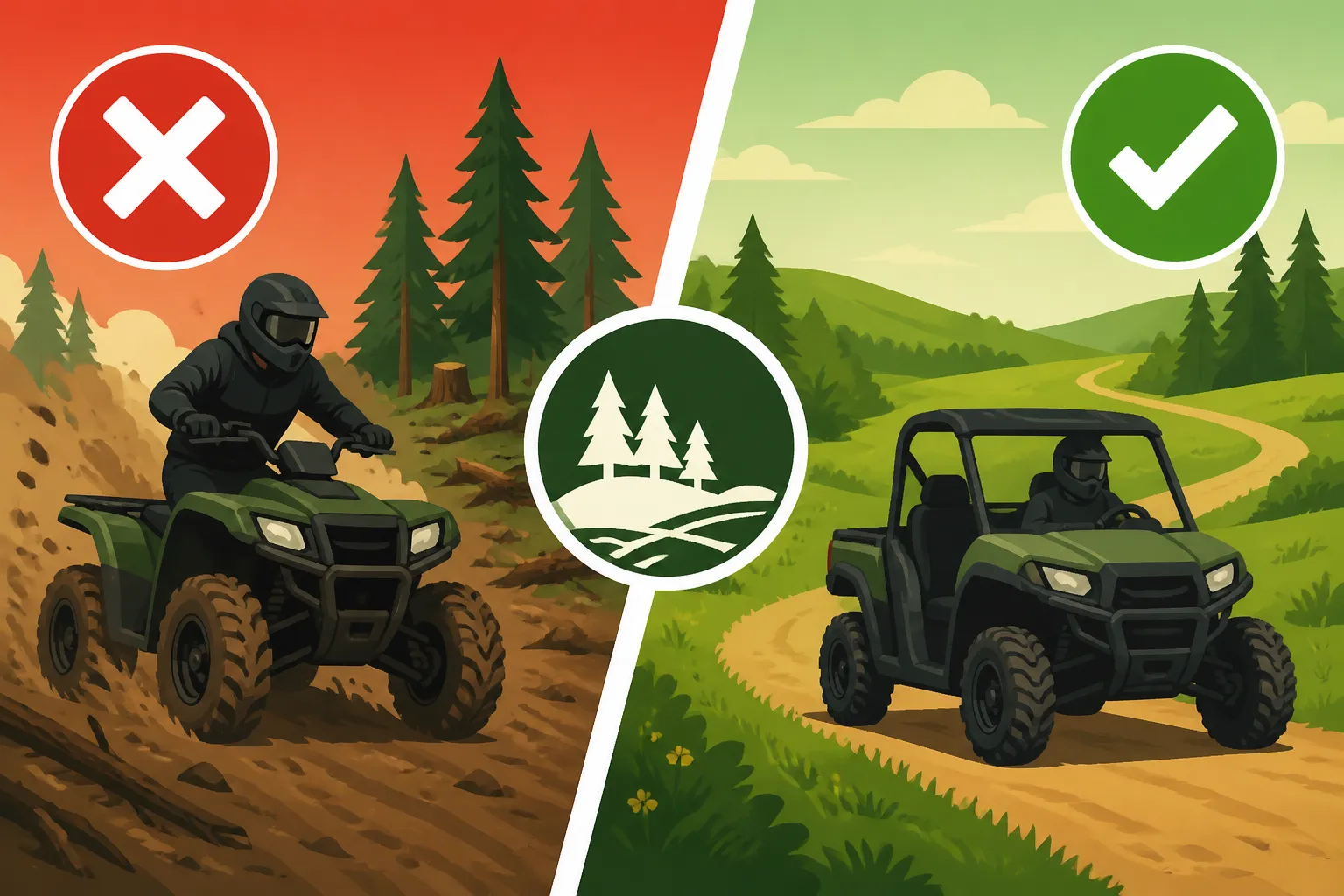
Use the route you discussed and turn around if it is blocked or conditions make it unsafe. Do not create a new trail to get around mud, a gate, a damaged bridge or a closure. A detour may cross a different parcel or disturb land that was not included in your permission.
This matters even on land that looks unused. A route may cross a pasture, a work area or a place where equipment is operating. Avoid cutting through vegetation, widening an existing track or driving over soft ground. If the route is too wet to use without damage, ask the holder whether to wait or take a different route.
Treat gates and livestock as part of the access agreement
Ask what to do with each gate before you ride. Some must be left as found; others must be closed after every rider passes. Do not assume that a group can leave a gate open while everyone catches up. Make sure the last person knows what the instruction is.
Give livestock room and reduce speed well before approaching them. Do not chase, crowd or split a herd, and do not use a horn or engine revving to push animals along. If cattle or other livestock are on the route, stop at a safe distance and contact the holder if you cannot pass without disturbing them. Reaching a Rancher Before You Cross Their Lease offers practical guidance on coordinating a crossing.
Check for closures and fire-related restrictions
Access permission does not override a temporary closure or fire restriction. Before a ride, check whether the land or route is closed and whether current conditions limit motorized use. Restrictions can change, so a message from a landholder received earlier does not guarantee that the area remains open.
Riders should also be ready to prevent and respond to fire. Follow current instructions for equipment and travel, keep the machine clear of combustible debris and avoid stopping in dry grass where heat or sparks could create a hazard. For more detail, see Saskatchewan Fire Season Riding Restrictions and Saskatchewan Wildfire Act Duties for Riders.
Carry the information you may need
Keep the permission record, route details and a way to contact the holder available during the ride. Also carry whatever documents are required for the machine and rider under the rules that apply to your trip. If an officer or land manager asks what you are doing, explain your route and show the relevant permission or contact information when asked.
Do not rely on a screenshot of a map alone as proof that you have access. A map can help show where you intended to go, but it does not establish that the occupant agreed to your ride. A clear message or written note describing the permission and its conditions is more useful.
A practical check before you unload
Use this checklist when you are planning to ride across or into occupied Crown land:
- Confirm the land status. Identify whether the route crosses occupied Crown land, private land, a grazing lease or another restricted area.
- Confirm the contact. Find the holder or ask the appropriate land office how to reach them.
- Request specific permission. Describe the machines, riders, route and timing.
- Record the answer. Keep the permission and any conditions in a form you can access offline.
- Check for changes. Look for current closures, signs, fire restrictions and route conditions shortly before departure.
- Stay within the agreement. Use only the approved route and do not add riders or activities that were not covered.
- Leave the area as required. Follow instructions for gates, livestock, waste and any other conditions.
If you cannot confirm whether the land is occupied, cannot reach the holder or cannot tell whether your route is included in the permission, do not treat silence as approval. Pause the plan and verify access before riding. That small check can prevent a trespass problem, avoid conflict with a landholder and protect a route other riders may also depend on.
For related access questions, Saskatchewan Private Land Permission explains the separate issue of crossing private property, while Saskatchewan Crown Land Occupant Permission focuses on consent from an occupant. The rules and contact details can differ by land type, so check the specific route rather than relying on what was allowed somewhere else.
Disclaimer
This article is for general informational purposes only and does not constitute professional advice. Laws, prices and regulations vary by location and change over time. Consult a qualified professional for guidance on your specific situation.