When a Peace Officer Can Seize Your Quad
There's nothing quite like the freedom of exploring Saskatchewan's vast landscapes on your ATV or UTV, but that freedom comes with a significant responsibility to know and follow the rules. It's an unfortunately common and deeply frustrating scenario for riders to face the prospect of a peace officer seizing their beloved quad, leaving them stranded and facing a heap of paperwork and fees. This comprehensive guide will walk you through the various circumstances under which a peace officer can legally seize your machine, explain the process, and offer advice on how to prevent this stressful situation and get your quad back if it does happen.
Understanding Peace Officer Authority in Saskatchewan
When you're out riding, whether it's on a grid road, a designated trail, or even private land, you're operating under the watchful eye of the law. Peace officers in Saskatchewan—which include RCMP, municipal police, conservation officers, and even some park officers—have specific powers granted to them under [Saskatchewan's All Terrain Vehicles Act] (the Act) and other related provincial legislation. They aren't just there to give out tickets; they have the authority to remove a machine from your possession under certain conditions, and it's vital to understand what triggers that power.
Powers of Investigation and Inspection
A peace officer can stop an ATV or UTV and require the operator to produce certain documents or information. This isn't just a random act; it's often based on reasonable grounds to suspect a violation. They might ask for proof of insurance, your driver's licence, or information about the machine itself. Refusing to comply with these requests can escalate the situation quickly and may lead to further action.
Beyond documents, officers can also visually inspect your machine for compliance with safety regulations, such as proper lighting, a spark arrestor, or modifications that might make it unsafe or illegal for the area you're riding in. If they suspect the machine is unregistered (which is fine, as ATVs aren't provincially registered), stolen, or being operated in a manner that endangers public safety, their powers increase significantly.
When Seizure Becomes an Option
Seizure isn't taken lightly, but it's a critical tool for officers to enforce the Act and ensure public safety. It’s typically reserved for situations where the violation is serious, creates an immediate hazard, or when the operator is unable or unwilling to comply with the law. For example, if a machine is being operated by someone who is dangerously impaired, or if it's in an area where its presence poses an unacceptable risk to the environment or other people, an officer has grounds to seize it.
The intent behind seizure is often to remove a dangerous situation from the public sphere, protect property, or gather evidence for a prosecution. It's not necessarily meant as a punishment itself, but rather as a preventative measure to stop further infractions or harm. Understanding this helps riders see why an officer might resort to such a measure, even if it feels unfair at the time.
Common Reasons for Quad Seizure
Let's dive into the specific scenarios that can lead to a peace officer seizing your quad. Many of these relate directly to the safe and legal operation of the machine, as laid out in the province's regulations. Being aware of these common pitfalls is your first line of defense against having your machine towed away.
Operating Without Required Insurance
This is a big one, and often the most surprising to riders. While Saskatchewan does not require provincial registration for ATVs, it absolutely requires them to be insured. Every ATV and UTV operated off a public road, or even crossing a public road, must have at least $200,000 in third-party liability insurance. [Saskatchewan Insurance Requirements for Riders] are clear on this point. If you cannot provide immediate proof of this insurance when requested by an officer, they have the grounds to seize your machine.
Imagine you're out for a ride with friends, and an officer pulls you over. They ask for proof of insurance, and you realize you left your card at home, or perhaps worse, you let your policy lapse. The officer can't just take your word for it. Without tangible proof, they might deem the operation illegal and seize the quad on the spot. This isn't just a hypothetical; it happens more often than riders realize, underscoring the importance of always carrying your insurance documentation.
Furthermore, if your insurance is invalid, expired, or simply non-existent, the consequences are even more severe. An officer must ensure that any vehicle operating on public or accessible lands is adequately insured to protect other road users and property. If you're uninsured and cause an accident, the financial implications could be devastating, which is why enforcement on this point is so strict.
Age and Supervision Violations
The Act has specific rules about who can operate an ATV and under what conditions, particularly concerning younger riders. [Saskatchewan Bans Riders Under 16] from operating ATVs without proper supervision or certification. Specifically, if a rider under 16 is operating an ATV, they must be under the direct supervision of a licensed adult who has held a driver's licence for at least 365 days. There's also an exception for riders aged 12 and over who have completed an approved safety course, which can replace the direct supervision requirement.
Consider a scenario where a 14-year-old is tearing across an open field, seemingly supervised by an adult watching from a distance. If an officer determines the "supervision" isn't direct enough (e.g., the supervisor isn't in a position to immediately intervene), or if the adult hasn't held their licence for the required 365 days as per [Saskatchewan's 365-Day Supervisor Rule], the quad could be seized. The officer's priority is the safety of the minor and the public.
Another common oversight is having a child as a passenger on a single-rider ATV. Quads are designed for specific rider capacities, and if a machine is clearly marked for one rider but is carrying two, especially a child, it's a violation. This puts the child at significant risk of injury, and an officer could seize the machine to prevent such dangerous operation from continuing. It's not about being a killjoy; it's about protecting vulnerable young people.
Riding in Prohibited Areas
Saskatchewan has clear boundaries for where ATVs and UTVs can and cannot be operated. Ignoring these rules can lead to serious consequences, including seizure. Public roads, certain Crown lands, and designated ecologically sensitive areas are common places where ATV use is either restricted or entirely prohibited. For example, [Saskatchewan Crown Land Prohibition Regulations] can close specific areas to quad use, especially during high-risk periods like wildfire season.
Imagine you're navigating what you think is a harmless cutline on Crown land, only to discover later it's part of a restricted zone. If a conservation officer finds you there, they may not just issue a ticket; they might seize your machine, especially if your presence is causing environmental damage or if it's a repeat offense. It's critical to know the land you're riding on and always verify access rules.
Many municipalities also have specific bylaws regulating ATV use within their boundaries. What's allowed on a rural grid road might be strictly prohibited on a town street, or even in certain ditches. [Saskatchewan Municipal Bylaws on Roads] can vary wildly from one community to the next. If you're riding your quad down Main Street in a town where it's explicitly forbidden, an officer could seize it as a public nuisance or a safety hazard, particularly if you're causing disruption or danger to pedestrians or other vehicles.
Impaired or Dangerous Operation
Operating an ATV under the influence of alcohol or drugs is just as serious as impaired driving in a car and carries similar, if not identical, penalties. [Saskatchewan Impaired Riding Penalties] are severe, and for good reason: an impaired rider is a danger to themselves and everyone around them. If a peace officer suspects you're operating your quad while impaired, they will absolutely seize your machine as part of their investigation and to prevent further danger.
This isn't just about swerving or obvious signs of impairment. Even a minor accident where impairment is suspected can trigger a seizure. The officer has a duty to remove the impaired operator and the potential source of danger from the public space. Your quad will likely be impounded as evidence and held until the legal process unfolds.
Beyond impairment, reckless or dangerous operation, such as excessive speed in inappropriate areas, stunting, or deliberately harassing wildlife, can also lead to seizure. If your actions demonstrate a blatant disregard for safety or the law, an officer can interpret this as a severe enough offense to warrant taking your machine. This protects not only other people but also the natural environment and animals.
Equipment and Safety Violations
While ATVs don't require provincial registration, they are still subject to equipment and safety standards. For instance, [Saskatchewan Helmet and Eye Protection Rules] are mandatory. If you're caught riding without an approved helmet securely fastened, or without proper eye protection, it's a safety violation. While an officer might initially issue a ticket, repeated offenses or particularly egregious situations (like a very young rider without a helmet) could prompt a seizure to prevent serious injury.
Consider modifications to your machine that make it illegal for the intended riding area. This could include excessively loud exhaust systems that violate noise bylaws, or modifications that make the quad unsafe for road crossings or ditch riding. While less common than the other reasons, if an officer determines your machine's equipment makes it an imminent danger to yourself or others, they have the discretion to remove it from operation.
Furthermore, if your ATV has been modified to operate at speeds far exceeding its design for a specific class, or if it lacks essential safety features like functional brakes or lights, an officer might intervene. The goal is always to ensure that machines on Saskatchewan's trails and roadsides are safe for all users, and that includes the machine itself being up to par.
The Seizure Process: What to Expect
No one wants their quad seized, but if it happens, knowing what to expect can help you navigate the immediate aftermath. The process can be unsettling, but understanding the steps involved can alleviate some of the stress.
Initial Encounter and Officer's Actions
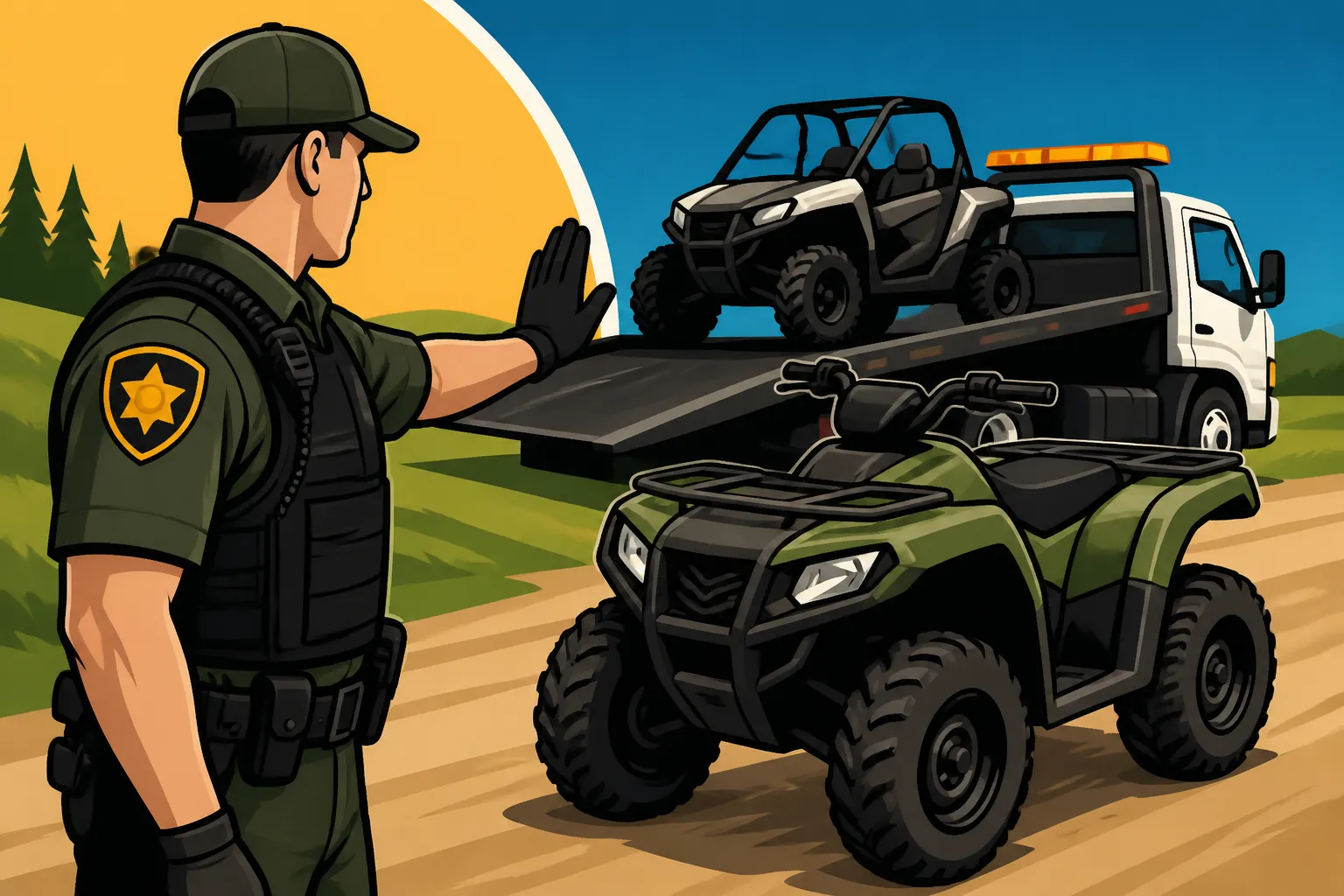
When a peace officer decides to seize your ATV, they will typically inform you of their decision and the reason for it. This conversation might happen roadside, or at the location where the violation occurred. They will likely ask you to dismount and move away from the machine. They'll also record details about the machine, the location, and the circumstances surrounding the seizure. This record is crucial for both their case and your ability to retrieve the quad later.
During this initial phase, it's important to remain calm and cooperative, even if you disagree with the officer's decision. Arguing or resisting can lead to additional charges, making an already difficult situation much worse. Ask clear questions about where your machine will be taken, how you can retrieve it, and what specific steps you need to take. Write down the officer's name, badge number, and the specific section of the Act or bylaw they are citing for the seizure.
The officer will then arrange for your quad to be transported to an impound lot or a secure facility. This usually involves calling a tow truck or other specialized vehicle capable of hauling an ATV. You will likely be responsible for these towing and storage fees, which can add up quickly. It's a frustrating situation, but a necessary part of the process.
Documentation and Next Steps
Once your quad is removed, the officer will complete formal paperwork detailing the seizure. This documentation will include the reason for the seizure, the date and time, the location, and a description of the ATV. You may receive a copy of this seizure report, which is vital for your records. If you are also issued a ticket for the violation that led to the seizure, this will be separate but related documentation.
At this point, you're looking at a two-pronged problem: addressing the violation (the ticket) and retrieving your machine (the seizure). You'll need to understand the charges against you and whether you plan to dispute them. For the machine, you'll be given instructions on how to contact the impound lot and what will be required for its release. This often involves proving ownership and paying any outstanding fines and fees.
It's a good idea to seek legal advice if you believe the seizure was unjust or if the charges are complex. A lawyer specializing in traffic or provincial offenses can help you understand your rights and options. Don't delay in addressing these issues, as storage fees for impounded machines can accumulate daily, adding to your financial burden.
Getting Your Seized Quad Back
Having your quad seized is a significant headache, but it's not the end of the road. There's a process to follow to get your machine back, and being prepared with the right documentation and understanding the steps involved is key.
Proving Ownership Without Registration
This is where many Saskatchewan ATV owners hit a snag, especially since there's no provincial registration or title for ATVs. You can't just show up to the impound lot with a driver's licence and expect to walk away with your quad. You need to prove you are the rightful owner. [Saskatchewan Proof of Ownership Without a Registry] usually relies on a strong bill of sale.
A comprehensive bill of sale, clearly showing your name, the seller's name, the date of purchase, the purchase price, and most importantly, the ATV's Vehicle Identification Number (VIN) or serial number, is paramount. If you bought your quad new from a dealer, your sales invoice serves this purpose. If you bought it privately, a handwritten bill of sale is typically sufficient, but it needs to be detailed. If you used a template from a service like LawDepot, that's even better, as it covers all the necessary legal points.
If you don't have adequate proof of ownership, this is where things get complicated. You might need to track down previous owners, or in some cases, apply for a statutory declaration. This is also where a service like LawDepot could help you draft a proper [Saskatchewan Bills of Sale Do the Work] to formalize your ownership, or even a sworn affidavit if you have lost your original documentation and need to attest to your ownership history. Without clear proof, the impound lot cannot release the machine, even if you're willing to pay all fees.
Appealing a Seizure
In some cases, you might feel that the seizure was unwarranted or based on a misunderstanding. While you can't typically "appeal" the physical act of seizure in the moment, you can certainly dispute the underlying ticket or charge that led to it. If the charges are dropped or you are found not guilty, this will strengthen your case for the return of your machine and potentially absolve you of some associated fees.
The process for disputing a ticket involves appearing in court on the date specified on your citation. You'll present your side of the story and any evidence you have to counter the officer's claim. This could include photos, witness statements, or documentation. If the court rules in your favour, you'll then take that decision back to the impound lot or the relevant authority (e.g., the Seizure and Impoundment Board if applicable, see [Getting a Seized Quad Released by the Board]) to arrange for the return of your quad.
Remember, appealing the ticket doesn't automatically mean your quad is released immediately or that all fees are waived. You might still be responsible for towing and storage fees, even if the underlying charge is dismissed. However, a successful appeal can certainly help your case and potentially reduce the overall financial burden.
Paying Fines and Fees
Realistically, in most seizure cases, you'll need to pay various fines and fees to get your quad back. These typically include:
- Towing Fees: The cost of transporting your quad from the seizure location to the impound lot.
- Storage Fees: A daily charge for keeping your quad at the impound lot. These can quickly accumulate, so prompt action is crucial.
- Administrative Fees: Some impound lots or municipal authorities may charge an administrative fee for processing the seizure and release.
- Fines for the Violation: The actual penalty for the offense that led to the seizure (e.g., no insurance, impaired operation, prohibited riding).
You will likely need to pay all these fees in full before the impound lot will release your machine. They are usually not negotiable at the point of release. You will also need to present your proof of ownership, as discussed earlier. Once all requirements are met and payments are made, your quad will finally be returned to you.
| Violation Type | Example Scenario | Risk of Seizure | Documentation Needed for Release (beyond ID) |
|---|---|---|---|
| No Insurance | Riding without current liability insurance. | High | Proof of current insurance, Bill of Sale |
| Underage/Unsupervised Riding | 14-year-old riding alone or with inadequate supervision. | High | Bill of Sale (for adult owner) |
| Prohibited Area | Riding on closed Crown land or town streets. | Medium-High | Bill of Sale |
| Impaired Operation | Operating under the influence of alcohol/drugs. | Very High | Bill of Sale (often after legal process) |
| Dangerous Operation | Reckless riding, excessive speed, stunting. | Medium-High | Bill of Sale |
| No Helmet/Eye Protection (repeat) | Consistently riding without required safety gear. | Low-Medium | Bill of Sale |
| Unsafe Equipment | Machine with critical safety features missing/broken. | Low-Medium | Bill of Sale |
| Stolen Machine | Operating a machine confirmed as stolen. | Very High | Proof of legal ownership (for rightful owner) |
Preventing Seizure: Best Practices
The absolute best way to deal with quad seizure is to prevent it from happening in the first place. A little foresight and adherence to the rules can save you a world of trouble, frustration, and money.
Know the Rules and Regulations
Ignorance of the law is never an excuse, and in Saskatchewan, the rules for ATVs and UTVs are quite specific. Take the time to familiarize yourself with [Saskatchewan's All Terrain Vehicles Act] and any relevant municipal bylaws in the areas you plan to ride. Pay close attention to age restrictions, supervision requirements, and where you are legally allowed to operate your machine. Is it permissible to ride on [Saskatchewan Rules for Riding a Ditch]? What about [Saskatchewan Rules for Crossing a Highway]? Knowing these answers before you hit the trail is crucial.
Check for any specific Crown land closures or restrictions before heading out, especially during fire season or in environmentally sensitive areas. Websites for provincial parks or environmental agencies often have up-to-date information on access. A quick phone call to a rural municipality office can also clarify any local bylaws that might affect your ride.
Carry Essential Documentation
Always, always, always carry proof of your liability insurance, your driver's licence (if applicable), and your bill of sale or proof of ownership when you're riding. Keep these documents in a waterproof bag on your person or securely on your quad. Don't rely on having them "somewhere at home." An officer needs to see them on demand. Even though there's no registration, your bill of sale is your proof that the quad belongs to you, and it's essential for proving ownership if your machine is ever seized or involved in an incident.
Having a robust bill of sale from the get-go is critical. If you're purchasing a used quad, ensure the seller provides a detailed, signed bill of sale including the VIN. If you're selling, provide one for the buyer. You can find excellent templates online, including from services like LawDepot, that ensure all the necessary information is captured for legal purposes. This simple step can prevent headaches if you ever need to prove ownership to an authority.
Practice Safe and Responsible Riding
Operating your ATV or UTV safely is not just about personal well-being; it's about staying on the right side of the law. This includes always wearing an approved helmet and appropriate eye protection as per [Saskatchewan Helmet and Eye Protection Rules]. Never operate your machine while impaired by alcohol or drugs. Ensure your machine is in good working order, with functional brakes, lights, and a spark arrestor.
Respect private property and only ride on land where you have explicit permission. Stay on designated trails where they exist, and respect any posted signage regarding speed limits, prohibited areas, or environmental restrictions. Being a responsible rider contributes to a positive image for the ATV community and reduces the likelihood of negative encounters with law enforcement.
Be Courteous and Cooperative with Officers
If you are stopped by a peace officer, remain calm, courteous, and cooperative. Follow their instructions, provide the requested documentation promptly, and answer their questions honestly. Even if you disagree with why you've been stopped, engaging in an argument or becoming confrontational will only escalate the situation.
If you believe a mistake has been made or your rights have been violated, you can address that through the proper channels later. Your immediate priority is to de-escalate the situation and provide the officer with what they need. This respectful interaction can sometimes make the difference between a warning and a ticket, or a ticket and a seizure.
Disclaimer
This article is for general informational purposes only and does not constitute professional advice. Laws, prices and regulations vary by location and change over time. Consult a qualified professional for guidance on your specific situation.