Saskatchewan Penalties for Riding a Closed Area
Riding an ATV or UTV into a closed area in Saskatchewan can lead to more than a frustrating turn-around. The consequences depend on who closed the land and which rule applies. Here’s how to distinguish a Crown land order, park restriction, fire-related closure and private-land issue—and what to do if you’re stopped or receive a ticket.
What counts as a closed area
“Closed area” can mean several different things. A trail may be temporarily shut, a provincial park may limit machines to designated routes, or an order may prohibit ATV use on Crown land. A private landowner may also refuse access. The reason for the closure matters because the authority behind it determines which rules and penalties may apply.
On Crown land, an order can restrict or prohibit ATV use in a defined area. The boundary may be shown on a map, described in an order or marked with signs. Check the current order and its location rather than relying on an old trail map or a route someone shared online. Saskatchewan Administrator Orders on Crown Land and Saskatchewan Crown Land Prohibition Regulations explain the kinds of restrictions riders may encounter.
Provincial parks have their own rules for where machines may travel. A trail or access road that appears open on a map is not automatically open to ATVs; machines may be limited to designated routes, and some roads, hiking trails, campgrounds or other areas may be closed to them. Review Saskatchewan Park Regulations for Machines and the rules for the particular park before unloading.
A fire-related closure can impose another layer of restrictions. An ATV might be prohibited from an area even when a trail was open earlier in the season. Fire conditions, closures and orders can change, so check the current information for the specific riding area before setting out. Saskatchewan Wildfire Season Rules for Riders covers this separate set of concerns.
Finally, not every “closed” sign represents the same legal situation. A landowner’s permission, a municipal bylaw, a park rule and a provincial order are not interchangeable. A rider who crosses private land without consent may face a trespass issue, while riding past a Crown land closure could be handled under a different law. Do not assume that one kind of permission or permit overrides another authority’s restriction.
| Situation | What the restriction may come from | What to check |
|---|---|---|
| Crown land closed to machines | An order or prohibition applying to the area | The order, boundary and current status |
| ATV use limited in a provincial park | Park rules and designated-trail requirements | The park’s current machine rules and trail notices |
| Area closed because of fire risk | A fire-related closure, ban or restriction | Current notices for the riding area |
| Private land access refused | The landowner’s decision and trespass rules | Whether you have clear permission |
| Road, ditch or trail restricted locally | A municipal bylaw or posted restriction | The local bylaw and signs |
Signs are useful, but they are not the only source of information. A closure may be communicated through an official order, map or notice, and signs may help identify the affected location. When the boundary is unclear, stop and confirm it before proceeding. Guidance on how prohibitions may be marked is available in Saskatchewan Sign Requirements for Prohibitions.
What penalties may apply
For offences under Saskatchewan’s All Terrain Vehicles Act, the maximum fine is capped at $1,000. That is the statutory ceiling for the offence category, not a promise that every rider will receive that amount, nor proof that every closed-area violation is charged under the Act. The applicable law depends on the location, the restriction and the conduct involved. Saskatchewan Fines Capped at $1,000 explains the Act’s maximum, while Saskatchewan Penalties for Riding a Closed Area is the topic addressed here.
A closed-area incident can have consequences beyond a fine under the ATV Act. If the closure is imposed under a different law or regulation, that law may set its own enforcement process and penalties. Fire-related offences, for example, are not simply another version of the ATV Act fine. The potential consequences can differ, so don’t treat the $1,000 cap as a universal limit for every rule that might apply.
| What happened | Potential consequence |
|---|---|
| You rode where an ATV restriction under the Act applies | A ticket or prosecution may follow; the Act’s maximum fine is $1,000 |
| You rode in a park area where machines are prohibited | Enforcement may proceed under park rules, with consequences that depend on the applicable provision |
| You entered an area under a separate fire closure | Fire-related rules may apply; the ATV Act maximum does not establish the penalty |
| You entered private land without permission | A trespass issue may arise, separate from an ATV closure offence |
| Your machine is seized or impounded | You may need to follow the applicable release process before getting it back |
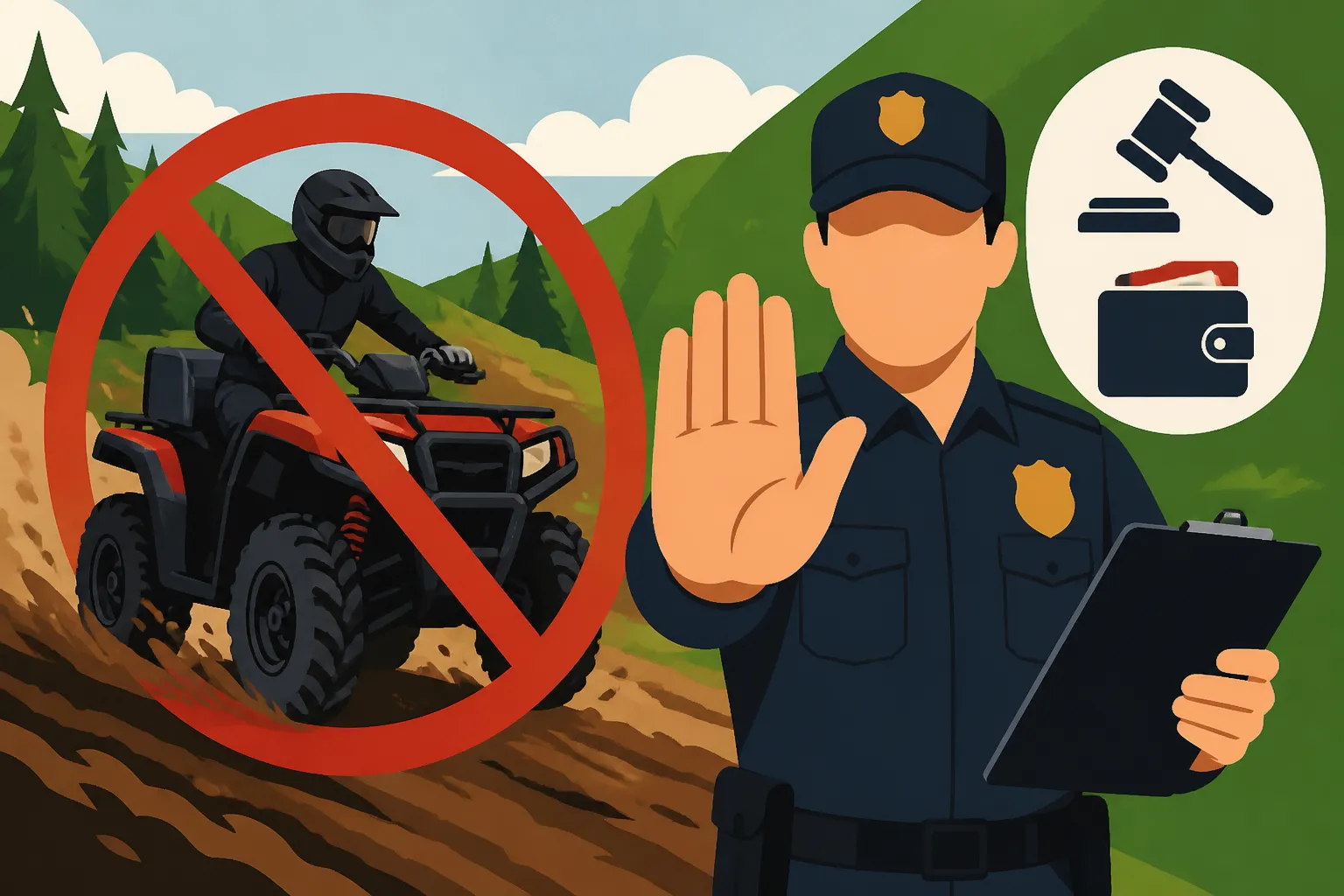
A peace officer’s response can also depend on what happened. A brief, accidental approach to a poorly marked boundary is not the same factual situation as continuing into a clearly closed area after being warned. But a rider should not assume that saying “I didn’t know” automatically removes liability. The location, signs or notices, the rider’s actions and the exact provision cited may all matter.
In some circumstances, a machine may be seized or impounded. That is a separate consequence from a fine, and it does not mean every rider found in a closed area will lose access to their machine. The authority to seize, the reason for doing so and the steps for release depend on the situation. See Saskatchewan Seizure and Impoundment Rules and Saskatchewan Release of a Seized Machine for more detail.
If an officer issues a ticket, check the document carefully. It should help identify the alleged offence and the next steps, such as how to respond or contest it. Keep the ticket, any written notices and relevant records together. If the citation refers to a law other than the ATV Act, do not assume the ATV Act’s fine cap applies.
What to do if you are stopped or ticketed
Stay calm and make the interaction safe. Stop where directed, avoid arguing on the trail and provide information or documents when lawfully requested. If you are uncertain about the boundary or what restriction applies, ask which order, bylaw or regulation is being enforced. You can note the answer without turning the roadside conversation into a dispute.
If you receive a ticket, take these steps:
- Read the citation in full. Note the alleged offence, the location, the law or regulation cited and the response instructions.
- Record the circumstances promptly. Write down where you entered the area, what signs or markers you saw, what route you took and when you learned about the restriction.
- Preserve useful evidence. Keep maps, dated photos, official closure notices, messages from landholders and any other records that show the route or information available to you.
- Confirm the boundary and authority. Look for the current order, park rule, fire notice or municipal bylaw that applies to that exact location.
- Follow the response deadline and procedure on the ticket. If you want to dispute it, use the official process rather than ignoring the notice.
- Get legal advice when the stakes are serious. This is especially important if the incident involved a seizure, a fire-related allegation, a repeat offence or possible damage to land.
Do not edit or delete photos, messages or location records that might be relevant. Preserve the original files and make a separate note explaining what each item shows. If a map or online notice has since changed, save what you can and record when you accessed it. That information may help clarify what you understood at the time, although it does not by itself determine whether an offence occurred.
A rider who believes a sign was missing or a boundary was confusing should document the issue objectively. Photograph the route and visible signs from a safe location, note the date and approximate location, and avoid entering the closed area again to get a better picture. A missing sign may be relevant evidence, but it is not a guaranteed defence; the restriction may have been communicated in another way or may apply regardless of a sign at the point where you entered.
How to reduce the risk before you ride
The most practical way to avoid a closed-area penalty is to check restrictions at the source before the machine leaves the trailer. A saved route, old map or social media post may not reflect a new closure. Check the authority responsible for the land, and look for notices that are specific to your planned area and date.
Use a pre-ride check like this:
- Identify who manages the land. Determine whether the route is on Crown land, in a provincial park, on private land or within a municipality.
- Check the relevant restriction. Look for current Crown land orders, park rules, fire-related notices and local bylaws as applicable.
- Confirm permission where needed. A trail that crosses occupied Crown land or private land may require permission. A public route does not grant access to adjoining property.
- Read signs at the trailhead and along the route. Stop if the signs conflict with a map or if the boundary is uncertain.
- Have a way to verify updates. Download available maps or notices before travelling into an area with limited service, and check for current information before departure.
- Turn around when the status is unclear. A detour is inconvenient; proceeding into a restricted area can create a much larger problem.
The rules may also change between nearby places. A trail can leave Crown land, enter a park or cross a municipal boundary without a rider noticing. Plan around the land and authority, not just the trail’s name. For riding in provincial parks, compare Saskatchewan Parks With Designated Trails Only with the specific park’s current rules. For broader access questions, Saskatchewan Crown Land Access Rules is a useful companion.
If a route becomes closed during a ride, turn back rather than trying to skirt the boundary. Riding around a barrier can put you in the same restricted area by another route, and it may make the circumstances look less accidental. Tell the other riders in your group, avoid disturbing signs or barriers, and report a confusing or damaged notice to the responsible authority.
Keep a record of the information you checked, especially for a longer trip or organized ride. A saved official notice, a map and the date you reviewed them can help your group make consistent decisions. This does not replace compliance with a later closure, but it makes it easier to identify when conditions have changed and where to verify them.
Disclaimer
This article is for general informational purposes only and does not constitute professional advice. Laws, prices and regulations vary by location and change over time. Consult a qualified professional for guidance on your specific situation.