Why Your Helmet Must Be Built for ATV Use
It's a common oversight, but the helmet you grab for a quick ATV ride isn't just any helmet. Many riders mistakenly believe a bicycle helmet or a construction hard hat offers enough protection, only to find themselves seriously at risk or even facing fines. This comprehensive guide will meticulously explain why the All Terrain Vehicles Act in Saskatchewan mandates a specific type of helmet, delve into the crucial safety standards, and walk you through what exactly makes an ATV helmet indispensable for your safety on the trails and ditches of our beautiful province.
Why "Any Old Helmet" Just Doesn't Cut It
You might have a garage full of helmets for various activities – cycling, skateboarding, maybe even a construction hard hat for those DIY projects. It’s tempting to think that since it's "a helmet," it provides enough protection for an ATV ride. However, this line of thinking can be incredibly dangerous and is a common misconception among riders, particularly those new to the sport or those who only ride occasionally. The forces, impact types, and speeds involved in ATV riding are vastly different from almost any other activity, demanding a specialized design that generic headgear simply cannot replicate.
Different Helmets, Different Protection Needs
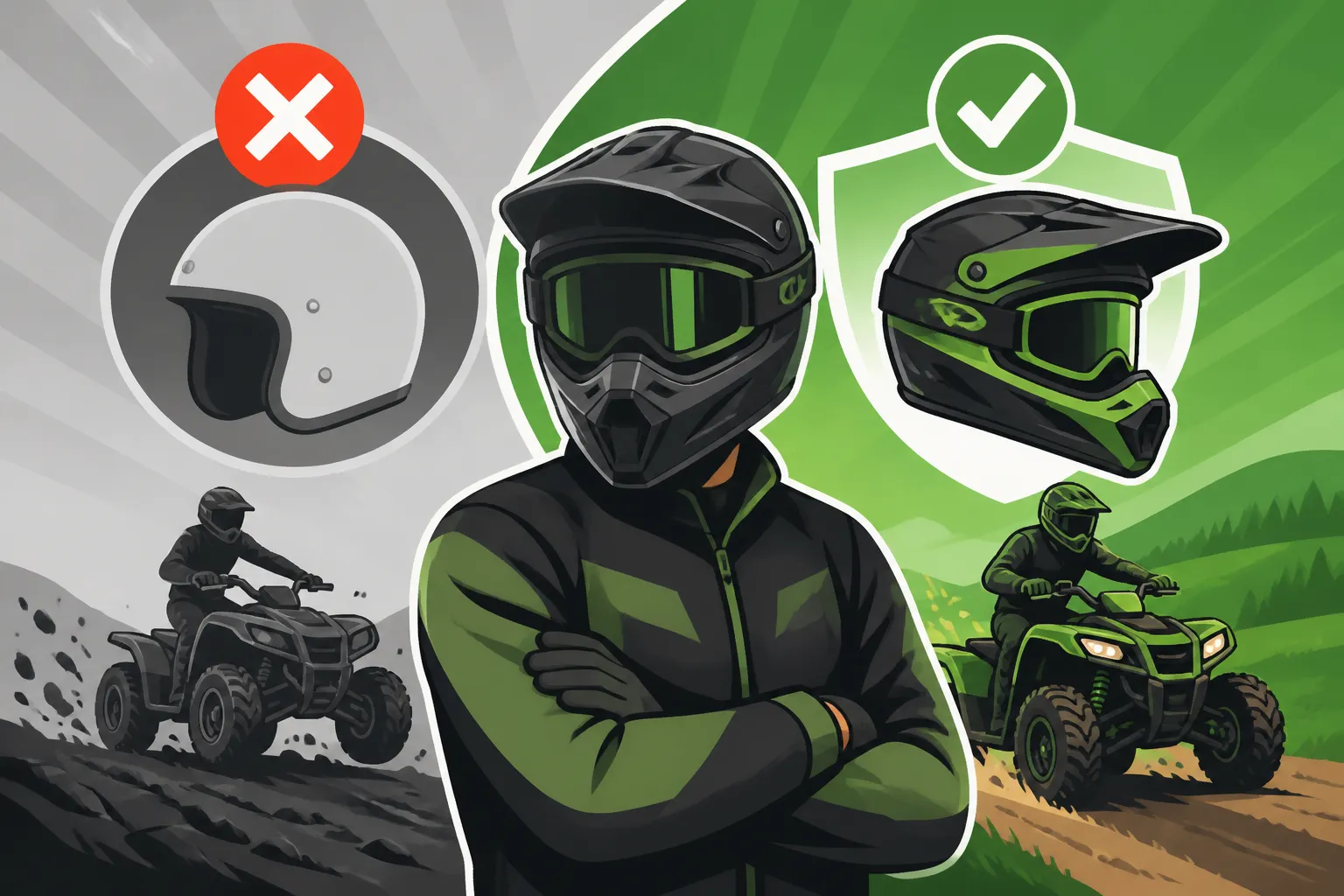
Consider the humble bicycle helmet. It's designed primarily to protect against impacts at relatively low speeds, often focusing on single, direct blows and distributing force across a wider area to prevent skull fractures. The foam inside is usually softer and designed to crush once, absorbing energy. Now, picture an ATV rollover. You might experience multiple impacts from different angles, grinding forces, and impacts against hard, uneven surfaces like rocks, trees, or even your own machine. A bicycle helmet's lightweight construction and limited coverage, especially around the jawline and back of the head, offer virtually no defense against such dynamic and violent scenarios. Its plastic shell is also much thinner and prone to shattering under the kind of forces an ATV rider might encounter.
Similarly, a construction hard hat, while robust in its own right, is built to protect against falling objects or glancing blows from above. It has very little padding and is designed to deflect rather than absorb direct impact energy, and certainly offers no protection against side impacts, rotational forces, or the kind of high-speed abrasions that can occur if you slide across gravel or pavement. Neither of these alternatives provides the full facial and jaw protection that is standard in most ATV-specific helmets, leaving critical areas exposed to injury from branches, flying debris, or direct impact during a crash. When you're venturing out on a Saskatchewan trail, whether it's a smooth gravel path or a challenging bush trail north of Prince Albert, the environment is unpredictable, and your head protection needs to match that reality.
The Specific Demands of ATV Riding
ATV riding introduces a unique set of hazards that specialized helmets are engineered to address. Unlike a motorcycle, which often rides on paved surfaces, an ATV takes you across diverse and frequently rugged terrain. This means potential impacts from low-hanging branches, flying rocks kicked up by other machines or your own tires, or even collisions with wildlife. The open nature of many ATVs and UTVs, particularly if you're not using a full cab, exposes your head to these elements. Furthermore, the higher centre of gravity and nimble handling of ATVs mean rollovers are a distinct possibility, often leading to impacts with the ground, rocks, or even the machine itself. An ATV helmet typically features a more robust outer shell to resist penetration and abrasion, a multi-density EPS (Expanded Polystyrene) foam liner designed to absorb impact energy effectively, and a sturdy chin bar to protect your face and jaw from direct frontal impacts or contact with the ground during a slide. These features are not arbitrary; they are the result of extensive research and testing to mitigate the specific risks associated with off-road riding. When you're considering gear from reputable names, you'll see these design principles evident across their offerings.
Saskatchewan's Legal Requirements for ATV Helmets
It's not just about common sense and personal safety; in Saskatchewan, wearing the correct type of helmet is a legal requirement under The All Terrain Vehicles Act. Peace officers, whether they're RCMP, provincial park rangers, or local bylaw enforcement, have the authority to pull you over and verify that your headgear meets the provincial standards. Getting caught without the proper helmet can lead to fines, which no one wants on what should be an enjoyable ride. Understanding these rules is critical for every rider, from the seasoned veteran to someone just exploring [Saskatchewan Rules for a 12-Year-Old Rider].
The All Terrain Vehicles Act Mandate
Section 17(1) of Saskatchewan's All Terrain Vehicles Act explicitly states that "no person shall operate or ride on an all terrain vehicle unless the person is wearing a helmet that complies with the regulations." This isn't a suggestion; it's a clear legal directive. The key phrase here is "complies with the regulations." This means your helmet can't just be any helmet; it must meet specific safety standards outlined in provincial law. This ensures that riders are genuinely protected, not just going through the motions. The Act aims to reduce serious head injuries, which are unfortunately common in ATV accidents when riders are either unhelmeted or wearing inadequate protection.
What does "complies with the regulations" mean in practice? It means your helmet must be manufactured to meet recognized safety standards. The most common standards accepted in Canada and North America include DOT (Department of Transportation) certification, Snell Memorial Foundation ratings, and ECE (Economic Commission for Europe) standards. These certifications aren't just stamps of approval; they signify that the helmet has undergone rigorous testing for impact absorption, penetration resistance, chin strap retention, and peripheral vision. If your helmet doesn't bear one of these recognized marks, it's not compliant, and you could be subject to penalties under the Act. A good helmet is an investment in your safety, and it's also a legal necessity. You can learn more about specific requirements in [Saskatchewan Helmet and Eye Protection Rules].
What Officers Look for on the Trail
When a peace officer conducts an [Saskatchewan Equipment Checks by Officers], one of the first things they'll scrutinize is your helmet. They aren't just looking to see if you have something on your head; they're looking for proof of compliance. This often involves checking for the certification sticker or label, usually located on the back or inside the helmet.
Here's what an officer typically checks:
- Certification Label: The presence of a DOT, Snell, or ECE sticker or molded-in marking is paramount. These labels are your proof that the helmet meets the necessary safety benchmarks. Without one, the officer has no way of verifying its compliance.
- Condition: Is the helmet in good repair? A helmet that is visibly damaged (cracks, significant dents, compromised straps) might be deemed unsafe even if it originally had a certification sticker. Helmets are designed for a single major impact; if it's been in a crash, it needs to be replaced, regardless of how it looks.
- Proper Fit and Fastening: The helmet must be worn correctly and securely fastened. A loose helmet or one with a chin strap unbuckled offers little protection and can even be more dangerous in a crash. Officers are looking for a snug fit, where the helmet doesn't move excessively when shaken, and the strap is securely fastened under the chin. [Straps Fastened by the Maker] are a non-negotiable part of the helmet's design and function.
- Appropriate Design: While the certification is key, the overall design should also be appropriate for ATV riding. This usually means a full-face or open-face style with a robust chin bar, designed for the impact conditions of off-road use. A novelty helmet or a very thin bicycle helmet won't pass muster, regardless of any ambiguous markings.
Understanding these checkpoints will not only help you stay on the right side of the law, but more importantly, ensure you're genuinely protected when you're out enjoying the [Saskatchewan Rules of Operation on a Trail].
Understanding Helmet Safety Standards
The world of helmet safety standards can seem like a jumble of acronyms: DOT, Snell, ECE. But each of these organizations plays a critical role in ensuring that the helmets we rely on provide verifiable protection. These standards aren't arbitrarily set; they are the culmination of years of research into impact physics, material science, and real-world accident data. Choosing a helmet that meets at least one of these standards is not just a recommendation; it's a legal and practical necessity for anyone riding an ATV in Saskatchewan.
What the Labels Mean: DOT, Snell, and ECE
When you pick up an ATV helmet, you'll typically find a small sticker or label indicating which safety standards it meets. These aren't just decorative; they are your assurance of quality and protection.
- DOT (Department of Transportation): This is the most common standard seen in North America. The DOT standard (FMVSS 218) is a self-certification process where manufacturers affirm their helmets meet the minimum safety requirements for highway use. While "self-certification" might sound lax, the DOT does perform random testing and can issue recalls or penalties for non-compliant helmets. DOT certification ensures a helmet can withstand specific impact forces, resist penetration, and has a reliable chin strap. For most recreational ATV riders, a DOT-certified helmet is a perfectly acceptable and legally compliant choice.
- Snell Memorial Foundation: Snell is an independent, non-profit organization that conducts more rigorous testing than the DOT standard. Snell certifications (e.g., M2020) are generally considered the gold standard for helmet safety. They test for higher impact energies, multiple impacts in the same location, and more severe penetration resistance. Helmets with a Snell rating often feature thicker shells and denser foam. While not strictly required by law in Saskatchewan, a Snell-certified helmet offers an added layer of protection that many serious riders appreciate.
- ECE (Economic Commission for Europe): The ECE 22.05 or 22.06 standard is recognized in over 50 countries globally and is the European equivalent of DOT, though often considered comparable to or even more stringent than DOT in some aspects. ECE certification involves batch testing, where a certain percentage of helmets from each production run are tested, rather than relying solely on manufacturer self-certification. Many helmets from international manufacturers will carry an ECE label, and these are also accepted in Saskatchewan.
When you're inspecting a helmet, always look for these labels. They are typically found on the back of the helmet or on the inside liner. [Finding the Compliance Label Inside Your Helmet] is crucial for verifying that your gear meets the necessary protective thresholds.
Why Certified Helmets Offer Superior Protection
The rigorous testing involved in obtaining DOT, Snell, or ECE certification is what differentiates these helmets from generic headgear. These tests simulate various crash scenarios, measuring the forces transmitted to the head upon impact.
Consider a rider navigating a rough trail, perhaps one of the challenging routes near [Porcupine Hills Riding in Saskatchewan]. If they hit an unexpected rut and are thrown from their machine, they could suffer a direct impact with a rock or tree. A certified ATV helmet is designed with:
- Impact Absorption: The EPS foam liner inside a certified helmet is engineered to progressively crush upon impact, extending the time over which the impact force is absorbed. This significantly reduces the peak force transferred to the brain, mitigating the risk of concussion and other traumatic brain injuries.
- Penetration Resistance: The outer shell, typically made from polycarbonate, fiberglass, or composite materials, is designed to resist sharp objects from piercing through to the skull. This is especially vital when riding in treed areas or where sharp debris might be present.
- Chin Strap Retention: A helmet is useless if it comes off during a crash. Certified helmets undergo stringent tests to ensure the chin strap system can withstand significant pulling forces, keeping the helmet securely on the rider's head. This is why ensuring your straps are properly [Straps Fastened by the Maker] is so important every time you ride.
In essence, these certifications are a promise from the manufacturer that their product meets a baseline (or higher) of safety, offering you the best possible chance of avoiding severe injury should an accident occur. Ignoring these standards means gambling with your well-being.
| Standard | Focus | Testing Method | General Rigor | Legally Accepted in Saskatchewan |
|---|---|---|---|---|
| DOT | Minimum highway safety for all vehicles | Manufacturer self-certification | Moderate | Yes |
| Snell | High-performance safety, multi-impact | Independent, more stringent | High | Yes (exceeds minimum) |
| ECE | International standard, batch testing | Government-mandated batch tests | Moderate-High | Yes |
Beyond the Helmet: Other Essential Eye Protection
While the helmet is the cornerstone of head protection, your eyes are equally vulnerable and demand specific attention, especially given the dusty, windy, and often debris-strewn environments of ATV riding. Saskatchewan's All Terrain Vehicles Act doesn't stop at helmets; it also has clear stipulations regarding eye protection. This isn't just about comfort; it's about maintaining clear vision for safe operation and preventing serious, debilitating injuries that could otherwise permanently impair your sight.
Goggles or a Shatterproof Shield: A Must-Have
Riding an ATV without eye protection is akin to driving a car with your eyes closed – it's simply asking for trouble. Whether you're kicking up dust on a grid road or navigating through dense bush, your eyes are constantly exposed to hazards. Flying dust, mud, small rocks, insects, and even low-hanging branches can enter your eyes, causing immediate irritation, temporary blindness, or even permanent damage. These distractions can lead to a loss of control, turning a minor inconvenience into a major accident.
Saskatchewan law recognizes this danger. The All Terrain Vehicles Act requires operators and passengers to wear "suitable eye protection." For most ATV riders, this means either a pair of purpose-built riding goggles or a shatterproof face shield integrated into a full-face helmet. These options are designed to withstand impacts from debris, provide a wide field of vision, and often feature anti-fog coatings to maintain clarity in varying conditions. They are also typically vented to reduce sweat and improve airflow, crucial for comfort during longer rides on a hot day. Just as you might source durable parts for your machine from a company like SuperATV, you should ensure your eye protection is robust and reliable. When choosing, look for lenses made from polycarbonate, which is highly impact-resistant and less likely to shatter upon impact compared to standard plastics.
Tinted Eyewear and Night Riding Rules
The choice of eye protection isn't just about form; it's also about function, particularly when considering different lighting conditions. Many riders prefer tinted goggles or shields for bright, sunny days, as they reduce glare and eye strain, enhancing visibility on sun-drenched trails or open fields. However, what works well during the day can become a significant hazard after dark.
Saskatchewan's regulations are very clear on this: [Saskatchewan Tinted Eyewear at Night] is generally prohibited. The rule exists for a very good reason: tinted lenses drastically reduce the amount of light reaching your eyes, impairing your ability to see hazards in low-light conditions. What might appear as a faint shadow or a subtle dip in the trail during the day becomes completely invisible with tinted eyewear at night, increasing the risk of accidents.
Therefore, if you plan to ride as the sun sets or venture out after dark, you must switch to clear lenses or a clear face shield. Many riders who use full-face helmets will have interchangeable shields, or those who prefer goggles will carry a spare pair with clear lenses. It’s a simple swap that can make all the difference between a safe evening ride and a dangerous incident. Remember, your eyes need to be able to fully perceive the terrain and any obstacles ahead, and restricted vision at night due to inappropriate tinting can severely compromise your safety and lead to potential fines.
In summary, prioritizing a certified ATV helmet and appropriate eye protection isn't just about ticking boxes on a legal checklist; it's about investing in your personal safety and enjoyment of the sport. The risks of head and eye injuries in ATV riding are real, and the right gear is your best defense.
Disclaimer
This article is for general informational purposes only and does not constitute professional advice. Laws, prices and regulations vary by location and change over time. Consult a qualified professional for guidance on your specific situation.