Saskatchewan Municipal Speed Limits for Quads
Municipal speed limits for quads in Saskatchewan depend on where you ride and which local rules apply. A province-wide maximum does not automatically make every street open to ATVs, or make that maximum legal on a municipal road. Here’s how to separate provincial limits from local bylaws and check the rules before you ride.
Saskatchewan speed limits and municipal rules
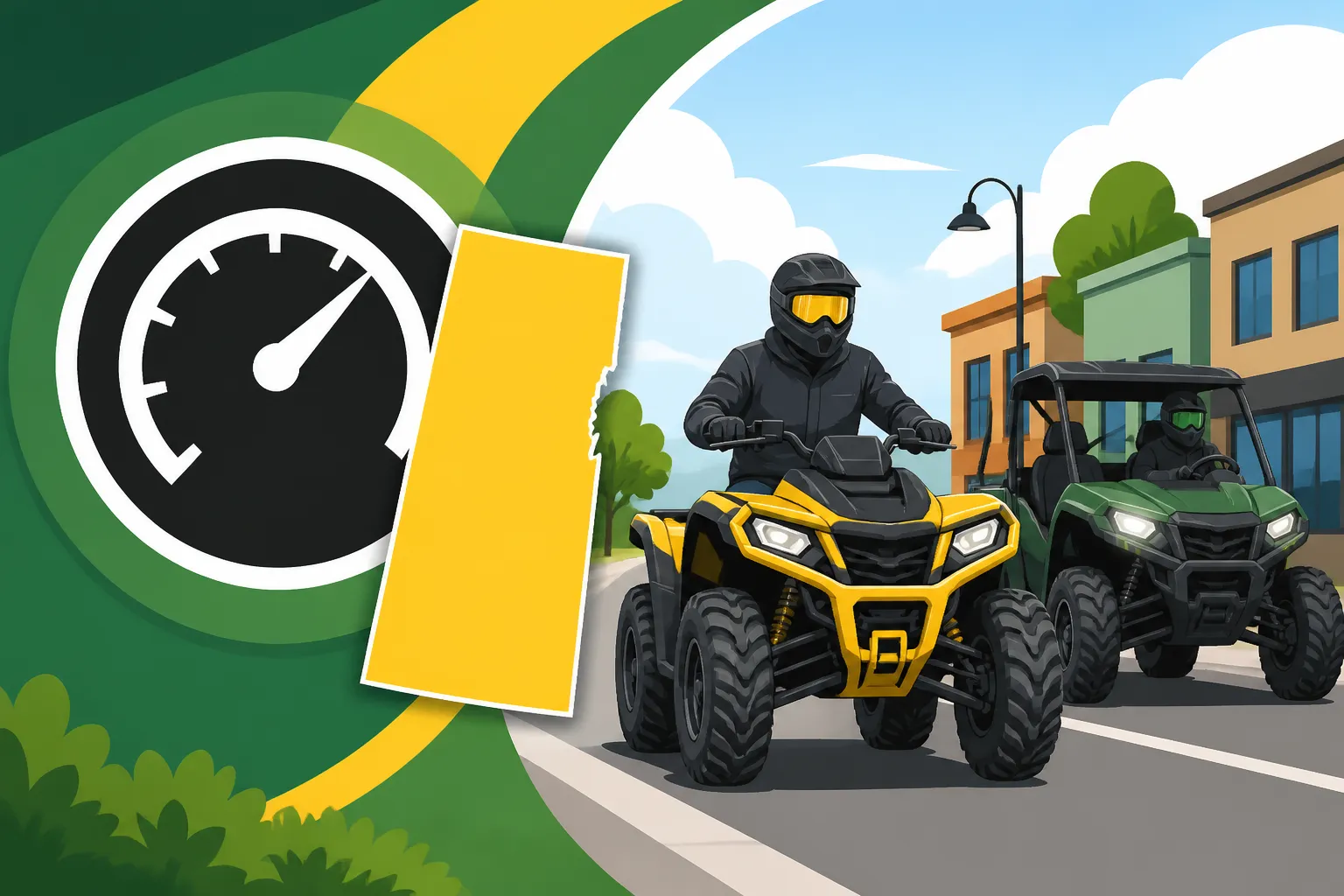
Saskatchewan has a general maximum speed of 80 km/h for an ATV, with a lower 30 km/h limit when riding on the travelled portion of a highway. Treat these as maximums, not as a promise that you can ride at those speeds on any road. A municipal bylaw or posted restriction may require you to go slower, or may prohibit ATV use on a road entirely.
The first question is whether the route is open to ATVs. Municipalities can make bylaws that permit or restrict ATV use on roads within their jurisdiction. Those bylaws may set conditions such as approved streets, operating hours, speed limits or required local permits. A route being inside a town or rural municipality does not, by itself, mean it is legal for quads.
For a broader look at when road riding is allowed, see Can You Ride an ATV on the Road in Saskatchewan? and Saskatchewan ATV Road Rules Explained. The main point is to check both the road-access rule and the speed rule. A municipal speed limit cannot be read as permission to ride a route that is closed to ATVs.
| Where you are riding | Speed rule to keep in mind | What to check |
|---|---|---|
| General ATV operation | The provincial maximum is 80 km/h | Whether the route is open and whether a lower restriction applies |
| Travelled portion of a highway | The provincial maximum is 30 km/h | Whether riding on that portion is permitted, plus any lower local limit |
| A municipal road or street | A local bylaw or sign may set a lower speed | The municipality’s bylaw, approved routes and posted signs |
| A trail or private route | The road-speed maximum may not answer the whole question | Land access, trail rules, signs and any operator conditions |
A posted speed limit for ordinary road traffic is not always the same thing as an ATV-specific rule. Read signs as instructions for the road, but do not assume a posted limit gives you permission to operate a quad there. If a road is signed at a higher speed than the ATV limit that applies to you, follow the lower ATV limit. If the municipality sets a lower ATV speed, follow that local limit.
How to work out the limit on a specific road
A reliable answer takes a little more than looking at the speed sign. Check the route and the local rule in this order:
- Identify who controls the road. It may be inside a city, town, village or rural municipality, or it may be a provincial highway. The local government may not control every road passing through its boundaries.
- Confirm that ATVs are allowed there. Look for the municipality’s ATV bylaw, an approved-route map or a direct answer from the municipal office. Some bylaws permit riding only on named roads; others prohibit it on particular streets or throughout the municipality.
- Find any ATV-specific speed limit. The bylaw may state a limit for all permitted routes or make different rules for certain areas. Check for posted signs, too.
- Apply the lowest limit that governs your situation. Do not use the general provincial maximum if a lower statutory, municipal or posted restriction applies.
- Check the conditions attached to the permission. A route may have time-of-day, crossing, age, licence, equipment or permit requirements in addition to its speed limit.
For example, suppose a town allows ATVs on a named street but its bylaw sets a speed lower than the general provincial maximum. The local limit applies on that street. If the street is not an approved route, the fact that the bylaw contains a speed limit for other roads does not make this one open.
The same caution applies when the road is posted at a low speed for regular traffic. A sign might indicate a school, residential or other restricted area, but you should still check the bylaw for ATV-specific rules. Do not infer that a quad is allowed because cars use the road, or that the ATV limit rises because the regular posted speed is higher.
To find the local rule, start with the municipality’s website and search for its ATV or off-road vehicle bylaw. If the wording is unclear, ask the municipal office which routes are approved and what speed limit applies to an ATV on each one. Saskatchewan Bylaw Lookups Before You Ride offers a useful starting point for checking local rules, and Saskatchewan Municipalities With ATV Bylaws can help you understand why the answer varies from place to place.
Why the speed limit is only one part of road riding
ATV road rules involve more than speed. The provincial framework sets operating requirements, while local bylaws can control where a quad may travel within a municipality. You may need to meet both sets of requirements before using a road.
A bylaw that allows road use might still limit which streets are open, how an ATV can cross a road or what equipment and documents an operator must have. A municipality may also prohibit riding in certain areas. Check Saskatchewan Bylaws That Permit Road Riding and Saskatchewan Bylaws That Prohibit Riding for the difference between permission and restrictions.
Other requirements can apply even when you are travelling below the speed limit. For instance, riders may need to follow rules about licensing, insurance, helmets and passengers. The general requirements are covered in Saskatchewan ATV Road Rules Explained. Local conditions can add another layer, so check the bylaw rather than relying on a rule from a neighbouring municipality.
A local plate or permit is another separate issue. Some municipalities run their own schemes, but a local plate does not automatically authorize ATV use on every street, and it does not replace the speed limit. Check Saskatchewan Municipal Plate Schemes to understand what these local programs do and do not cover. If you plan to ride across municipal boundaries, verify the requirements in each place; permission in one municipality may not carry over to the next.
Do not rely on a map, a social media post or a previous trip as proof that a route is currently open. Bylaws can differ between neighbouring communities, and signs or temporary restrictions may affect a route. If a sign and a general summary seem to conflict, treat the sign as a reason to stop and confirm the rule before continuing.
A practical pre-ride check
Before taking a quad onto a municipal road, confirm the route, limit and operating conditions together. This prevents the common mistake of focusing on speed while overlooking that the road is closed to ATVs or subject to another local condition.
Use this checklist:
- Check the municipality and road authority. Do not assume the town controls a highway simply because it passes through town.
- Find the current bylaw or approved-route information. Look for named roads, restricted areas and conditions.
- Note the ATV speed limit separately from the regular road sign. Apply any lower rule that governs your ride.
- Look for signs at the point of entry. A sign may mark a restricted area, route or special condition.
- Confirm permit or plate requirements. A local permit may be required for some routes, but it is not a substitute for permission to ride there.
- Recheck before crossing into another municipality. Local rules may change at the boundary.
- Ask the municipal office when in doubt. Keep a note of the answer and the bylaw or route information you relied on.
If an officer asks about your route or speed, being able to explain which bylaw or approved route you checked can help clarify what you understood. It does not excuse a violation, but it is better than assuming the general 80 km/h maximum applies everywhere.
The safest working rule is straightforward: verify that the road is open to ATVs, then follow the lowest applicable speed limit and any local conditions. Saskatchewan’s general maximums do not override a municipal restriction, and a municipal speed limit does not open a road that is otherwise closed to quads.
Disclaimer
This article is for general informational purposes only and does not constitute professional advice. Laws, prices and regulations vary by location and change over time. Consult a qualified professional for guidance on your specific situation.