Saskatchewan Fines for Riding Without a Plate
A quad or side-by-side in Saskatchewan does not need a province-wide ATV plate, but that does not mean every ride is plate-free. Some municipalities have their own permit or plate bylaws, and riding without the required local authorization can lead to a fine. The key is knowing which rules apply where you plan to ride.
Is there a Saskatchewan-wide fine for riding without an ATV plate?
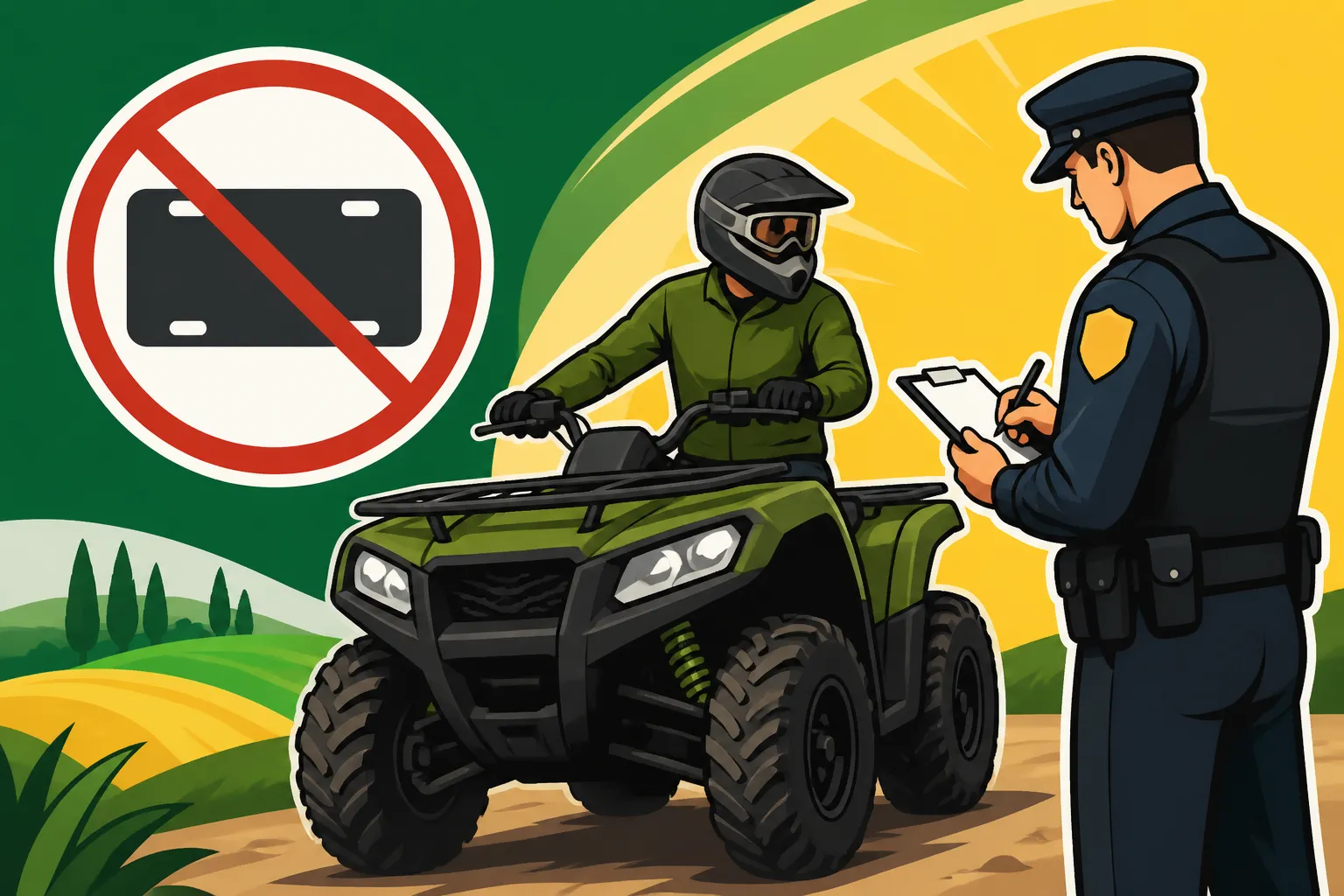
There is no province-wide ATV registration plate for Saskatchewan riders to buy. That means there is no single provincial “no plate” fine that applies everywhere simply because an ATV has no provincial plate. Saskatchewan’s system is different from a vehicle-registration system: local rules may still require a plate, permit or other authorization in particular places.
The absence of a provincial plate does not make municipal requirements optional. If a town, village, resort area or rural municipality has a bylaw requiring local authorization, riding there without it may result in a ticket under that bylaw. The amount and the circumstances depend on the local rule, not on a single province-wide ATV plate law.
This distinction is easy to miss because people use “registration,” “plate” and “permit” as if they mean the same thing. In Saskatchewan, a municipal ATV plate or permit is a local requirement where a municipality has created a scheme. It is not provincial registration and does not automatically authorize riding in other municipalities. For background, see Saskatchewan Has No ATV Plate or Decal and Saskatchewan Municipal ATV Plates Explained.
| Situation | What the absence of a plate means | What to check |
|---|---|---|
| Riding where no local plate scheme applies | No province-wide ATV plate is required just to make the machine provincially registered | Land access, operating rules, insurance and any road-use restrictions |
| Riding in a municipality with a plate or permit bylaw | The local authorization may be required even though the province issues no ATV plate | The bylaw, where it applies, how to obtain authorization and the current penalty |
| Crossing into another municipality | A plate issued locally may not satisfy the next municipality’s rules | Whether the local plate is recognized and whether a separate permit is needed |
| Riding on private land | A plate is not a substitute for the landowner’s permission | Permission, any applicable exemptions and local restrictions |
A local plate also does not replace the general rules for operating an ATV. Riders still need to consider such matters as insurance, licensing, age requirements, equipment and where riding is allowed. A plate is not a blanket permission to use public roads, trails or someone else’s property.
Before travelling, check the rules for the actual municipality and land you intend to use. A plate from your home community may not cover a trailhead, road or riding area elsewhere. Which Municipalities Actually Sell You a Quad Plate provides a useful starting point, but confirm requirements directly with the relevant local office before you ride.
What can the fine be?
There is no single amount to quote for every Saskatchewan location. A municipality sets its own requirements and penalties through its bylaws, so a fine for riding without a local plate can vary. The amount may also depend on the exact offence: for example, failing to obtain a required plate, riding in a prohibited area, or disobeying another condition may be treated as separate violations.
A published Lakeland rule identifies a $300 fine for riding unplated on municipal land. That is a local example, not a province-wide penalty. Do not assume the amount applies in a different town or rural municipality, or that it remains unchanged. Check the current bylaw and any applicable schedule of fines with the local authority. For the specific local issue, see Saskatchewan Lakeland Fines for No Plate.
A ticket may be only one part of the problem. If a rider is stopped, the officer may also ask about insurance, the rider’s licence or permission to use the land. If the ride involves a prohibited road, trail or area, having a municipal plate will not necessarily resolve that separate issue. Local plate rules and operating rules are related, but they are not interchangeable.
If you receive a ticket, read the notice carefully. It should identify the alleged offence, the issuing authority and the available response or payment process. Do not assume that paying a fine for one issue settles other alleged violations. If the notice is unclear, contact the authority named on it and ask which bylaw provision applies and what options are available to dispute it.
Municipal bylaws can change, and local rules are not always summarized consistently online. When the penalty matters to your plans, use the municipality’s current bylaw or ask the office that administers the plate scheme. A quick confirmation before the ride is more reliable than relying on a fine amount quoted for a different place.
How to check whether you need a plate
Start with the municipality where you will actually ride, not only the place where you live or store the machine. If your route passes through several communities, check each one. A local plate may be valid only within the issuing municipality, and an adjacent municipality may have different rules or no plate scheme at all.
Use this practical checklist before loading the machine:
- Identify the location. Note the municipality, trail system, road or other land where the ATV will operate. If the route crosses municipal boundaries, list each one.
- Ask whether a local scheme applies. Contact the town, village or rural municipality and ask whether ATV plates or permits are required for that location and type of riding.
- Confirm the exact coverage. Ask whether the plate applies to the specific roads, trails or municipal lands you plan to use, and whether it is recognized outside the issuing area.
- Check the current bylaw and fine. Ask where the bylaw can be read and whether the penalty schedule is current. Do not rely on an old sign, an online discussion or another rider’s recollection alone.
- Ask what proof to carry. Find out whether the plate must be displayed in a particular way and whether you should carry a receipt, permit document or proof of insurance.
- Check other operating rules separately. Verify access permission, road restrictions, insurance and rider requirements. A local plate does not automatically settle those questions.
For local offices and plate schemes, Saskatchewan Bylaw Lookups Before You Ride and Saskatchewan Rural Municipality Rules can help frame what to ask. If you are riding around Candle Lake, check the rules for that municipality and riding area rather than assuming another community’s plate arrangement applies. Saskatchewan Candle Lake Road Rules covers a separate part of the local picture.
When calling or visiting an office, make the question specific. “Do I need an ATV plate?” can produce an incomplete answer if staff do not know where you intend to ride. Instead, give the name of the trail, road or municipal area and ask whether your planned use is allowed, whether a plate or permit is needed, and what penalty applies if it is missing.
Keep a record of the information you receive, especially if the rules are not obvious. A dated email or a copy of the current bylaw can help you confirm what you were told. It is still your responsibility to follow the rules in force at the time of your ride, so recheck if a long time passes between planning and travelling.
What a municipal plate does and does not do
A municipal plate is best understood as local authorization under a local scheme. It is not a Saskatchewan-wide registration document, and it does not transform an ATV into a highway-registered vehicle. It may help a municipality administer local riding access, but its purpose and coverage depend on the bylaw that created it.
In particular, do not assume a plate:
- Allows road riding wherever you choose.
- Gives permission to use private property or occupied land.
- Grants access to Crown land, a park or a trail that is otherwise closed.
- Replaces liability insurance or proof of insurance.
- Is accepted by every municipality.
- Transfers automatically when the machine is sold.
The distinction matters when you travel. You might have a plate issued by one municipality and still need to comply with a different municipality’s rules at your destination. Or you may reach a location where no local ATV plate is issued, but other access, insurance or operating restrictions remain in force. Check each part of the trip rather than treating the plate as a travel pass.
Carry documents that help explain who owns the machine and whether it is insured. Saskatchewan does not use a provincial ATV registry in the same way it registers road vehicles, so a bill of sale or other ownership records can be useful if ownership is questioned. See Saskatchewan Proof of Ownership on the Trail. Also confirm what insurance proof you need to have available; Proof of Insurance Is What Saskatchewan Officers Ask For covers that separate requirement.
If you are buying or borrowing a machine, ask the current owner about any local plate or permit and whether it can remain with the machine. Local authorization may be tied to a person, property or municipality rather than simply following the ATV. Do not assume that a seller’s plate makes your own planned ride legal. Contact the issuing municipality and confirm what a new owner or visiting rider must do.
The safest rule is straightforward: no provincial ATV plate does not mean no local rules. Find out whether the municipality where you plan to ride requires a plate or permit, verify the current penalty directly, and check access and operating requirements separately. That keeps a local fine from becoming an avoidable surprise—and helps ensure the ride itself is allowed.
Disclaimer
This article is for general informational purposes only and does not constitute professional advice. Laws, prices and regulations vary by location and change over time. Consult a qualified professional for guidance on your specific situation.