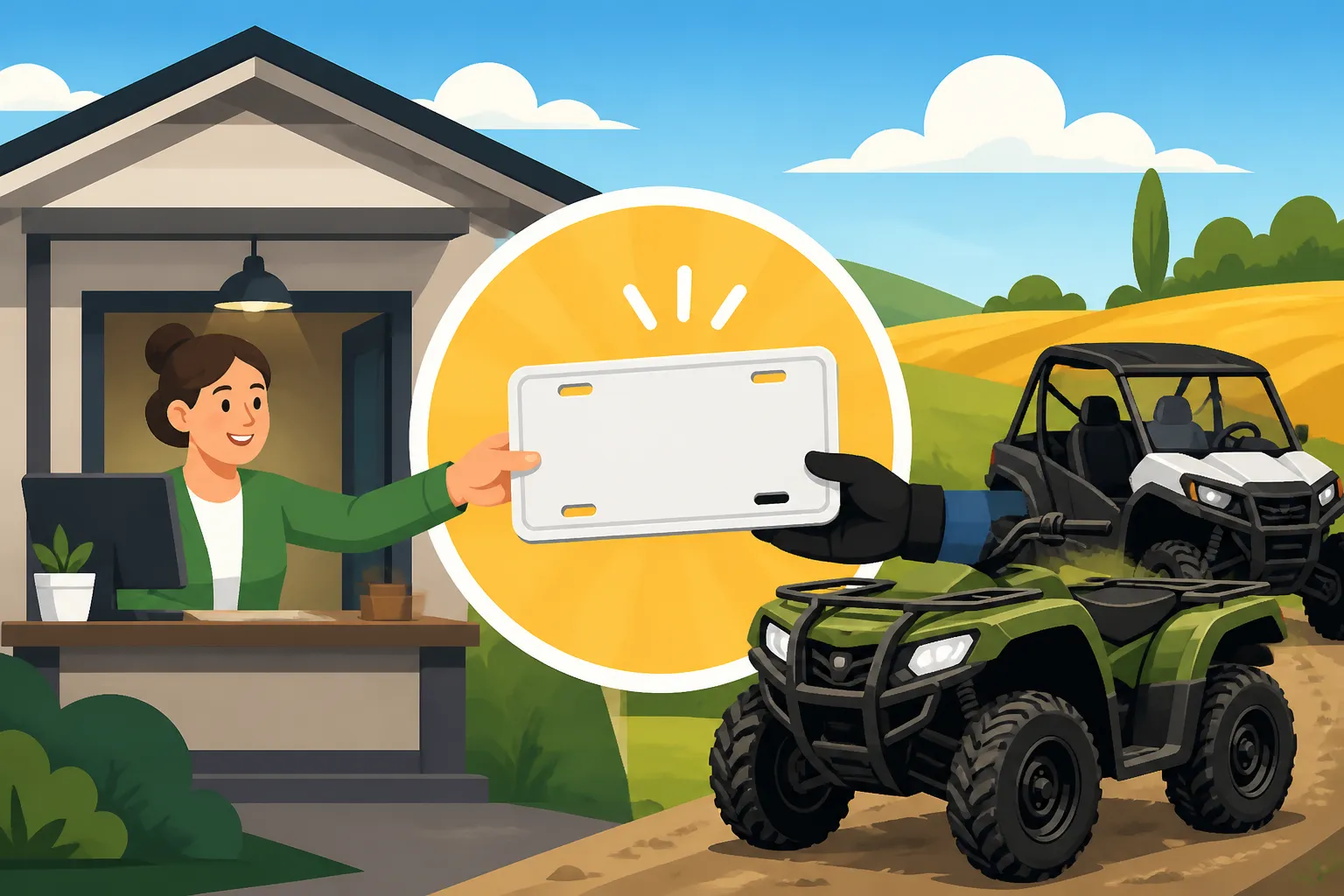
Village Office Hours When You Need a Plate
A village office may be the place to get a local ATV plate, but its hours can decide whether you ride today or make another trip. Saskatchewan has no province-wide ATV registration, and municipal plate programs are local. Before hauling your machine, confirm that the office issues plates, is open, and can handle your specific request.
First confirm that the office issues the plate you need
In Saskatchewan, a municipal ATV plate is not the same as provincial registration. The province does not issue a general ATV plate, while some municipalities operate local plate schemes with their own coverage and rules. A plate from one community should not be assumed to authorize riding in another. Start by checking Saskatchewan Municipal ATV Plates Explained and Which Municipalities Actually Sell You a Quad Plate to understand what kind of program applies where you plan to ride.
This distinction matters when you are deciding whether a village office visit is worthwhile. A village may sell a local permit, but it may not issue plates at all. Another municipality may have a scheme but handle new plates, renewals, replacements, or payments differently. And a local plate does not automatically make every road or trail open to ATVs. The local bylaws and land-access rules still matter.
Before setting out, confirm three separate things:
- The machine is eligible. Ask whether the program covers your ATV or UTV, and whether it has any restrictions on machine type or use.
- The office can complete your transaction. Check that staff issue the plate you need, rather than only answering questions or directing applicants elsewhere.
- The plate applies where you intend to ride. Ask what area the scheme covers and whether separate municipal or park rules apply at your destination.
An office that sells a plate is not necessarily the right office for every issue. For example, the municipality may be able to explain its own road rules but not confirm access to private land or a provincial park. For local coverage, see Saskatchewan Municipal Plate Schemes; for the rules of riding in a particular community, consult the municipality directly.
Check hours and services before you drive
Do not rely on a general directory listing, an old social media post, or the fact that the office was open the last time you visited. Village office hours can be limited, and the person who handles plates may not be available throughout those hours. An office may also close temporarily or require an appointment for a specific service.
Contact the issuing office using its current official contact details. A phone call is often the quickest way to confirm whether you can get the plate in person. If you cannot reach anyone, look for an official municipal notice or website and avoid assuming that the office will be open simply because its usual schedule says it should be.
Ask these questions plainly:
- Are you currently issuing new ATV or UTV plates?
- Can I get the plate at the office, or do I need to arrange it another way?
- What are your public counter hours on the day I plan to come?
- Is the person who processes plate requests available during those hours?
- Do I need an appointment?
- What information or documents should I bring?
- What payment methods can you accept?
- Can you confirm the local area where the plate is valid?
- If the office is closed, is there an official alternative?
Keep the answer specific. “The office is open on weekdays” does not necessarily mean a plate can be issued during any weekday visit. If the office says to come during a certain window, confirm the date and whether that window applies to your transaction.
| What you need | What to confirm with the office |
|---|---|
| A new plate | Whether new plates are available and issued in person |
| A renewal | The renewal process, deadline, and whether the existing plate must be shown |
| A replacement | What information is needed if the plate is lost or damaged |
| A plate for a different machine | Whether the local program allows it and what application details are required |
| A plate for a visitor | Whether non-residents can apply and what local limits apply |
| A plate for riding elsewhere | Whether the plate is recognized in the destination area |
| A payment outside office hours | Whether an official remote payment or pickup option exists |
Use the office’s current instructions for costs and payment. Municipal charges and accepted payment methods can vary, and they may change. Do not assume that a cheque, cash, card, or electronic transfer will be accepted just because another municipality accepts it. If the office offers remote payment, ask how and when the plate itself can be collected or whether another proof of authorization is provided.
For a broader explanation of local charges, see Saskatchewan Municipal Plate Costs. If you already have a plate and are planning a renewal visit, Saskatchewan Plate Renewal Deadlines may help you identify what to confirm. The office remains the best place to verify its current process.
Prepare the paperwork and plan for a closed office
A short visit is easier when you arrive with the details the municipality asks for. Requirements are not necessarily identical from one plate program to another, so get the office’s own list before you go. Depending on the local process, it may ask for information about the machine, the owner, the intended use, or an existing plate.
Write down the machine’s make, model, and serial or vehicle identification number before leaving home. If you are unsure where to find the number, photograph it clearly and check that the characters are readable. A mistaken digit can slow down an application or create trouble later. For ownership paperwork, a bill of sale can be important where there is no provincial ATV title to transfer; Saskatchewan Proof of Ownership Without a Registry explains why keeping purchase records matters.
A useful preparation checklist:
- Confirm the plate program and its boundaries. Make sure the office serves the place where you plan to ride.
- Get the office’s current hours and appointment requirements. Ask about the specific day and service, not just general opening hours.
- Gather the requested machine and ownership information. Bring the records the office tells you to bring.
- Check payment details. Confirm the amount with the municipality and bring an accepted payment method.
- Ask what you will receive. Clarify whether the office issues a physical plate, a permit, a receipt, or other documentation.
- Check where and how to display it. Follow the local scheme’s instructions rather than guessing.
- Keep the confirmation and paperwork. Store proof of the transaction with your machine records.
If you arrive and the office is closed, do not improvise by displaying an old plate, borrowing someone else’s plate, or treating a receipt as authorization unless the municipality has explicitly told you that is allowed. A plate may be tied to a particular owner, machine, or local scheme. Read Why a Municipal Plate Cannot Be Transferred before relying on another person’s plate.
Call or message the office and ask what to do next. If the municipality has a designated alternate contact, after-hours process, or online option, use only the method it confirms. A nearby town’s plate program is not automatically a substitute. Before travelling to another office, check whether its program covers the area where you intend to ride.
If your main concern is making a long trip without the right paperwork, see Planning a Village Office Visit Before You Drive. It is also sensible to carry ownership information and insurance proof when riding, but neither document turns a local plate into province-wide permission. For the role of a bill of sale, Your Bill of Sale Stands In for a Registration offers relevant context.
A plate is only one part of the ride plan
Getting to the village office during its hours solves only the plate question. Before unloading at a trailhead or riding on a road, check the rules that apply to the exact location. A municipal plate does not by itself grant access to private land, Crown land, a provincial park, or a road that is closed to ATVs.
For a road or trail within a municipality, ask the municipality which routes are permitted and whether any local restrictions apply. A plate program may operate alongside bylaws that limit where, when, or how a machine can be used. Saskatchewan Municipalities With ATV Bylaws and Saskatchewan Bylaw Lookups Before You Ride can help you identify the kinds of local questions to check, but confirm the current rules with the municipality.
For parks and other designated riding areas, check the site’s own permit and access requirements. A local village plate may not replace a park permit, insurance proof, or any other requirement for that area. If the trip involves Crown land, confirm land access and any closures before you go. Local plate coverage and permission to ride are separate questions.
Visitors should be especially careful not to treat a plate as reciprocal across communities. A plate issued by one municipality may have no effect in another, and an out-of-province plate should not be assumed to satisfy Saskatchewan rules. Ask the office in the municipality where you intend to ride what applies to visitors. Saskatchewan Visitors and Municipal Plates provides additional context for that question.
A practical pre-ride check is:
- Is the office that issues the plate open, and can it complete the transaction?
- Does the local program cover this machine and this rider?
- Does the plate apply in the place where the machine will be used?
- Are the intended roads, trails, or land open to ATVs and UTVs?
- Are separate permits, insurance, or safety requirements relevant?
- Do you have the ownership and other documents you may need to show?
If any answer is uncertain, check with the relevant municipality, park office, landholder, or other authority before riding. That extra call is usually easier than arriving at a closed office or finding out at the trailhead that a local plate does not cover the route.
Disclaimer
This article is for general informational purposes only and does not constitute professional advice. Laws, prices and regulations vary by location and change over time. Consult a qualified professional for guidance on your specific situation.