Saskatchewan Visitors and Municipal Plates
Saskatchewan Visitors and Municipal Plates
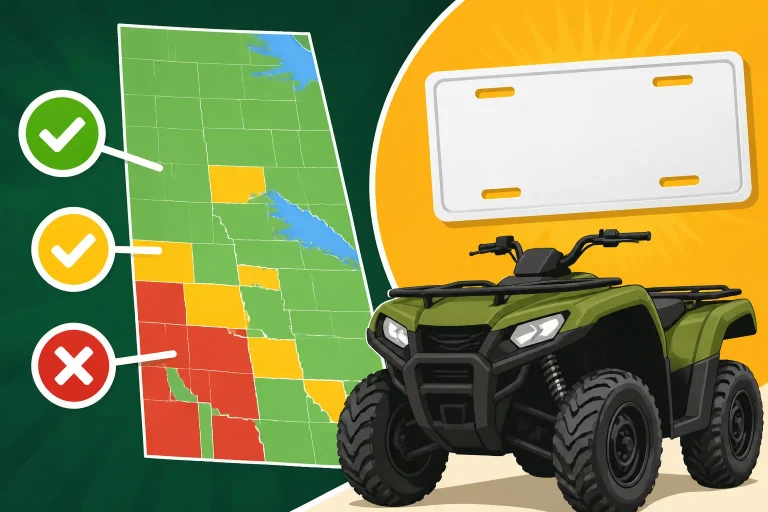
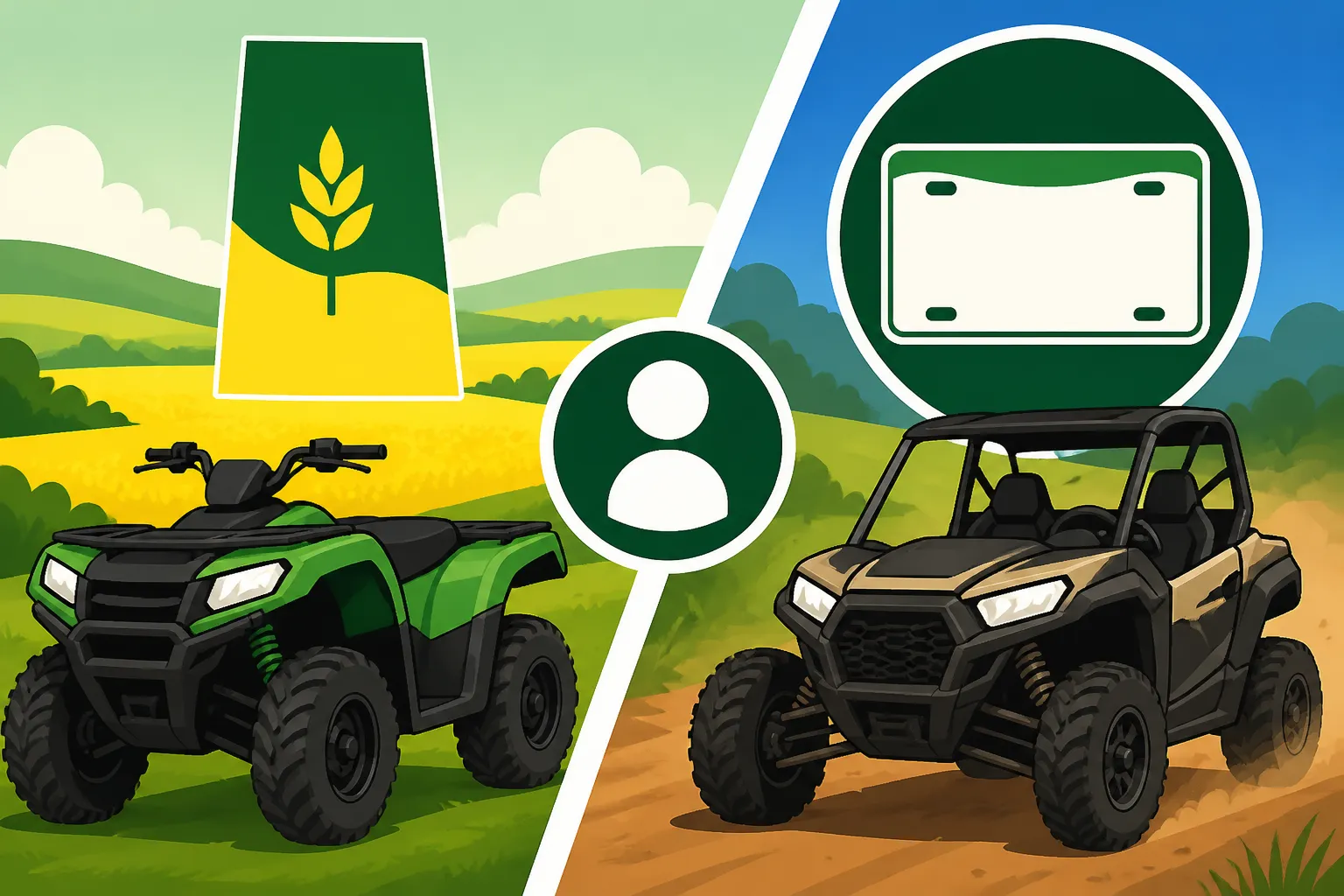
Visitors bringing an ATV or UTV to Saskatchewan often expect its home-province plate or registration to work everywhere. Saskatchewan has no province-wide ATV registration, but some municipalities run local plate or permit schemes. The practical answer depends on where you ride: a visitor should check each municipality’s rules rather than assume a home plate, or a permit bought elsewhere, is accepted.
What a Saskatchewan municipal plate means
Saskatchewan does not issue a province-wide ATV plate or registration. That does not mean there are no local requirements. Some municipalities operate their own schemes, generally tied to riding within the area covered by the local rules. A plate from one of these schemes is not the equivalent of provincial vehicle registration.
The key distinction is between provincial registration and local permission to ride. A municipal plate or permit may satisfy a local requirement, but it does not automatically authorize riding in another town or rural municipality, on provincial park trails, or on land where access is restricted.
For background on the province-wide system, see Saskatchewan Does Not Register ATVs and Saskatchewan Municipal Plate Schemes. The absence of a provincial registry is also why Saskatchewan Has No ATV Plate or Decal in the province-wide sense.
A municipal plate may look like a registration plate, but it should be understood as a local permit or identifier. The municipality sets the details: which machines are covered, where they may be used, what documents are needed, how the permit is displayed, whether a visitor must obtain one, and when it expires. Those conditions can differ between places.
| What you have | What it generally tells you | What it does not establish by itself |
|---|---|---|
| Registration or plate from your home jurisdiction | Your machine may be recorded or authorized under that jurisdiction’s system | That every Saskatchewan municipality accepts it for local riding |
| Saskatchewan municipal plate or permit | You have obtained the local authorization described by that municipality | Permission to ride throughout Saskatchewan or on every trail |
| Proof of insurance | The machine has insurance documentation to show if required | Permission to use a road, trail, park, or private property |
| Bill of sale or other ownership records | Evidence connecting you to the machine | A riding permit or approval to cross someone else’s land |
| Provincial park trail permit, where required | Permission under the relevant park’s permit system | A municipal permit or authorization for riding outside the park |
The table is a starting point, not a substitute for the local bylaw or permit conditions. A municipal plate is not a universal pass, and having one does not erase other requirements. Riders still need to follow rules for the machine, the operator, insurance, land access, and the place where they are riding.
How local rules affect visitors
A visitor can encounter local plate requirements even though the province does not register ATVs. The municipality’s rules may apply to machines used within its boundaries or on particular roads and areas. Whether a visitor must buy a local permit, can use a permit from another municipality, or qualifies for an exception depends on the applicable scheme.
Do not rely on a seller’s description, a friend’s experience in another town, or a plate that looks similar. A visitor arriving for a weekend may have different questions from a local owner who uses the machine throughout the season. Ask the municipality that controls the riding area and describe your situation clearly.
Useful questions include:
- Does the local plate scheme apply to visiting riders? Ask specifically about a machine registered or permitted in another province.
- Where does the requirement apply? Confirm whether it covers municipal roads, trails, other local land, or a defined part of the municipality.
- Is a permit required before riding, or only for certain roads or areas? Do not assume that a plate is required everywhere in town—or nowhere.
- Are out-of-area permits accepted? Ask whether the municipality recognizes another local permit, a home-province plate, or neither.
- What do I need to bring? The municipality may ask for information such as proof of ownership, insurance, or machine details.
- How must the plate or permit be displayed? A permit that is purchased but not displayed as directed may not meet the local condition.
- What is the validity period? Check the expiry and whether the permit is tied to a rider, machine, or season.
- Are there separate rules for a side-by-side? Make sure the scheme covers your vehicle type and not just a conventional ATV.
The right contact is usually the municipality administering the scheme, such as the relevant rural municipality, town, or village office. If a club, campground, dealer, or local rider gives you advice, treat it as a useful lead, then verify the current rule with the office responsible for it. A nearby municipality may have a different bylaw or no plate program at all.
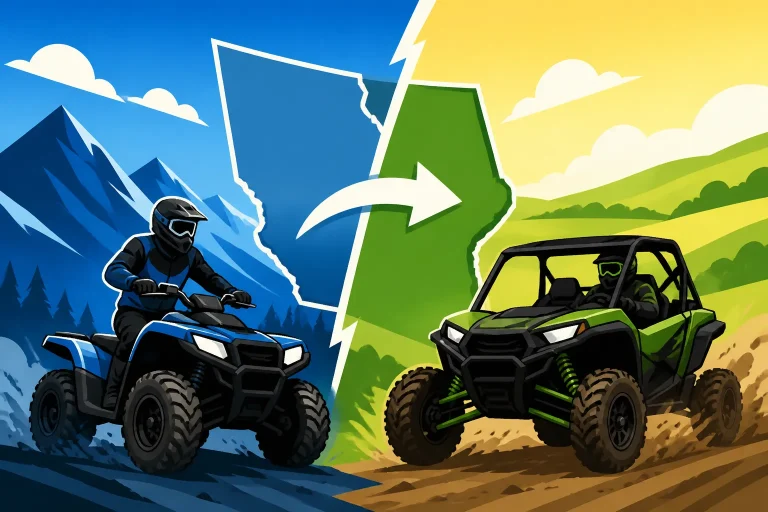
The distinction matters especially when a ride starts in one place and continues into another. A municipal permit could be valid only within the issuing area. Crossing a boundary does not automatically extend its coverage, even if the road or trail continues and the machine remains unchanged.
For more detail on where a local program operates, see Which Municipalities Actually Sell You a Quad Plate and Riding in a Municipality With No Plate Scheme. If you are comparing local requirements, Saskatchewan Municipalities With ATV Bylaws and Saskatchewan Bylaw Lookups Before You Ride can help you frame what to check.
Home-province plates and reciprocity
“Reciprocity” sounds straightforward: if a machine is legal at home, it should be accepted when it crosses a provincial boundary. For Saskatchewan ATV visitors, that assumption can cause trouble because the province does not issue a general ATV registration that other jurisdictions can simply recognize. A local municipal plate scheme is a different thing again.
A home-province plate may be meaningful under the rules where it was issued. It can help identify the machine or show that the rider has complied with a home-jurisdiction requirement. But that does not prove that a Saskatchewan municipality treats it as a substitute for its own permit. Nor does a Saskatchewan municipal plate necessarily have standing in another province.
Think of each item of paperwork as answering a limited question:
- A home-jurisdiction registration or plate may address requirements where it was issued.
- A Saskatchewan municipal permit addresses the local conditions set by the municipality that issues it.
- Insurance documentation addresses coverage, subject to the policy and applicable rules.
- Ownership records help show who owns or possesses the machine.
- A park permit, where one is required, addresses the park’s permit system.
These documents are not interchangeable. A municipal permit does not transfer automatically with a machine, and a machine’s home-province registration does not necessarily settle local access. If you plan to ride in more than one Saskatchewan community, ask about each one separately. If a trip continues outside Saskatchewan, check the destination jurisdiction’s rules as well.
This is particularly important for riders from Alberta and Manitoba. The provinces may use different systems for off-road machines, and a visitor should not infer Saskatchewan’s local requirements from what is normal at home. See Saskatchewan Visitors From Alberta and Saskatchewan Visitors From Manitoba for visitor-specific considerations, and Saskatchewan Registration Compared to Alberta or Saskatchewan Registration Compared to Manitoba for the broader system difference.
A simple way to avoid confusion is to ask the local office this exact kind of question: “I am visiting from outside Saskatchewan, and my machine has the paperwork issued where I live. Do I also need your municipal permit to ride in the area I plan to use?” Mention the vehicle type, the riding location, and the length of your visit. “Is my plate valid in Saskatchewan?” is too broad; the useful answer depends on which local scheme and riding area you mean.
The same caution applies to a Saskatchewan permit you already hold. Do not assume it covers another community simply because both places are in Saskatchewan. For example, checking whether a permit from the District of Lakeland is accepted in Candle Lake is a local question, not a province-wide reciprocity question. The relevant issue is the rules of the place where you will ride. Does a Lakeland Plate Work at Candle Lake? addresses that kind of boundary check.
What a municipal plate does not replace
A local plate or permit is only one part of planning a ride. It does not grant unrestricted access, make an otherwise prohibited road legal for ATV use, or replace operator and equipment requirements. Visitors should separate the question “Do I need a municipal plate?” from “Am I allowed to ride here at all?”
Roads and local access
A municipal scheme may relate to specified local roads or areas, but the permit alone does not mean every road in the municipality is open to off-road machines. Road access can depend on provincial rules and local bylaws. Confirm whether the specific road or route is open and whether there are restrictions on direction, speed, time, or where the machine may travel.
A posted route, trail map, or previous ride is not conclusive evidence that access remains open. Local rules can change, and a route may pass through land controlled by more than one authority. Review Saskatchewan ATV Road Rules Explained and Saskatchewan Rules for Riding a Town Street if your plan includes public roads or streets.
Parks and trails
A municipal permit and a park trail permit serve different purposes. A town’s plate scheme does not automatically satisfy park requirements; a park permit does not necessarily satisfy a municipal bylaw. Check the park’s current trail and permit conditions before unloading or entering a trail system. If your route links a community with a park, confirm requirements for both parts of the trip.
The same goes for club trails and other managed routes. A trail’s existence does not itself establish that a visitor may ride it, and trail access may have conditions beyond a local plate. Use the appropriate trail or park information for the location, not just the permit attached to the machine.
Insurance and ownership papers
Keep proof of insurance with you and make sure the policy applies to the machine and the way you intend to use it. A municipal plate does not provide insurance. The municipality may ask for proof as part of a permit application or during use, and other officials may have separate reasons to ask for it. See Saskatchewan Visitors and Insurance and Saskatchewan Insurance Proof on the Trail.
Carry ownership information as well, especially if the machine is borrowed, recently purchased, or registered in another jurisdiction. Useful records might include a bill of sale, registration papers from home, or a written note confirming permission to use a borrowed machine. These records do not replace a local permit, but they can help explain who owns the machine and why you are operating it. For more on the role of ownership records, see Saskatchewan Proof of Ownership Without a Registry.
A visitor’s checklist before heading out
The safest approach is to verify local rules before loading the machine. A short call or message to the municipality can prevent a long drive followed by a ride that is not allowed—or a stop to obtain paperwork you could have arranged beforehand.
- Pin down the riding area. Write down the municipality, trail system, park, and any roads or land you expect to use. If the route crosses boundaries, list each one.
- Identify the machine accurately. Say whether it is an ATV, UTV, or side-by-side, and provide any details the local office requests. Do not assume a scheme covers all off-road vehicles on identical terms.
- Ask whether visitors need a local plate. Explain that you are from outside Saskatchewan and describe the home-province plate or registration you have.
- Ask about acceptance and exceptions. If the municipality says another permit or plate may be accepted, confirm which one and how to prove it. Get the relevant details directly from the office.
- Confirm the application process. Ask where to apply, what records to bring, how payment works, and whether the permit must be collected in person.
- Check display and expiry requirements. Find out where the permit goes and when it stops being valid. Do not rely on the appearance of a plate to infer its validity.
- Check the actual route. Confirm road access, trail access, park conditions, and any local restrictions separately from the plate question.
- Pack supporting documents. Bring proof of insurance, ownership or authorization to use the machine, and any permits the area requires.
- Recheck close to the trip. A permit program, access condition, or local closure may change. Confirm with the responsible office before travel, especially if your trip was planned well in advance.
If you are applying for a permit, allow time to resolve details before your departure. A municipal office may have specific hours, and the process may differ by community. If the local information is unclear, ask for the bylaw, permit conditions, or a written explanation of how the rule applies to visitors. Keep a copy of the response with your trip papers.
A visitor planning a route through several towns should not buy one plate on the assumption it will cover the whole journey. Instead, work out which jurisdictions the route enters and ask each one whether its scheme applies. If there is no local plate program in one area, that does not automatically mean riding is allowed there; other bylaws, land rules, and road restrictions may still apply.
Common visitor situations
“My machine has a plate from home. Do I still need one here?”
Possibly, depending on the local program and where you plan to ride. A home-province plate is not an automatic province-wide exemption in Saskatchewan. Tell the local municipality what documentation you have and ask whether it recognizes it for the specific area.
“I bought a municipal plate in one community. Can I use it elsewhere?”
Do not assume so. Municipal schemes are local, and the issuing permit’s area and conditions matter. Ask the destination municipality whether it accepts the permit. If you cannot confirm acceptance, treat the schemes as separate until the local office says otherwise.
“I am only visiting for a short time. Does that exempt me?”
A short visit does not by itself establish an exemption. The municipality may have visitor rules or exceptions, but those need to be confirmed. Ask before you ride rather than relying on the length of your stay as a reason the rules do not apply.
“I am riding only on private land. Do I need the municipal plate?”
The answer depends on the local scheme and the land-use circumstances. Permission from a landowner and a municipal permit are different questions. Ask the municipality whether its rule covers the location and type of riding you have in mind, and get the landowner’s permission where needed. See [Saskatchewan Private Land Permission] for the separate access issue.
“The plate is on the machine, so am I covered?”
Not necessarily. Check that it is current, belongs to the machine or rider as required, and applies to the place where you are riding. Also confirm insurance, road or trail access, and any park conditions. A visible permit is not a substitute for checking the rest of the rules.
The useful rule for visitors is simple: treat municipal plates as local unless the municipality confirms otherwise. Keep home-jurisdiction documents with you, but do not treat them as a blanket replacement for local permission. Verify the route, the machine category, and the current conditions with the office responsible for each area before riding.
Frequently Asked Questions
Does Saskatchewan issue ATV registration to visitors?
No province-wide ATV registration is issued in Saskatchewan. Some municipalities have local plate or permit schemes, so visitors should check the requirements for the specific area where they plan to ride.
Does my home-province ATV plate count as a Saskatchewan municipal plate?
Not automatically. Ask the municipality administering the scheme whether it accepts your home-jurisdiction documentation or requires its own permit.
Can one Saskatchewan municipal plate cover a whole trip?
Do not assume that it can. Municipal permits are local, and acceptance outside the issuing area depends on the destination’s rules. Check each municipality along the route.
Does a municipal plate let me ride on any road or trail?
No. A plate does not by itself authorize access. Road, trail, park, landowner, insurance, and operator rules may apply separately.
Disclaimer
This article is for general informational purposes only and does not constitute professional advice. Laws, prices and regulations vary by location and change over time. Consult a qualified professional for guidance on your specific situation.