Which Certificate Satisfies the Act for a Youth
A youth riding an ATV or UTV in Saskatchewan may be able to ride without an adult escort after completing an approved safety course. The key is that not every training card qualifies: the course must satisfy the Act’s approval requirement. Here’s what to check before choosing a course, relying on a certificate or heading out to ride.
Which certificate satisfies the Act
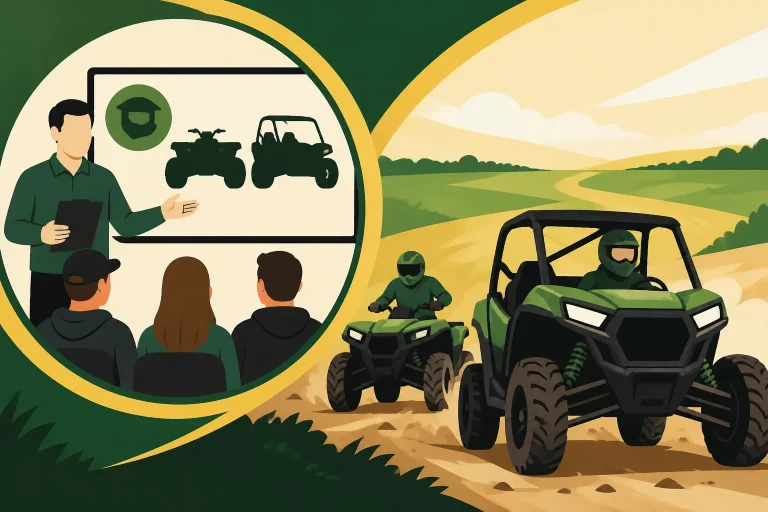
For an eligible youth, the relevant proof is a certificate or other completion record for an ATV safety course approved by the Administrator under Saskatchewan’s all-terrain vehicle rules. Completing a course is not enough if it was not approved for this purpose. A general online safety class, a dealer orientation or a certificate from another province should not be assumed to qualify.
The practical question to ask the course provider is specific: “Is this course approved by the Administrator for the youth exception under Saskatchewan’s All Terrain Vehicles Act, and what proof will I receive?” Ask for the course’s official name and how its completion record identifies the student. If the provider cannot confirm that approval, check with the provincial authority responsible for the Act before enrolling.
| What to check | Why it matters |
|---|---|
| The course is approved by the Administrator for the Act’s youth requirement | Approval, rather than the course’s general safety value, determines whether it can satisfy the exception |
| The youth completes the approved course | A parent’s attendance, registration or partial completion is not the same as the youth completing it |
| The student receives proof of completion | A certificate or other official record helps show that the requirement was met |
| The proof identifies the youth | A certificate belonging to a parent, sibling or other rider does not establish that this youth completed the course |
| The course is intended for the relevant vehicle and legal requirement | Training for a different machine or purpose may not count |
| The provider confirms the current status of the course | Approval and course offerings can change; verify before relying on an older listing |
Do not choose a course solely because its title includes “ATV safety.” That wording describes the subject, not necessarily its legal status. Some training may be valuable for safe riding without satisfying the Act’s approved-course condition. Similarly, a certificate accepted in another jurisdiction may not automatically meet Saskatchewan’s requirement.
The Act’s age rules determine when a youth needs an exception and what options are available. For the broader age framework, see Saskatchewan ATV Age Requirements and Saskatchewan Rules for a 12-Year-Old Rider. The approved-course question is narrower: it is about whether a particular youth completed a course accepted for the purpose set out in Saskatchewan law.
Who can use the course option
The course certificate is relevant to young riders who fall within the Act’s youth restrictions and are eligible to use the approved-course exception. It is not a general permit for anyone of any age, and it does not remove the need to follow other operating rules.
Saskatchewan’s youth rules include a minimum age and an exception for eligible riders. A qualifying course can provide an alternative to riding with a supervisor, but it does not erase the age limit or make every route, trail or road open to a youth. Review Saskatchewan’s Exception for Riders 12 and Over alongside the general age rules if the rider is near the minimum age. Do not assume that a course makes a younger child eligible when the law does not allow it.
The certificate is also personal to the youth who completed the course. It does not transfer to a sibling or friend, and it does not certify the machine. If several young people will ride, each one needs to meet the applicable requirement individually. Keep each rider’s completion record clearly identified and easy to retrieve.
Age is only one part of the decision. Depending on the rider and where the machine will be used, other requirements may apply, including rules about a supervisor, insurance, helmets, passengers, equipment, land access and road use. A course completion record is not a substitute for permission to enter private land or a trail permit where one is required. It also does not authorize a youth to ride on a road where riding is prohibited.
A useful way to think about the certificate is as proof of one specific legal qualification. It can address the youth’s training option under the Act. It does not replace every other condition that applies to operating an ATV or UTV. For a wider view of riding requirements, see Saskatchewan ATV Road Rules Explained and Saskatchewan Insurance Requirements for Riders.
Course certificate or adult supervisor
The approved course and adult supervision are alternative routes for an eligible youth under the youth rule. A family should compare the two options based on the rider’s readiness, where the machine will be used, and whether the required supervision can be provided—not just on which option is easier to arrange.
A supervisor must meet the legal conditions. Having a parent nearby, riding in the same group or watching from a vehicle does not automatically satisfy the rule. The supervisor’s age and driving-licence history matter, and the adult may have responsibilities while supervising. The details are covered in Saskatchewan’s 365-Day Supervisor Rule. If the youth is relying on a supervisor, check those conditions rather than treating “adult present” as sufficient.
| Option | What the family needs to confirm | Common misunderstanding |
|---|---|---|
| Approved safety course | The Administrator approves the course for the youth exception, and the youth completes it and receives proof | Any ATV course or training card will qualify |
| Adult supervisor | The adult meets the legal age and licence-history conditions and supervises as required | Any adult nearby counts |
| Either option | The youth is eligible by age and follows all other applicable rules | Meeting one youth condition makes all riding lawful |
The course option may suit a youth who will ride regularly and whose family wants the rider to complete structured training. Supervision may be the more practical option for a one-time outing, provided the adult meets the statutory conditions and can supervise properly. Neither option should be treated as a shortcut around sound judgment: a certificate is not proof that a young rider is ready for a particular machine, terrain or traffic situation.
A course is especially useful when the adult supervisor will not be present on future rides. But do not assume that a completion certificate permits unsupervised riding in every setting. The Act’s exception addresses a particular youth restriction; municipal bylaws, landowner permission, park rules and other safety requirements may still apply. How a Safety Course Replaces a Supervisor explains the relationship between those two options.
How to verify, keep and show the proof
Before booking, get confirmation from the provider that the course is approved for the specific legal purpose. If that answer is unclear, pause and verify with the provincial authority responsible for administering the Act. A provider’s advertising, a friend’s experience or a certificate from a different location is not a reliable substitute for confirmation.
Use this checklist:
- Confirm the youth’s age and identify which rule or exception applies.
- Ask the provider for the course’s exact name and confirmation of Administrator approval for the Act’s youth requirement.
- Confirm who must complete the course and what completion proof the youth will receive.
- Keep the certificate or official record in a place where a parent or rider can find it.
- Check whether the youth’s planned riding area has separate requirements, such as a local bylaw, landowner permission or park rules.
- Review the other operating requirements that apply to the rider, machine and location.
- If an officer or park official asks for proof, provide the actual record rather than relying only on a verbal statement that the course was completed.
Keep the original certificate if practical, and make a secure copy or photo as a backup. A digital copy can help when the paper record is misplaced, but ask the relevant authority whether it accepts that format. Do not alter the document or rely on a screenshot that cuts off the rider’s name, course information or completion details.
The youth should know where the proof is kept and be able to explain which course they completed. A parent can help by carrying the record or keeping a copy with the machine’s other paperwork. The details of what an officer may ask to see are covered in Proof Shown to a Peace Officer. A completion certificate is evidence of training; it is not necessarily a document the rider must carry in every circumstance, so confirm what proof is expected for the planned activity.
If a certificate is lost, contact the course provider and ask whether it can issue a replacement or verify completion. If the provider has closed or cannot locate the record, ask the provincial authority what evidence it will accept. Do not assume that a parent’s memory, an old registration email or a payment receipt proves successful completion of an approved course.
The safest course-selection decision is straightforward: verify the legal approval first, make sure the youth—not just an accompanying adult—completes the course, and keep clear proof. Then check the separate rules for the planned ride. That prevents a common and costly misunderstanding: treating a generic training certificate as permission to ride without meeting Saskatchewan’s requirements.
Disclaimer
This article is for general informational purposes only and does not constitute professional advice. Laws, prices and regulations vary by location and change over time. Consult a qualified professional for guidance on your specific situation.