Saskatchewan Free Permits at Moose Mountain
Moose Mountain is one of the Saskatchewan parks where an ATV trail permit is free, but free does not mean automatic or interchangeable with every other kind of permission. Riders still need to understand the park’s permit process, trail limits, insurance expectations and rules for younger operators. This guide explains what to check before you load up, including what visiting riders should confirm.
What the Moose Mountain permit covers
The permit is permission to use designated ATV trails in the park, subject to the park’s current rules. It is not a provincial ATV registration, a municipal plate, insurance or blanket permission to ride anywhere in the park.
That distinction matters because Saskatchewan does not issue a province-wide ATV plate or trail pass. A park permit applies to the riding area and conditions for which it is issued; it does not replace separate local requirements outside the park. For the wider picture, see Saskatchewan Has No Provincial Trail Pass and Saskatchewan Park Trail Permits Are Free.
Moose Mountain’s trail network is commonly described as having about 47 kilometres of riding. Treat that as a general sense of scale, not a promise that every segment will be open when you arrive. Trail access can change with weather, maintenance, fire conditions and park decisions. Check with the park before travelling, especially if your route depends on a particular loop or connection. Moose Mountain’s 47 Kilometres in Saskatchewan gives more detail about the network.
A free permit is still a permit. You may need to complete the required information or use acknowledgement process before riding, and you must follow any instructions about where to display or carry it. Ask the park office what the current process is rather than assuming a previous visit, another rider’s paperwork or a municipal plate is enough.
| What you need | What it does | What it does not do |
|---|---|---|
| Moose Mountain trail permit | Allows use of designated trails under park rules | Register the ATV across Saskatchewan or open closed areas |
| Proof of insurance | Shows that the machine has required liability coverage when requested | Replace the trail permit |
| Municipal plate, where applicable | Meets a local municipality’s plate rules | Automatically authorize riding inside a provincial park |
| Registration from another jurisdiction | May identify or register a visiting machine at home | Override Saskatchewan rules or park-specific requirements |
| Landowner or lease-holder permission | Gives access where permission is needed | Replace park permission on provincial park land |
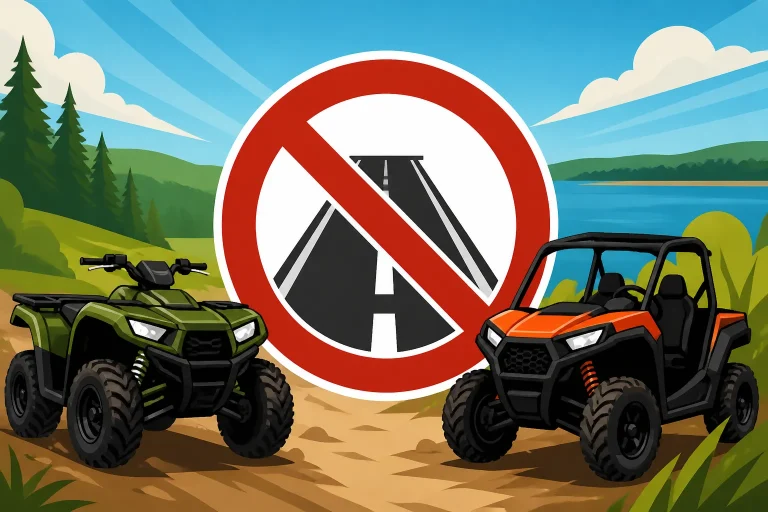
The permit should also not be confused with permission to ride roads, beaches, campgrounds, hiking trails or other park areas that are not designated for machines. Keep to the routes the park identifies as open to ATVs. Park boundaries contain different kinds of facilities and land uses, and access for one purpose does not mean access for every purpose. For a general overview, read Saskatchewan Parks With Designated Trails Only.
A useful way to think about the permit is as one item in a small set of checks: Is this machine allowed on the designated route? Is the permit process complete? Is the route open today? Do I have the required insurance and rider supervision? Are there temporary fire or weather restrictions? If you can answer those questions before unloading, you are much less likely to arrive at a trailhead only to discover that one missing detail changes your plans.
How to get the free permit before riding
The permit itself has no charge, but allow time for the required park steps. The process can involve an information session and an ATV use acknowledgement form. Ask the park office whether you need to attend an information session, where to complete the paperwork and how the permit must be displayed. Do not rely on an old photo of a permit or a friend’s description of last season’s process.
A practical sequence
- Contact the park before you travel. Confirm that ATV riding is open for your intended dates and ask how permits are being issued. Also check whether an information session or a signed use form is required.
- Ask what to bring. Find out whether the permit process requires proof of insurance, machine details, rider information or other documents. Requirements and office arrangements can change.
- Complete the required information or session. If the park directs you to attend an information session, plan for it before the ride rather than trying to squeeze it in after arriving late in the day.
- Sign and keep the acknowledgement. Read the form before signing. It may set out responsibilities for staying on designated routes, following closures and using the park safely.
- Ask how to display the permit. Confirm where it belongs on the machine and whether you should also carry a copy of any related paperwork.
- Check conditions again on the day. A permit does not guarantee that a particular trail will remain open. Follow current notices at the office and trailhead.
The practical details are worth confirming directly because permit pickup arrangements can differ from what a rider expects. A park office, campground office or district office may be involved in different processes, and the right place can depend on current operating arrangements. A quick call can prevent a long detour. Picking Up a Trail Permit at the Campground Office and The Info Session That Comes Before Your Permit explain the kinds of steps riders may encounter.
If you are travelling with a group, do not assume one person’s permit covers every machine. Ask the park whether permits are issued per machine, per operator or through another arrangement. Make sure each rider knows the rules and that the required information is available for each machine. A group leader can keep a simple list of permit status, insurance proof and emergency contacts, but should not treat that list as a substitute for the park’s own process.
Keep the permit legible and in the position the park specifies. A permit stuffed under a seat may be hard to verify when an officer asks to see it. If the permit is a paper document, protect it from rain and mud while ensuring it remains available for inspection. If the park uses another format, follow its directions. More on placement is covered in Where to Display Your Park Trail Permit.
Give yourself extra time if you are bringing a first-time rider or a young operator. The permit process is a good moment to check that everyone understands trail boundaries, passing etiquette, speed expectations and what to do if a machine breaks down. It is easier to cover those points at the trailhead than to discover halfway into a loop that a rider thought the permit allowed off-trail exploring.
Rules and documents to sort out separately
A park permit does not make a machine road-legal, insure it or remove the rider’s responsibilities under Saskatchewan law. Treat these as separate checks. A useful starting point is Saskatchewan ATV Insurance Requirements, especially if the machine is borrowed, newly purchased or insured under a policy you have not reviewed recently.
Insurance and proof
Carry proof of the required liability insurance and know how to produce it if a park officer asks. Confirm that the policy applies to the specific machine and intended use. If you are borrowing an ATV or UTV, do not assume the owner’s policy automatically covers every rider or circumstance. Ask the owner or insurer to clarify.
A photo of an insurance document on a phone can be handy, but keep in mind that a phone may lose power, break or have no signal. Ask the park what proof it accepts, and keep a practical backup if appropriate. Liability Insurance Produced on Demand in a Park explains why insurance proof can matter even when a permit is free.
Rider age and supervision
Age and supervision rules are separate from permit paperwork. Saskatchewan has rules affecting riders under 16, including supervision requirements and a safety-course route for some younger operators. Check the current rules for the rider’s age and circumstances before the trip; do not assume that a parent riding nearby automatically satisfies every requirement. Start with Saskatchewan ATV Age Requirements and Riders 12 to 16 Need Supervision in a Park.
If a young rider is using an escort instead of a course certificate, confirm the applicable conditions carefully. The supervisor may have responsibilities of their own, and the park may expect the group to follow the provincial rules as well as its trail conditions. Make sure the supervising adult knows which machine the young rider will operate and can remain close enough to supervise effectively.
Machine and trail access
The park’s designated routes are not an invitation to ride through other park areas. Stay on the trails identified as open to ATVs, obey signs and barriers, and turn around when a route is closed. Do not use a hiking path, campground road or beach as a shortcut unless the park explicitly allows it.
A machine that is legal to operate elsewhere may not be suitable or permitted on every park route. Check any restrictions that apply to vehicle type, passengers or equipment. A side-by-side and a single-rider quad may be treated differently by a particular trail or local instruction. Ask the park if you are unsure whether your specific machine is allowed.
Also distinguish a park trail from a public road or municipal route used to reach it. A municipal plate scheme, where one exists, is a local rule and may not apply in the park. Conversely, the park permit does not give you permission to ride on a town street or rural road. Read Saskatchewan Municipal ATV Plates Explained and check the local rules for any riding outside the park.
Visiting from another province or riding with a group
Visitors should not assume that a plate or registration from home automatically satisfies every Saskatchewan requirement. At the same time, a Saskatchewan park permit is not a substitute for complying with the rules that apply to visiting machines and riders. Before setting off, check the requirements for your home jurisdiction, Saskatchewan and Moose Mountain itself.
A visitor from Alberta or Manitoba should verify what documents to carry, whether their home registration or identification is relevant, and what insurance proof is needed. The park office can clarify the park process, while the appropriate Saskatchewan information source can clarify provincial requirements. The visitor guides Saskatchewan Visitors From Alberta and Saskatchewan Visitors From Manitoba are useful starting points.
Do not confuse reciprocity with permission. Even if your home paperwork is recognized for a particular purpose, it does not open closed park trails, waive the use acknowledgement process or remove age and insurance rules. If you are riding with a mixed group, make sure every visitor has checked their own situation rather than relying on the Saskatchewan resident who organized the trip.
For a club ride or organized event, ask early whether ordinary individual permits are enough or whether the event needs additional approval. A routine family outing and a large organized ride may not follow the same process. Confirm the group’s size, route, timing, insurance documentation and any event-specific conditions with the park before advertising or travelling. Saskatchewan Event Permits for a Ride covers the separate question of organized rides.
A group leader can make the day smoother with a short pre-ride check:
- Confirm the permit process and that each machine is covered by the required paperwork.
- Collect a working phone number for each rider and identify who will lead and sweep.
- Make sure everyone knows which routes are open and where the group will stop.
- Agree that no one will leave the designated trail to explore a tempting side track.
- Carry a basic repair kit, first aid supplies and a plan for a machine that cannot continue.
- Set a turnaround time so the group is not trying to finish the route after dark.
For equipment, buy only what solves a real need. A waterproof document pouch, basic tool roll or compact first-aid kit can be useful; if you shop on Amazon, compare dimensions and water resistance rather than relying on product photos alone. Check that any item can be secured safely and will not interfere with controls, lights or access to the machine.
Before you unload: a Moose Mountain checklist
Permit paperwork is only one part of a safe and worthwhile trip. A little preparation reduces the chance of losing time at the trailhead or damaging the route for the next rider.
Check access and conditions
Confirm that the park is allowing ATV use on your planned date and that the routes you expect to ride are open. Ask about any temporary closure, construction, trail maintenance, fire restriction or local notice. If conditions are wet, soft or recently affected by storms, be prepared to change your route or postpone. Riding around a muddy patch can widen a trail and create damage that lasts long after the weather improves.
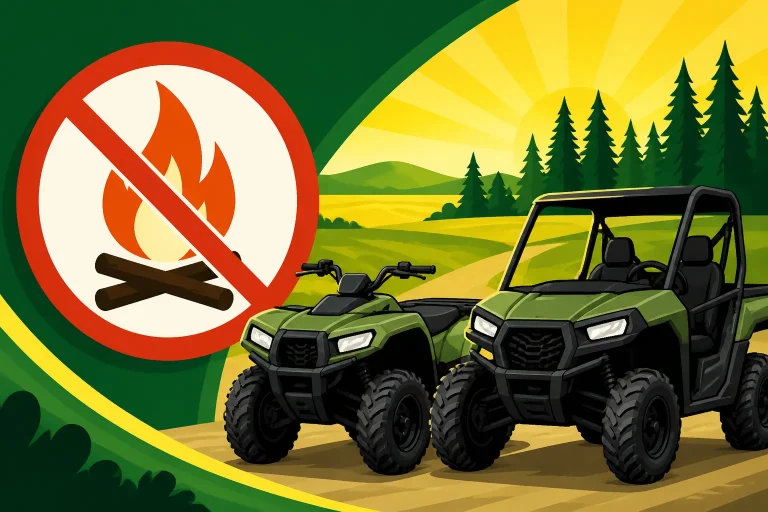
Check wildfire notices and fire bans before you leave, then keep checking during the trip. Fire-related restrictions can change access, and operating a hot machine in dry vegetation creates risks beyond the trail itself. Read Saskatchewan Wildfire Season Rules for Riders and Saskatchewan Fire Ban Lookups for a broader preparation checklist.
Prepare the machine and the people
Inspect the machine before loading it. Check tires, brakes, lights, steering, fluid leaks and the condition of any winch or recovery equipment you plan to use. Secure loose cargo and confirm that passengers are permitted on that machine and are properly seated. A seat on a machine does not necessarily mean it is designed or approved to carry a passenger.
Pack for the route rather than for the parking lot. Bring water, weather-appropriate clothing, a first aid kit and a way to contact help. Cell service can be inconsistent in outdoor areas, so tell someone where you plan to ride and when you expect to return. A paper map or offline map can be a sensible backup if a phone loses signal or power. If using Amazon to find a map case or portable charger, check that the item suits the conditions and can be carried without creating a loose-object hazard.
For long rides, carry documents where they stay dry and can be reached without unpacking everything. Keep your permit, insurance proof and any relevant rider paperwork together, but do not put them somewhere that will be difficult to show an officer. [Saskatchewan Insurance Proof at a Park Office] offers more on what to have available.
Ride with the park in mind
Stick to the marked trail, follow posted speed and direction instructions, and give other users room. Slow down near trailheads, intersections and places where visibility is limited. Keep noise and dust in mind, particularly near campsites and other visitors. If you encounter wildlife, stop at a safe distance and do not chase or crowd it.
Do not assume that a quiet-looking route is unused or that no one will notice a shortcut. Staying on the marked trail protects habitat, reduces conflict with other park users and helps keep access available. If you see a blocked trail or damaged sign, report it instead of going around the barrier. Saskatchewan Trail Etiquette Locals Expect has more practical guidance for sharing the route.
If the machine becomes stuck, avoid tearing up the trail while trying to free it. Use recovery equipment carefully, ask for help and choose the least damaging option. A winch can help, but it is not a licence to pull trees, damage signs or leave the designated route. If the problem cannot be handled safely, contact the park or emergency assistance as appropriate.
After riding, clean mud and plant material from the machine before heading to another riding area. This helps limit the spread of invasive species and avoids carrying seeds from one location to another. Check the park’s current cleaning instructions and use a suitable wash area if one is available. Saskatchewan Machines Washed Before a Park Ride explains why this small step is worth building into the routine.
Common permit misunderstandings
“It’s free, so I can just ride.”
No. Free describes the permit cost, not the permission process. Complete the park’s required steps and follow the conditions attached to the permit.
“My municipal plate is the park permit.”
Not necessarily. A municipal plate scheme and a provincial park trail permit serve different purposes. Ask the park what it requires, and check local rules wherever you ride outside the park.
“The permit lets me ride anywhere in Moose Mountain.”
No. Use only designated routes that are open to ATV riding. A permit does not open hiking trails, closed roads, beaches, campgrounds or other restricted areas.
“I rode there last year, so I know the process.”
The process, office arrangements, trail conditions and restrictions can change. Confirm before travelling, especially if your visit is built around a particular trail or event.
“My insurance is on file with the seller.”
A seller’s paperwork does not establish that your current machine and use are insured. Confirm your own policy and carry proof that meets the applicable requirements.
“A visitor’s home registration settles everything.”
It may be relevant, but it does not replace Saskatchewan requirements or park conditions. Visitors should verify their own paperwork, insurance and rider rules.
If you remember one thing, make it this: get the current permit instructions from the park, then treat the permit as one piece of the trip plan. Verify that the trails are open, carry the required insurance proof, follow age and supervision rules, and stay on designated routes. That preparation is more useful than relying on a plate, a past visit or somebody else’s paperwork.
Disclaimer
This article is for general informational purposes only and does not constitute professional advice. Laws, prices and regulations vary by location and change over time. Consult a qualified professional for guidance on your specific situation.