Nothing to Reciprocate With
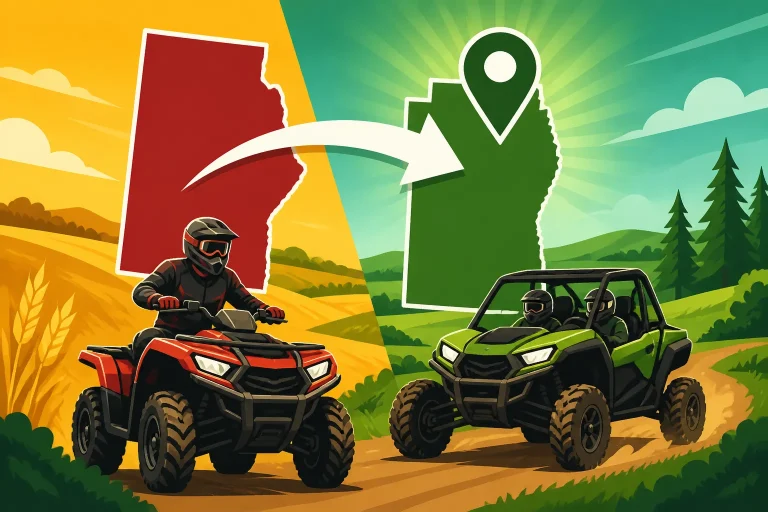
Visitors sometimes expect to show an ATV registration from home and have Saskatchewan recognize it under a reciprocity agreement. The complication is that Saskatchewan does not issue provincial ATV registrations. Here’s what that means for visiting riders, and what to check instead before unloading your machine.
Why there is no ATV registration to reciprocate
Registration reciprocity generally depends on two places having comparable registration systems. One jurisdiction registers a machine, and another recognizes that registration under specified conditions. Saskatchewan has no province-wide ATV registration system, so there is no Saskatchewan ATV registration for another province to recognize—and no provincial ATV plate that visiting riders can obtain or use as a reciprocal equivalent.
That does not mean Saskatchewan has no rules for ATVs and UTVs. It means the rules are not built around a provincial ATV registration document. Riders still need to follow the laws that apply to operating an off-road vehicle, including rules about licensing, age, insurance, safety equipment, road use and access to land. Do You Need to Register an ATV in Saskatchewan? explains the province-wide registration question in more detail.
The distinction matters because the word “registration” can mean different things in different places. A province or state may issue an official registration certificate or plate for off-road machines. Saskatchewan municipalities may instead have local plate or permit schemes, while some provincial parks have their own trail permit requirements. Neither kind of local authorization creates a provincial ATV registry.
A visitor’s home registration, permit or plate does not automatically settle every question about riding in Saskatchewan. It may be useful evidence about the machine or its status where it was issued, but it does not override Saskatchewan operating rules, a local bylaw, a park requirement or a landowner’s decision about access. Likewise, the absence of a Saskatchewan provincial plate does not mean that a rider can ignore rules that apply to the area.
This is why it is better to ask, “What do I need for this ride?” than to ask only whether Saskatchewan reciprocates an ATV registration. The answer depends on where you intend to ride, what route you plan to use, and whether a local permit or plate scheme applies.
| What you may have from home | What it does in Saskatchewan | What to check separately |
|---|---|---|
| Provincial or state ATV registration | It does not become a Saskatchewan provincial registration | Local bylaws, land access and operating rules |
| A home-jurisdiction plate | It does not create automatic permission to ride everywhere | Whether the municipality requires its own plate or permit |
| Proof of insurance | It can help show coverage, but it does not replace other requirements | Whether the policy covers the machine and intended use |
| A trail or park permit from home | It does not automatically authorize use in a Saskatchewan park | The destination’s current permit and trail rules |
| A bill of sale or ownership record | It can help document ownership | Keep it separate from riding permits and insurance proof |
Saskatchewan does register snowmobiles, which can make the difference confusing for people who ride both kinds of machines. An ATV registration process in another jurisdiction should not be assumed to have a Saskatchewan counterpart simply because snowmobiles have a provincial system. See Saskatchewan Snowmobile Registration Compared for that distinction.
What visitors should check before riding
A practical plan starts with the specific destination. Saskatchewan does not have one province-wide ATV pass that grants access to all public land, trails, roads or parks. Permissions and restrictions can differ between a municipal area, a provincial park, private land, Crown land and a designated club trail.
Before travelling, confirm the following:
- Where the route goes. A trail map, club page or route shared by another rider may not show every current closure, land boundary or bylaw restriction. Check with the municipality, park office, land manager or trail organization responsible for the area.
- Whether a local plate or permit is required. Some municipalities operate local schemes. These are separate from provincial registration and may apply only within the municipality or under its bylaw. Do not assume that a plate from one town works in another. Saskatchewan Municipal ATV Plates Explained covers the purpose and limits of these local schemes.
- Whether a park permit is needed. Some parks require riders to complete a process before using designated trails; other areas have different rules. Confirm what applies to your chosen park, including where to obtain and display any permit. The province-wide absence of an ATV registry does not remove park requirements.
- Whether you have permission to enter the land. Crown land, private land, grazing leases and occupied land can have different access conditions. A road or track that appears open is not proof that riding is allowed. For Crown land questions, see Saskatchewan Crown Land Access Rules; for leased land, check Saskatchewan Grazing Lease Permission.
- Whether your insurance is suitable. Carry proof of insurance and confirm with your insurer that the policy covers the machine, the riders, and the type of riding planned. A registration card from home is not proof that your policy covers a particular use or location. Saskatchewan Insurance Rules for Visitors and Saskatchewan Proof of Insurance Is What Saskatchewan Officers Ask For explain the insurance questions visitors should consider.
- Whether the machine and riders meet operating rules. A home permit does not replace local requirements for a driver’s licence, minimum rider age, helmets, eye protection or other equipment. Review Saskatchewan ATV Road Rules Explained before using roads, ditches or crossings.
If you are riding with a group, assign someone to confirm the route and requirements before the trip. It is easy for a group to confuse a municipal plate, a park trail permit and a provincial registration because they may all look like proof that a machine is “allowed.” They answer different questions. A local plate may address a municipal bylaw; a park permit may address access to specified trails; a registration document comes from the jurisdiction that issued it. None should be treated as a universal pass.
Visitors should also avoid relying on a seller’s or host’s description alone. “You don’t need registration here” may be true in the narrow sense that Saskatchewan does not issue provincial ATV registrations, but that statement says nothing about a local bylaw, a park permit, insurance or permission to cross a particular property. Ask for the exact destination and rule involved.
Municipal plates, park permits and home documents
Local ATV plates are the most common source of confusion. A municipality may operate a scheme that requires a plate or permit for riding in a defined area. That local requirement is not provincial ATV registration, and it does not establish a single system that applies across Saskatchewan. Where a scheme exists, its boundaries, application process, fees, renewal rules and permitted roads or trails are matters to confirm with the municipality. Fees and conditions can change, so check directly with the local office before setting out.
A plate issued by one municipality should not be treated as valid everywhere. The municipality may have authority only over its own roads or designated areas, and a neighbouring community may have different rules—or no comparable scheme. This is why a visitor should confirm both the local requirement and the route. A machine may pass through more than one jurisdiction during a ride.
Park permits are another separate layer. A park may limit machines to designated trails and require an acknowledgement or permit before riding. That authorization is tied to the park’s rules, not to a home-province registration. Check the current park information before arrival, because permit steps, trail access and seasonal restrictions can vary by location. Saskatchewan Park Trail Permits Are Free provides context on park permits, but confirm the process with the park you plan to visit.
Home documents still have practical value. A registration certificate, purchase receipt, bill of sale, insurance card or serial-number record can help establish information about the machine. But those documents do not substitute for permission to ride, and a home plate does not become a Saskatchewan municipal plate. Keep ownership records and riding authorizations distinct so that you can provide the right document when asked.
For a machine that is not registered in its home jurisdiction, or that has changed hands recently, bring whatever reliable ownership records you have. A bill of sale, insurer’s document and clear record of the serial number can help resolve questions about who owns the machine. They are not a substitute for the local rules, but they can make it easier to explain the machine’s status. Saskatchewan Proof of Ownership Without a Registry and How to Prove You Own an ATV in Saskatchewan discuss the role of ownership paperwork.
If you are bringing a machine from another province, do not assume that a lack of provincial registration in Saskatchewan means you can skip paperwork at home. Saskatchewan’s system does not cancel requirements imposed by the jurisdiction where the ATV is normally kept or used. Confirm your home-jurisdiction obligations separately, especially if the machine is being transported, sold, insured or used across a border.
A simple way to avoid a reciprocity mistake
The safest approach is to separate the questions instead of trying to resolve them with one registration card.
First, identify the exact riding area and route. Determine whether you will be on municipal roads, park trails, Crown land, private land or a combination. Then contact the authority or organization responsible for that specific area and ask whether a local plate, park permit, written permission or other authorization is required. If the route crosses jurisdictions, check each one.
Next, confirm that your insurance applies to the trip and that you can show proof of coverage. Ask your insurer about any limits or exclusions that could matter for off-road use, passengers, a UTV, or riding outside your home province. Insurance documents and registration documents serve different purposes, so carry the relevant proof rather than assuming one will answer every question.
Finally, review the operating rules that apply to the riders and machine. A visiting rider may be familiar with a different set of age, licence, helmet, road-use or equipment rules at home. Saskatchewan rules still matter while riding in Saskatchewan. A local permit cannot authorize conduct that is prohibited under provincial law, and a registration from home does not change the rules for roads, crossings or land access.
A useful pre-trip checklist is:
- Confirm the destination and route, including any municipal or park boundaries.
- Ask the relevant municipality whether it has an ATV plate scheme and whether visitors are covered by it.
- Ask the park or trail manager about permits, designated trails and current closures.
- Obtain permission before entering private land or land where permission is required.
- Carry proof of insurance and check that the policy covers the planned use.
- Keep ownership records and the machine’s serial number available.
- Review Saskatchewan’s rider, equipment and operating rules.
- Recheck local information shortly before departure in case access conditions have changed.
The key point is narrow but important: Saskatchewan has no provincial ATV registration system to participate in a registration reciprocity arrangement. That does not mean a visitor has no obligations, nor does it mean that a home registration automatically grants access. Treat registration, municipal plates, park permits, insurance and land permission as separate matters, and confirm each one for the ride you actually plan to make.
Disclaimer
This article is for general informational purposes only and does not constitute professional advice. Laws, prices and regulations vary by location and change over time. Consult a qualified professional for guidance on your specific situation.