Saskatchewan Parent Riding With a Child
A parent riding with a child in Saskatchewan needs to work out two different things: whether the child may operate an ATV or UTV, and whether the machine can safely carry a child as a passenger. The rules depend on the child’s age, supervision or training, and where the machine is being ridden. Here’s how to plan a ride without confusing those requirements.
First decide whether your child will ride or drive
A child riding as a passenger is not the same as a child operating their own ATV. Saskatchewan has rules for both, and meeting one set does not automatically meet the other.
For a child operating a machine, the key age distinction is 16. Riders under 16 are generally restricted from operating an ATV where the provincial rules apply, but an exception is available for riders aged 12 and over when the required supervision or approved training conditions are met. A child under 12 should not be treated as eligible for that exception. Check the current official rules before riding, especially if your plans involve roads or other places with specific restrictions. For more detail, see Saskatchewan ATV Age Requirements and Saskatchewan’s Exception for Riders 12 and Over.
For a child riding as a passenger, the important question is whether the particular machine was designed to carry a passenger. The law does not make an adult-sized single-seat ATV suitable for a child just because the child can hold on. Look for a passenger seat and appropriate footrests, and follow the manufacturer’s instructions for the machine and the child’s size. Passengers Are Legal Only on Machines Built for Them explains why the machine’s design matters.
| Your child’s role | What to check first | Common mistake |
|---|---|---|
| Operating their own ATV or UTV | Age, the applicable youth exception, supervision or approved training, and where the ride will take place | Assuming a parent’s presence alone automatically satisfies every requirement |
| Riding as a passenger | Whether the machine is designed for a passenger and whether the child can sit securely with feet supported | Carrying a child on a single-seat machine or letting them ride on a rack |
| Riding on private land | Who owns or occupies the land, whether permission is needed, and what rules still apply | Assuming private land makes every age, safety, or access issue irrelevant |
| Riding in a park or on a managed trail | The site’s machine rules, permits, age conditions, and current closures | Assuming a youth exception under one rule set overrides a park’s separate conditions |
Before choosing a machine, decide which role your child can manage safely. A child may be old enough to qualify for a supervised riding exception but still be too small, inexperienced, or tired for a long ride. Legal eligibility is a starting point, not a safety assessment.
If your child will operate a machine
For an eligible rider aged 12 to 15, the rules provide a route involving a qualified supervisor or an approved safety course. Do not assume that “I’m their parent” is enough. The supervisor must meet the applicable licence requirement, including having held a driver’s licence for the required period. Review The Supervisor Needs a Licence Held 365 Days and What the 365-Day Supervisor Rule Actually Requires before relying on supervision.
The rules also recognize approved training as an alternative to having a supervisor in the circumstances covered by the exception. Not every online video, dealer demonstration, or informal lesson is necessarily an approved course. Confirm that the course satisfies the applicable requirement and keep the completion evidence available. Which ATV Training Courses the Administrator Has Approved and Which Certificate Satisfies the Act for a Youth are useful places to start.
A parent who is supervising should treat the role as active responsibility, not simply riding somewhere nearby. The law’s treatment of the supervisor can carry consequences if the young operator breaks a rule. Keep the child within the level of supervision required, choose a route you can monitor, and stop if you lose sight of them or conditions become difficult. See Why a Supervisor Can Be Ticketed for a Rider.
A sensible pre-ride check includes:
- Confirm the child’s age and pathway. Work out whether the child qualifies for the youth exception and whether supervision or an approved course is required for this ride.
- Check the route. A trail, private field, ditch, grid road, town street, and provincial park can involve different access rules. Do not assume a route is permitted just because an ATV can physically travel on it.
- Check the machine. Match the machine’s size and controls to the child’s ability. The child should be able to reach the controls and operate them without stretching or losing balance.
- Set clear limits. Agree on where the child may ride, how far ahead they may go, how to stop, and what to do if the adult is no longer visible.
- Carry required proof. Bring any documents needed to show that the supervision or training condition has been met, along with insurance information where required.
The rule about age and supervision does not replace the rules of operation. A young rider still needs suitable protective equipment and must follow applicable riding restrictions. For example, helmet and eye protection requirements are addressed in Saskatchewan ATV Helmet Law. The rules for road and ditch travel are not interchangeable with trail rules, so check Saskatchewan ATV Road Rules Explained before planning a route that touches a road or roadside area.
If your child will ride as a passenger
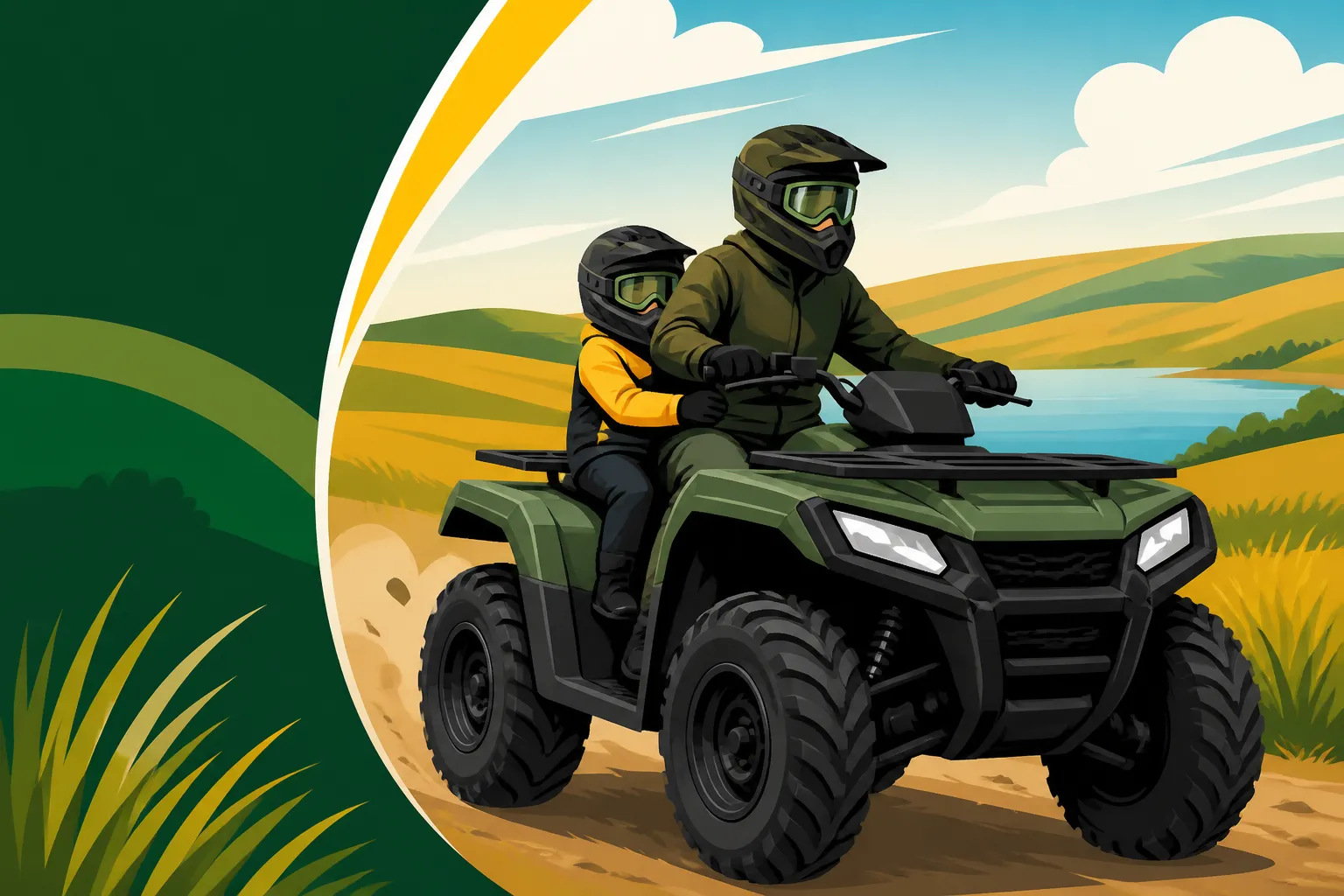
Start with the machine, not the child’s willingness to hold on. A passenger should have a proper passenger position, secure foot support, and enough space to remain seated as the machine moves. A child perched on a cargo rack, fender, or improvised seat is not made safe by a slow speed or a short distance.
Read the operator’s manual for passenger limits and instructions. If the machine is designed for one rider, do not carry a passenger. If it is designed for two, check that the child can use the passenger position as intended. A passenger who cannot keep their feet supported or stay seated may be at risk of slipping, being struck by moving parts, or shifting the machine’s balance.
A parent operating the machine should also consider whether the child can follow basic instructions: sit in the intended position, keep hands and feet where directed, and avoid sudden movements. A child who is tired, frightened, or distracted may not be able to do that consistently. Choose a short, easy ride first and stop if the child is uncomfortable.
A passenger’s age and size do not eliminate the operator’s responsibility to ride carefully. Avoid steep or uneven terrain, abrupt turns, and speeds that make it difficult to keep the passenger secure. Do not assume that a side-by-side is automatically suitable for every child; check the manufacturer’s passenger guidance and any applicable restraint instructions.
Protective equipment matters for passengers as well as drivers. Use a properly fitted helmet and eye protection, and make sure clothing and footwear are appropriate for the ride. If you are unsure which helmet standards or eye protection apply, see Saskatchewan Helmet Standards Accepted and Saskatchewan Eye Protection Requirements. A passenger should not be carried without the safety equipment required for the circumstances.
Plan around the place you intend to ride
A child may be eligible to operate a machine under one set of conditions, but that does not grant permission to ride on every trail, road, park, or piece of land. Check access separately from the youth rule.
On private land, permission and land status matter. A field that looks open may belong to someone else, be subject to a lease, or have restrictions on access. Saskatchewan also has specific private-land exemptions and rules that depend on the circumstances. For background, read Saskatchewan Private Land Exemptions and [Saskatchewan Private Land Permission]. A parent’s ownership or permission to use one property does not authorize riding across neighbouring land.
Managed trails and provincial parks may have their own conditions, including designated routes, permits, age requirements, and closures. Check the rules for the specific site before loading the machines. A general youth exception should not be read as permission to ignore a park’s restrictions. Saskatchewan Provincial Park Machine Rules and Saskatchewan Park Regulations for Machines can help you identify the separate questions to confirm.
Roadside travel needs particular care. Saskatchewan road rules may restrict where an ATV can travel, how it crosses a highway, and what local bylaws allow. A short road connection between trails can still be subject to restrictions. Check the route with the relevant municipality and review Saskatchewan Rules for Crossing a Highway and Saskatchewan Bylaws That Permit Road Riding. Do not plan a family ride around an assumption that all grid roads or ditches are open to ATVs.
Before setting out, use this quick checklist:
- Confirm whether your child is a driver or passenger for the ride.
- For a young operator, confirm the age exception and the required supervision or approved training.
- Check that the supervisor meets the licence condition and understands their responsibility.
- Use a machine suited to the child’s size and role.
- Confirm land access, trail rules, park conditions, and any local bylaws.
- Make sure the required safety equipment is fitted and worn.
- Carry relevant training, insurance, or permission information.
- Choose a route and pace that leave room to stop early.
If any part of the plan is unclear, pause and verify it with the relevant official office or land manager before riding. That is easier than discovering at a trailhead that a child’s training, machine, or route does not meet the conditions.
Disclaimer
This article is for general informational purposes only and does not constitute professional advice. Laws, prices and regulations vary by location and change over time. Consult a qualified professional for guidance on your specific situation.