Why a Plate Does Not Follow the Machine
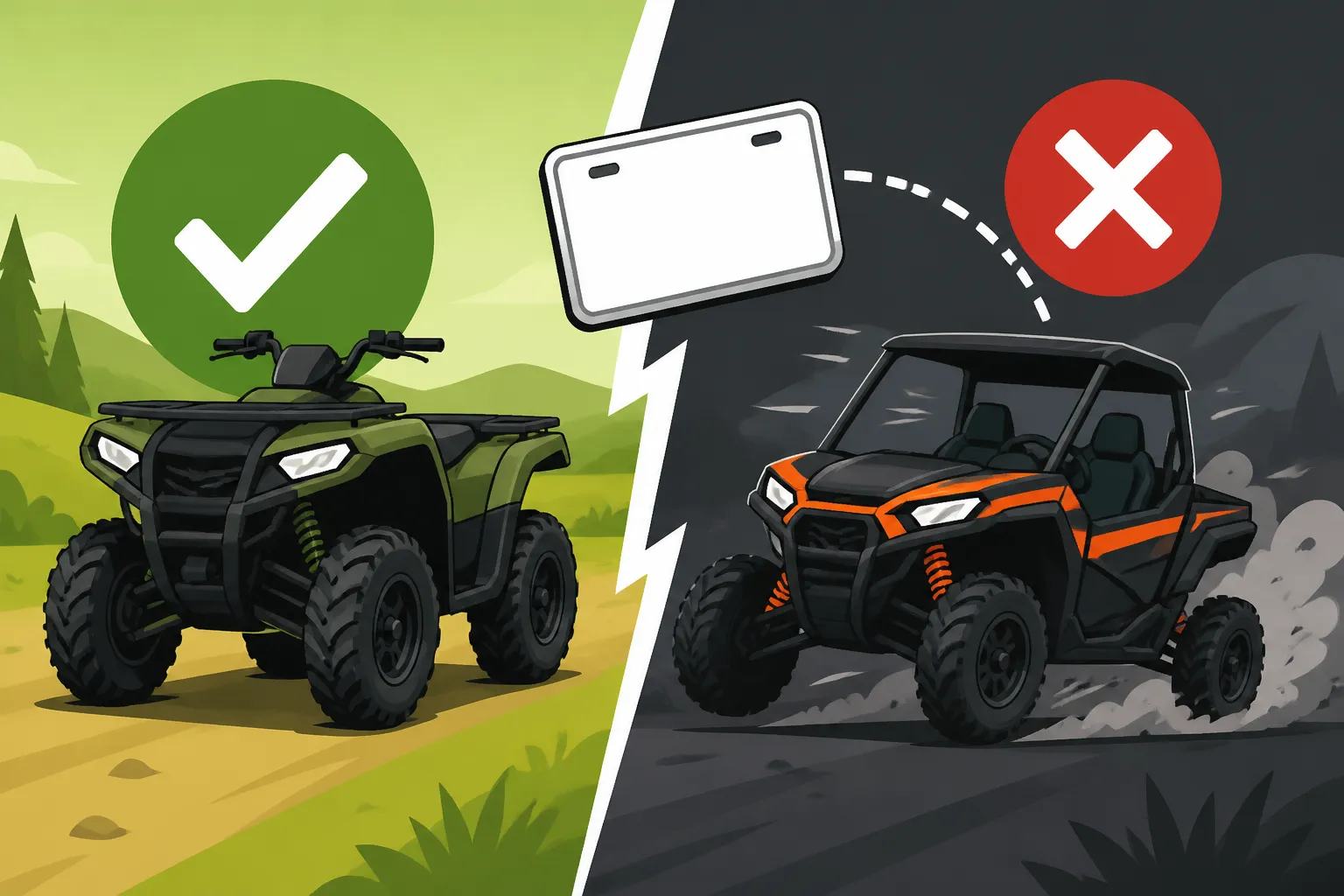
A Saskatchewan quad or side-by-side may have a municipal plate, but that plate usually does not transfer with the machine when it is sold. The reason is that a municipal plate is local permission tied to a particular person or local scheme, not provincial registration attached to the vehicle. Knowing the difference helps sellers avoid handing over the wrong paperwork and buyers avoid riding on a plate they cannot use.
A municipal plate is not provincial registration
Saskatchewan does not issue a province-wide ATV plate or registration document for quads and many other off-road machines. Some municipalities have their own plate or permit schemes for riding in areas they control. Those local programs are separate from provincial vehicle registration and do not create a plate that automatically belongs to the machine.
That distinction matters during a sale. A buyer may see a plate bolted to the ATV and reasonably assume it is part of the machine, like a licence plate on a registered road vehicle. But a local plate may instead show that a particular person has paid for permission to ride under a municipality’s rules. The municipality’s process determines who can use it, where it is valid, whether it expires, and whether it can be transferred.
The details vary from one place to another. A town may issue a permit to an owner for use within its boundaries; another local program may have different application and renewal steps. A plate from one municipality also does not necessarily grant riding permission in another. Before relying on a plate, check the current rules with the office that issued it. For a broader explanation of these local schemes, see Saskatchewan Municipal ATV Plates Explained and Which Municipalities Actually Sell You a Quad Plate.
| What the buyer sees | What it may actually mean | What to check |
|---|---|---|
| A plate attached to the ATV | A local municipality issued a plate or permit under its own program | Which municipality issued it and who it was issued to |
| A plate number on a bill of sale | The seller has recorded an identifier, not necessarily transferred permission | Whether the local office allows a transfer |
| A plate with an upcoming expiry | The seller may have had a current permit | The buyer’s own eligibility and renewal requirements |
| No provincial registration document | Often normal for an ATV in Saskatchewan | Proof of ownership and any local permit needed for intended riding |
A municipal plate is not the same thing as proof of ownership, insurance, or permission to ride on every road and trail. It can be one part of a local scheme, but buyers should not treat it as a universal pass. Saskatchewan’s lack of a province-wide ATV plate is explained in Saskatchewan Has No ATV Plate or Decal, while the local rules that may still apply are covered in Saskatchewan Rural Municipality Rules.
Why the plate usually stays with the person, not the ATV
A local plate program is generally meant to identify a permit holder or show that the holder has met local requirements. That is different from a vehicle registry, where a registration record is designed to track a vehicle and its current registered owner. When a local plate is not transferable, the seller’s permission ends with the seller’s eligibility under that scheme. The buyer must apply or renew according to the municipality’s process.
This approach lets the local authority manage its own permit holders and riding rules. The municipality can confirm who has applied, collect any required information, communicate local restrictions, and decide how permits are renewed or replaced. If plates simply followed machines from one owner to another, its records could quickly become inaccurate. The new rider might not live in the area, might not have completed the local process, or might plan to ride somewhere the plate does not cover.
The plate’s physical attachment does not change its administrative status. A seller can remove it before the sale, or the buyer can remove it afterward, but neither action transfers the underlying permission. In some programs, an office may require a plate to be returned or may have a particular process for a sale. Ask before removing or disposing of one, especially if the local program tracks issued plates.
The rule also helps explain why a buyer should not pay extra simply because an ATV comes with a municipal plate. Unless the municipality confirms that the buyer can use it, the plate may have no practical value to the new owner. The buyer might need to apply for a new permit, obtain a replacement plate, or ride without using that scheme if it is not needed for the planned area. The local office can explain the available options and any current requirements.
For the general non-transferability issue, see Why a Municipal Plate Cannot Be Transferred. If the seller is preparing to hand in a plate, Surrendering a Municipal Plate When You Sell may help clarify the questions to ask.
What buyers and sellers should do during a sale
A clean sale separates ownership paperwork from the local permit. The bill of sale records the transaction and identifies the machine; the municipality handles the permit under its own rules. Do not rely on a plate alone to prove that the seller owns the ATV or that the buyer has acquired the right to use it.
Before money changes hands, the buyer and seller can work through these steps:
- Identify the issuing municipality. Ask where the plate or permit came from. If the seller is unsure, look for paperwork or contact the local office using the plate number and the machine’s details.
- Ask whether the permit is transferable. Get the answer from the office that administers the scheme, not just from the seller. Ask whether the plate must be returned, whether a buyer must apply separately, and whether the rules change when the buyer lives outside the municipality.
- Confirm where the buyer plans to ride. A permit may only apply within a defined area or under specific local bylaws. It may not authorize riding on provincial land, a neighbouring municipality’s roads, or private property.
- Write a proper bill of sale. Include the parties’ names, date, agreed price, machine description, and complete serial number or VIN. Record whether any plate or related paperwork was physically handed over, but do not describe that as a transfer of permit rights unless the municipality has confirmed it.
- Keep copies of the documents. Both parties should retain a signed bill of sale and any relevant correspondence from the municipality. The buyer should keep the seller’s permit paperwork separate from proof of ownership.
- Apply or renew before riding where required. Confirm the buyer’s own permit status and any local restrictions before using roads or trails covered by the scheme.
A bill of sale is especially important because Saskatchewan does not provide the same provincial ATV registration record that many buyers expect from road vehicles. The paperwork helps establish who sold and bought the machine, but it does not replace any local permit application. See Saskatchewan Bills of Sale Do the Work and Saskatchewan Proof of Ownership Without a Registry for more on keeping ownership records clear.
The seller should also avoid promising that the plate “comes with” the ATV unless the municipality explicitly permits that arrangement. A safer description is that the machine has a plate from a named local program, and the buyer must confirm whether it can be used. If a municipality requires the plate back, the seller should follow that direction rather than leaving it on the machine and assuming the buyer can keep it.
The buyer should not assume that a seller’s expired or current plate solves the next renewal. Renewal processes can be tied to the permit holder, the municipality, the plate number, or another local record. Ask about renewal timing and replacement procedures directly. Saskatchewan Municipal Plate Renewals and Saskatchewan Municipal Plate Replacements cover those separate issues.
What a municipal plate does not prove
Even if a plate is current and correctly issued, it does not settle every legal or practical question about riding. It does not automatically prove ownership, provide insurance, or make every route open to ATVs. A buyer should assess each item separately.
Ownership: A bill of sale, earlier purchase records, and a machine’s serial number help document the chain of ownership. A plate is not a substitute for those records. Make sure the serial number on the machine matches the paperwork, particularly when buying privately or when the seller has limited documentation. How to Prove You Own an ATV in Saskatchewan explains why those records matter.
Insurance: A local permit should not be treated as proof of insurance. Ask the seller whether a policy exists, but arrange coverage for the buyer’s own use and confirm what proof must be carried. A policy may need to be changed or replaced when ownership changes. See Saskatchewan Insurance Requirements for Riders and Saskatchewan Insurance Proof on the Trail.
Access: Local plates do not grant access to private land, Crown land, a provincial park, or a neighbouring municipality unless the applicable rules say so. Permission and access rules depend on the land and the route. Check the specific bylaws and land-use rules before riding; Saskatchewan Bylaw Lookups Before You Ride is a useful starting point.
Road use: A plate does not make a road legal for ATV use. Road and ditch access depends on the law and local bylaws, along with any restrictions on the particular route. A municipality may allow some riding and prohibit other streets or areas. Review Saskatchewan ATV Road Rules Explained and the local authority’s current rules before planning a route.
Visitors and out-of-area buyers: Someone who buys a machine with a local plate may not qualify to use that plate, particularly if they live elsewhere. Visitors also need to distinguish the rules that apply to their own circumstances from the seller’s local permit. For related guidance, see Saskatchewan Visitors and Municipal Plates.
A practical way to think about the plate
Treat the plate as evidence that a local permit may have existed, not as a transferable feature of the ATV. The machine can be sold with its ownership documents and accessories, but permission under a local program should be confirmed with the program administrator. That simple distinction avoids a common handover problem: the buyer assumes a plate is valid for them, while the municipality still recognizes only the previous permit holder.
If the seller cannot confirm the program details, the buyer can contact the local office before completing the purchase or make the permit question a condition of the sale. If the office says the plate does not transfer, record that understanding and value the ATV on its own merits. Do not pay for a permit benefit that the buyer may not be allowed to use.
The bottom line is straightforward: in Saskatchewan, a municipal ATV plate is a local authorization, not a provincial registration attached permanently to the machine. When the ATV changes hands, verify the local rules, document the sale separately, and arrange any permit the new rider needs.
Disclaimer
This article is for general informational purposes only and does not constitute professional advice. Laws, prices and regulations vary by location and change over time. Consult a qualified professional for guidance on your specific situation.