Saskatchewan Park Regulations for Machines
A Saskatchewan park is not automatically open to ATVs or UTVs just because it has bush roads or trails. Access can depend on the park, the route, the season and whether you have completed its permit steps. This overview explains how to check where machines are allowed, what paperwork to carry and which rules to confirm before unloading.
What park regulations mean for ATV and UTV riders
Saskatchewan does not have one rule that gives off-road machines blanket access to provincial parks. A park may allow riding on particular designated trails while prohibiting machines on nearby roads, hiking paths, beaches, campground areas or other routes. Permission to enter a park is not permission to ride anywhere within it.
Park rules apply alongside provincial laws. The provincial Saskatchewan ATV road rules explained govern matters such as operation, age, helmets and insurance, while park regulations and local directions determine where motorized use is allowed within a park. Crown land rules are a separate matter: a trail that crosses Crown land outside a park does not automatically establish a legal route inside the park.
A useful way to think about the rules is to check three layers before a trip:
- The law: Do provincial requirements allow you and your machine to operate?
- The park: Does that park allow the type of machine you plan to ride?
- The route and date: Is the specific trail open to that machine on the day you intend to go?
All three need to line up. A trail shown on an old map, a route used by local riders, or a road leading to a campsite is not enough to establish that ATV or UTV use is permitted.
The distinction matters because park areas can include different types of land and infrastructure. A designated machine trail may connect to a road that is closed to machines. A park may allow access only during a defined operating season. A closure may affect one section while leaving other routes open. Signs, current park information and directions from park staff should take precedence over assumptions based on past visits.
| What you need to confirm | Why it matters | Where to check |
|---|---|---|
| Whether the park allows your machine type | Access may be limited to particular machines or routes | Current park information or park office |
| Which trails are designated | A park entrance or open road does not mean every route is open | Current trail map, signs and staff |
| Whether a permit or form is required | Some parks have a permit process before riding | Park office or the stated permit pickup location |
| Whether the trail is open today | Seasonal conditions, maintenance, fire or other closures can change access | Park alerts, signs or staff |
| What documents and equipment to carry | Officers may ask for insurance proof or other compliance information | Provincial rules and park directions |
This approach is more reliable than relying on a general list of “ATV parks.” A list can help you choose a destination, but it cannot confirm the current status of a particular trail.
Where machines can ride inside a park
The safest rule is to stay on routes specifically designated for motorized use. Do not treat a park’s regular road network as an ATV trail network, and do not follow an informal track simply because it looks well travelled. Park roads, service roads and trails can each have different rules.
In parks that permit machine use, the designated route may be a limited part of the park rather than a network covering the whole area. Riders should look at the current map and match the route on the ground to the route shown there. If signs mark a closure or a route restriction, follow the sign even if an older map or a previous visit suggests otherwise.
Some common assumptions cause trouble:
- “It is a road, so I can ride it.” A road may be closed to off-road machines, or open only to other kinds of traffic.
- “There are tire tracks, so it must be legal.” Tracks show that someone has ridden there, not that the route is authorized.
- “I can ride to my campsite.” Camping access and machine access are separate questions. A campground may be closed to machines even if a designated trail runs nearby.
- “The trail continues beyond the park boundary, so I can keep going.” Rules can change at the boundary. Check the land status and access rules for the next section.
- “The trail is on a snowmobile map, so ATVs are allowed.” A trail’s permitted use can depend on the season and the specific park’s rules.
Park regulations may also separate motorized trails from hiking trails, beaches, boat launches, picnic areas and other facilities. Keep machines within authorized routes and park them only where permitted. Do not use a closed route as a shortcut between two open sections.
Park examples are not blanket permission
Saskatchewan parks associated with designated machine trails include Moose Mountain, Narrow Hills and Great Blue Heron. That does not mean every road or trail in any of these parks is open to every machine. Each park has its own route details, operating conditions and visitor requirements. Check the current information for your chosen park rather than assuming the same arrangement applies at all three.
For example, Moose Mountain Provincial Park ATV Trails describes one park’s trail opportunity, while Narrow Hills Provincial Park ATV Trails and Great Blue Heron Provincial Park ATV Trails relate to different trail systems. Use park-specific information to plan the route, then confirm current openings before hauling your machine.
Other parks may have limited or no ATV access. The Saskatchewan Parks With Designated Trails Only distinction is important: permission is tied to designated routes, not general park access. A park may also close trails temporarily because of weather, maintenance, fire risk or another management concern. When in doubt, ask the park office which exact route is open to your machine.
Permits, forms and proof to carry
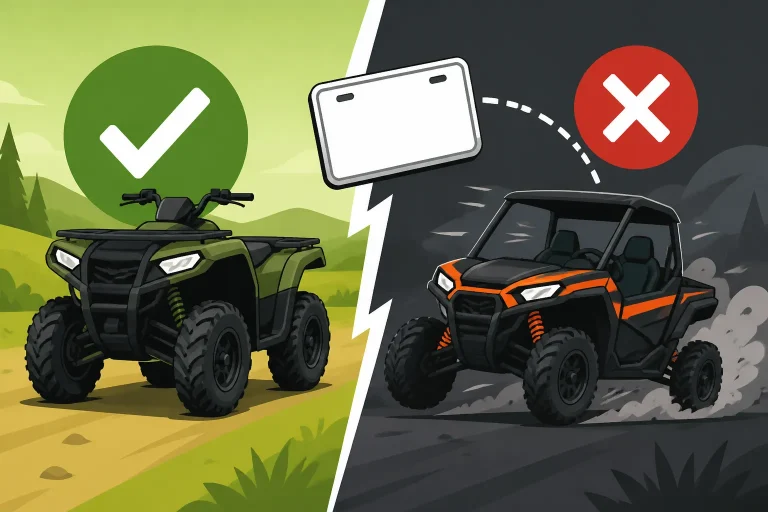
Permit requirements are park-specific. Some parks require riders to complete a process before using designated trails; other parks may have different requirements or no trail permit requirement. Do not assume that a permit obtained at one park applies at another, or that a municipal ATV plate is a substitute for a park permit.
Where a park requires a permit, there may be an information session, acknowledgement form or other step before it is issued. A park may direct riders to a campground office or district office for pickup. Follow the park’s stated process and keep the permit visible if the instructions require it. If you are unsure where to obtain it, contact the park before you travel rather than waiting until you have unloaded.
Some Saskatchewan park trail permits are available without a charge, but the process and conditions still matter. The [Saskatchewan Park Trail Permit Cost] topic is useful context; do not mistake a no-charge permit for unrestricted access or assume that every park follows an identical process. In parks where an info session or use form is required, completing that step is part of being authorized to ride. See The Info Session That Comes Before Your Permit and Signing the Use Form at a District Office for examples of the steps riders may encounter.
Carry the documents that apply to your ride, and keep them easy to show. Depending on the rules and circumstances, that can include:
- Your park permit or evidence that you completed the required process
- Proof of liability insurance
- Identification and any licence required for the operator
- Information that helps identify the machine, such as its serial number
- Any permission or authorization required for land outside the park
A municipal plate, where a municipality has its own plate scheme, does not replace a park permit or provincial legal requirements. Likewise, a bill of sale can help establish ownership but does not authorize riding on a closed trail. For the separate local-plate issue, see Saskatchewan Municipal ATV Plates Explained.
Insurance deserves particular attention. Provincial requirements apply, and a park may require proof to be produced on demand. Keep proof accessible rather than buried in a vehicle or left at home. If you are riding with a group, each operator should know how to access the relevant insurance information for their machine. Park staff or an officer may ask for proof even when no permit is displayed on the machine.
Do not confuse these documents with proof of ownership. Ownership paperwork can be useful if there is a question about who owns a machine, but it does not establish that a route is open, that a permit is valid or that the operator meets riding requirements. Likewise, a park permit does not necessarily prove that the machine is insured or that the person operating it is legally permitted to ride.
Before your visit, confirm what the permit covers. Ask whether it applies to one operator, a machine, a group or a particular date range; whether it must be displayed; and whether you need to attend an information session in person. If requirements are unclear, get the park’s directions before setting off.
Rider, machine and conduct rules
Park access does not suspend provincial operating rules. Riders still need to comply with applicable requirements for age, supervision, licensing, helmets, eye protection, insurance, passengers and safe operation. The details depend on the rider and circumstances, so check the current rules before taking a child or a visitor on a ride.
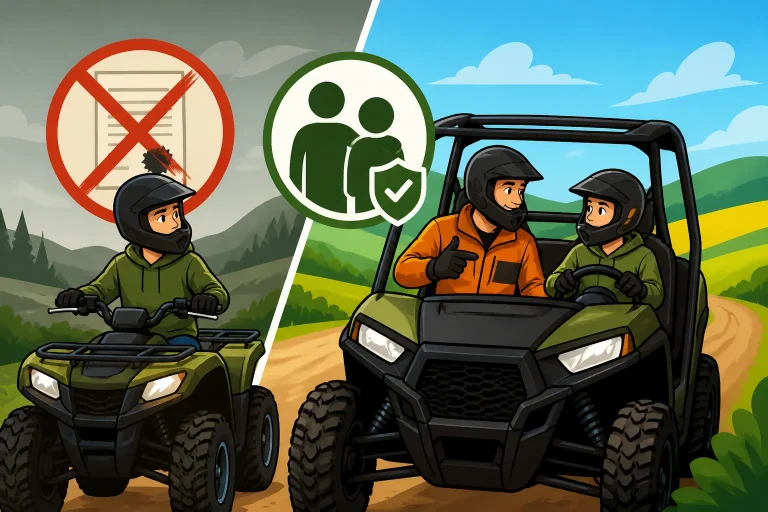
Young riders need special planning. Park information identifies supervision requirements for riders in the relevant youth age range, and the provincial rules also set conditions for younger operators. Do not assume that a child can ride alone because a parent is nearby in the park, or that sitting on a machine as a passenger is allowed. Passenger use depends on the machine being designed to carry a passenger, and park directions may add restrictions. See Riders 12 to 16 Need Supervision in a Park and Saskatchewan Rules for a Child Passenger when planning a family outing.
The operator should understand the machine and be able to control it on the route’s surface and conditions. A narrow forest trail, soft ground, steep section or wet crossing may demand more skill than a wide, firm route. If a trail is beyond the ability of a rider or machine, turn back rather than attempting it because the route appears short on a map.
Machine type also matters. A trail may not be suitable for the width, weight or turning radius of every side-by-side. Before riding a UTV, confirm that the park’s route and instructions permit it and that the vehicle can safely fit the trail. Do not assume that a route suitable for a small ATV will be appropriate for a wider machine. For more on general operation requirements for side-by-sides, see Saskatchewan Rules for a Side-by-Side Driver.
Follow park directions on speed, stopping, passing, parking and noise. Slow down near other visitors, staff, wildlife and trail junctions. Give hikers and other trail users room, and avoid unnecessary revving or aggressive riding. A machine can create dust, noise and trail damage even when the operator stays on the permitted route, so considerate riding is part of keeping access available.
Environmental care is a practical requirement, not just good manners. Stay on the established route, avoid widening muddy sections, and do not bypass puddles or obstacles by creating a new track. Where a park asks riders to clean machines to prevent the spread of invasive species, do so before entering or moving between riding areas. Mud and plant material can carry seeds and other organisms into places where they do not belong. Park information on Saskatchewan Machines Washed Before a Park Ride covers why cleaning requirements matter.
Fire conditions can affect access as well. Seasonal restrictions, fire bans or closures may limit where you can ride or whether a trail is open at all. Riders should check current alerts and obey closure signs rather than relying on conditions from a previous trip. A machine can also create a fire hazard if combustible material collects around hot parts. Follow applicable fire-safety requirements and inspect the machine during the day, especially after riding through dry grass or brush.
If a park trail connects to a public road, do not assume the connection authorizes road riding. Road use has its own rules, and the park route may end at the road edge. Confirm the legal route and crossing requirements before using the connection. For general travel between trails and roads, consult Saskatchewan Rules for Crossing a Highway.
A practical pre-ride check
A few minutes of checking can prevent a long tow to a closed trail or a difficult conversation with park staff. Use this process for each visit, including a return to a park you have ridden before.
- Choose the park and verify machine access. Confirm that ATVs or UTVs are allowed at the park, and check whether the rules differ by machine type.
- Get the current trail map. Identify the designated route and its limits. Do not rely only on an old downloaded map, a social post or tracks visible on the ground.
- Check the date and conditions. Look for seasonal openings, trail closures, fire restrictions, maintenance notices or weather-related changes.
- Complete the permit steps. Find out whether you need an information session, an acknowledgement form, a permit pickup or a display requirement.
- Review the operator requirements. Check the rules that apply to each rider, particularly for youth, passengers and visiting operators.
- Pack required proof. Keep insurance information, permit details and other relevant documents accessible.
- Confirm access at the trailhead. Read posted signs before unloading or starting the ride. If a sign conflicts with an older map or an online description, stop and ask park staff.
- Stay on the authorized route. Turn around if the route is closed, unclear or beyond the machine’s ability.
A short call to the park office can settle questions that a general map cannot. Ask direct questions: Is this specific trail open to my machine? Is a permit required? Where do I obtain it? Do I need to attend an information session? Is proof of insurance required on the trail? Are there current closures or restrictions?
Keep a backup plan. If a trail is closed, do not improvise by riding on a nearby road or unmarked track. Choose another route that is confirmed open, or save the ride for another day. Access rules protect other park users and the land, and respecting them helps avoid damage that can lead to further restrictions.
Frequently Asked Questions
Can I ride an ATV anywhere in a Saskatchewan provincial park?
No. Access is limited to parks and routes where machine use is permitted. Stay on designated trails and follow signs, seasonal restrictions and park-specific instructions.
Do I need a permit to ride in every park?
Not necessarily. Permit requirements vary by park. Some locations may require a permit and completion of a process such as an information session or acknowledgement form. Confirm the requirements for the park you plan to visit.
Does a municipal ATV plate replace a park permit?
No. A municipal plate scheme and a park permit serve different purposes. A local plate does not by itself authorize riding on a park trail or replace other legal requirements.
What should I carry while riding?
Carry any required park permit and proof of insurance, along with the identification or licence information applicable to the operator. Check the park’s instructions and provincial requirements before leaving.
Disclaimer
This article is for general informational purposes only and does not constitute professional advice. Laws, prices and regulations vary by location and change over time. Consult a qualified professional for guidance on your specific situation.